
Cape Starling
Lamprotornis nitens
At a glance
Habitat
- Wooded savanna, forest edges, riverine bush, plantations, parks and gardens
Diet
- Fruit and invertebrates; also nectar and occasional human food scraps
Activity
- Diurnal; forages mainly on the ground but also in trees
Size
- Length: about 25 cm Weight: about 75–105 g
Range
- Southern and south-central Africa from Angola and Zambia south to South Africa
Description
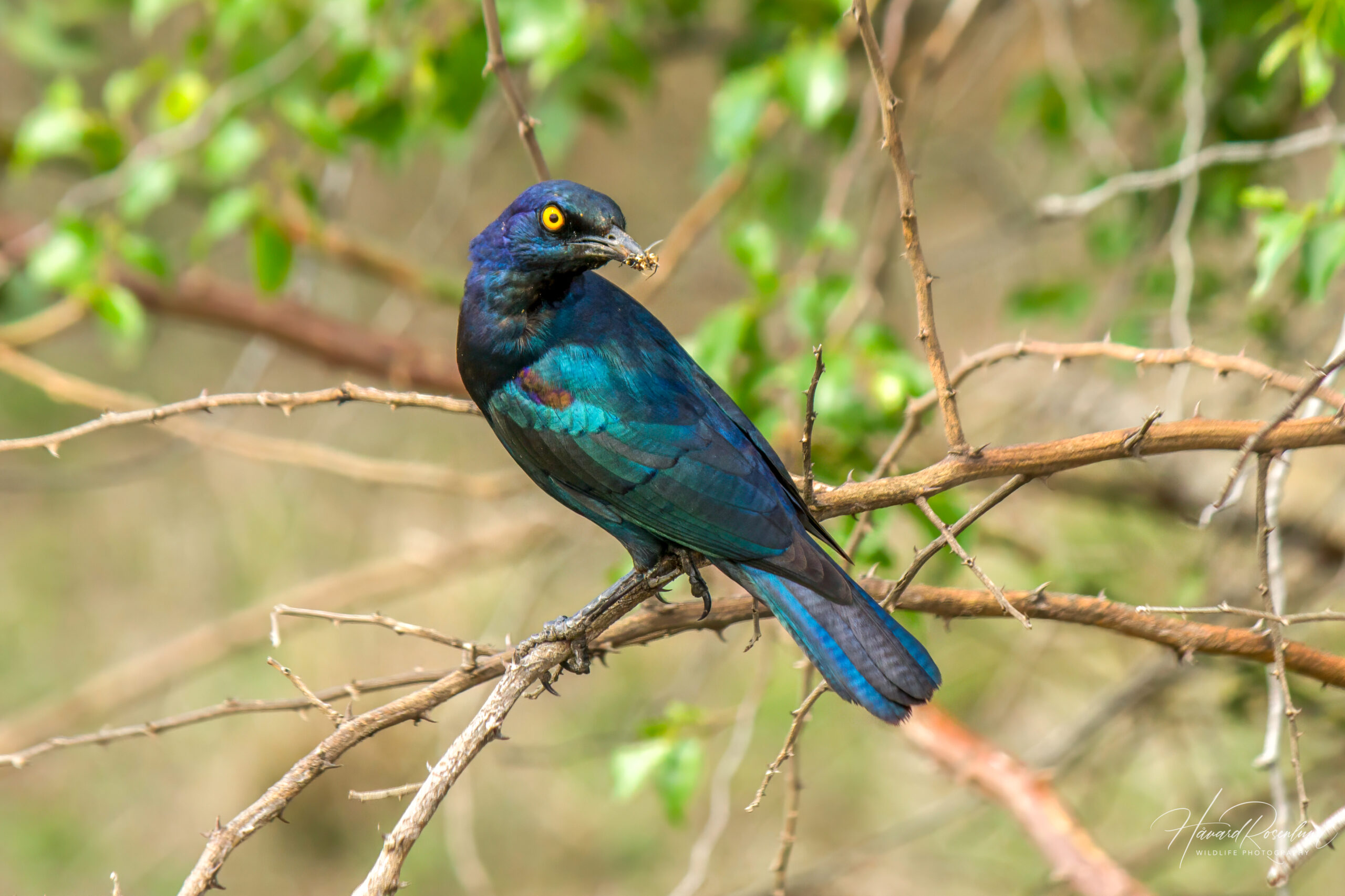
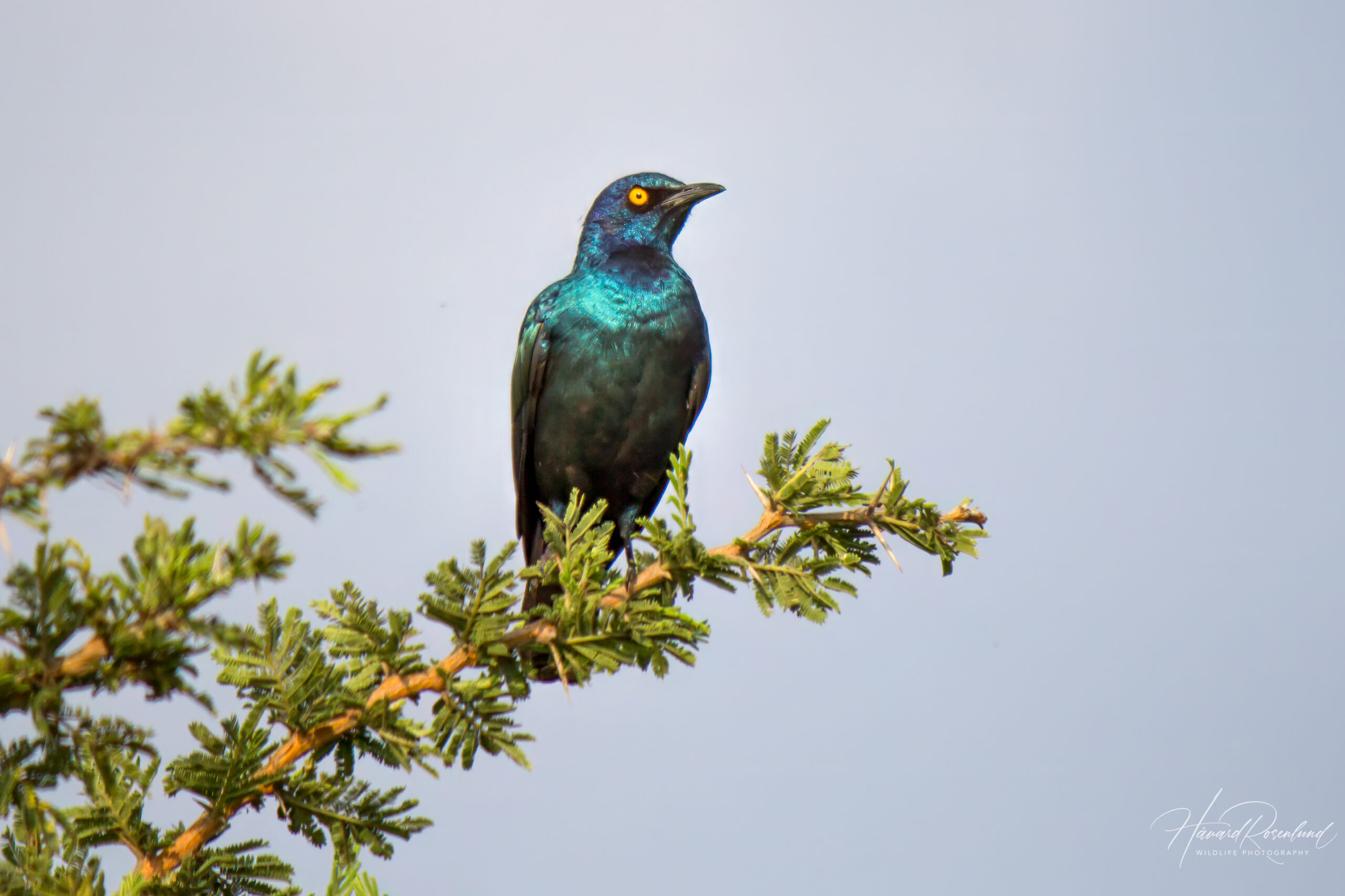
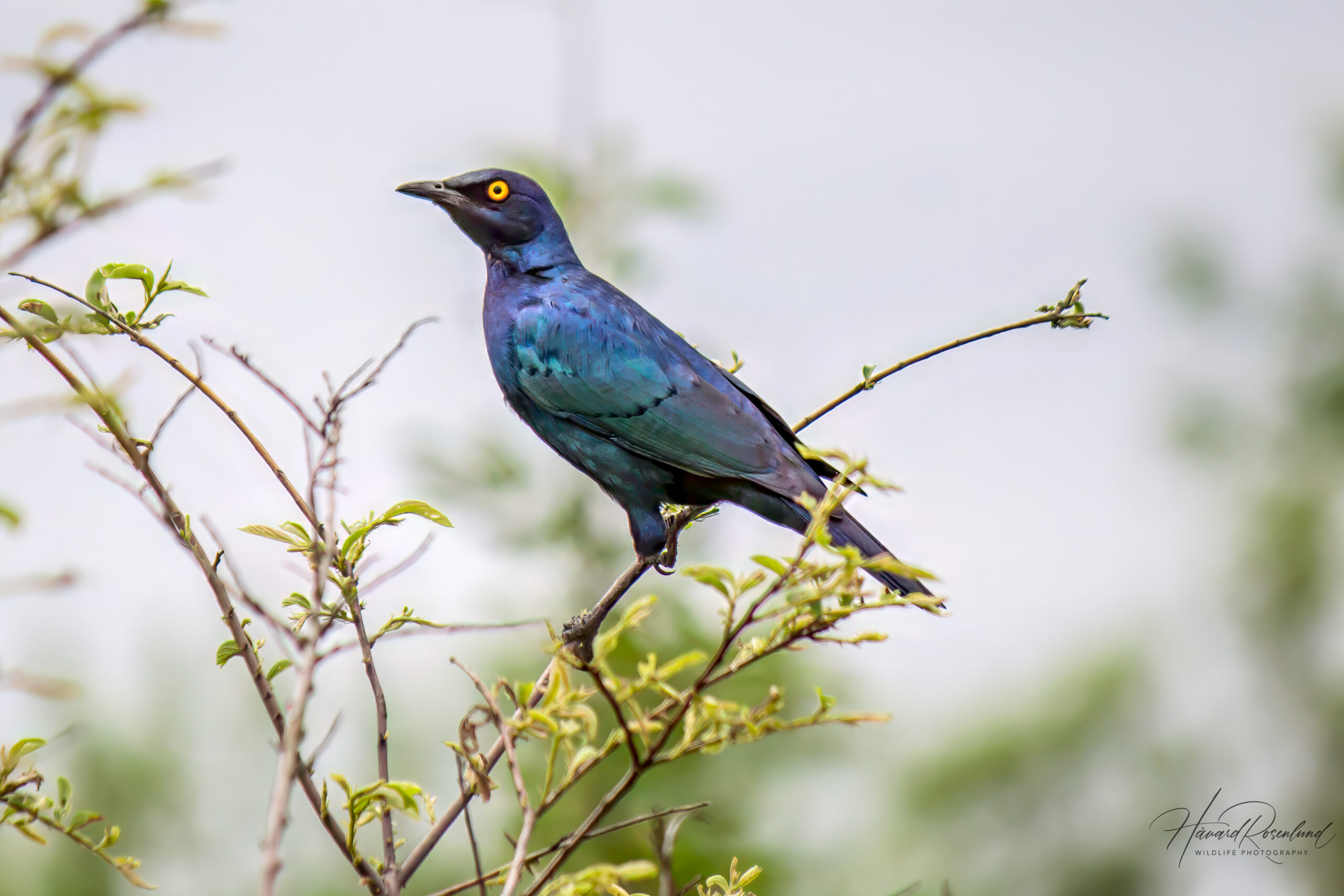
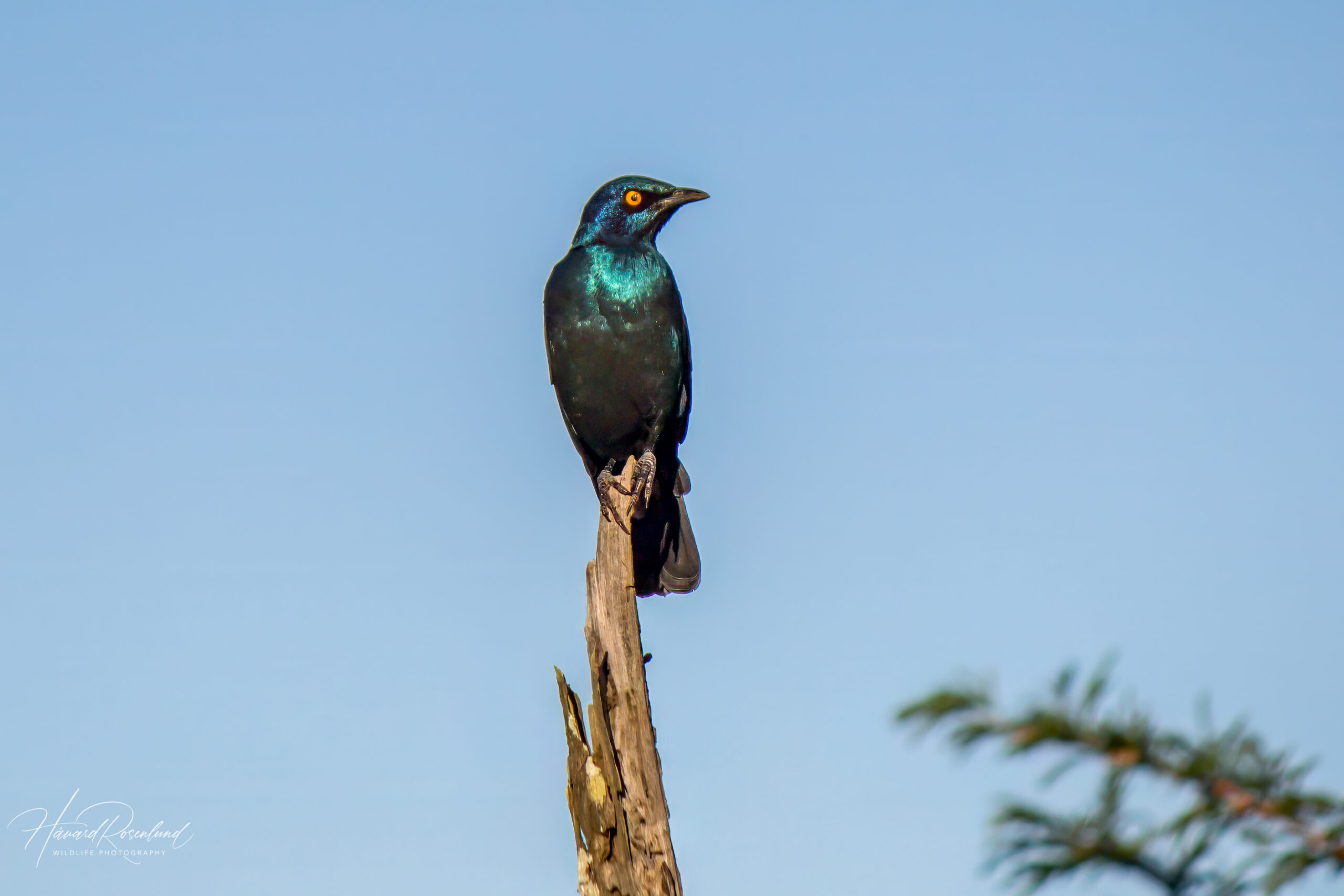
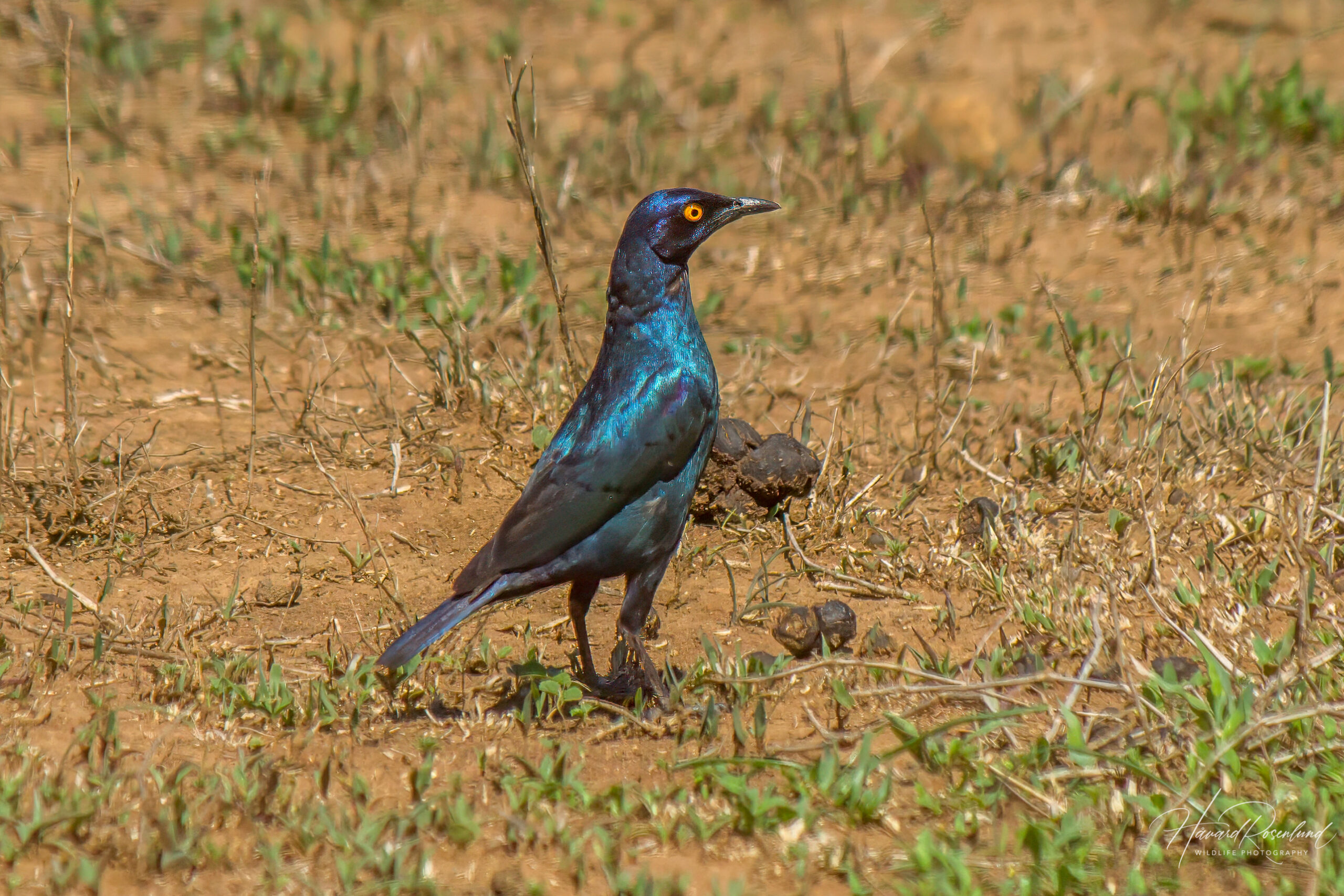
The Cape starling (Lamprotornis nitens), also known as the Cape glossy starling, is a medium-sized glossy starling of southern and south-central Africa. Adults are about 25 cm long and usually weigh roughly 75–105 g. Both sexes have intensely iridescent blue-green plumage, bright orange-yellow eyes and a bronzy-purple shoulder patch that can be difficult to see unless the light catches it. Juveniles are duller and less glossy.
The metallic colours are structural rather than produced by blue or green pigments. Microscopic structures in the feathers reflect different wavelengths as the viewing angle changes, which is why the plumage can shift dramatically from dark blue to brilliant green in sunlight.
Among southern African glossy starlings, Cape starling is particularly easy to confuse with greater blue-eared starling (Lamprotornis chalybaeus), which has a distinct dark ear patch and more bluish flanks and belly. Burchell's starling (Lamprotornis australis) is much larger and longer-tailed, while black-bellied starling (Notopholia corusca) is smaller and slimmer with a black belly and much less glossy plumage.
Habitat
Cape starlings occupy wooded savanna, forest edges, riverine bush, plantations, parks and well-treed gardens. They are adaptable and readily use human-modified landscapes where mature trees, open feeding areas and nesting cavities remain available.
The combination of trees for roosting and nesting with open ground for feeding is especially useful, allowing the species to persist across both natural savanna and many settled landscapes.
Diet
The diet is broad and includes insects and other invertebrates, fruit and nectar, with scraps of human food also taken around settlements and camps.
Much feeding takes place on the ground, where Cape starlings run or hop while searching for invertebrates and other food. Fruit and nectar are taken in trees and shrubs, so birds switch readily between terrestrial and arboreal feeding sites.
They sometimes associate with large mammals, taking ectoparasites directly from them or catching insects disturbed by their movement. This opportunistic strategy allows the species to exploit both seasonal natural foods and short-lived concentrations of prey.
Social behaviour
Cape starlings are mainly sedentary and strongly social. Outside the breeding season they commonly forage and roost in flocks of around 10–20 birds, sometimes together with other starling species. During breeding they live in smaller family groups centred on stable monogamous pairs.
Young birds may remain with their family group for several years rather than dispersing immediately. Vocal interactions help maintain contact within these groups. These long-lasting family groups distinguish the species from some related starlings with more territorial or colonial social systems.
Breeding
Cape starlings are monogamous cooperative breeders. Young from earlier broods can remain with the breeding pair and help feed later chicks, and a breeding pair can have as many as six helpers. This connects the species' long-lasting family groups directly with its breeding system.
The species nests in cavities and can reuse the same breeding site for many years. One pair used the same nest site for 20 years. Natural tree holes and abandoned woodpecker or barbet cavities are typical, but holes in riverbanks, pipes and buildings can also be used. The cavity is filled with coarse material and lined with dry grass, dung and pieces of snakeskin.
In southern Africa, egg-laying occurs mainly from September to February. Clutches contain two to six eggs, commonly around three. The female incubates alone for about two weeks, while both parents and any helpers feed the chicks. Young leave the nest after roughly 20 days and remain with the family group afterwards.
Status
The Cape starling is classified as least concern on the IUCN Red List. It remains widespread and locally common across much of southern Africa and tolerates many modified landscapes.
Local abundance still depends on suitable wooded habitat, food and access to nest cavities, but no major range-wide threat is currently recognised.
Image gallery
Loading map and observations…
Have you seen this species?
Independent species archive
Did you find this species page useful?
Wildlife Vagabond is independently built and maintained. Voluntary support helps cover hosting, maps, data storage and continued improvements to the species archive.
Support Wildlife VagabondSpecies content will remain freely available.
References
Information about the species’ global distribution and status is based primarily on global Red List data. See the references below for details.
- Biodiversity Explorer – Lamprotornis nitens. (n.d.). habitat, food and cooperative breeding, based on Roberts Birds of Southern Africa. https://www.biodiversityexplorer.info/birds/sturnidae/lamprotornis_nitens.htm
- BirdLife International. (n.d.). Cape Starling species factsheet. https://datazone.birdlife.org/species/factsheet/cape-starling-lamprotornis-nitens
- Craig, A. (1983). The timing of breeding and wing‐moult of four African Sturnidae. Ibis, 125(3), 346-352. https://doi.org/10.1111/j.1474-919X.1983.tb03120.x
- Henry, L., Craig, A. J. F. K., Lemasson, A., & Hausberger, M. (2015). Social coordination in animal vocal interactions. Is there any evidence of turn-taking? The starling as an animal model. Frontiers in Psychology, 6. https://doi.org/10.3389/fpsyg.2015.01416
- International Union for Conservation of Nature. (n.d.). Cape Starling (Lamprotornis nitens). The IUCN Red List of Threatened Species. https://www.iucnredlist.org/species/22710675/132089574