
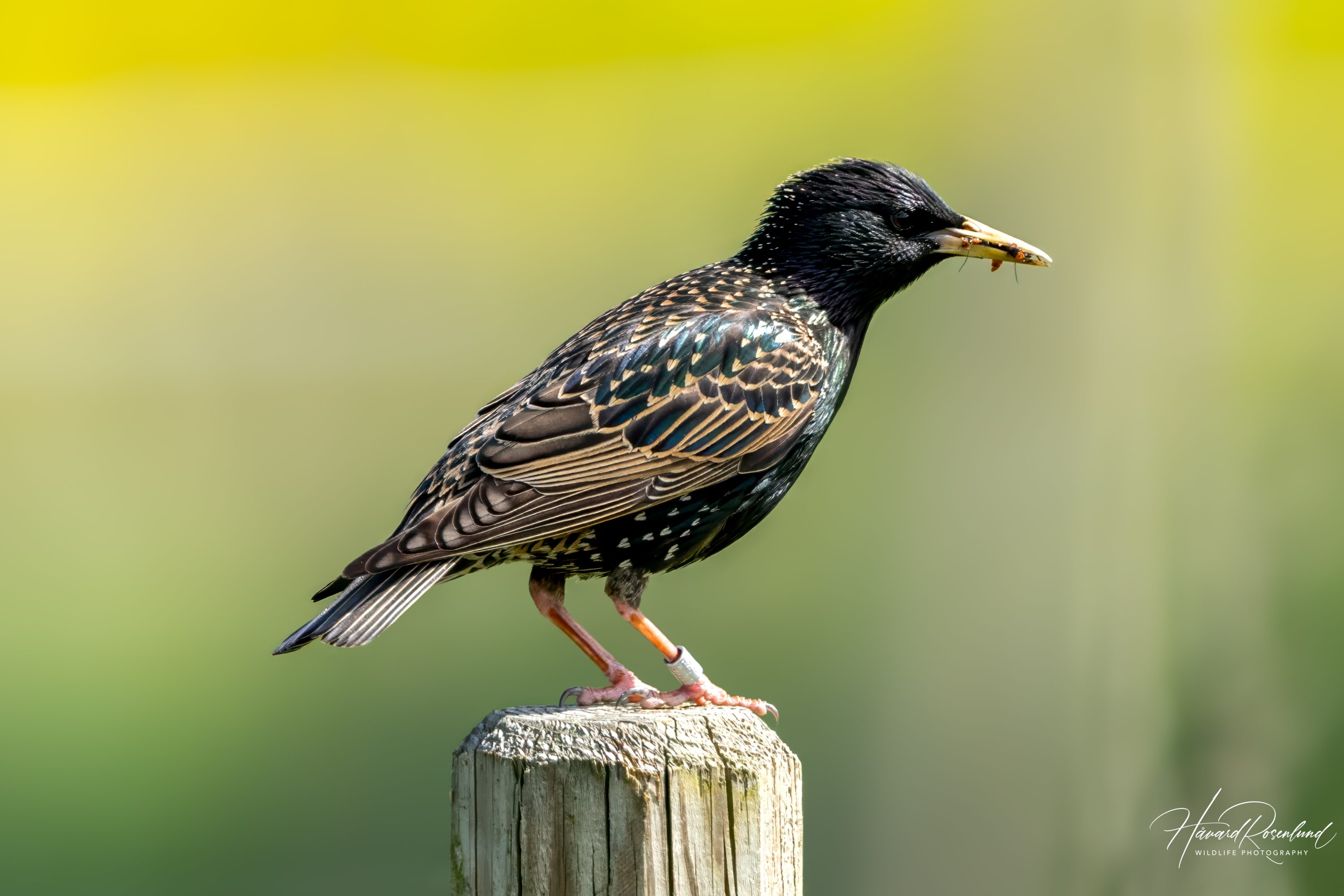
Common Starling
Sturnus vulgaris
At a glance
Habitat
- Farmland, grassland, parks, gardens and towns with short feeding areas and nearby cavities
Diet
- Mostly insects and other soil invertebrates; also fruit, seeds and grain
Activity
- Diurnal
Size
- Length: 20–23 cm Weight: 85 g
Range
- Native across Europe, western and central Asia and North Africa; introduced widely elsewhere
Description
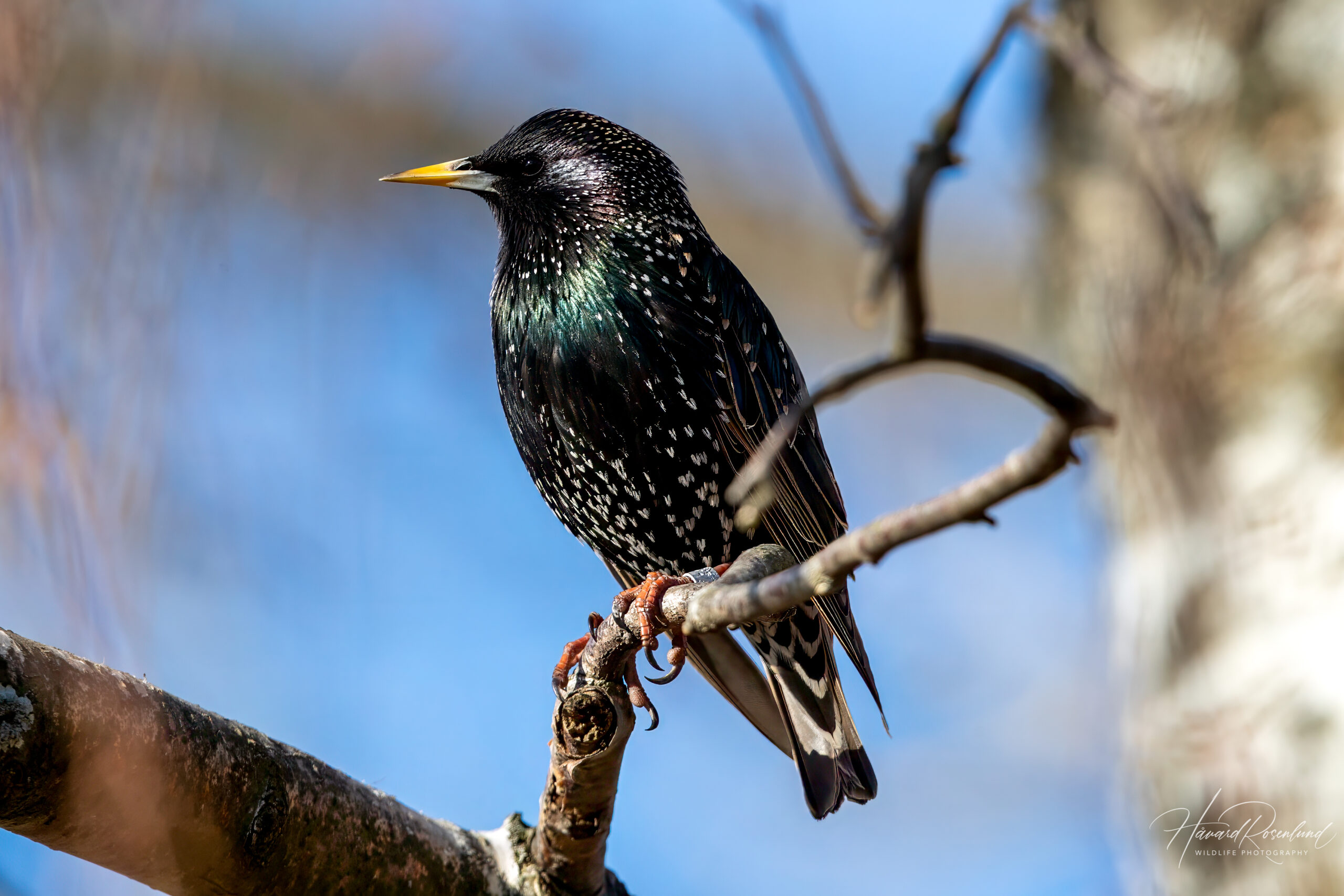
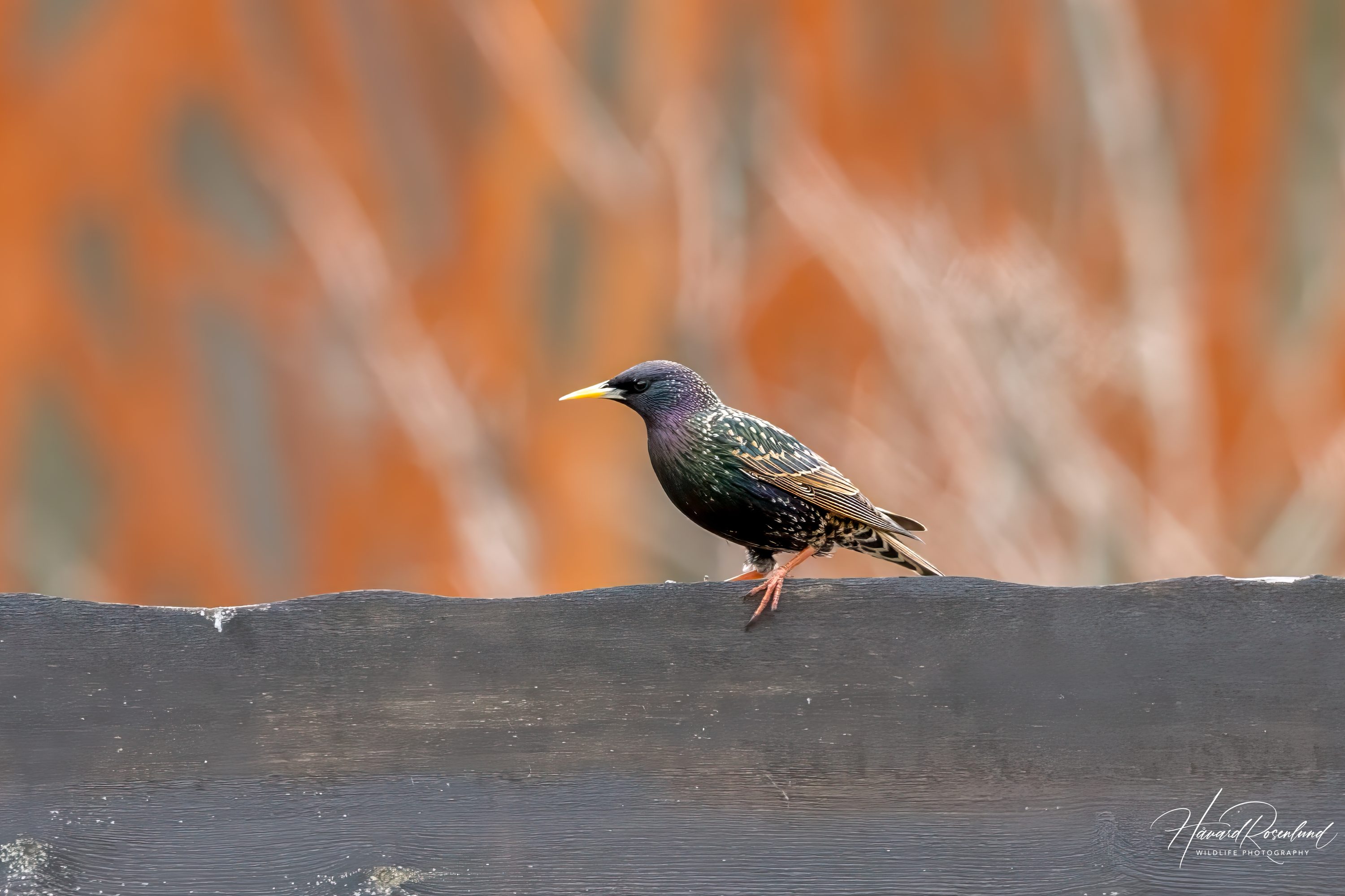
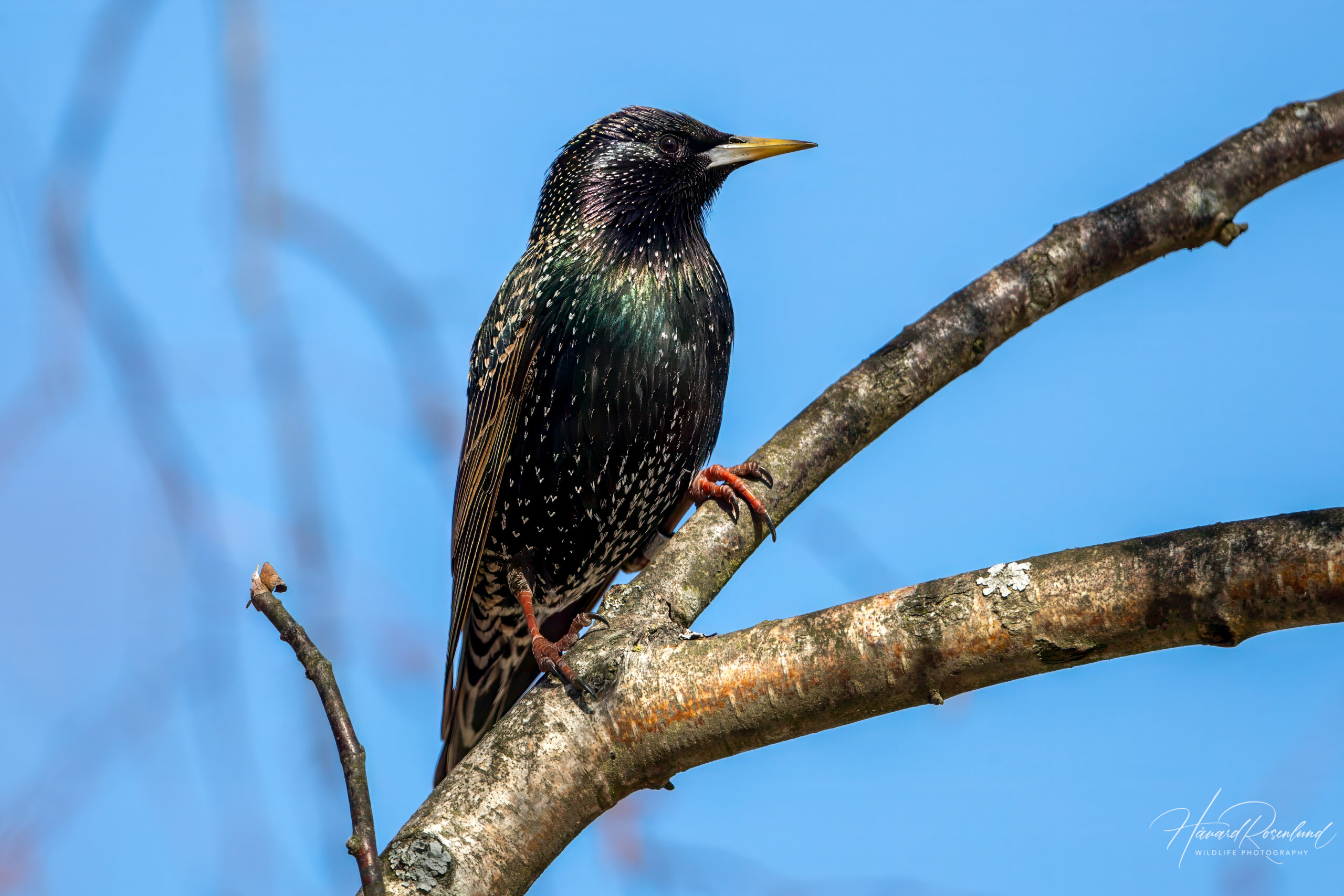
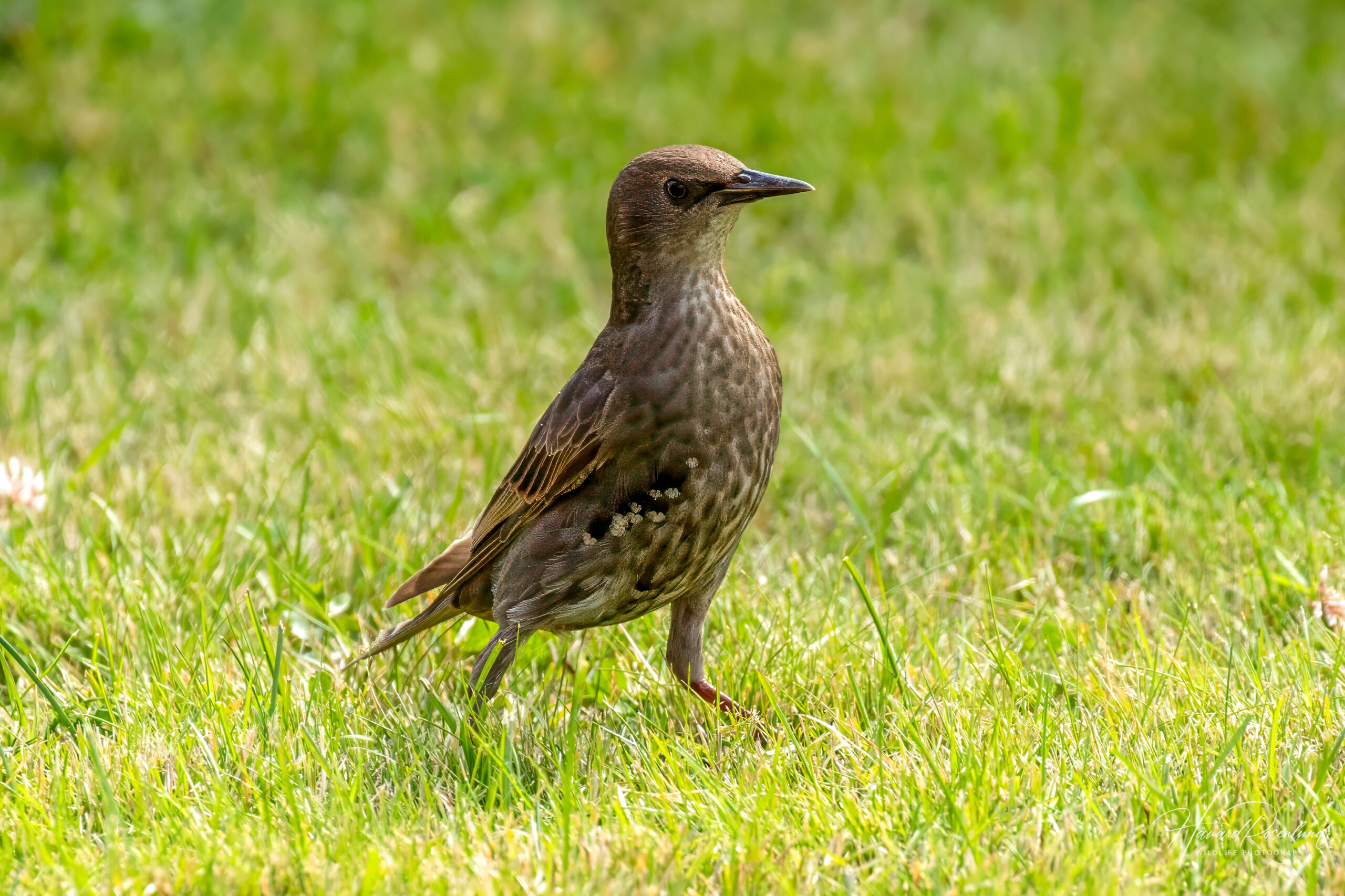
The common starling (Sturnus vulgaris), also widely called the European starling, is a compact songbird native across most of Europe and into western and central Asia, with populations also reaching North Africa. Adults are about 20–23 cm long and weigh around 85 g. At a distance the plumage can look simply black, but close views reveal strong green and purple iridescence. Fresh autumn and winter feathers have pale tips that create the familiar spotted appearance; these tips gradually wear away toward the breeding season. The long bill is dark in winter and turns yellow in breeding adults.
Starlings are exceptionally varied vocalists and readily imitate other birds as well as mechanical and environmental sounds. Their short tail and pointed wings give them a compact, fast-flying silhouette, especially obvious when birds gather into large flocks.
Habitat
Starlings favour open landscapes with short vegetation for feeding and nearby cavities for nesting. Grazed farmland, pasture, lawns, parks, villages and towns can therefore be particularly suitable. They also use orchards, woodland edges and other open habitats where feeding ground and nesting sites occur close together.
The quality of feeding habitat depends on more than simply having grass. Short, often moist turf with accessible soil invertebrates can be especially valuable during breeding. This helps explain why changes in grazing, drainage and other agricultural practices can alter starling numbers even when the broad landscape still appears open.
Diet
Starlings are omnivorous but rely heavily on soil invertebrates such as insect larvae, beetles, earthworms, spiders and other small animals when these are abundant, especially while feeding young. Fruit, seeds and grain become more important at other times of year, and birds readily exploit food that suddenly becomes available in large quantities.
A characteristic feeding technique is open-bill probing. The bird inserts the closed bill into soil, turf or vegetation and then forces the mandibles apart, opening the substrate and gaining access to hidden prey. The strong straight bill therefore serves both to expose food and to pick it up.
Social behaviour
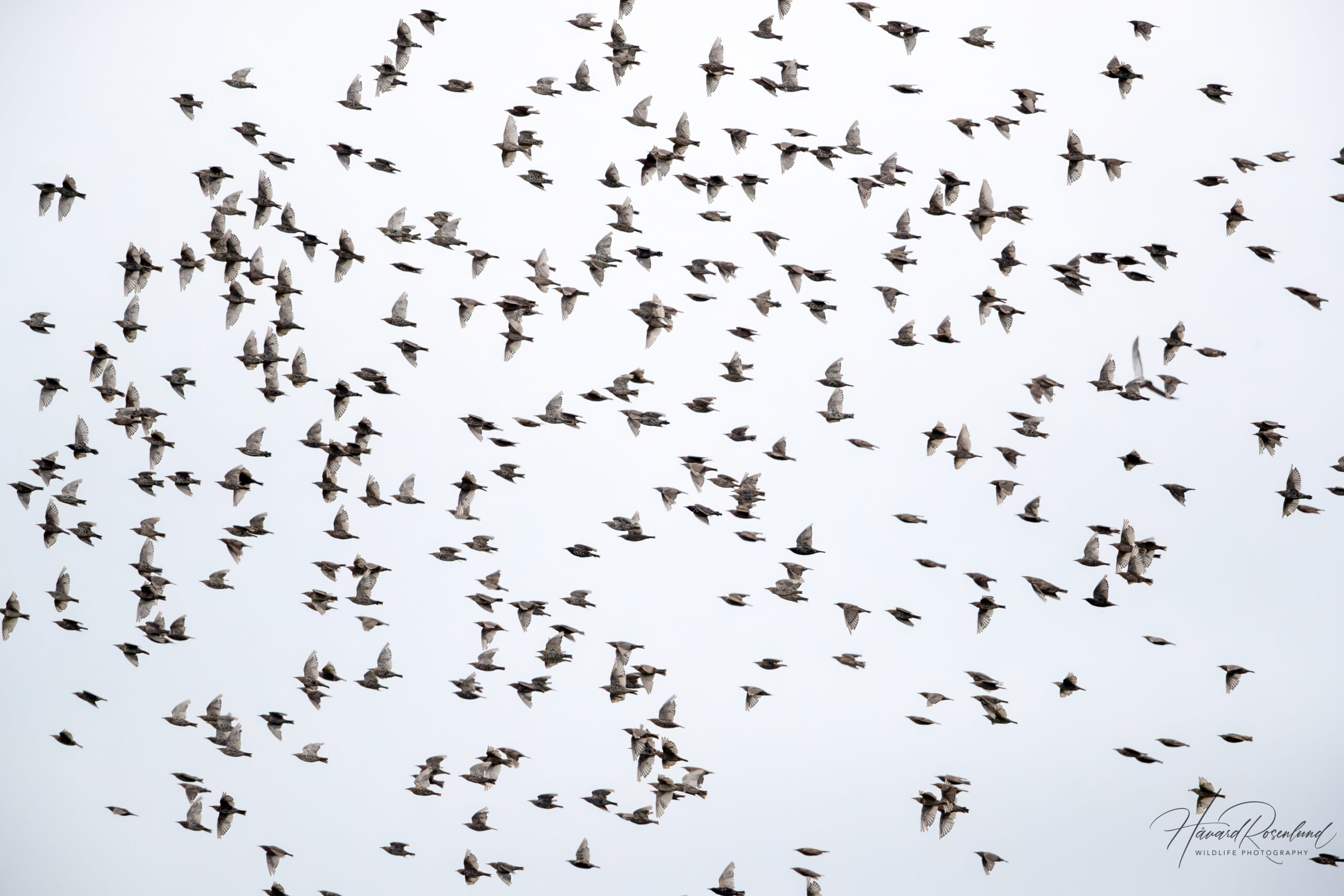
Outside the breeding season starlings are intensely social and can gather at large communal roosts. Before settling for the night, flocks may form the rapidly changing aerial formations known as murmurations, with hundreds or thousands of birds turning almost simultaneously before dropping into reedbeds, trees or urban roost sites.
Detailed three-dimensional studies show that this coordination is based mainly on local interactions rather than each bird tracking the entire flock. Individual starlings respond on average to roughly six or seven of their nearest neighbours, largely independent of the physical distance separating them. Later modelling found that interaction with about six or seven neighbours provides a particularly effective balance between group cohesion and the effort required by each bird to respond to others.
Communal roosts are not fixed social groups. Birds join and leave as feeding conditions and weather change, and the number using a roost can vary greatly through the season.
Migration
Migration varies across the range. Many birds in western and southern Europe are resident, while northern and eastern breeders are more migratory and move south or west in autumn. Britain and other relatively mild parts of western Europe receive large numbers of winter visitors from northern Europe, so winter flocks can contain both local residents and migrants.
How far a starling migrates therefore varies greatly. Weather, latitude and food availability all influence whether an individual remains near its breeding area or moves hundreds or thousands of kilometres.
Breeding
Starlings are cavity nesters and use holes in trees and buildings, nest boxes and other enclosed structures. Males often begin filling a selected cavity with grasses and other material before pairing, while females complete the nest. Competition for good cavities can be intense, both between starlings and with other hole-nesting birds. Starlings may breed alone or in loose colonies, with several pairs nesting close together where suitable cavities are plentiful.
A typical clutch contains 4–5 pale blue eggs. Both sexes incubate, usually for about 12–15 days, and both feed the nestlings, which normally leave the cavity after roughly 19–23 days. One brood is common across much of the range, while second broods occur more often in some populations and under favourable conditions.
Introduced populations
Starlings have been introduced far beyond their native range, including North America, Australia, New Zealand and South Africa. Several introduction attempts were made in North America during the nineteenth century, with releases in New York in 1890–91 among those associated with the population that subsequently spread across most of the continent.
The birds can compete aggressively for nesting cavities and can create agricultural and urban conflicts, but their effects on native wildlife are more nuanced than the species’ reputation sometimes suggests. An analysis of 27 native North American cavity-nesting birds found changes that could be linked to starlings in ten species, but only five showed any negative effect, and for most of those the evidence did not all point in the same direction. Local competition can therefore be real without implying broad population suppression across native cavity nesters.
Status
The common starling is classified as least concern on the IUCN Red List. It retains an enormous native and introduced range, but this global category hides major regional declines within parts of its native European range.
The 2025 update from the Pan-European Common Bird Monitoring Scheme, based on monitoring through 2024, shows a 65% decline in the European breeding index over the long term, from 1980 to 2024. Over the most recent ten-year period, 2015–2024, the decline was much smaller at 4%. The long-term decrease has therefore been far less pronounced in the past decade at continental scale, although trends continue to differ among countries.
Image gallery
Loading map and observations…
Have you seen this species?
Independent species archive
Did you find this species page useful?
Wildlife Vagabond is independently built and maintained. Voluntary support helps cover hosting, maps, data storage and continued improvements to the species archive.
Support Wildlife VagabondSpecies content will remain freely available.
References
Information about the species’ global distribution and status is based primarily on global Red List data. See the references below for details.
- Ballerini, M., Cabibbo, N., Candelier, R., Cavagna, A., Cisbani, E., Giardina, I., Lecomte, V., Orlandi, A., Parisi, G., Procaccini, A., Viale, M., & Zdravkovic, V. (2008). Interaction ruling animal collective behavior depends on topological rather than metric distance: Evidence from a field study. Proceedings of the National Academy of Sciences, 105(4), 1232-1237. https://doi.org/10.1073/pnas.0711437105
- BirdLife International. (n.d.). Common Starling species factsheet. https://datazone.birdlife.org/species/factsheet/common-starling-sturnus-vulgaris
- British Trust for Ornithology. (n.d.). Starling. https://www.bto.org/learn/about-birds/birdfacts/starling
- Cornell Lab of Ornithology. (n.d.). European Starling. https://www.allaboutbirds.org/guide/European_Starling/overview
- International Union for Conservation of Nature. (n.d.). Common Starling. The IUCN Red List of Threatened Species. https://www.iucnredlist.org/species/22710886/137493608
- Koenig, W. D. (2003). European Starlings and Their Effect on Native Cavity‐Nesting Birds. Conservation Biology, 17(4), 1134-1140. https://doi.org/10.1046/j.1523-1739.2003.02262.x
- Pan-European Common Bird Monitoring Scheme. (n.d.). Trends of wild birds in Europe, 2025 update. https://pecbms.info/trends-of-wild-birds-in-europe-2025-update/
- Robinson, R. A., Siriwardena, G. M., & Crick, H. Q. (2005). Status and population trends of StarlingSturnus vulgarisin Great Britain. Bird Study, 52(3), 252-260. https://doi.org/10.1080/00063650509461398
- Young, G. F., Scardovi, L., Cavagna, A., Giardina, I., & Leonard, N. E. (2013). Starling Flock Networks Manage Uncertainty in Consensus at Low Cost. PLoS Computational Biology, 9(1), e1002894. https://doi.org/10.1371/journal.pcbi.1002894