
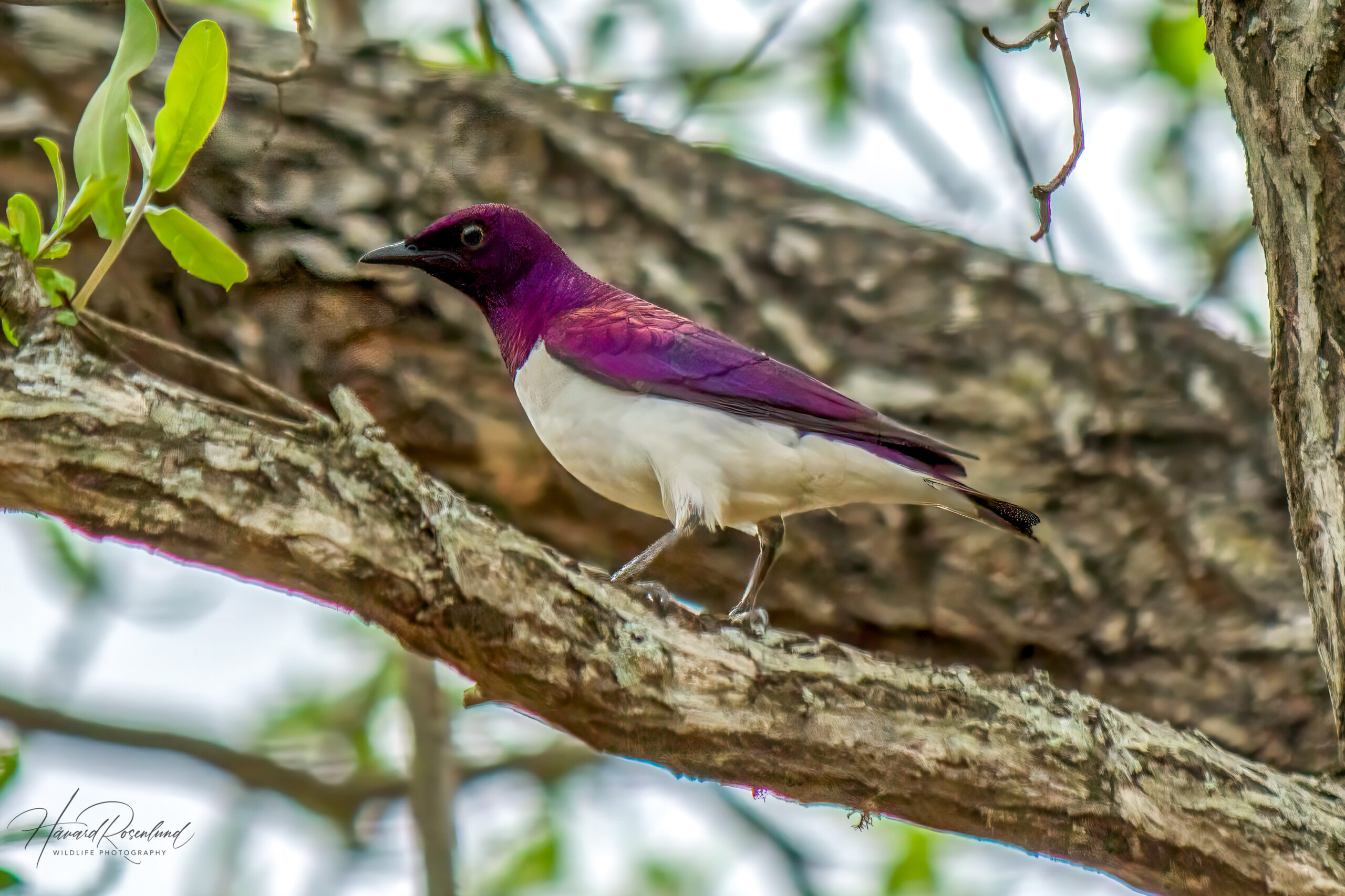
Violet-backed Starling
Cinnyricinclus leucogaster
At a glance
Habitat
- Open woodland, forest edges, wooded savanna, riverine trees and gardens
Diet
- Mostly fruit, supplemented by insects such as flying termites
Activity
- Diurnal; mainly arboreal
Size
- Length: 17–18 cm Weight: about 45 g
Range
- Sub-Saharan Africa and the southwestern Arabian Peninsula
Description
The violet-backed starling (Cinnyricinclus leucogaster), also known as the amethyst starling, is a small African starling with pronounced sexual dimorphism. Adult males have brilliant iridescent violet-purple upperparts and clean white underparts. Females look entirely different, being brown above and heavily streaked brown-and-white below; juveniles resemble females. Adults are about 17–18 cm long and weigh around 45 g.
The species is the only member of the genus Cinnyricinclus. It is widespread across sub-Saharan Africa and also occurs in the southwestern Arabian Peninsula.
Habitat
Violet-backed starlings favour open woodland, forest edges, wooded savanna, riverine woodland and other tree-rich but relatively open habitats rather than continuous closed forest. They also occur in plantations and well-treed gardens.
Fruiting trees strongly influence local distribution. Birds may appear in numbers where fruit is abundant and then move on as the fruit is depleted, so their presence at a particular site can be highly seasonal even outside longer-distance migration.
Diet
Fruit forms the bulk of the diet, including berries, figs, mulberries and mistletoe fruits. Insects are also important, especially during breeding.
Violet-backed starlings forage mainly in trees and are rarely seen feeding on the ground. Small fruits are swallowed whole, while pieces may be taken from larger fruits. Insect prey is picked from foliage or taken in short aerial sallies, and winged termites can be caught in large numbers during swarming events.
Migration
The species shows extensive seasonal movement within Africa. Many birds breeding in southern Africa begin arriving from more tropical regions around September, remain through the warm rainy season and depart again around April or May. Elsewhere populations can be more sedentary or nomadic.
These broad seasonal movements overlap with shorter local shifts in response to fruit availability. As a result, flock size and local abundance can change quickly when feeding conditions improve elsewhere.
Breeding
Violet-backed starlings nest in cavities, including natural tree holes and hollow posts. The nest itself is made from coarse plant material and leaves. Breeding timing varies geographically; in southern Africa it is concentrated mainly from spring into late summer. Clutches usually contain two to four eggs.
The female incubates alone for about 12–14 days. After hatching, both parents feed the chicks, which leave the cavity after roughly 17–21 days. The species has also been recorded as a host of the lesser honeyguide (Indicator minor), an African brood parasite.
Status
The violet-backed starling is classified as least concern on the IUCN Red List. It has an enormous range and remains common in many suitable wooded habitats.
The global population is nevertheless thought to be declining. The decline is not currently severe enough for the species to be considered threatened, but continued loss and degradation of wooded habitats could affect regional populations.
Image gallery
Loading map and observations…
Have you seen this species?
Independent species archive
Did you find this species page useful?
Wildlife Vagabond is independently built and maintained. Voluntary support helps cover hosting, maps, data storage and continued improvements to the species archive.
Support Wildlife VagabondSpecies content will remain freely available.
References
Information about the species’ global distribution and status is based primarily on global Red List data. See the references below for details.
- Biodiversity Explorer – Cinnyricinclus leucogaster. (n.d.). food, movements and breeding, based on Roberts Birds of Southern Africa. https://www.biodiversityexplorer.info/birds/sturnidae/cinnyricinclus_leucogaster.htm
- BirdLife International. (n.d.). Violet-backed Starling species factsheet. https://datazone.birdlife.org/species/factsheet/violet-backed-starling-cinnyricinclus-leucogaster
- International Union for Conservation of Nature. (n.d.). Violet-backed Starling (Cinnyricinclus leucogaster). The IUCN Red List of Threatened Species. https://www.iucnredlist.org/species/22710791/131959396