
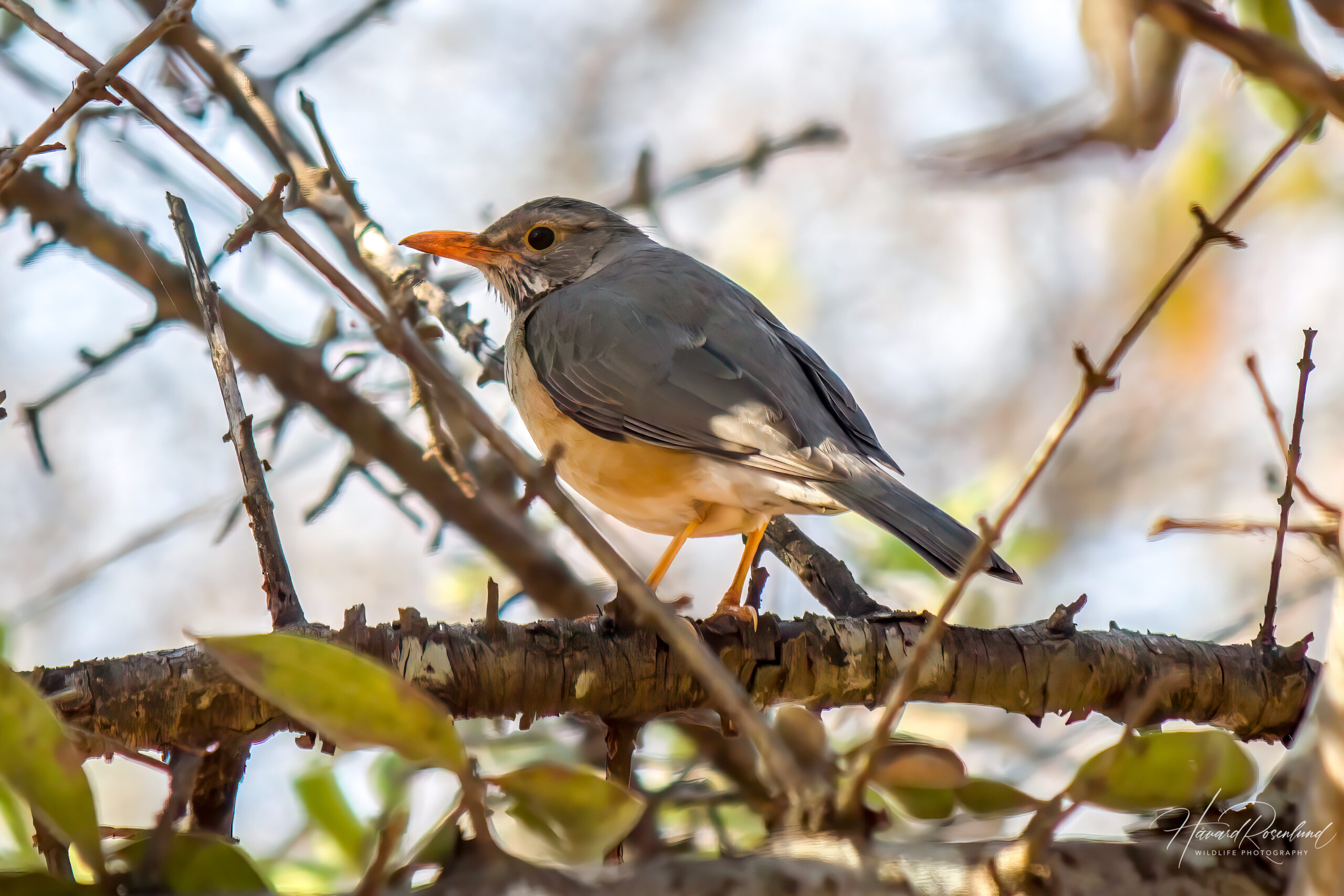
Kurrichane Thrush
Turdus libonyana
At a glance
Habitat
- Dry and moist woodland, bushveld, thickets, parks and gardens
Diet
- Insects, earthworms and other invertebrates, supplemented by fruit
Activity
- Diurnal; often most vocal around dawn and dusk
Size
- Length: 21–23 cm Weight: 51–58 g
Range
- South-central and southeastern Africa, from Tanzania and Angola south to South Africa
Description
The Kurrichane thrush (Turdus libonyana) is a medium-sized African thrush of south-central and southeastern Africa. Adults are about 21–23 cm long and weigh roughly 51–58 g. The upperparts are olive-grey to brown, while the flanks and sides of the breast are warm orange-brown and the centre of the belly is pale. A yellow to orange bill and eye-ring, together with the contrasting orange flanks, help separate it from other thrushes in the same region.
Several geographic subspecies are recognised and differ subtly in size and plumage across the range. The English name Kurrichane derives from Kaditshwene, a historical Tswana settlement in present-day South Africa that was rendered as “Kurrichane” in early European accounts.
Habitat
Kurrichane thrushes occur in a wide variety of wooded habitats, including miombo and other open woodland, moist woodland, bushveld, thickets, riverine vegetation, plantations, parks and mature gardens. They often favour places where trees and shrubs provide cover above patches of open or leaf-littered ground.
The willingness to use well-vegetated human settlements allows the species to remain common in many parts of its range, provided that enough ground cover, trees and feeding areas remain.
Diet
The species is omnivorous but feeds heavily on invertebrates. Beetles, ants, caterpillars, spiders, earthworms, millipedes and other small animals are taken, while figs, berries and other fruit provide an important seasonal supplement. Small vertebrates are occasionally eaten.
Most feeding takes place on the ground. Kurrichane thrushes run or hop through leaf litter, pause to listen or inspect the substrate and turn leaves aside or probe the soil for hidden prey, as many thrushes in the genus Turdus do.
Behaviour
Kurrichane thrushes are usually encountered singly or in pairs and are largely resident across their range.
The male's rich, fluting song is one of the species' most conspicuous features and is delivered particularly around dawn and dusk from an exposed perch. Song helps mark the territory and maintain contact between partners, while harsher calls occur during alarm and aggressive encounters.
Breeding
In southern Africa egg laying occurs mainly from August to March, peaking from September to December. Pairs defend a breeding territory, and the female builds the nest alone, often completing it in one or two days. It is commonly placed in a fork close to a tree trunk and consists of a base of mud and rootlets supporting a cup of grass, twigs and leaves.
Clutches contain one to four eggs, most often two or three. The female incubates alone for about 12–15 days and broods the newly hatched chicks, while both parents feed them. Young leave the nest after roughly 12–16 days but can remain dependent on the adults for weeks afterwards.
The Kurrichane thrush is recorded as a host of the red-chested cuckoo (Cuculus solitarius), although brood parasitism appears to be uncommon. Experiments published in 2005 showed that the species is good at recognising foreign eggs: Kurrichane thrushes rejected 60% of eggs that mimicked their own and 81% of clearly non-mimetic eggs.
Status
The Kurrichane thrush is classified as least concern on the IUCN Red List. It is widespread and locally common across much of south-central and southeastern Africa.
The species uses both natural woodland and many modified habitats such as plantations, parks and gardens. Local clearing of wooded habitat can reduce populations, but no major range-wide threat is currently known.
Image gallery
Loading map and observations…
Have you seen this species?
Independent species archive
Did you find this species page useful?
Wildlife Vagabond is independently built and maintained. Voluntary support helps cover hosting, maps, data storage and continued improvements to the species archive.
Support Wildlife VagabondSpecies content will remain freely available.
References
Information about the species’ global distribution and status is based primarily on global Red List data. See the references below for details.
- Biodiversity Explorer. (n.d.). Kurrichane Thrush (Turdus libonyanus). Iziko Museums of South Africa. https://www.biodiversityexplorer.info/birds/muscicapidae/turdus_libonyanus.htm
- BirdLife International. (n.d.). Kurrichane Thrush species factsheet. https://datazone.birdlife.org/species/factsheet/kurrichane-thrush-turdus-libonyana
- Honza, M., Kuiper, S. M., & Cherry, M. I. (2005). Behaviour of African turdid hosts towards experimental parasitism with artificial red‐chested cuckoo Cuculus solitarius eggs. Journal of Avian Biology, 36(6), 517-522. https://doi.org/10.1111/j.0908-8857.2005.03358.x
- International Union for Conservation of Nature. (n.d.). Kurrichane Thrush. The IUCN Red List of Threatened Species. https://www.iucnredlist.org/species/22708712/94173279