
Common Bulbul
Pycnonotus barbatus
At a glance
Habitat
- Wooded savanna, thickets, forest edges, riverine vegetation, plantations, orchards, gardens, parks and other well-vegetated human landscapes
Diet
- Mostly fruit; also insects, spiders, nectar, flowers, seeds and occasional small vertebrates
Activity
- Diurnal; active and vocal through much of the day
Size
- Length: 15–20 cm Weight: 34–49.5 g
Range
- Widespread across much of Africa; the dark-capped group occupies most of southern Africa
Description
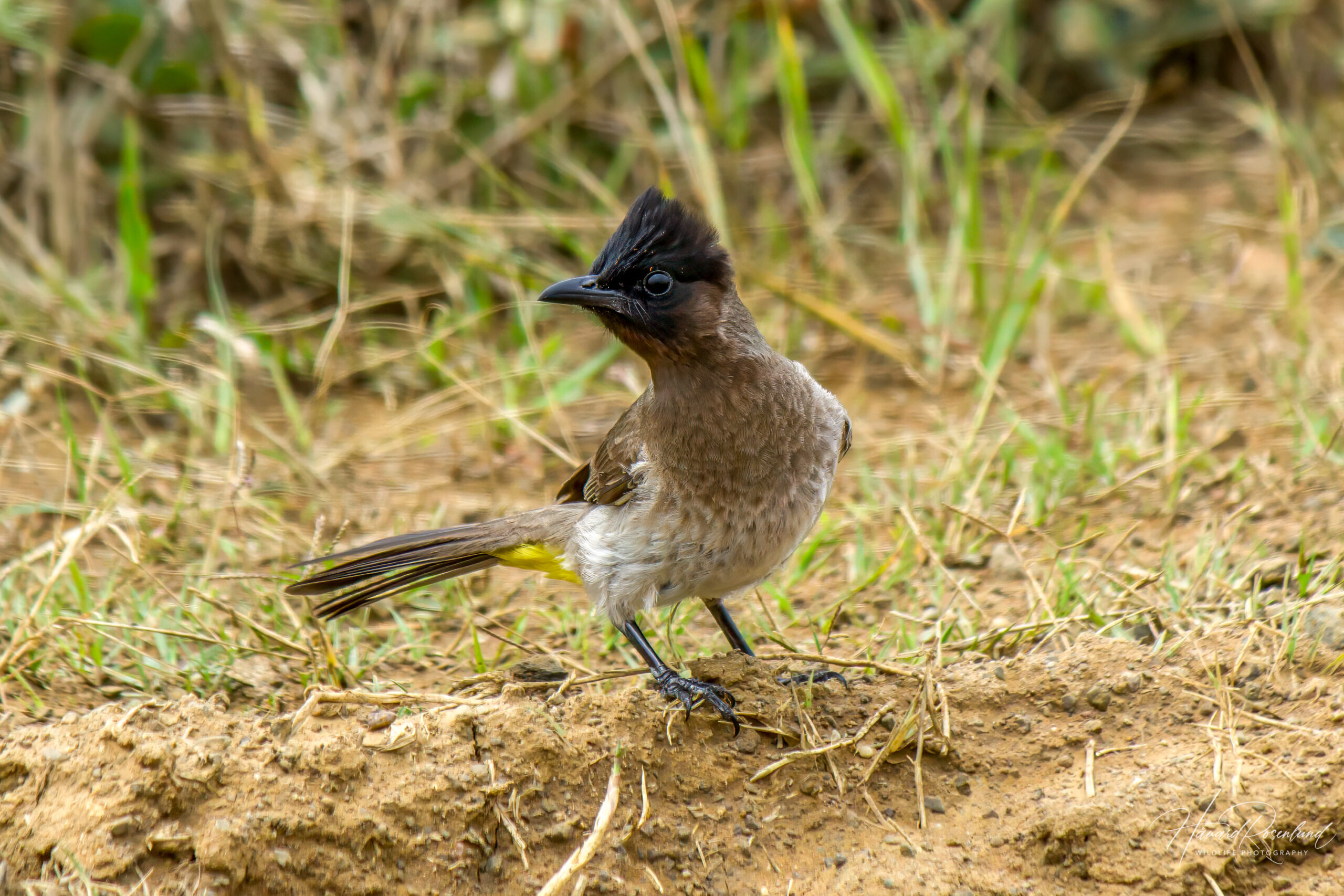
The common bulbul (Pycnonotus barbatus) is one of Africa’s most familiar and adaptable songbirds. Adults are about 15–20 cm long and weigh roughly 34–49.5 g. They have a slightly peaked crown, brown upperparts and a darker face and throat, while the colour of the breast, belly and undertail varies geographically.
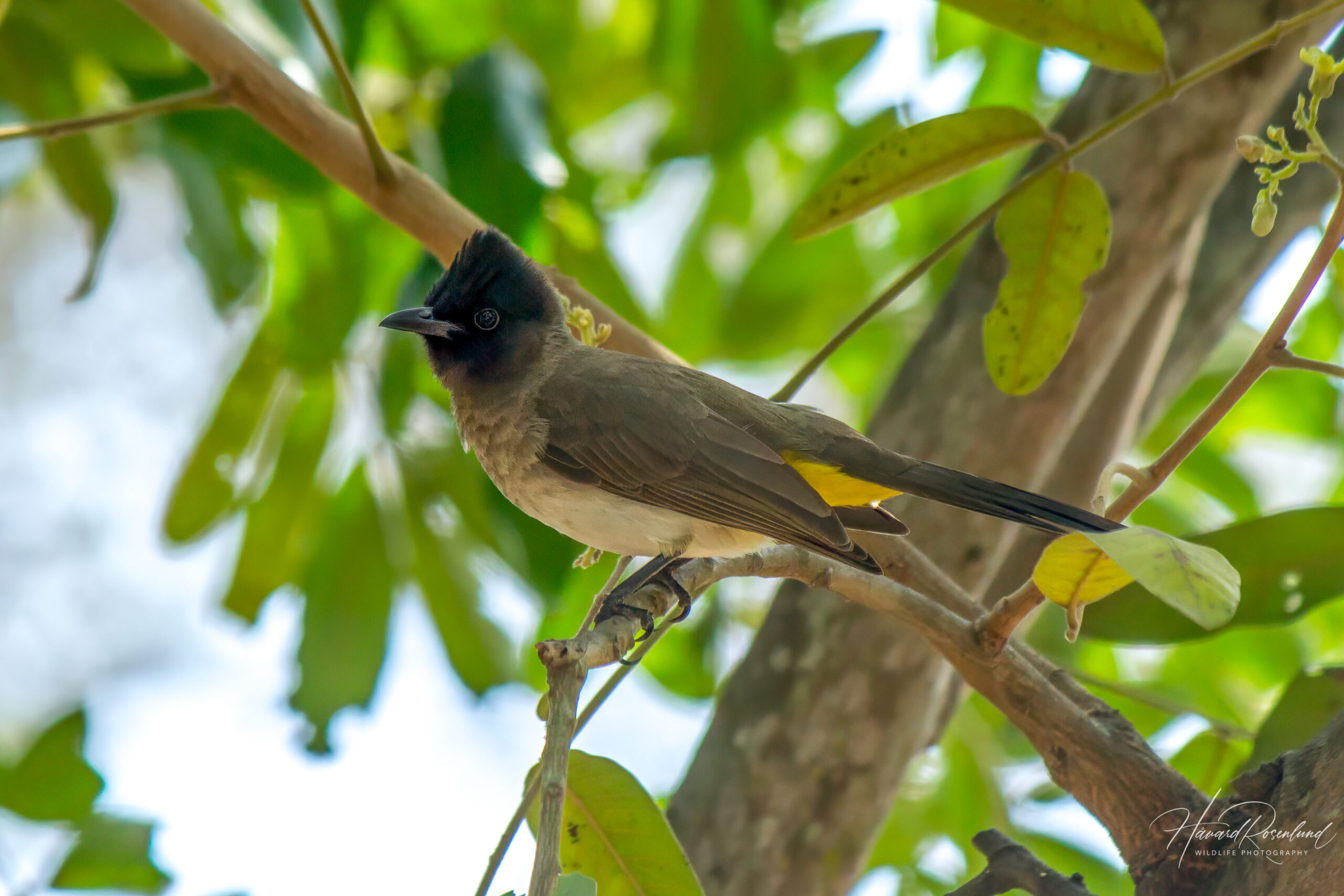
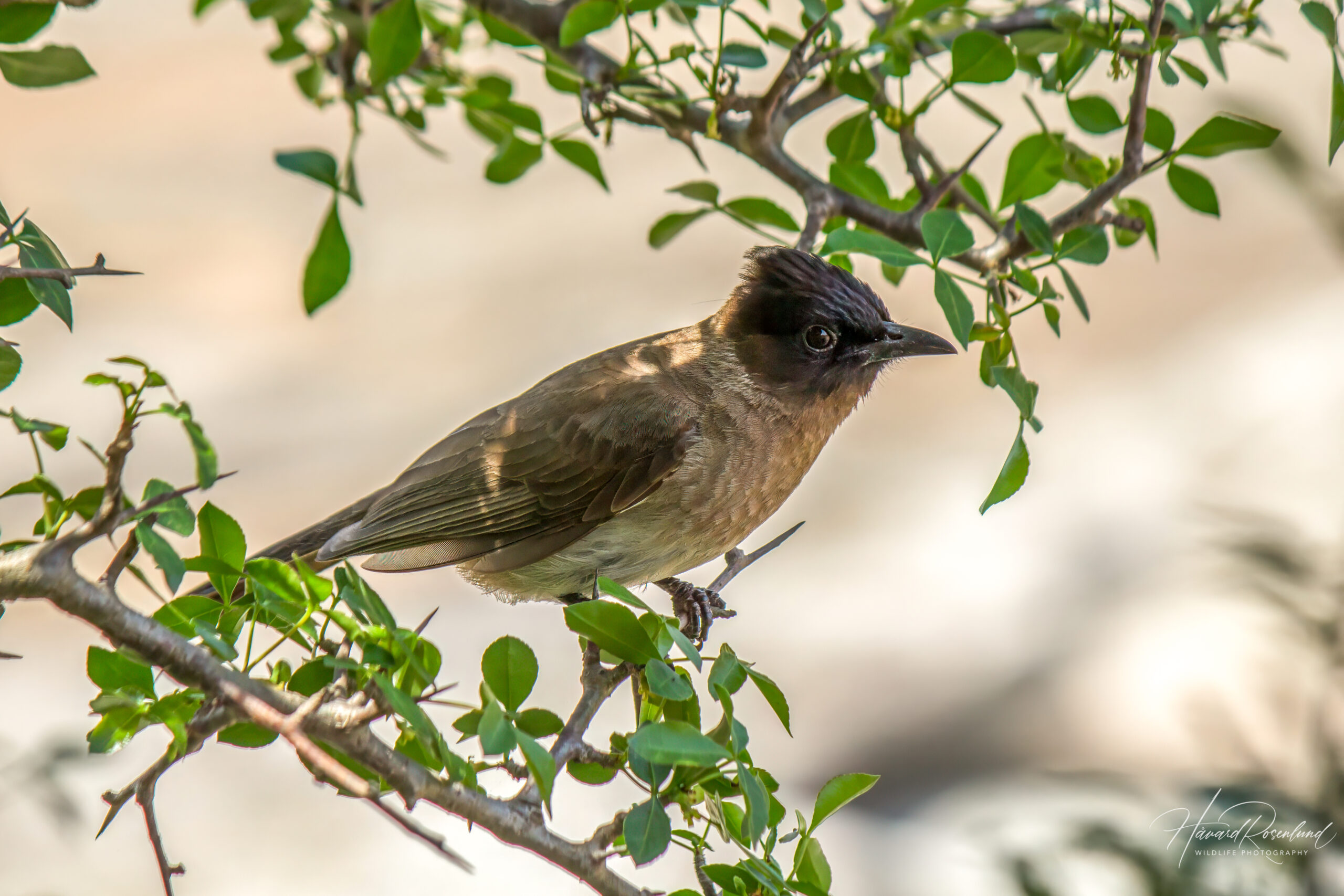
The birds photographed on this page belong to the dark-capped southern form, with a very dark head and face, brownish breast, pale belly and bright yellow undertail coverts.
Taxonomy
The common bulbul has long been treated as a complex of geographically varying forms. The southern dark-capped form was often recognised as a separate species, Pycnonotus tricolor, but current AviList taxonomy places it within the common bulbul as P. barbatus tricolor.
The older splits were based largely on plumage differences across Africa. These differences change gradually between neighbouring populations, while vocal differences have not provided equally clear species boundaries. The broader treatment therefore brings the dark-capped birds of southern Africa together with other forms under P. barbatus.
Habitat
Common bulbuls occur in a wide range of wooded and well-vegetated habitats, including savanna, thickets, forest edges, riverine vegetation, plantations, orchards, parks and gardens. They often become particularly abundant around settlements, where irrigated vegetation and cultivated fruit provide reliable food and cover.
The species tolerates considerable habitat modification as long as shrubs and trees remain, helping explain its abundance in both natural edge habitats and human-dominated landscapes.
Diet
Fruit dominates the adult diet, but common bulbuls also eat insects, spiders, flowers, nectar, seeds and occasional small vertebrates. They forage mainly in trees and shrubs, swallowing small fruits whole and gleaning invertebrates from foliage. They also take flying insects, investigate termite galleries and follow driver-ant columns to catch prey flushed from cover.
Fruit-eating makes the species an effective seed disperser. In a study of Afromontane forest restoration in Nigeria, common bulbuls accounted for 71% of frugivore visits to isolated trees in grassland. These trees acted as focal points for seed arrival, showing how a common edge-dwelling bird can help return forest plants to cleared landscapes.
Behaviour
Common bulbuls are active, conspicuous and highly vocal birds. They occur in pairs, family groups and small flocks, while larger loose gatherings can form around rich food sources outside the breeding season.
Their loud chattering calls make them easy to detect even in dense vegetation. Vocal behaviour varies geographically and locally: neighbouring birds may share song phrases, whereas populations only a few kilometres apart can have noticeably different repertoires.
Breeding
Breeding timing varies across the enormous range and can extend through much of the year in tropical populations. During courtship males use calls and a wing-fluttering display, and pairs defend the area around the nest.
The female builds a small cup nest of dry grass, rootlets and twigs, often bound with spider web and placed in a tree or shrub about 1–5 m above the ground. A clutch usually contains two to five eggs. The female incubates for about 12–15 days while the male may feed her. After hatching she broods the chicks almost continuously at first; later both adults spend more time away from the nest while foraging, and both feed the young.
Although adults eat large quantities of fruit, newly hatched young are fed almost entirely insects during their first week, providing protein for rapid growth. Chicks leave the nest after roughly 10–17 days but remain dependent on the adults for some time afterwards.
Status
The common bulbul is globally classified as Least Concern on the IUCN Red List. The current assessment was published in 2018. No precise global population estimate is available, but the species has an enormous range and the overall population trend is considered increasing.
Its success is partly linked to its ability to use disturbed and human-modified habitats. Local birds may be persecuted where they feed on cultivated fruit, and intensive removal of shrubs and fruiting trees can reduce habitat, but no major threat across its range currently puts the species close to a threatened category.
Image gallery
Loading map and observations…
Have you seen this species?
Independent species archive
Did you find this species page useful?
Wildlife Vagabond is independently built and maintained. Voluntary support helps cover hosting, maps, data storage and continued improvements to the species archive.
Support Wildlife VagabondSpecies content will remain freely available.
References
Information about the species’ global distribution and status is based primarily on global Red List data. See the references below for details.
- AviList. (2026). v2025b. https://www.avilist.org/checklist/v2025b/
- Biodiversity Explorer. (n.d.). Dark-capped Bulbul (southern form). Iziko Museums of South Africa. https://www.biodiversityexplorer.info/birds/pycnonotidae/pycnonotus_tricolor.htm
- BirdLife International. (n.d.). Common Bulbul species factsheet. https://datazone.birdlife.org/species/factsheet/common-bulbul-pycnonotus-barbatus
- Craig, A. J. F. K. (2022). African birds as army ant followers. Journal of Ornithology, 163(3), 623-631. https://doi.org/10.1007/s10336-022-01987-0
- Fishpool, L., & Tobias, J. (2020). Common Bulbul (Pycnonotus barbatus). Birds of the World. https://doi.org/10.2173/bow.combul2.01
- International Union for Conservation of Nature. (2018). Common Bulbul. The IUCN Red List of Threatened Species. https://www.iucnredlist.org/species/22712650/132101179
- Jaafar, R., Yadok, B. G., Elisha, E. B., & Chapman, H. M. (2021). Grassland trees and the common bulbul Pycnonotus barbatus promote Afromontane forest restoration. Biotropica, 53(5), 1379-1393. https://doi.org/10.1111/btp.12986