
Sombre Greenbul
Andropadus importunus
At a glance
Habitat
- Dense coastal scrub, thickets, forest edges, riverine woodland and wooded gardens
Diet
- Fruit and berries, insects, small snails, flowers, buds and nectar
Activity
- Diurnal
Size
- Length: 15–18 cm Weight: about 26 g
Range
- Eastern and southern Africa, from Kenya and southern Somalia south to the Cape
Description
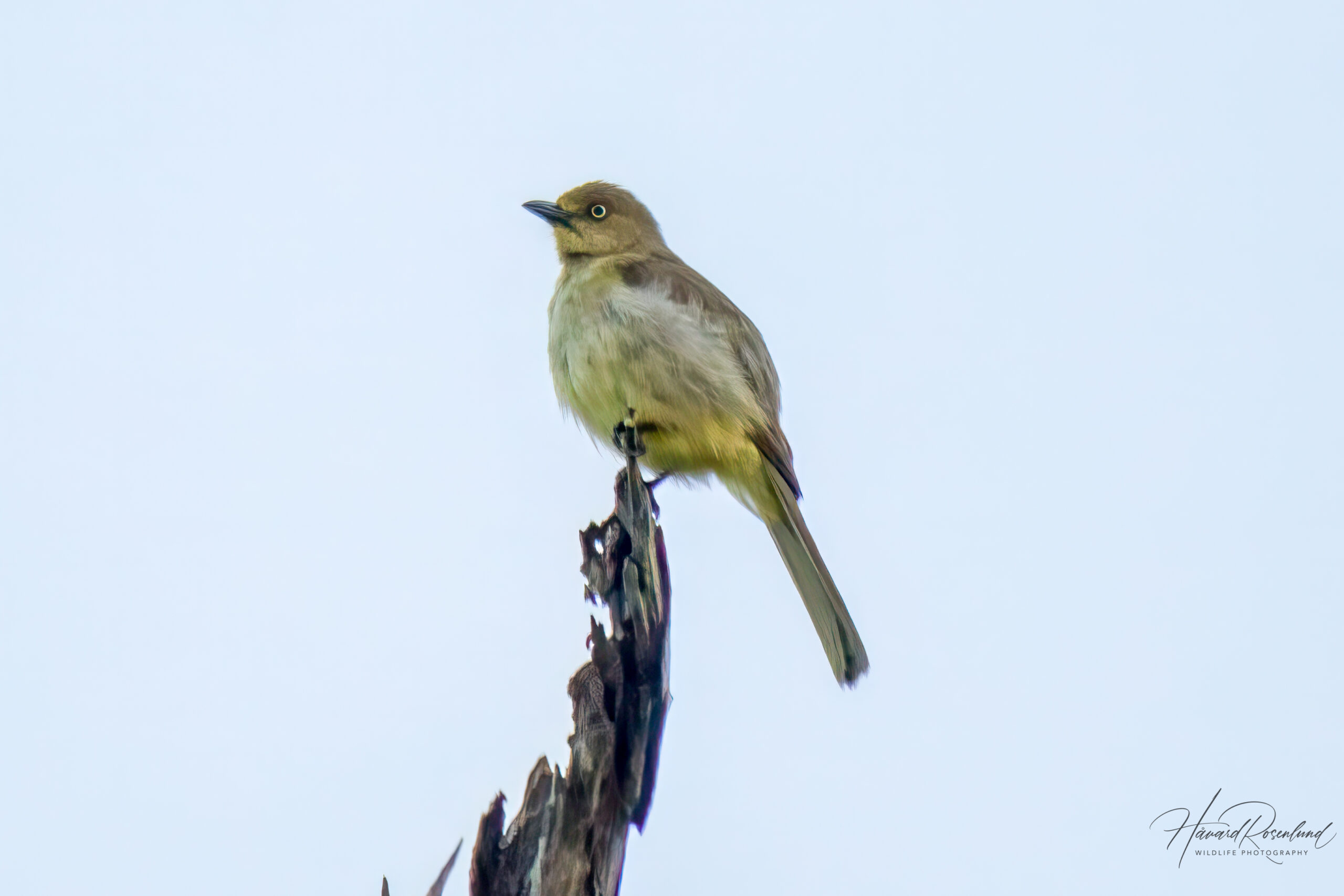
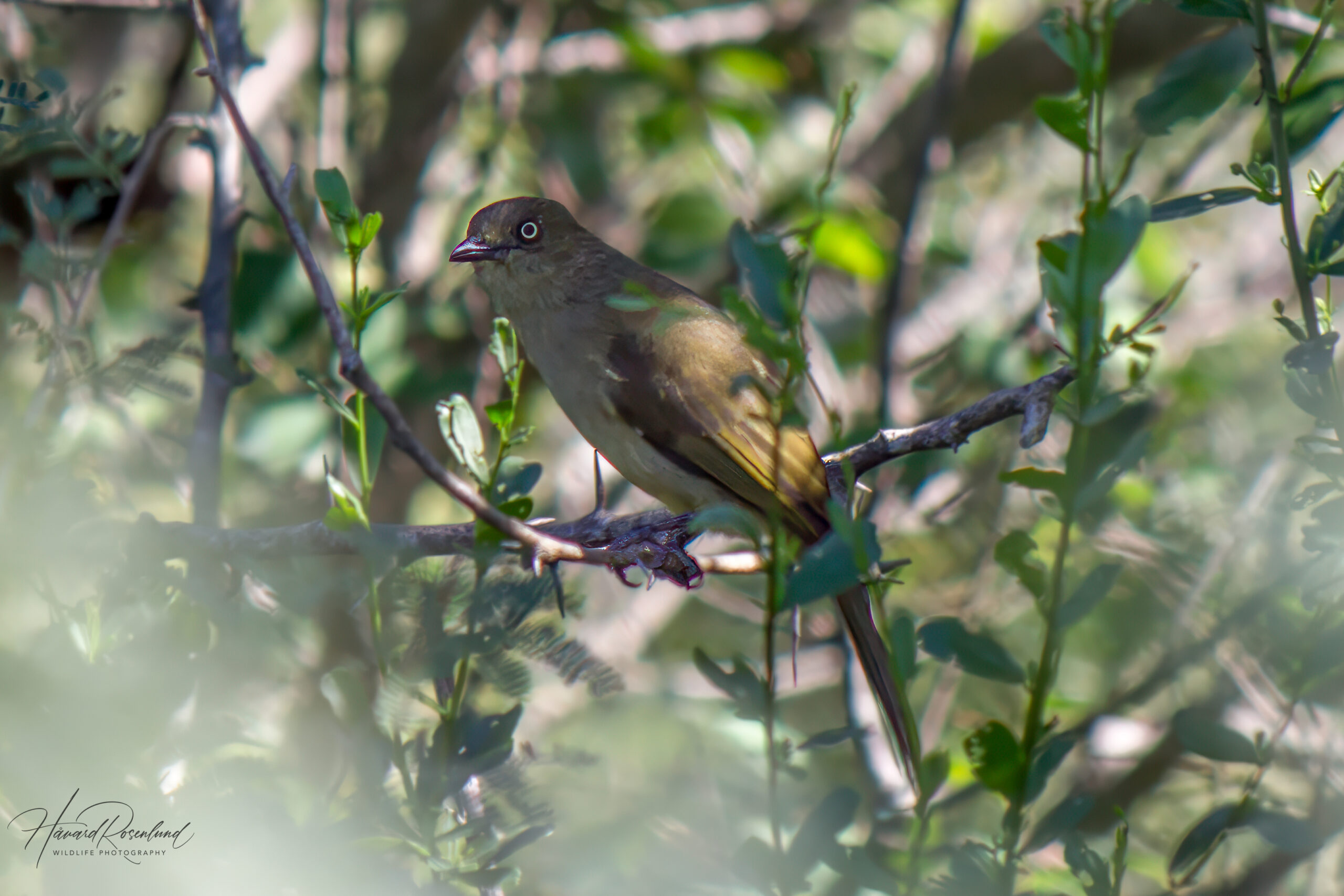
The sombre greenbul (Andropadus importunus) is an inconspicuous but extremely vocal bulbul of dense vegetation in eastern and southern Africa. Adults are about 15–18 cm long and weigh around 26 g. Both sexes look alike, with dull olive-green upperparts, olive-grey underparts, a black bill and striking pale whitish eyes. Juveniles have brown eyes, a paler bill and a yellowish eye-ring.
Several other greenbuls share its subdued olive plumage, but the very pale eye is an excellent field mark in adults; similar species generally have darker eyes or more contrasting head and underpart patterns. Even where common, sombre greenbuls are often identified by voice before they are seen because they spend so much time inside thickets and leafy canopies.
Habitat
Sombre greenbuls occupy coastal scrub, forest and forest edges, dense thickets in wooded valleys, riverine vegetation and several types of woodland. They are strongly associated with dense woody cover, including thickets along drainage lines in otherwise drier landscapes.
The species also uses alien thickets and well-wooded suburban gardens. This gives it some tolerance of modified landscapes, but it is much less characteristic of open country where continuous shrubs, trees and sheltered foliage are absent.
Diet
The diet is broad. Fruit and berries are important, together with insects and other invertebrates, including small snails. Birds also take succulent leaves, flowers, unopened buds and aloe nectar, allowing them to switch among seasonal food sources.
Most foraging occurs in the canopy and dense foliage, where sombre greenbuls pick food from leaves and branches. They sometimes descend into the understorey or leaf litter and may make short aerial sallies after flying insects before returning quickly to cover.
Behaviour
Sombre greenbuls are resident and normally encountered singly or in pairs, with larger non-breeding gatherings forming mainly where food is exceptionally abundant. They are shy in dense cover but become conspicuous when singing from the top of a tree or bush to advertise a territory. The loud, repeated song is one of the characteristic sounds of southern African thickets.
A SAFRING study published in 2014 found very high site fidelity among adults and limited dispersal among juveniles, together with regional differences in body size and moult. Annual survival among adults was on average more than twice that of juveniles. Sombre greenbuls are therefore predominantly sedentary forest and thicket birds rather than regular long-distance migrants.
Breeding
In southern Africa egg laying can occur from October to April, with a strong peak from October to December. Sombre greenbuls are monogamous and territorial solitary nesters. The female builds a rather flimsy open cup of twigs, rootlets, grass, lichen and other plant material, normally up to about 4 m above ground and often attached to supporting twigs with spider web.
Clutches contain one to three eggs. The female incubates alone for about 12–13 days while the male brings her food. Both parents feed and brood the chicks, which leave the nest after roughly 10–14 days and may continue receiving food for up to three weeks. Adults can perform a broken-wing distraction display when the nest is threatened, and nests are frequently parasitized by Jacobin cuckoos (Clamator jacobinus).
Status
The sombre greenbul is classified as least concern on the IUCN Red List and remains common through much of its broad eastern and southern African range.
Its ability to use several woodland, thicket and suburban habitats gives it some resilience to landscape change, although dense woody cover remains central to its ecology and local populations can be reduced where thickets and forest margins are extensively cleared.
Image gallery
Loading map and observations…
Have you seen this species?
Independent species archive
Did you find this species page useful?
Wildlife Vagabond is independently built and maintained. Voluntary support helps cover hosting, maps, data storage and continued improvements to the species archive.
Support Wildlife VagabondSpecies content will remain freely available.
References
Information about the species’ global distribution and status is based primarily on global Red List data. See the references below for details.
- Biodiversity and Development Institute. (2026). Sombre Greenbul. https://thebdi.org/2026/06/03/sombre-greenbul-andropadus-importunus/
- BirdLife International. (n.d.). Sombre Greenbul species factsheet. https://datazone.birdlife.org/species/factsheet/sombre-greenbul-andropadus-importunus
- BirdLife Norge. (n.d.). Norske navn på verdens fugler. https://www.birdlife.no/fuglekunnskap/navn/
- Bonnevie, B. T. (2014). Variations in moult, morphology, movement and survival rates of the Sombre Greenbul Andropadus importunus within southern Africa. Ostrich, 85(2), 161-170. https://doi.org/10.2989/00306525.2014.902403
- International Union for Conservation of Nature. (n.d.). Sombre Greenbul. The IUCN Red List of Threatened Species. https://www.iucnredlist.org/species/22712795/131966190
- Store norske leksikon. (n.d.). Krattbylbyl. https://snl.no/krattbylbyl