
Common Shelduck
Tadorna tadorna
At a glance
Habitat
- Estuaries, tidal mudflats, saltmarshes, shallow coasts and some inland wetlands
Diet
- Mostly small snails and other benthic invertebrates, plus crustaceans, insects and some plant material
Activity
- Diurnal and tidal; feeding activity follows access to shallow mudflats
Size
- Length: ~58–67 cm Weight: Adults average ~1.25 kg
Range
- Breeds across temperate Eurasia; winters mainly farther south and west
Description
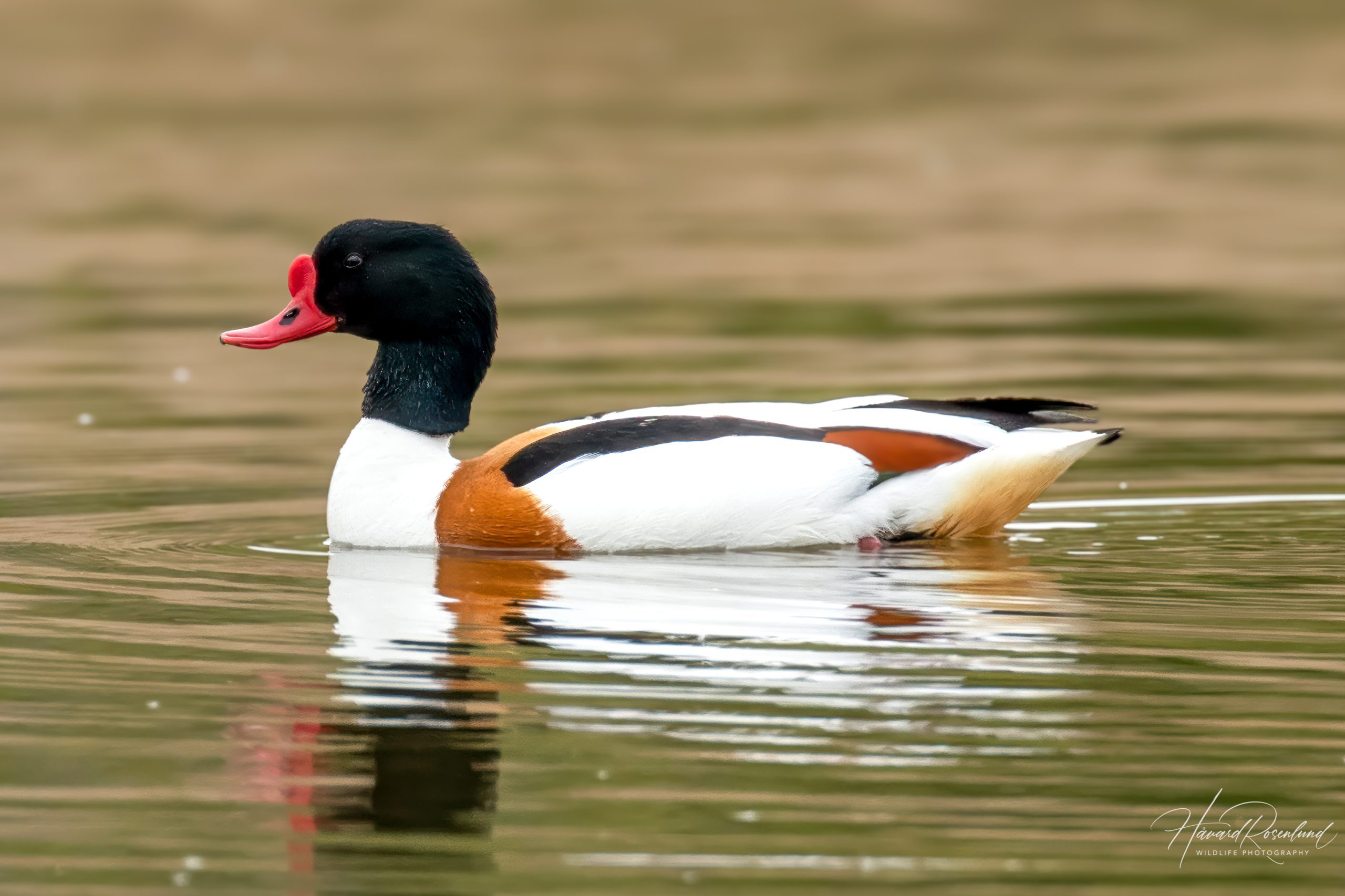
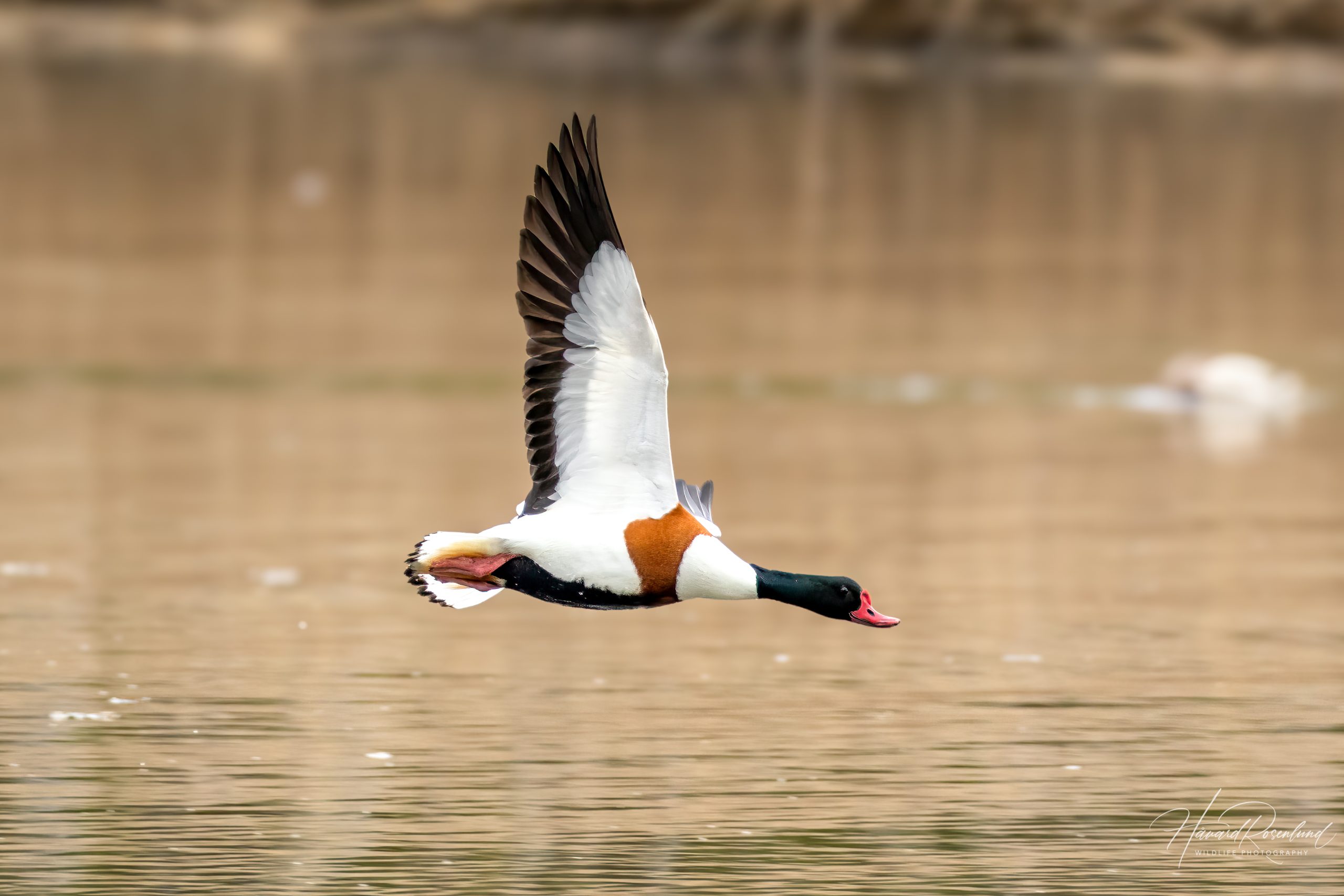
The common shelduck (Tadorna tadorna) is a large, long-legged waterfowl intermediate in appearance between a typical duck and a small goose. Adults are strikingly patterned in white, black and chestnut, with a dark green head, bright red bill and pinkish-red legs. A black stripe runs down the centre of the belly. Males are larger and develop a conspicuous red knob at the bill base during the breeding season, while females have a smaller bill and often show more white around its base.
Adults are roughly 58–67 cm long with a wingspan of about 110–133 cm and average around 1.25 kg, with males averaging about 1.31 kg and females about 1.08 kg. The combination of white body, chestnut breast band, black flight feathers and red bill makes adults difficult to confuse with other European waterfowl.
Habitat
Common shelducks are most characteristic of shallow coastal environments, especially estuaries, tidal mudflats, saltmarshes, sheltered bays and brackish lagoons. Extensive mud and sand flats are particularly valuable because they expose rich feeding areas on and within the seabed at low tide. Breeding birds also use coastal islands, dunes, farmland near the shore and some inland lakes and reservoirs.
Nesting habitat does not have to lie directly beside the feeding area. Because nests are usually hidden in cavities or burrows, pairs may travel between sandy ground, rabbit warrens or other suitable nest sites and nearby wetlands where the adults and later the ducklings feed.
Diet
The diet is dominated by small invertebrates living on or in the bottom. Tiny snails are especially important in many coastal populations, together with bivalves, crustaceans, worms, insect larvae and other animals living in mud and shallow water. Algae, seeds and other plant material are taken in smaller amounts.
Shelducks feed by sweeping and filtering the bill through wet mud and shallow water, pecking from the surface and sometimes upending. Their feeding schedule is strongly influenced by the tide: receding water exposes large areas of mud where prey can be filtered efficiently before the flats are covered again.
Behaviour
Social organisation changes strongly through the year. In late winter, established pairs leave the larger winter flocks and spread out over suitable shores and wetlands. Breeding pairs can become strongly territorial, and unusually for ducks both members of the pair may take part in defending a feeding area against other shelducks.
After breeding, territoriality relaxes and the birds become much more gregarious again. They gather into larger flocks during post-breeding movements, wing moult and winter, before pairs separate from the flocks again as the next breeding season approaches.
Migration
Movement patterns vary across the range. Some birds winter close to their breeding areas, while northern and continental populations migrate to milder coasts. A particularly distinctive movement occurs after breeding, when large numbers travel to traditional moulting sites where they replace all flight feathers and become temporarily flightless.
The Wadden Sea is of exceptional importance for this wing moult. Counts in the German Wadden Sea averaged about 206,000 moulting shelducks in 1996–2002. Numbers there later fell while concentrations increased in the Dutch Wadden Sea, showing that the main moulting areas can shift within the wider Wadden Sea. Because the birds are flightless for several weeks, undisturbed offshore and tidal areas are a critical part of the annual cycle.
Breeding
Pairs are generally monogamous and may retain pair bonds between breeding seasons. The nest is unusual for a large waterfowl: females often use rabbit burrows, natural holes, hollow trees, spaces beneath buildings or other dark cavities, sometimes well away from the water. The nest itself is lined with vegetation and down.
A typical clutch contains about 8–10 eggs. The female incubates for roughly 29–31 days while the male remains nearby and helps defend the area. The downy young leave the nest soon after hatching and are led to feeding water. Broods may later join together into larger groups attended by a smaller number of adults. Young become capable of flight after about 45–50 days.
Status
The common shelduck is classified as least concern on the IUCN Red List and remains widespread across Eurasia. Regional trends vary, but the species' annual cycle depends heavily on productive estuaries, tidal feeding flats and a small number of major moulting areas.
The huge concentration of flightless birds in the Wadden Sea creates a specific vulnerability: disturbance or habitat change in a relatively small number of sites can affect birds originating from a very large breeding area. The species can therefore be secure at global scale while still depending strongly on the condition of a few key wetlands.
Image gallery
Loading map and observations…
Have you seen this species?
Independent species archive
Did you find this species page useful?
Wildlife Vagabond is independently built and maintained. Voluntary support helps cover hosting, maps, data storage and continued improvements to the species archive.
Support Wildlife VagabondSpecies content will remain freely available.
References
Information about the species’ global distribution and status is based primarily on global Red List data. See the references below for details.
- BirdLife International. (n.d.). Common Shelduck species factsheet. https://datazone.birdlife.org/species/factsheet/common-shelduck-tadorna-tadorna
- British Trust for Ornithology. (n.d.). Shelduck BirdFacts. https://www.bto.org/learn/about-birds/birdfacts/shelduck
- Green, R. M. W., Burton, N. H. K., & Cook, A. S. C. P. (2021). Migratory movements of British and Irish Common Shelduck Tadorna tadorna: a review of ringing data and a pilot tracking study to inform potential interactions with offshore wind farms in the North Sea. Ringing & Migration, 34(2), 71–83. https://doi.org/10.1080/03078698.2019.1887670
- International Union for Conservation of Nature. (n.d.). Common Shelduck. The IUCN Red List of Threatened Species. https://www.iucnredlist.org/species/22680024/154560262
- Patterson, I. J. (1982). The Shelduck: A study in behavioural ecology. Cambridge University Press. https://doi.org/10.1017/CBO9780511753473
- Wadden Sea World Heritage. (n.d.). Wadden Sea Quality Status Report – Migratory birds and moulting ducks. https://qsr.waddensea-worldheritage.org/reports/migratory-birds