
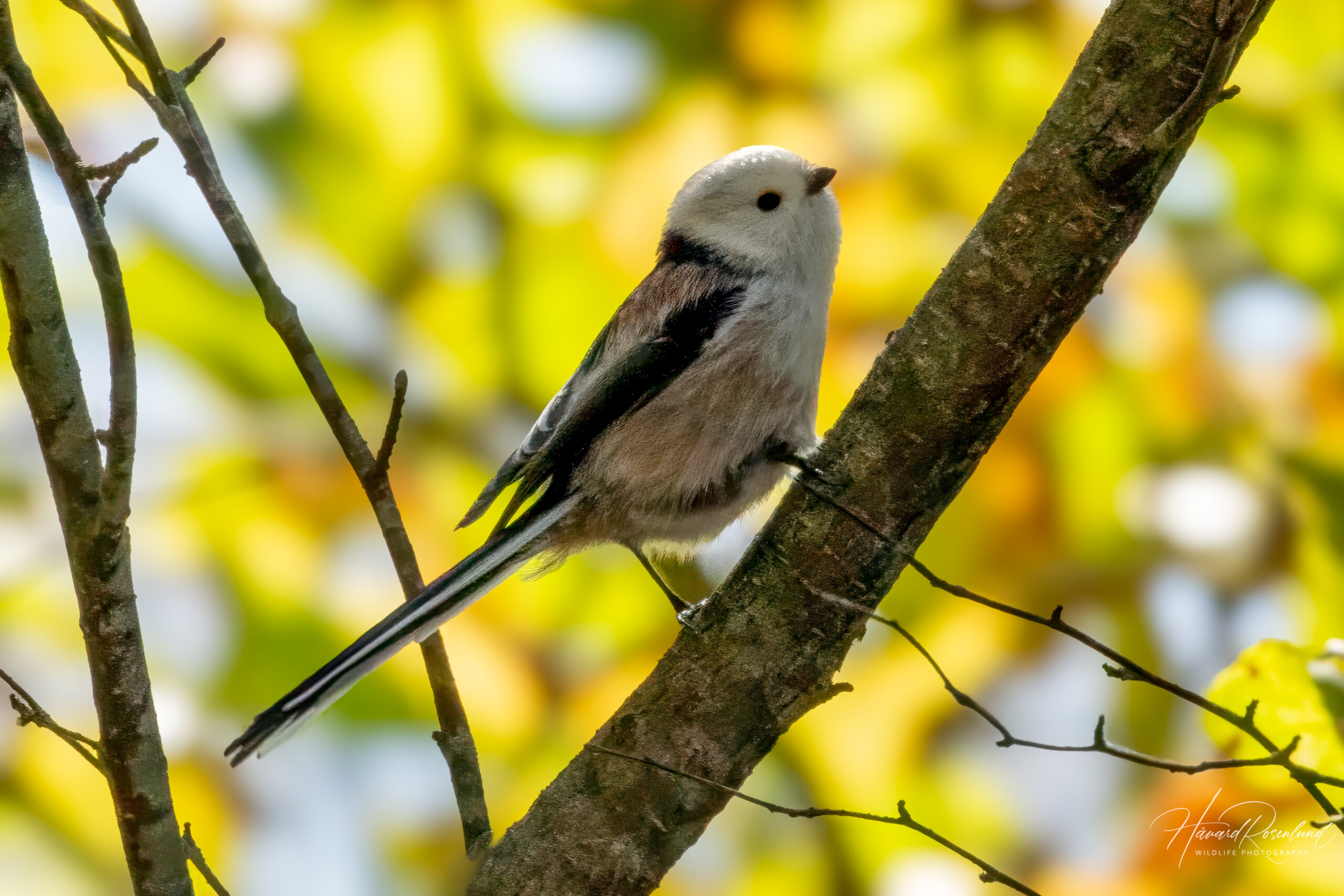
Long-tailed Tit
Aegithalos caudatus
At a glance
Habitat
- Deciduous and mixed woodland, wet woodland, scrub, hedgerows, parks and gardens with dense low vegetation
Diet
- Small insects, insect eggs, spiders and other tiny invertebrates; small amounts of seeds in winter
Activity
- Diurnal
Size
- Length: 13–15 cm Weight: ca. 7.8 g
Range
- Across temperate Eurasia from western Europe to Japan; mainly resident, with irregular movements in some northern and eastern populations
Description
The long-tailed tit (Aegithalos caudatus) is a tiny Eurasian songbird with an exceptionally long tail. It measures about 13–15 cm from bill to tail tip but weighs only around 7.8 g; the tail itself is longer than the body. Adults are pale and fluffy-looking, with black wings and back, variable pink tones on the shoulders and flanks, and a long black-and-white tail. Males and females look alike.
Plumage varies markedly across the species' enormous range. Northern forms, including the nominate A. c. caudatus, can have a completely white head, whereas many western and southern populations show dark stripes above the eyes. Despite its English name, the long-tailed tit is not a true tit of the family Paridae, but belongs to the long-tailed tit family Aegithalidae.
Habitat
Long-tailed tits favour structurally rich deciduous and mixed woodland, wet woodland, scrub, hedgerows and woodland edges, and also use parks and mature gardens. Dense shrubs and fine outer branches provide both feeding opportunities and cover.
The species is especially associated with landscapes that combine trees with a well-developed shrub layer. This structure becomes important during breeding as well, because the elaborate nest is commonly concealed in dense bushes, hedges or forks among branches.
Diet
The diet is dominated by very small invertebrates, particularly insects, insect eggs and spiders. Small amounts of seeds may be taken in winter, and birds sometimes visit feeders, but they remain much more strongly insectivorous than most familiar garden tits.
Food is picked from leaves, buds and fine branches, with the birds moving almost continuously through vegetation and often hanging acrobatically from thin twigs to reach prey.
Social behaviour
After breeding, families and relatives assemble into cohesive flocks that move through a shared winter range while maintaining contact with frequent calls. These flocks are not random gatherings: long-term research shows that kin associations persist outside the breeding season and help create local neighbourhoods of relatives that later influence opportunities for cooperative breeding.
At night the birds roost pressed tightly together in a line. Huddling reduces heat loss in a species weighing less than 10 g, and birds on the exposed ends of a roost lose more body mass overnight than those in more sheltered central positions. The close social system therefore has an important thermoregulatory role as well as keeping relatives together.
Breeding
The nest is one of the most elaborate built by a European passerine. Both members of the pair construct a closed, domed structure from moss, plant fibres, lichen and spider silk, camouflaging the outside with flakes of lichen and lining the inside heavily with feathers. A completed nest can contain well over a thousand feathers, which form an important part of its insulation and allow the flexible walls to expand as the brood grows.
Long-tailed tits normally raise one brood. A typical clutch contains six to eight eggs, incubated by the female for about 15–18 days. Both parents feed the naked, altricial chicks, which normally remain in the nest for about 15–17 days and continue to receive food after fledging. Nest predation is common and is central to the species' unusual cooperative breeding system.
Every adult initially attempts to breed as part of a pair. If a nest fails early, the pair may try again, but birds whose attempt fails later often have too little time to start another brood. Some then redirect their parental effort and become helpers at another active nest, feeding both nestlings and fledglings.
Helpers preferentially assist relatives. Experiments and three decades of long-term research show that this kin-biased helping can increase the productivity of related broods and give helpers indirect fitness benefits, because relatives' offspring carry many of the same genes. Males become helpers more often than females. This is therefore different from cooperative systems in which non-breeding offspring simply remain with their parents: long-tailed tit helpers have normally attempted to reproduce themselves earlier in the same season.
Status
The long-tailed tit is classified as least concern on the IUCN Red List. It has a vast Eurasian range and is not currently considered of global conservation concern.
Numbers can nevertheless fluctuate strongly between years. Long-term British research shows that adult survival responds to weather across several seasons, with spring and autumn conditions sometimes more important than winter cold alone. The species can recover quickly after poor years because of its high breeding potential.
Image gallery
Loading map and observations…
Have you seen this species?
Independent species archive
Did you find this species page useful?
Wildlife Vagabond is independently built and maintained. Voluntary support helps cover hosting, maps, data storage and continued improvements to the species archive.
Support Wildlife VagabondSpecies content will remain freely available.
References
Information about the species’ global distribution and status is based primarily on global Red List data. See the references below for details.
- Artsdatabanken. (2021). Stjertmeis, Norsk rødliste 2021. https://lister.artsdatabanken.no/rodlisteforarter/2021/28721
- BirdLife International. (n.d.). Long-tailed Tit species factsheet. https://datazone.birdlife.org/species/factsheet/long-tailed-tit-aegithalos-caudatus
- British Trust for Ornithology. (n.d.). Long-tailed Tit BirdFacts. https://www.bto.org/learn/about-birds/birdfacts/long-tailed-tit
- Hatchwell, B. J., Sharp, S. P., Simeoni, M., & McGowan, A. (2009). Factors influencing overnight loss of body mass in the communal roosts of a social bird. Functional Ecology, 23(2), 367-372. https://doi.org/10.1111/j.1365-2435.2008.01511.x
- International Union for Conservation of Nature. (n.d.). Long-tailed Tit. The IUCN Red List of Threatened Species. https://www.iucnredlist.org/species/103871923/87471081
- McGOWAN, A., SHARP, S. P., & HATCHWELL, B. J. (2004). The structure and function of nests of Long‐Tailed Tits Aegithalos caudatus. Functional Ecology, 18(4), 578-583. https://doi.org/10.1111/j.0269-8463.2004.00883.x
- Morinay, J., Woodward, B. K., Russell, A. F., Sharp, S. P., & Hatchwell, B. J. (2025). Ecological and demographic drivers of kin‐directed cooperation in a social bird: Insights from a long‐term study. Journal of Animal Ecology, 94(4), 485-500. https://doi.org/10.1111/1365-2656.14237
- Russell, A. F., & Hatchwell, B. J. (2001). Experimental evidence for kin-biased helping in a cooperatively breeding vertebrate. Proceedings of the Royal Society of London. Series B: Biological Sciences, 268(1481), 2169-2174. https://doi.org/10.1098/rspb.2001.1790