
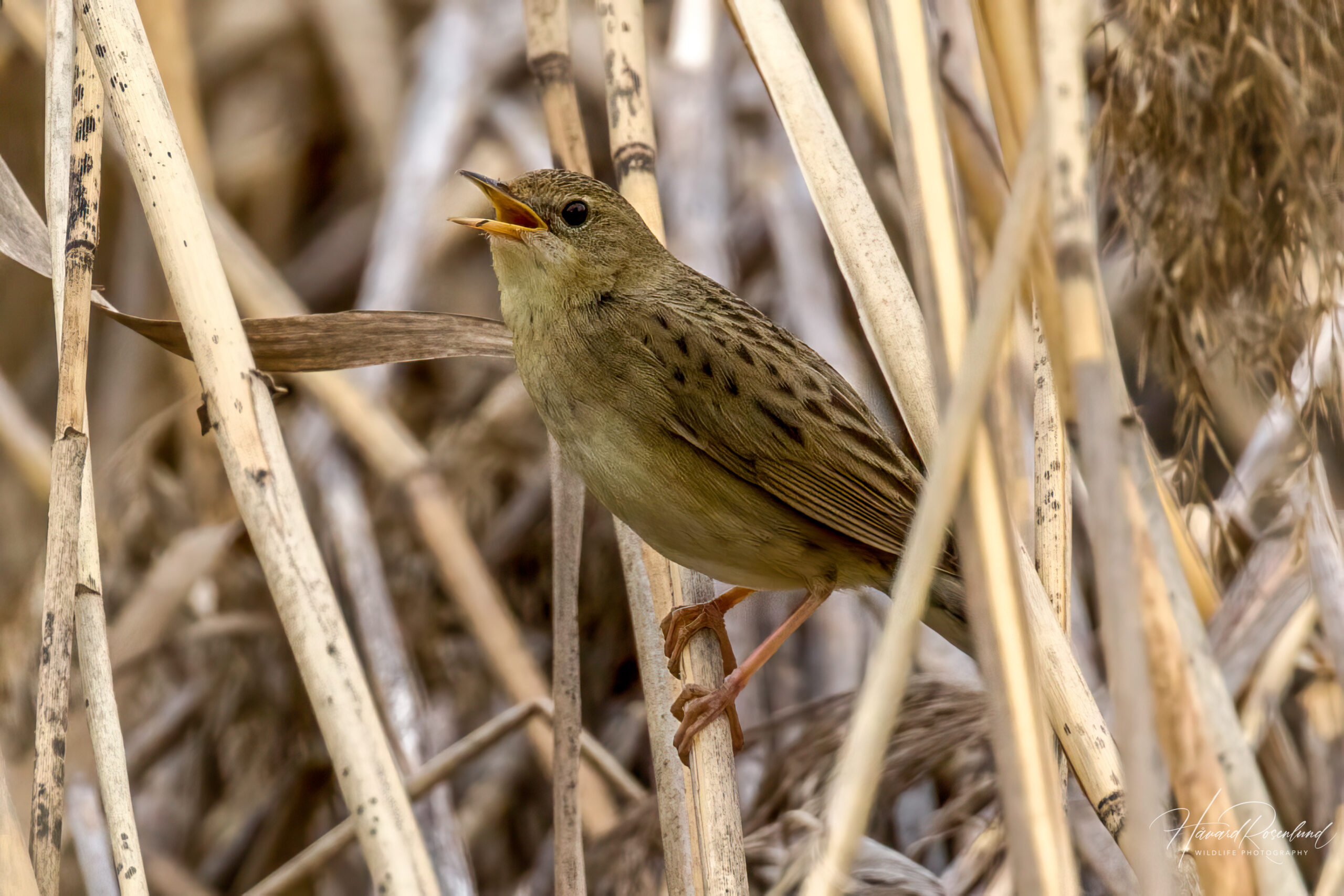
Common Grasshopper Warbler
Locustella naevia
At a glance
Habitat
- Damp grassland, sedge and rush beds, reed margins, scrub, heath and young woodland clearings
Diet
- Insects, spiders and other small invertebrates
Activity
- Feeds mainly by day; migrates at night and males sing by day or night
Size
- Length: 12–13 cm Weight: about 10–16 g
Range
- Breeds from Europe and northwestern Africa to western and central Asia; winters mainly in sub-Saharan Africa
Description
The common grasshopper warbler (Locustella naevia) is a small, secretive songbird that breeds across much of Europe and east into western and central Asia. It measures about 12–13 cm and weighs roughly 10–16 g, with an average close to 13 g in British ringing data.
The upperparts are olive-brown with dark streaks, while the underparts are paler and usually only faintly marked. The rounded tail is warm brown, the legs are pinkish and the pale eyebrow is weak. The sexes look alike.
The species is often detected by sound before it is seen. The male's long, dry mechanical reel resembles a grasshopper or fishing reel and can continue for several minutes at a time.
Taxonomy
Common grasshopper warblers are generally divided into four subspecies. The nominate L. n. naevia breeds from Europe east to European Russia and is the form occurring in Norway. L. n. obscurior occurs around the Caucasus, L. n. straminea from western Siberia to western China, and L. n. mongolica from Kazakhstan south to Afghanistan and east to western Mongolia.
Migration differs among these forms. Western populations winter mainly in Africa, whereas L. n. mongolica migrates south to northern India. This explains why older accounts may include India in the species' winter range even though it is not a wintering area for northwestern European birds.
Habitat
Breeding habitat combines dense low cover with scattered taller stems or bushes. Typical sites include damp meadows, sedge and rush beds, reed margins, overgrown ditches, heath, bramble, young plantations and woodland clearings.
Suitable vegetation is often temporary. Early-successional sites can become unsuitable when they are drained, cut intensively or develop into tall, closed scrub, so local populations may shift as vegetation structure changes.
Diet
The diet consists mainly of insects, spiders and other small invertebrates, including beetles, flies, moth larvae and other prey living in dense ground vegetation.
Most food is collected on or close to the ground. The bird moves methodically through dense grass, sedges and low scrub, picking prey from stems, leaves and the ground while remaining largely concealed.
Behaviour
Common grasshopper warblers spend most of their time close to the ground inside tangled vegetation. They run and creep through grass, sedges and low scrub and often disappear into cover rather than fly when disturbed. Even a singing male can be difficult to locate, although he may occasionally climb to an exposed stem or bush.
Males sing both during daylight and at night, especially soon after arrival in spring. The reel functions both as a territorial signal and in attracting a mate, and its apparent volume rises and falls as the bird turns its head. Singing often becomes less frequent once nesting is underway and may increase again if another breeding attempt begins.
Migration
The species is a nocturnal long-distance migrant. European birds cross the Mediterranean and Sahara and winter mainly in sub-Saharan Africa. Ringing data link northwestern European populations particularly with West Africa and the western Sahel.
North Africa is primarily a passage and stopover region rather than a major wintering area. Migration across the Sahara requires birds to build sufficient fuel reserves before long barrier crossings, and timing varies between spring and autumn routes.
Breeding
Pairs breed in dense low vegetation. Both adults help build a cup of grass, sedges, moss and leaves, hidden on or very close to the ground. The clutch usually contains four to six eggs, with a broader range of about three to seven.
Both parents incubate for roughly 12–15 days and feed the chicks. The young leave the nest after about 10–13 days, before they are capable of sustained flight, and remain concealed nearby while receiving food. A pair may raise two broods in a favourable season. British ringing data indicate that breeding normally begins at one year of age; the oldest ringed bird in the BTO data reached 5 years and 16 days.
Status
The common grasshopper warbler is classified as least concern on the IUCN Red List, although the overall population trend is decreasing. The European breeding population has been estimated at approximately 638,000–1.13 million pairs, with substantial regional variation.
Loss of open, structurally varied breeding vegetation is an important local pressure. Wetland drainage, intensive mowing, unsuitable grazing, removal of rough grass and scrub mosaics and natural succession can all make former territories unsuitable. As a long-distance migrant, the species is also affected by conditions at stopover sites and in its African wintering range.
Image gallery
Loading map and observations…
Have you seen this species?
Independent species archive
Did you find this species page useful?
Wildlife Vagabond is independently built and maintained. Voluntary support helps cover hosting, maps, data storage and continued improvements to the species archive.
Support Wildlife VagabondSpecies content will remain freely available.
References
Information about the species’ global distribution and status is based primarily on global Red List data. See the references below for details.
- Avibase. (n.d.). Locustella naevia and current subspecies treatment. https://avibase.bsc-eoc.org/species.jsp?avibaseid=BC0E4C9F
- Baker. (1990). Breeding biology of the Grasshopper Warbler in Britain. https://britishbirds.co.uk/journal/article/breeding-biology-grasshopper-warbler-britain
- Bayly, N. J., Rumsey, S. J. R., & Clark, J. A. (2011). Crossing the Sahara desert: migratory strategies of the Grasshopper Warbler Locustella naevia. Journal of Ornithology, 152(4), 933-946. https://doi.org/10.1007/s10336-011-0676-3
- BirdLife International. (n.d.). Common Grasshopper Warbler Locustella naevia species factsheet. https://datazone.birdlife.org/species/factsheet/common-grasshopper-warbler-locustella-naevia
- BirdLife Norge. (n.d.). Norske navn på verdens fugler: gresshoppesanger Locustella naevia. https://www.birdlife.no/fuglekunnskap/navn/
- British Trust for Ornithology. (n.d.). Grasshopper Warbler bird facts, biometrics and population trends. https://www.bto.org/learn/about-birds/birdfacts/grasshopper-warbler
- EURING/CMS. (n.d.). Eurasian-African Bird Migration Atlas: Grasshopper Warbler. https://migrationatlas.org/node/1703
- Gilbert, G. (2012). Grasshopper WarblerLocustella naeviabreeding habitat in Britain. Bird Study, 59(3), 303-314. https://doi.org/10.1080/00063657.2012.672400
- International Union for Conservation of Nature. (2017). Locustella naevia. The IUCN Red List of Threatened Species. https://www.iucnredlist.org/species/22714657/118740792