
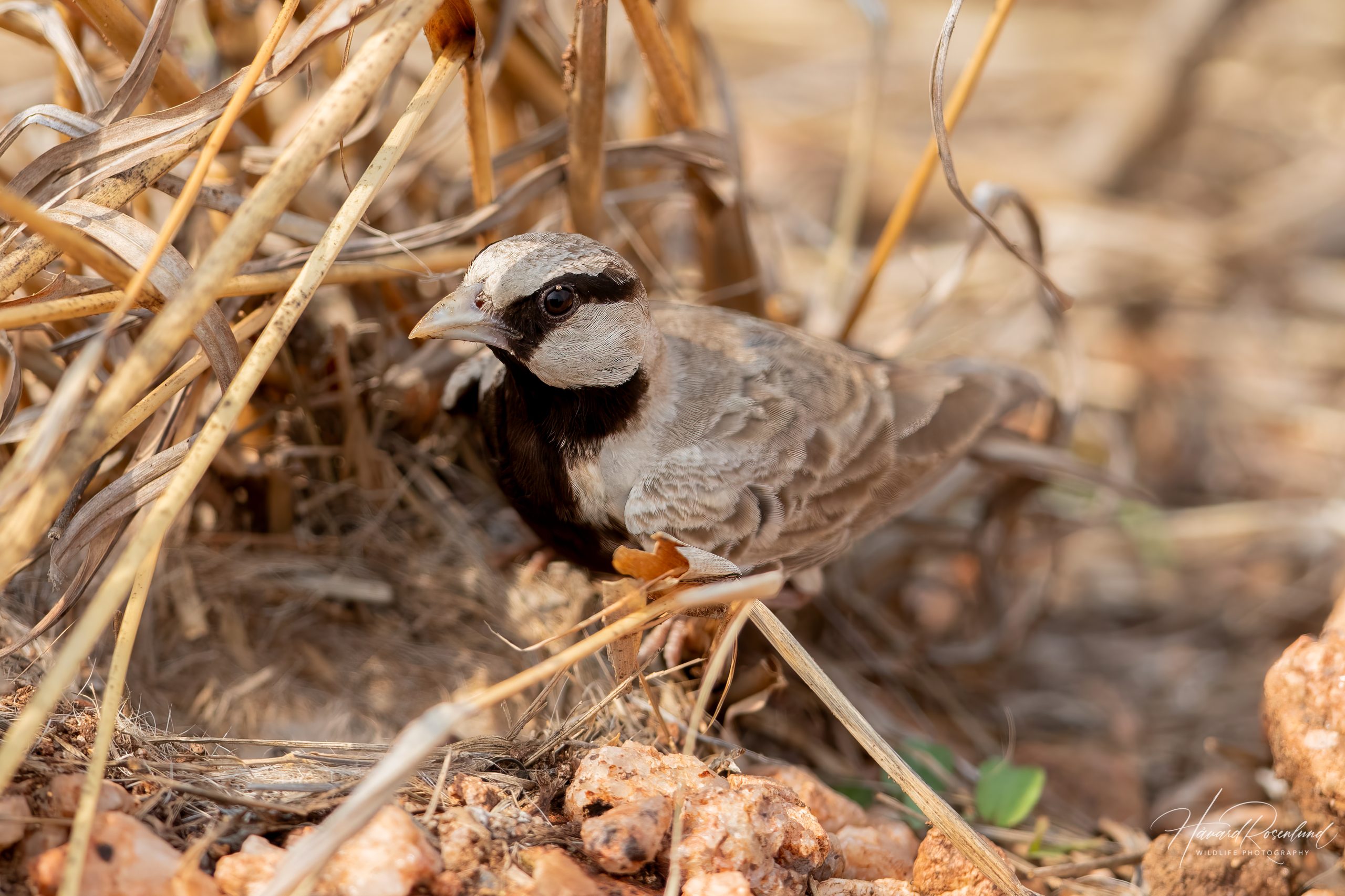
Ashy-crowned Sparrow-Lark
Eremopterix griseus
At a glance
Habitat
- Open dry plains, short grassland, scrub, fallow fields and other sparsely vegetated ground
Diet
- Mainly seeds and grain, supplemented by small insects
Activity
- Diurnal; roosts on the ground at night
Size
- Length: 12–14 cm Weight: about 16 g
Range
- Indian subcontinent from Pakistan across India to Bangladesh and Sri Lanka
Description
The ashy-crowned sparrow-lark (Eremopterix griseus) is a small, stocky lark of the Indian subcontinent. Adults are roughly 12–14 cm long and weigh around 16 g. The sexes look very different: the male has an ashy-grey crown and cheeks contrasting with a black face, throat and underparts, while the female is much plainer and sandy brown.
This strong sexual dimorphism makes the male conspicuous in the breeding season but the female remarkably well camouflaged on dry ground. The short bill, compact body and ground-dwelling habits give the species a sparrow-like appearance despite its place among the larks. Male black-crowned sparrow-larks (Eremopterix nigriceps) are similar, but have a black rather than ashy-grey crown.
Habitat
Ashy-crowned sparrow-larks favour open dry country with patches of bare ground, short grass and sparse scrub. Typical habitats include fallow fields, stubble, dry farmland, sandy river margins, wasteland and other sparsely vegetated plains.
The species is well adapted to hot open environments but generally avoids the most barren interiors of true desert. Its camouflage works best where soil, dry grass and scattered stones create a broken background.
Diet
The birds forage almost entirely on the ground, feeding mainly on grass seeds and fallen grain, supplemented by small insects and other invertebrates.
Foraging birds walk or make short hops across open ground and pick food directly from the surface. Agricultural stubble and fallow fields can provide both seed and insect food where vegetation remains low and open.
Behaviour
The species is usually seen in pairs or small groups and may form larger flocks outside the breeding season. Much of its everyday behaviour takes place on the ground, where birds walk or hop between feeding patches and often remain inconspicuous against dry soil and sparse vegetation.
When disturbed, individuals frequently crouch close to the ground before taking flight. At night they roost on the ground, sometimes in shallow depressions.
Breeding
Breeding is irregular and closely linked to local rainfall. In southern India it may extend from about February to September, while in Sri Lanka breeding is concentrated mainly around May and June. Males perform a striking song flight during courtship: a bird climbs into the air, dives with partly closed wings while giving a long descending whistle, rises again and may repeat the sequence several times before returning to the ground.
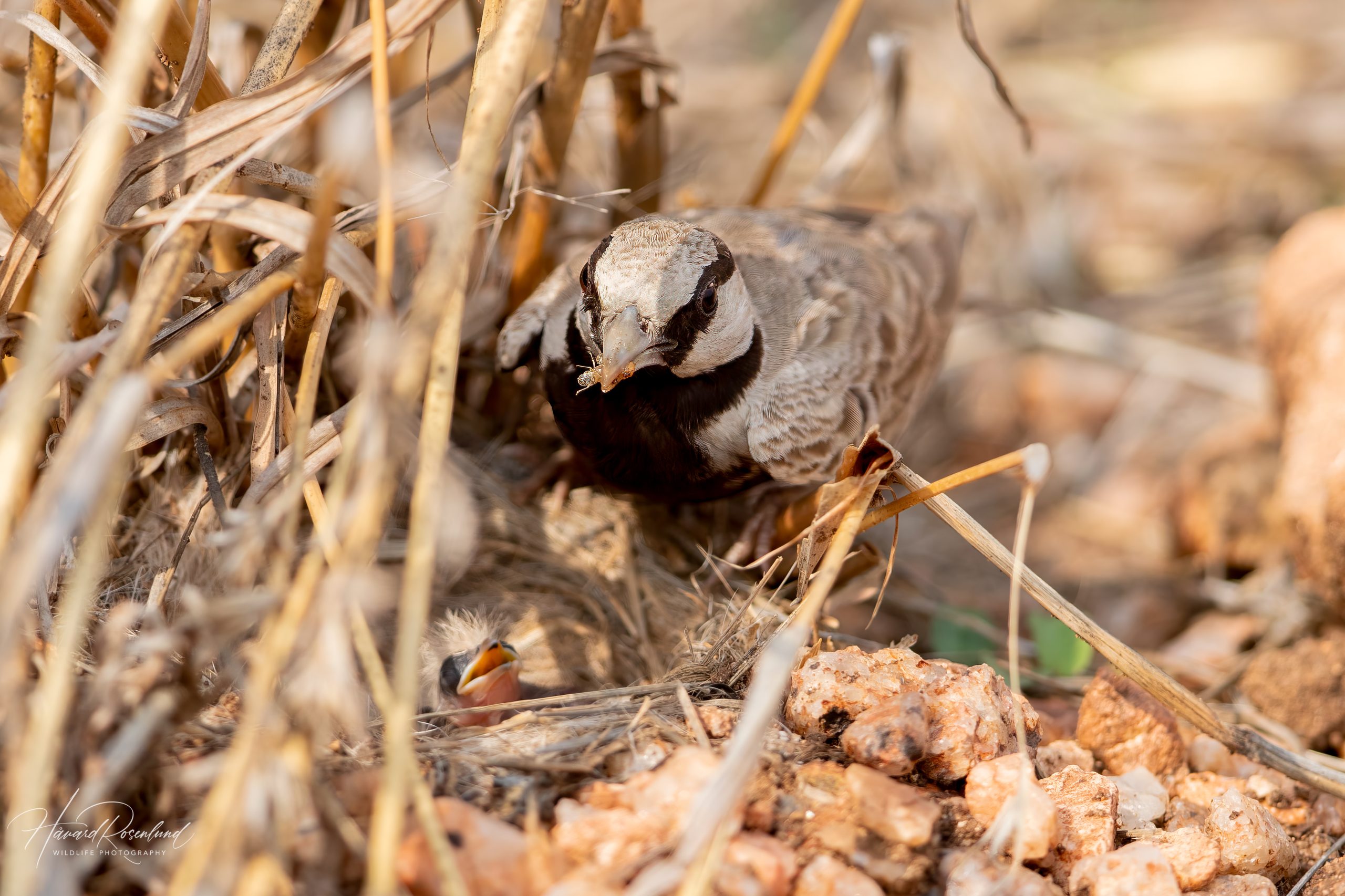
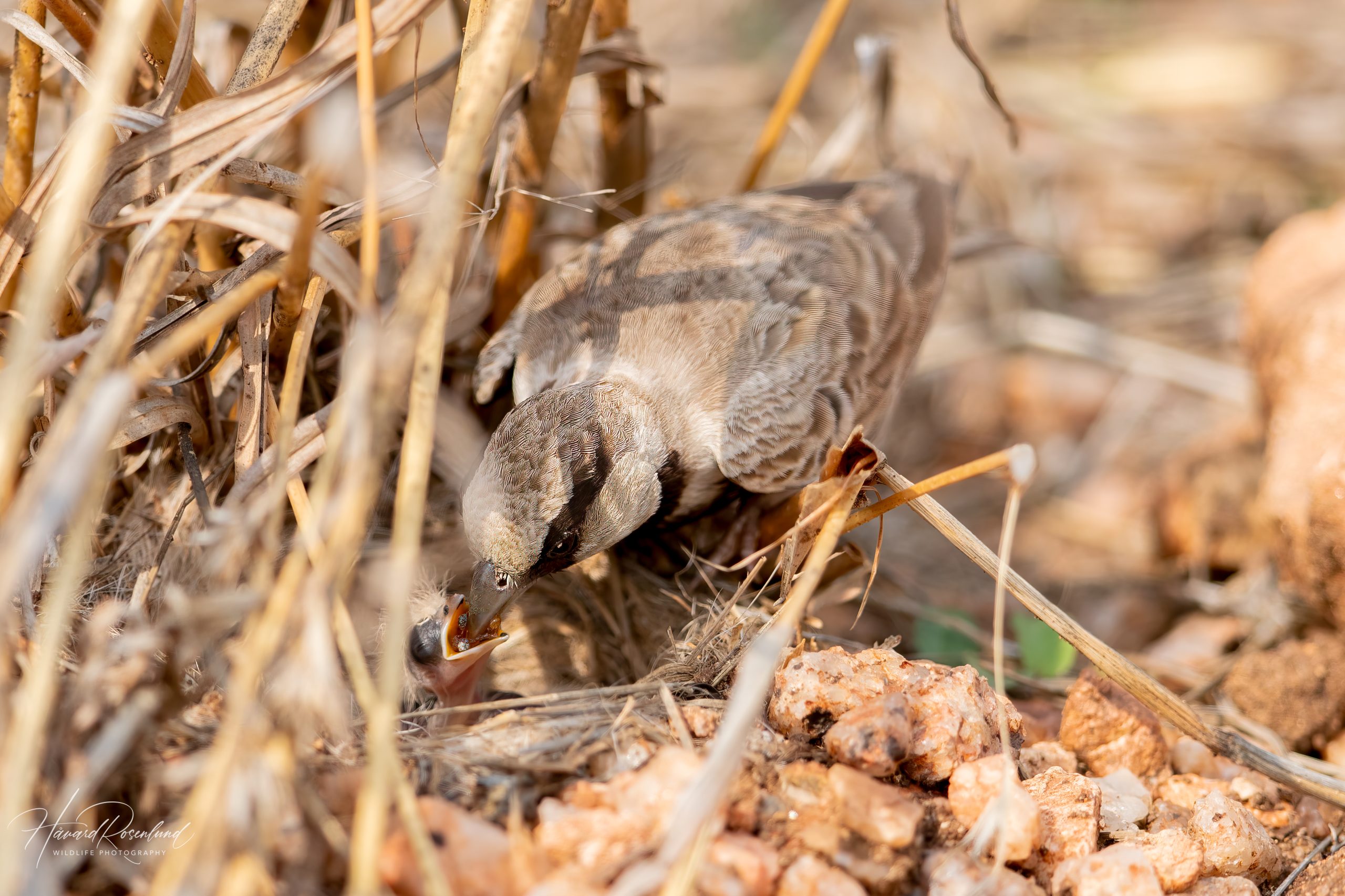
The nest is a small grass-lined depression on the ground, usually placed beside or beneath sparse vegetation where both the nest and incubating bird are well camouflaged. Clutches usually contain two or three eggs. Both sexes incubate, and the eggs hatch after about 13–14 days; both parents feed the young. A study published in 2021 from Kini in Nanded District, Maharashtra, likewise documented both adults taking part in nest construction and parental care.
Status
The ashy-crowned sparrow-lark is classified as least concern on the IUCN Red List and remains widespread across much of the Indian subcontinent.
State of India's Birds 2025 estimates a long-term national decline of about 53.42%, with an uncertainty interval of −59.87 to −45.29%. The recent annual decline is estimated at about 3.23%, with an interval of −3.97 to −2.49%. Both intervals remain below zero, indicating a clear decline in India despite the species' broad distribution.
Image gallery
Loading map and observations…
Have you seen this species?
Independent species archive
Did you find this species page useful?
Wildlife Vagabond is independently built and maintained. Voluntary support helps cover hosting, maps, data storage and continued improvements to the species archive.
Support Wildlife VagabondSpecies content will remain freely available.
References
Information about the species’ global distribution and status is based primarily on global Red List data. See the references below for details.
- AviList. (n.d.). Eremopterix griseus taxonomy. https://explore.avilist.org/
- Balkhande, J. V. (2021). First record of nesting pattern and breeding biology with parental care of Ashy crowned sparrow lark Eremopterix griseus at Kini Tq. Bhokar Dist. Nanded, Maharashtra. International Journal of Life Sciences, 9(1), 129–134. https://ijlsci.in/ls/index.php/home/article/view/567
- BirdLife International. (n.d.). Ashy-crowned Sparrow-Lark species factsheet. https://datazone.birdlife.org/species/factsheet/ashy-crowned-sparrow-lark-eremopterix-griseus
- eBird. (n.d.). Ashy-crowned Sparrow-Lark. Cornell Lab of Ornithology. https://ebird.org/species/acslar1
- International Union for Conservation of Nature. (n.d.). Eremopterix griseus. The IUCN Red List of Threatened Species. https://www.iucnredlist.org/species/22717228/94525125
- State of India's Birds. (2025). 2025 – Ashy-crowned Sparrow Lark. https://stateofindiasbirds.in/species/dl-ascspl1/