
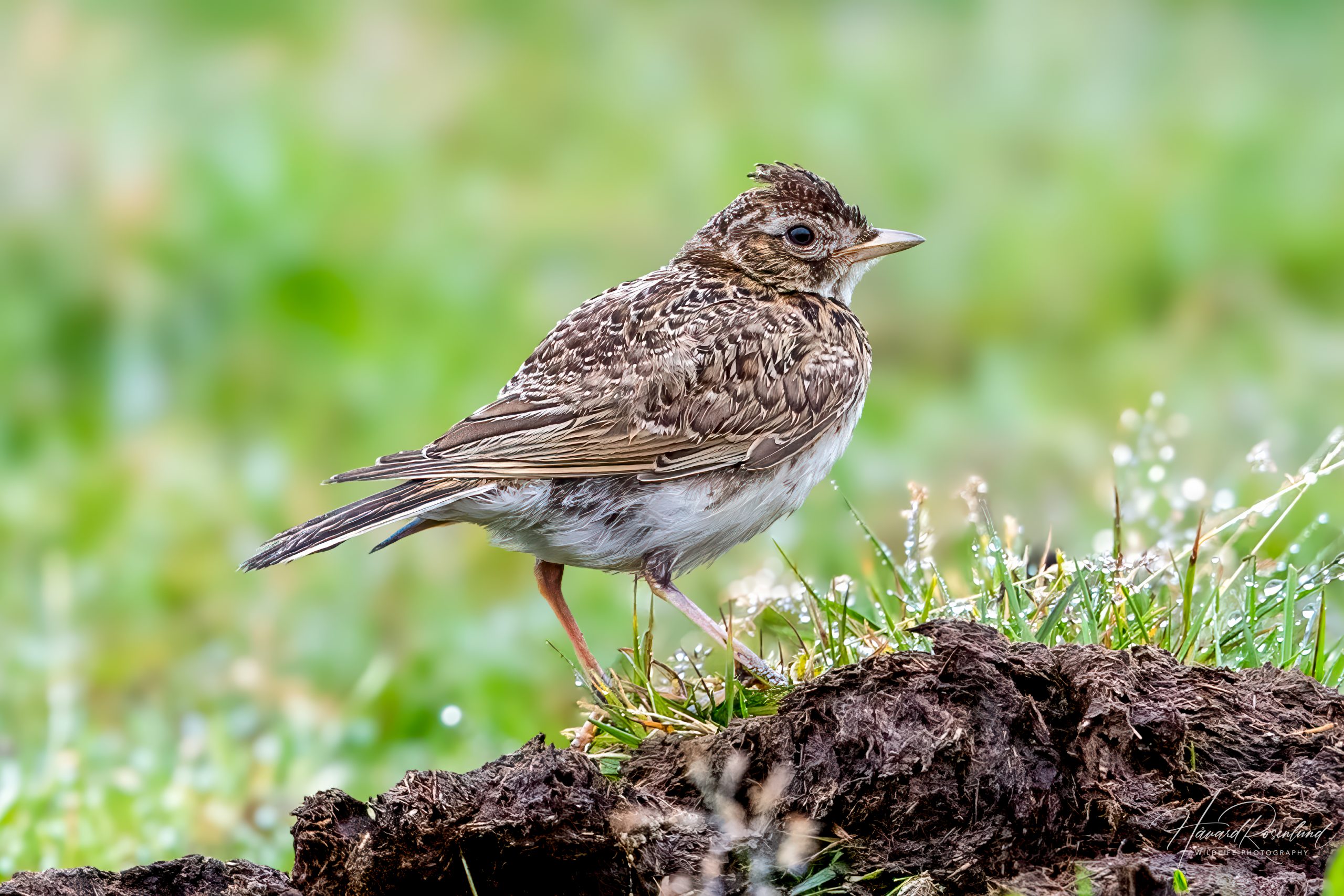
Eurasian Skylark
Alauda arvensis
At a glance
Habitat
- Open farmland, grassland, heath and other treeless landscapes with low or patchy vegetation
Diet
- Seeds and green plant material outside breeding; more insects and other invertebrates during spring and summer
Activity
- Diurnal
Size
- Length: 18–19 cm Weight: 30–45 g
Range
- Breeds across most of Europe and temperate Asia; northern populations move south in winter
Description
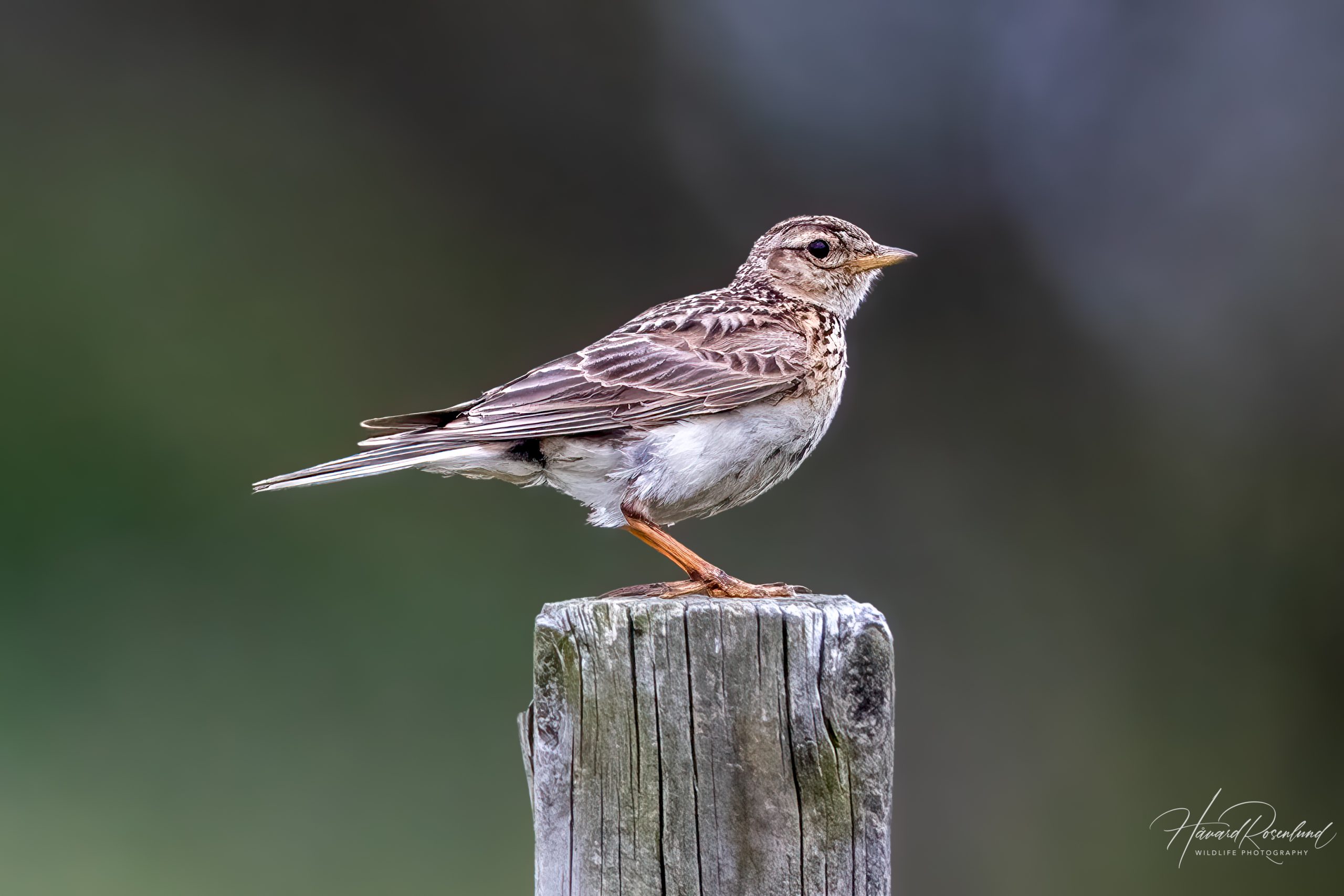
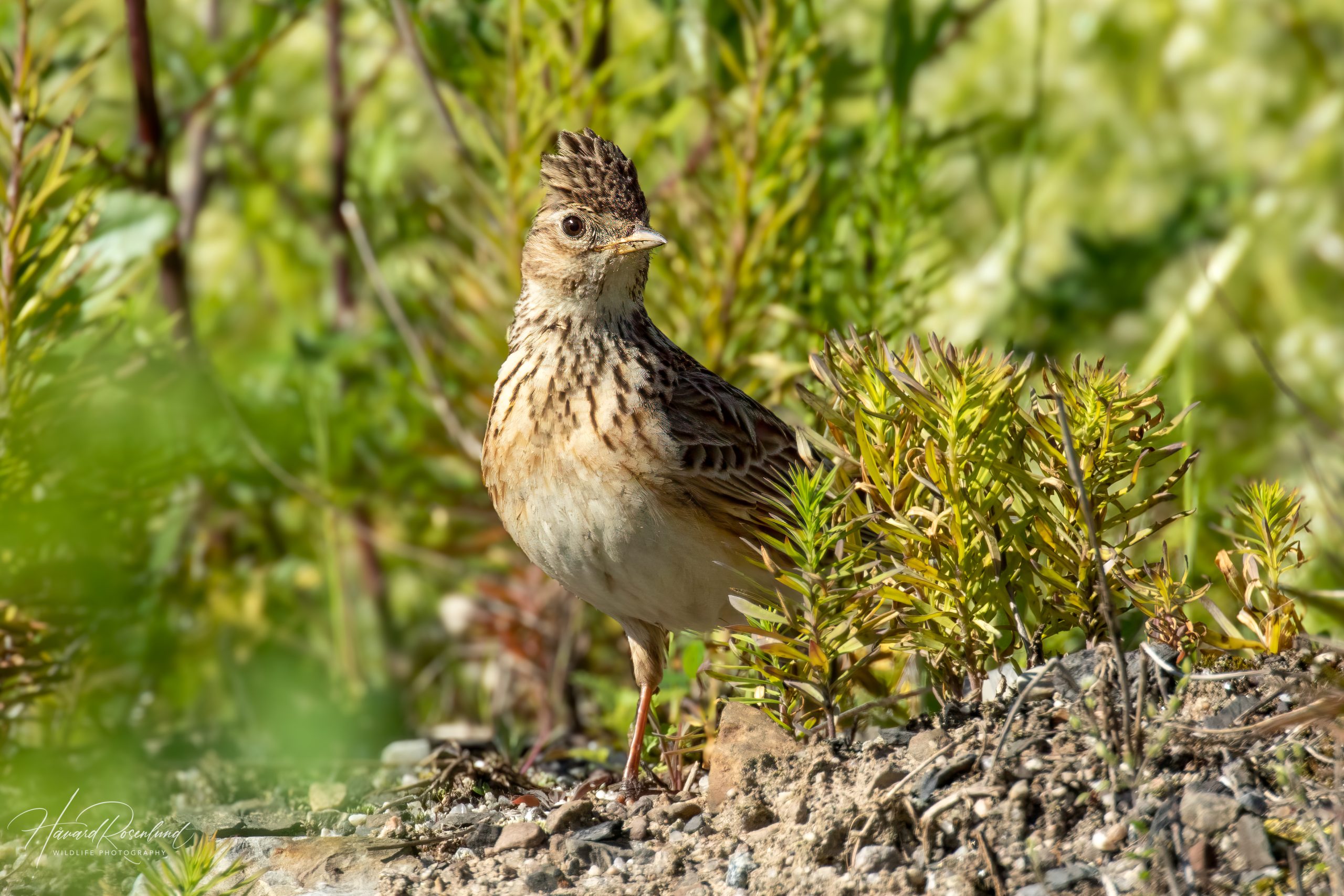
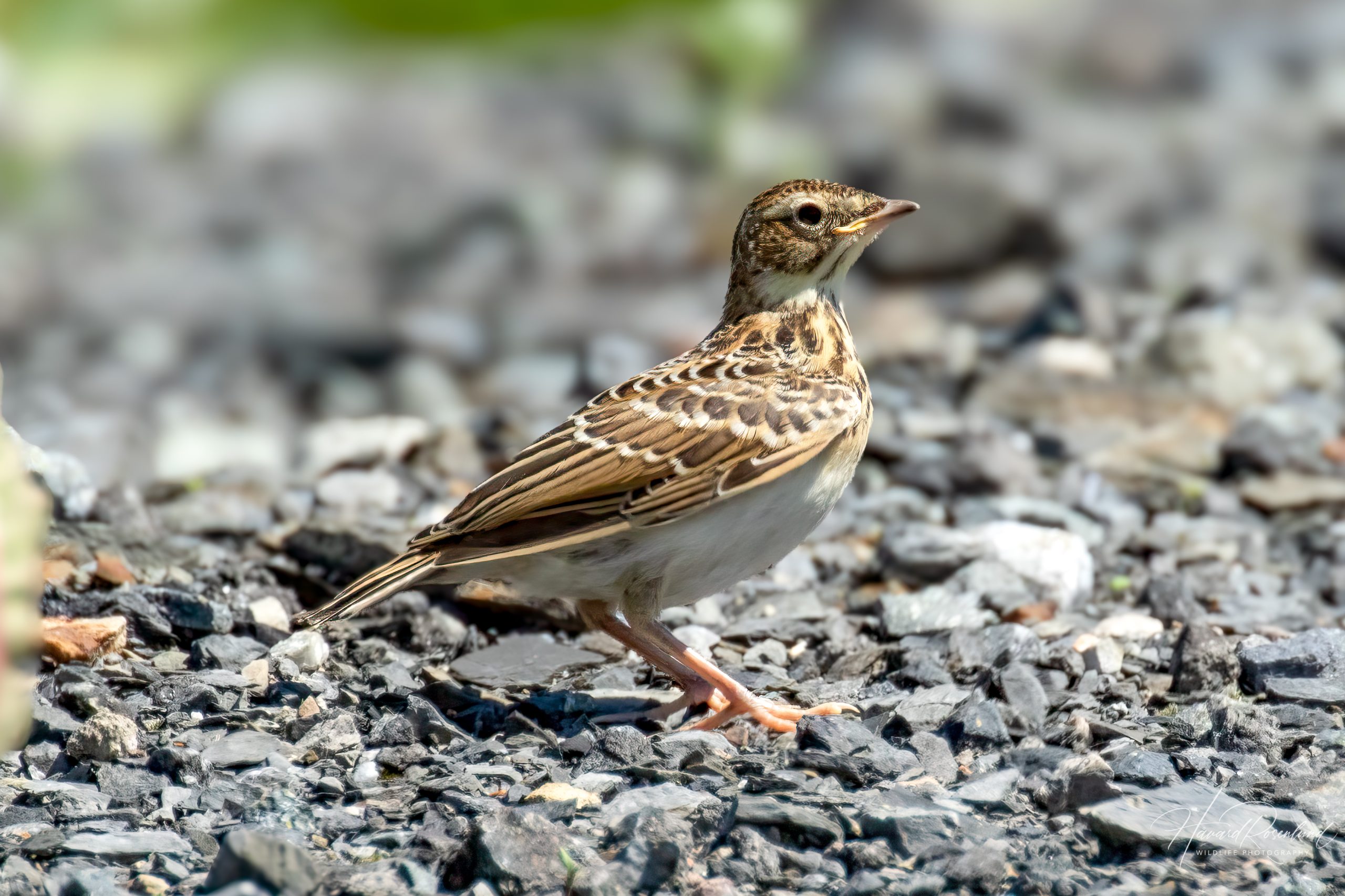
The Eurasian skylark (Alauda arvensis) is a streaked brown lark of open country across Europe and much of temperate Asia. Adults are about 18–19 cm long with a wingspan of roughly 30–36 cm, broad rounded wings, a relatively long tail and a small crest that can be raised. The cryptic plumage is extremely effective on bare soil and among short vegetation, where the species spends most of its time.
The smaller woodlark (Lullula arborea) can be similar, but has a shorter tail, a broader pale supercilium that curves around the rear of the head and a more contrasting black-and-white pattern at the bend of the wing. Skylarks are longer-tailed and usually look more elongated both on the ground and in flight.
Habitat
Skylarks require open landscapes with little vertical structure. They breed in arable fields, pastures, hay meadows, coastal grassland, heath, dunes and other treeless habitats. Vegetation must be tall enough to conceal a ground nest but sufficiently open for the adults to walk and forage efficiently.
A study published in 2022 from heterogeneous farmland in Germany showed how quickly habitat value can change during the breeding season. As winter cereals became too dense, skylarks shifted nesting attempts into crops such as sugar beet and set-aside, and almost all radio-tagged birds continued breeding until at least 1 July. A mixture of crops and open patches can therefore extend the period in which suitable nesting habitat remains available.
Diet
The diet changes strongly with season. Seeds, cereal grain and green plant material are important in autumn and winter, while insects and other invertebrates become much more important during the breeding season. Beetles, caterpillars, spiders and other small arthropods provide protein for growing chicks.
A study published in 2001 on 18 farms in southern England found that wintering skylarks strongly selected cereal stubbles, where grain formed an important part of the diet. Stubble fields used by skylarks also held more available seed than unused fields. During breeding, invertebrates become much more important, and field margins and other less intensively managed patches can provide useful feeding areas.
Behaviour
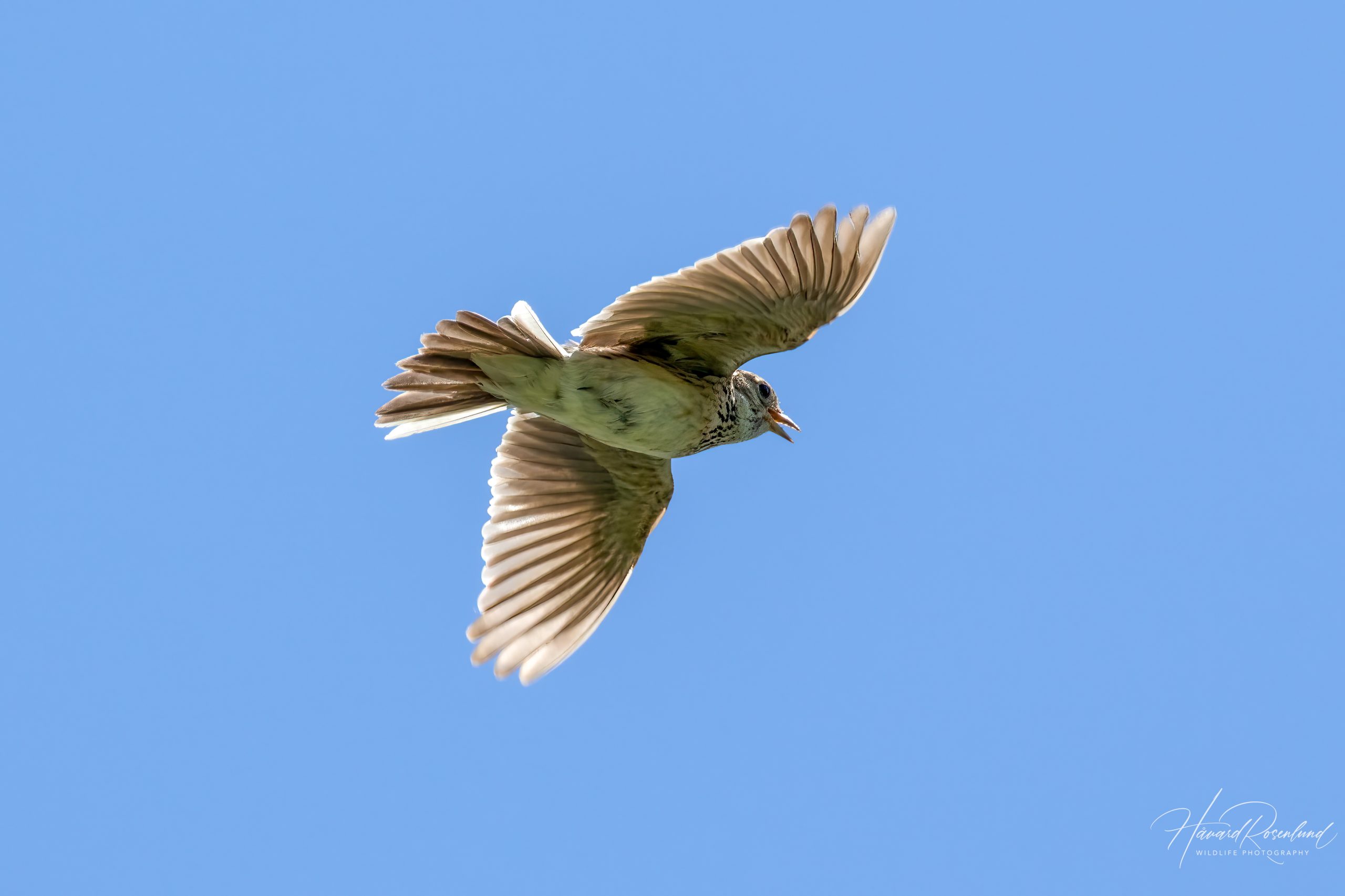
Males establish breeding territories and mark them with the species' famous song flight. A bird rises steeply while singing and may remain about 50–100 metres above the ground before gradually descending. The rapid, continuous song of trills and varied phrases can last for many minutes; because the species spends most of its time on the ground, the aerial display allows a male to signal across an open landscape without needing tall song posts.
Two studies published in 2008 showed that the song also carries information about who belongs to the local neighbourhood. Males on adjoining territories shared characteristic sequences of syllables that formed a local group signature and allowed neighbours to be distinguished from strangers. Playback experiments also found that tolerance of neighbours was strongest in the middle of the breeding season, when territory boundaries were stable, but weaker during settlement early in the season and again late in the season as young birds became independent.
Social behaviour
Outside the breeding season skylarks become much more social and can form sizeable flocks on farmland, saltmarshes and coastal grasslands. Flocking helps birds exploit scattered food patches and may improve predator detection in the open landscapes they favour.
Migration
The Eurasian skylark is a partial migrant. Birds breeding in western and southern parts of Europe may remain resident or move only short distances, while northern and eastern populations migrate south and west when winter weather makes the ground inaccessible. Scandinavian and Russian birds contribute to wintering populations in western and southern Europe, and some continue to North Africa.
Movements are flexible and strongly influenced by snow cover and frost. Mild winters can allow birds to remain much farther north, while severe weather can trigger conspicuous cold-weather movements. Return to northern breeding areas begins early in spring as open ground becomes available.
Breeding
The nest is a shallow cup on the ground, usually placed beside or within a tuft of vegetation. The female builds the nest and incubates a typical clutch of three or four eggs for about 12–14 days. Both parents feed the chicks, which leave the nest before they are strong fliers and continue to be cared for nearby.
A study published in 2002 of 995 nests on farmland in southern England found predation to be the most common cause of nest failure, while trampling and agricultural operations were equally important in grassland. Nests in cereals were about twice as likely to succeed as nests in grass or set-aside. A six-year Dutch study published in 2015 likewise found strong effects of breeding crop: nest survival was lowest in grassland because of frequent silage cutting, and chicks in cereals had lower body weight than chicks in grassland and lucerne. Field-margin availability alone did not improve nest survival or nestling weight.
Status
The Eurasian skylark is classified as least concern on the IUCN Red List and remains extremely widespread and numerous. Nevertheless, the species has undergone major long-term declines across much of western Europe, especially in intensively farmed landscapes.
Changes from spring- to autumn-sown cereals, fewer winter stubbles, denser crops, pesticide use and reduced habitat diversity can affect both breeding opportunities and food supply. The strongest declines are concentrated in intensively farmed regions.
Image gallery
Loading map and observations…
Have you seen this species?
Independent species archive
Did you find this species page useful?
Wildlife Vagabond is independently built and maintained. Voluntary support helps cover hosting, maps, data storage and continued improvements to the species archive.
Support Wildlife VagabondSpecies content will remain freely available.
References
Information about the species’ global distribution and status is based primarily on global Red List data. See the references below for details.
- BirdLife International. (n.d.). Eurasian Skylark species factsheet. https://datazone.birdlife.org/species/factsheet/eurasian-skylark-alauda-arvensis
- Briefer, E., Aubin, T., Lehongre, K., & Rybak, F. (2008). How to identify dear enemies: the group signature in the complex song of the skylark Alauda arvensis. Journal of Experimental Biology, 211(3), 317–326. https://doi.org/10.1242/jeb.013359
- Briefer, E., Rybak, F., & Aubin, T. (2008). When to be a dear enemy: flexible acoustic relationships of neighbouring skylarks, Alauda arvensis. Animal Behaviour, 76(4), 1319-1325. https://doi.org/10.1016/j.anbehav.2008.06.017
- British Trust for Ornithology. (n.d.). BirdFacts – Skylark. https://www.bto.org/learn/about-birds/birdfacts/skylark
- Donald, P., Buckingham, D., Moorcroft, D., Muirhead, L., Evans, A., & Kirby, W. (2001). Habitat use and diet of skylarks Alauda arvensis wintering on lowland farmland in southern Britain. Journal of Applied Ecology, 38(3), 536-547. https://doi.org/10.1046/j.1365-2664.2001.00618.x
- Donald, P. F., Evans, A. D., Muirhead, L. B., Buckingham, D. L., Kirby, W. B., & Schmitt, S. I. A. (2002). Survival rates, causes of failure and productivity of Skylark Alauda arvensis nests on lowland farmland. Ibis, 144(4), 652-664. https://doi.org/10.1046/j.1474-919X.2002.00101.x
- International Union for Conservation of Nature. (n.d.). Eurasian Skylark. The IUCN Red List of Threatened Species. https://www.iucnredlist.org/species/102998555/132039889
- Kuiper, M. W., Ottens, H. J., van Ruijven, J., Koks, B. J., de Snoo, G. R., & Berendse, F. (2015). Effects of breeding habitat and field margins on the reproductive performance of Skylarks (Alauda arvensis) on intensive farmland. Journal of Ornithology, 156(3), 557-568. https://doi.org/10.1007/s10336-015-1159-8
- Püttmanns, M., Lehmann, F., Willert, F., Heinz, J., Kieburg, A., Filla, T., Balkenhol, N., Waltert, M., & Gottschalk, E. (2022). No seasonal curtailment of the Eurasian Skylark's (Alauda arvensis) breeding season in German heterogeneous farmland. Ecology and Evolution, 12(9), e9267. https://doi.org/10.1002/ece3.9267