
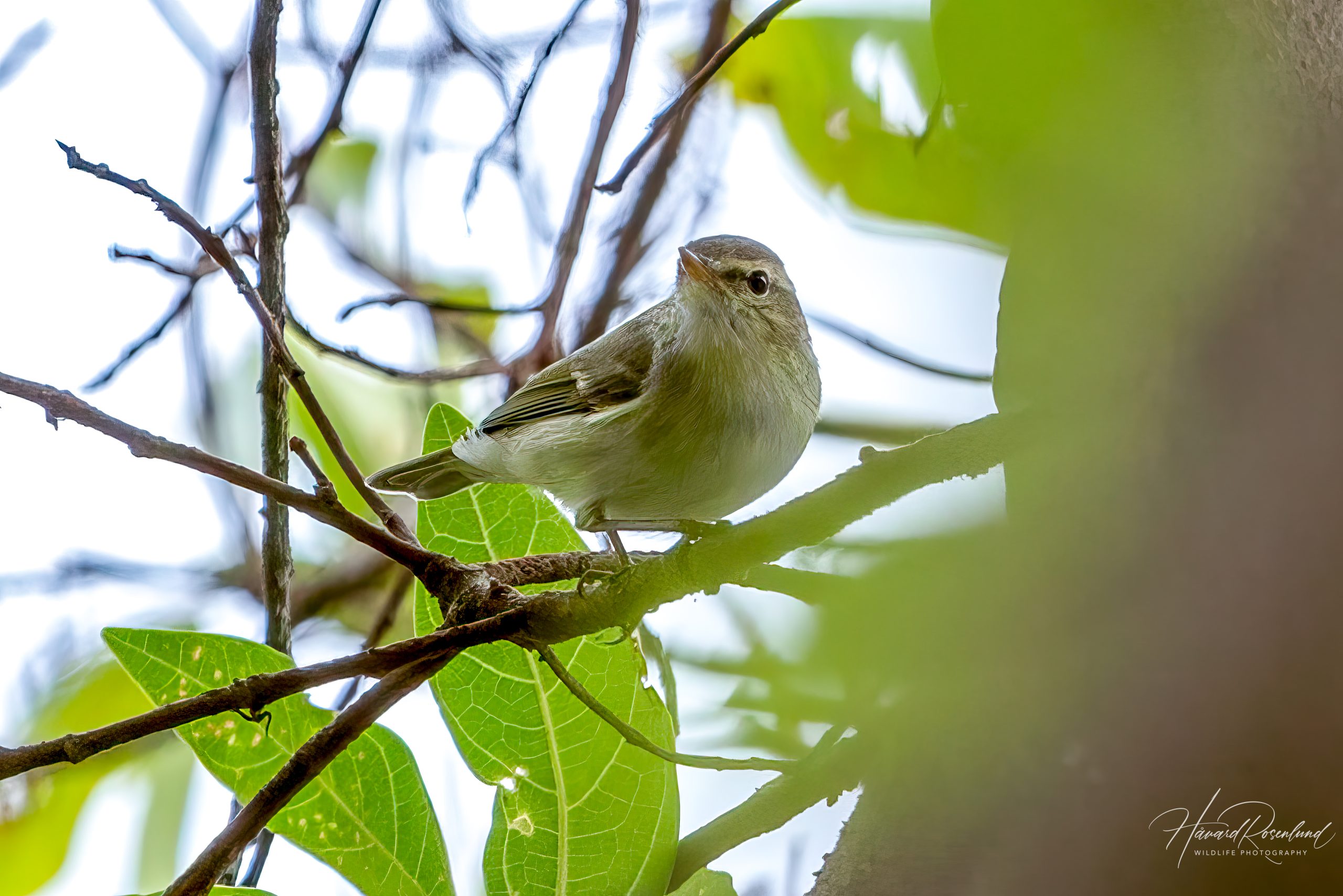
Greenish Warbler
Phylloscopus trochiloides
At a glance
Habitat
- Temperate and montane forest, woodland, forest edges and scrub; woodland and plantations are widely used in winter
Diet
- Mostly insects, spiders and other small invertebrates taken from foliage or caught in short aerial sallies
Activity
- Diurnal
Size
- Length: 10–11 cm Weight: about 7.5 g
Range
- Breeds from north-eastern Europe through Russia and Central Asia to the Himalayas; winters mainly across the Indian subcontinent and nearby South Asia
Description
The greenish warbler (Phylloscopus trochiloides) is a small leaf warbler, usually about 10–11 cm long and weighing around 7.5 g. It has olive-green to grey-green upperparts, pale underparts, a long pale eyebrow and usually one distinct pale wing-bar. The fine bill and active, lightweight build suit a bird that spends much of its time searching foliage for small prey.
The species varies geographically, and four subspecies are recognised in current major checklists. Differences in plumage are often subtle, while song varies much more strongly between populations. These vocal differences have played an important role in understanding the evolutionary history of the wider greenish warbler complex.
Arctic warbler (Phylloscopus borealis) can look similar and also shows a wing-bar, but it is generally larger and more robust, with a longer, deeper-based bill. Greenish warbler is more delicate and usually shows a single narrow wing-bar and a broad supercilium that reaches the bill base.
Evolution
The greenish warbler complex became one of the most famous examples used to explain a ring species. In a ring species, neighbouring populations spread around a geographical barrier and continue to interbreed with nearby populations, while the populations at the two ends can become so different that they meet again without freely interbreeding.
A landmark study published in 2001 reconstructed such a pattern around the Tibetan Plateau. The western and eastern population chains had diverged gradually in song and genetics, while the two northern forms meeting in central Siberia were reproductively isolated and did not recognise each other's songs in playback experiments.
Later work showed that the history was more complicated than a perfectly continuous ring. A genome-wide study published in 2014 found historical breaks in gene flow at several points, together with later hybridisation, including limited introgression between the northern forms. A 2017 analysis added evidence that populations had occupied several geographically isolated refuges during the ice ages of the Late Pleistocene and argued that the complex should not be treated as a simple example of speciation produced only by continuous isolation by distance. The greenish warblers therefore remain a particularly valuable example of how geographical isolation, gradual divergence, gene flow and renewed contact can interact during speciation, even though the classic ring-species model is now regarded as too simple.
Habitat
Greenish warblers breed in a range of wooded habitats, from deciduous and mixed forest to mountain woodland, forest edges and scrub. In the Himalayas and other highland regions they may breed in relatively cool forest well above the lowlands.
During migration and winter they use woodland, wooded gardens, plantations, scrub and other areas with enough foliage for active insect hunting.
Diet
The diet consists mainly of small insects, spiders and other invertebrates. Birds search rapidly through leaves and fine branches, picking prey directly from vegetation and probing into clusters of foliage.
They also hover briefly to reach prey from the underside of leaves and make short flights after insects in the air. This flexible feeding style allows them to exploit several layers of foliage while moving continuously through trees and shrubs.
Behaviour
Greenish warblers are active, restless birds that move almost continuously through foliage and fine branches. Even when present in good numbers they can be difficult to watch for long because they rarely remain on one exposed perch and often disappear quickly back into leaves and shrubs.
Males use song to mark and defend territories. The song varies conspicuously among populations, and these differences are an important part of the behavioural divergence described in the species’ evolutionary history.
Migration
The greenish warbler is a long-distance migrant. Northern and western breeding populations leave Eurasian breeding areas after summer and travel south to winter mainly on the Indian subcontinent and adjoining parts of South and Southeast Asia. Birds return north in spring to breed.
Migration connects very different ecological regions, from cool temperate and mountain forests to tropical and subtropical wintering habitats. The western edge of the regular breeding range reaches Fennoscandia, with established populations in Finland and Sweden. A few birds also reach Norway each year; Artsdatabanken reports 1–5 singing individuals annually, but there is no established breeding population there.
Breeding
Breeding generally begins in late spring or early summer. The female builds a covered nest on or very close to the ground, usually concealed among low vegetation, moss, roots, stones or other cover. A typical clutch contains four to six eggs.
The female performs the incubation, which lasts about 12–13 days. Both parents feed the nestlings, and the young usually leave the nest after roughly 12–14 days. Timing varies across the enormous breeding range, especially with latitude and elevation.
Status
The greenish warbler is classified as least concern on the IUCN Red List and remains widespread across Eurasia and South Asia.
Image gallery
Loading map and observations…
Have you seen this species?
Independent species archive
Did you find this species page useful?
Wildlife Vagabond is independently built and maintained. Voluntary support helps cover hosting, maps, data storage and continued improvements to the species archive.
Support Wildlife VagabondSpecies content will remain freely available.
References
Information about the species’ global distribution and status is based primarily on global Red List data. See the references below for details.
- Alcaide, M., Scordato, E. S. C., Price, T. D., & Irwin, D. E. (2014). Genomic divergence in a ring species complex. Nature, 511(7507), 83-85. https://doi.org/10.1038/nature13285
- BirdGuides. (n.d.). Greenish Warbler or Arctic Warbler identification. https://www.birdguides.com/articles/species-profiles/focus-on-greenish-warbler-or-arctic-warbler/
- BirdLife International. (n.d.). Greenish Warbler species factsheet. https://datazone.birdlife.org/species/factsheet/greenish-warbler-phylloscopus-trochiloides
- British Trust for Ornithology. (n.d.). BirdFacts – Greenish Warbler. https://www.bto.org/learn/about-birds/birdfacts/greenish-warbler
- Clement, P. (2020). Greenish Warbler (Phylloscopus trochiloides). In Birds of the World. Cornell Lab of Ornithology. https://doi.org/10.2173/bow.grewar3.01
- International Union for Conservation of Nature. (n.d.). Greenish Warbler. The IUCN Red List of Threatened Species. https://www.iucnredlist.org/species/103845399/119302608
- Irwin, D. E., Bensch, S., & Price, T. D. (2001). Speciation in a ring. Nature, 409(6818), 333-337. https://doi.org/10.1038/35053059
- Peterson, A. T., & Anamza, T. (2017). Reexamining Phylloscopus trochiloides complex as a ring species: a refugial counter‐hypothesis. Journal of Avian Biology, 48(12), 1608-1613. https://doi.org/10.1111/jav.01167
- State of India's Birds. (2025). State of India’s Birds 2025 – Greenish Warbler. https://stateofindiasbirds.in/species/grewar3/