
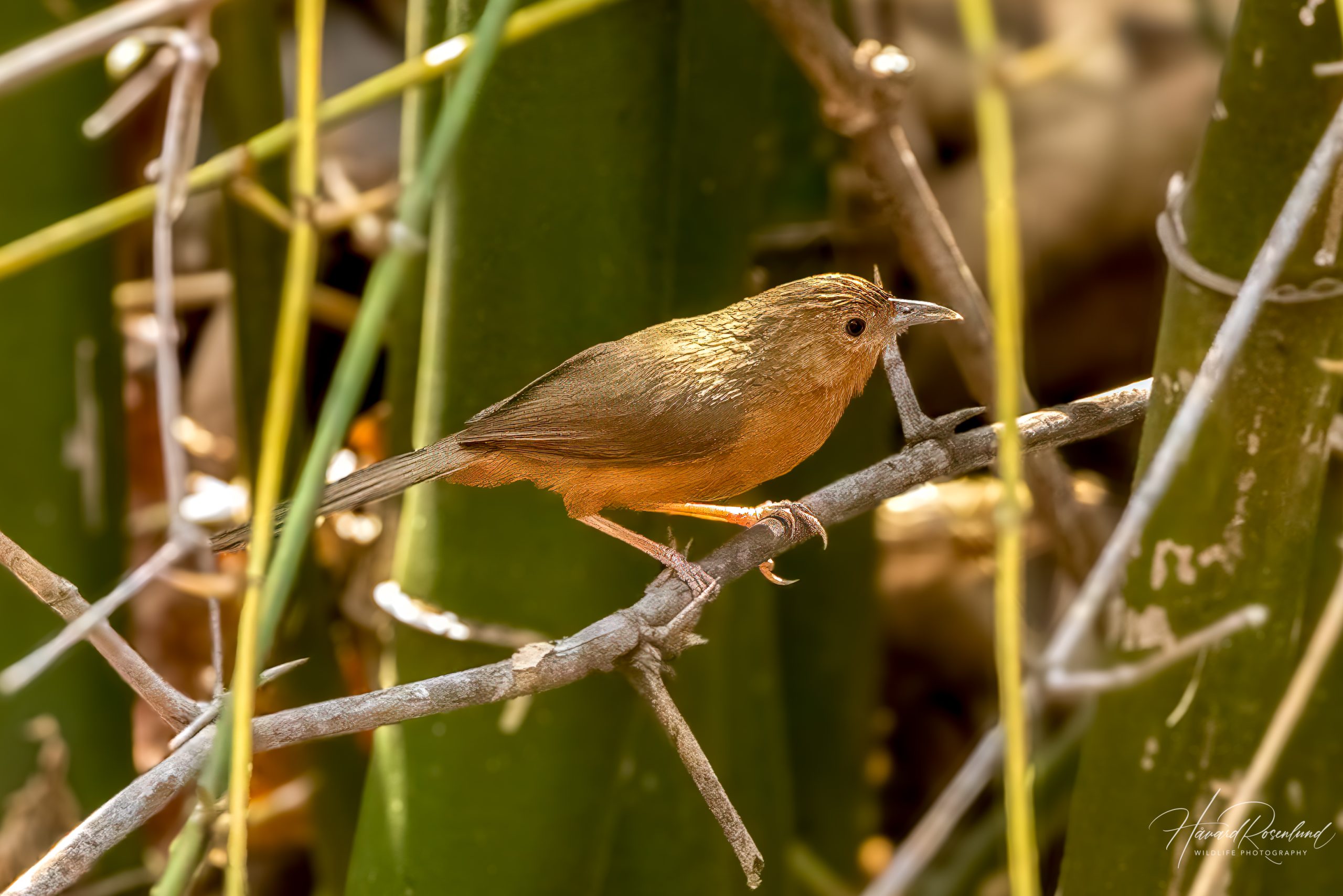
Tawny-bellied Babbler
Dumetia hyperythra
At a glance
Habitat
- Dense scrub, tall grass, bamboo, forest edges and overgrown agricultural land
Diet
- Mainly insects and other small invertebrates; also nectar and some plant food
Activity
- Diurnal
Size
- Length: 13–15 cm Weight: 12–15 g
Range
- Indian subcontinent, from Nepal through India to Sri Lanka
Description
The tawny-bellied babbler (Dumetia hyperythra) is a small, short-winged babbler of the Indian subcontinent, measuring about 13–15 cm and weighing roughly 12–15 g. It occurs from Nepal through much of India to Sri Lanka.
Plumage varies geographically. The tawny-bellied forms of much of India have warm rufous to tawny underparts and olive-brown upperparts, whereas birds in parts of western India and Sri Lanka have paler underparts and a conspicuous white throat. The 2024 Clements checklist recognised two groups within the species: the Tawny-bellied group (hyperythra) and the White-throated group (albogularis/phillipsi). They remain treated as a single species, D. hyperythra. The rounded wings and rather weak flight are well suited to a bird that moves mainly short distances through dense low cover.
Habitat
Tawny-bellied babblers inhabit dense scrub, tall grass, bamboo, forest edges, secondary growth and overgrown agricultural land. They normally remain close to the ground and favour tangled vegetation that provides continuous cover for feeding, movement and escape from predators.
The species forages mainly in the understory and close to the ground, where dense vegetation provides both feeding cover and shelter. It can use human-modified landscapes when enough scrub and tall vegetation remain, but clearing or repeatedly cutting low cover can make otherwise suitable areas unusable. Because the birds are resident and reluctant to cross large open spaces, connected patches of vegetation are especially valuable.
Diet
The diet consists mainly of insects and other small invertebrates, including larvae collected from leaves, stems, leaf litter and the ground. Birds forage by hopping and climbing through low vegetation, inspecting tangled plant material and occasionally descending into litter beneath shrubs.
Nectar from flowers is also taken, so the diet is not entirely insect-based.
Behaviour
Tawny-bellied babblers are usually encountered in pairs or small, loose groups that move together through dense low cover. They are often easier to hear than to see: soft, sharp contact calls help birds keep track of one another while hidden in vegetation, while alarm produces louder, more agitated calling and rapid movement deeper into cover.
Most locomotion consists of short hops, scrambling through stems and brief low flights between neighbouring patches. The birds are active and restless while foraging but reluctant to cross broad open ground. They are resident throughout the range, so even relatively small scrub and grass patches can become important daily refuges in fragmented landscapes.
Breeding
Breeding is closely associated with the rainy season and varies geographically, commonly extending from late spring into early autumn. The nest is a compact ball or dome of grass, bamboo leaves and other plant material, with an entrance at the side, and is concealed low in dense vegetation. Clutches usually contain three or four pinkish-white eggs speckled or blotched reddish to dark brown.
A breeding note published in 2009 followed a nest in Vadodara, Gujarat, during 2003. The nest contained four eggs, both adults took turns incubating and the incubation period lasted 12 days. Of the chicks that remained, two had left the nest nine days after hatching. Because this comes from one closely followed nest, broader species-specific figures for incubation and fledging remain limited.
Status
The tawny-bellied babbler is classified as least concern on the IUCN Red List. It has a broad distribution across the Indian subcontinent and can persist in some disturbed and agricultural landscapes where dense low vegetation remains.
The global population trend is considered decreasing. Loss and fragmentation of scrub, grass and secondary vegetation can remove the low, tangled cover used for feeding, nesting, movement and concealment. Local populations can therefore decline when dense low vegetation is repeatedly cleared.
Image gallery
Loading map and observations…
Have you seen this species?
Independent species archive
Did you find this species page useful?
Wildlife Vagabond is independently built and maintained. Voluntary support helps cover hosting, maps, data storage and continued improvements to the species archive.
Support Wildlife VagabondSpecies content will remain freely available.
References
Information about the species’ global distribution and status is based primarily on global Red List data. See the references below for details.
- Avibase. (n.d.). Dumetia hyperythra. https://avibase.bsc-eoc.org/species.jsp?avibaseid=DC4FBF45FE6A8CF8
- BirdLife International. (n.d.). Tawny-bellied Babbler (Dumetia hyperythra) species factsheet. https://datazone.birdlife.org/species/factsheet/tawny-bellied-babbler-dumetia-hyperythra
- Cornell Lab of Ornithology. (2024). Clements Checklist updates: new groups in Tawny-bellied Babbler. https://www.birds.cornell.edu/clementschecklist/updates-and-corrections-october-2024/
- eBird. (n.d.). Tawny-bellied Babbler. Cornell Lab of Ornithology. https://ebird.org/species/tabbab1
- Indian Biodiversity Portal. (n.d.). AVIS-IBIS – Dumetia hyperythra species account. https://indianbiodiversity.org/books/dumetia-hyperythra/45908
- International Union for Conservation of Nature. (n.d.). Dumetia hyperythra. The IUCN Red List of Threatened Species. https://www.iucnredlist.org/species/22716286/111106389
- Oiseaux.net. (n.d.). Tawny-bellied Babbler. https://www.oiseaux.net/en/tawny-bellied.babbler.html
- Vyas. (2009). Breeding notes on the Rufous-bellied Babbler Dumetia hyperythra. Indian Birds, 4(3), 114–115. https://indianbirds.in/pdfs/IB4.3_Vyas_RufousbelliedBabbler.pdf