
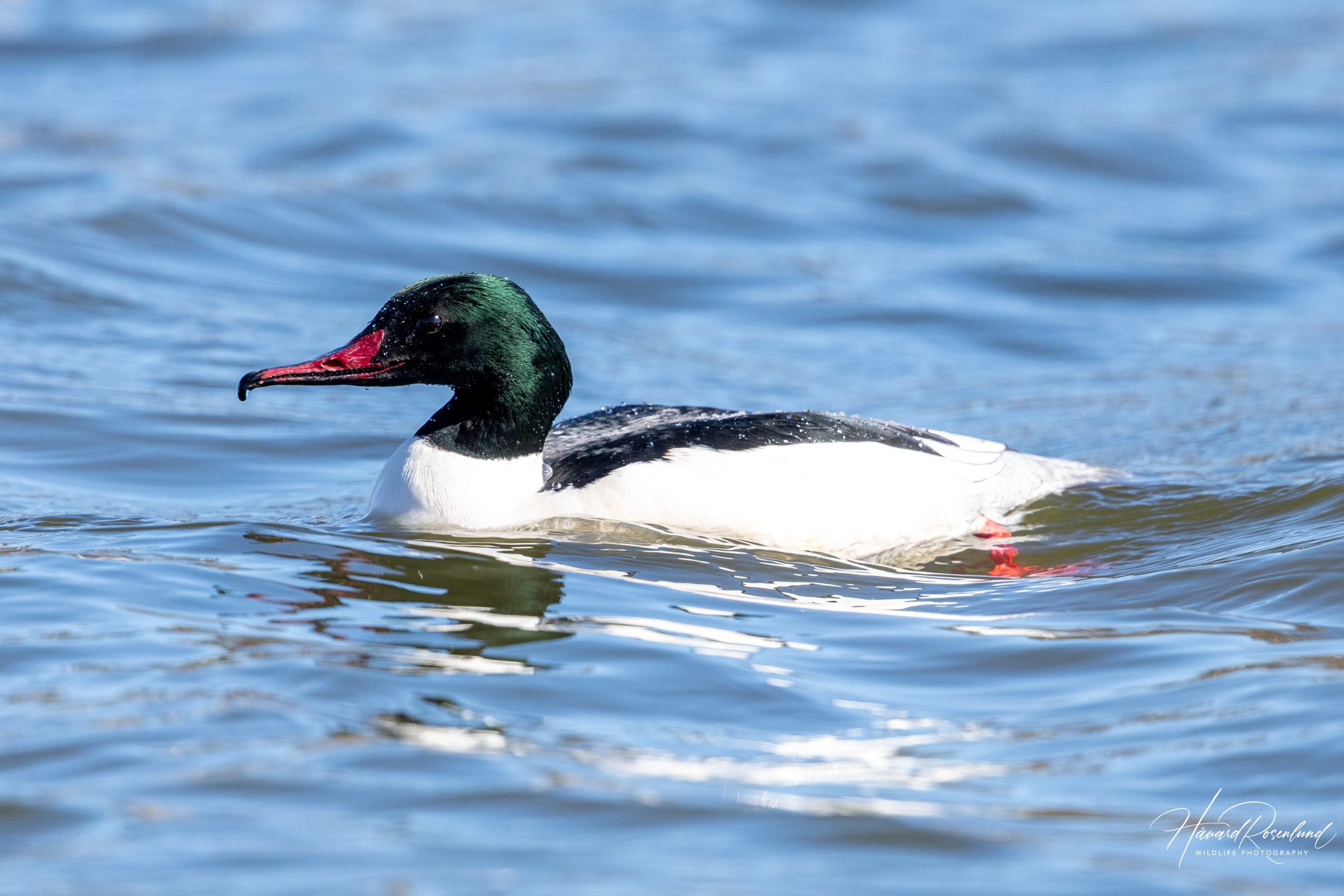
Common Merganser
Mergus merganser
At a glance
Habitat
- Clear rivers, lakes and reservoirs, often with mature trees or rocky cavities nearby for nesting; also ice-free estuaries and sheltered coasts in winter.
Diet
- Primarily fish, supplemented by aquatic insects, crustaceans, molluscs and occasionally amphibians.
Activity
- Diurnal; hunts actively underwater by sight.
Size
- Length: 58–72 cm; wingspan 78–97 cm Weight: 0.9–2.1 kg
Range
- Northern Europe and Asia and much of North America; northern breeders move south or to ice-free waters in winter.
Description
The common merganser (Mergus merganser), also known as the goosander in Europe, is a large fish-eating duck found across much of the Northern Hemisphere. Adults are about 58–72 cm long, have a wingspan of roughly 78–97 cm and typically weigh 0.9–2.1 kg, with males generally larger than females.
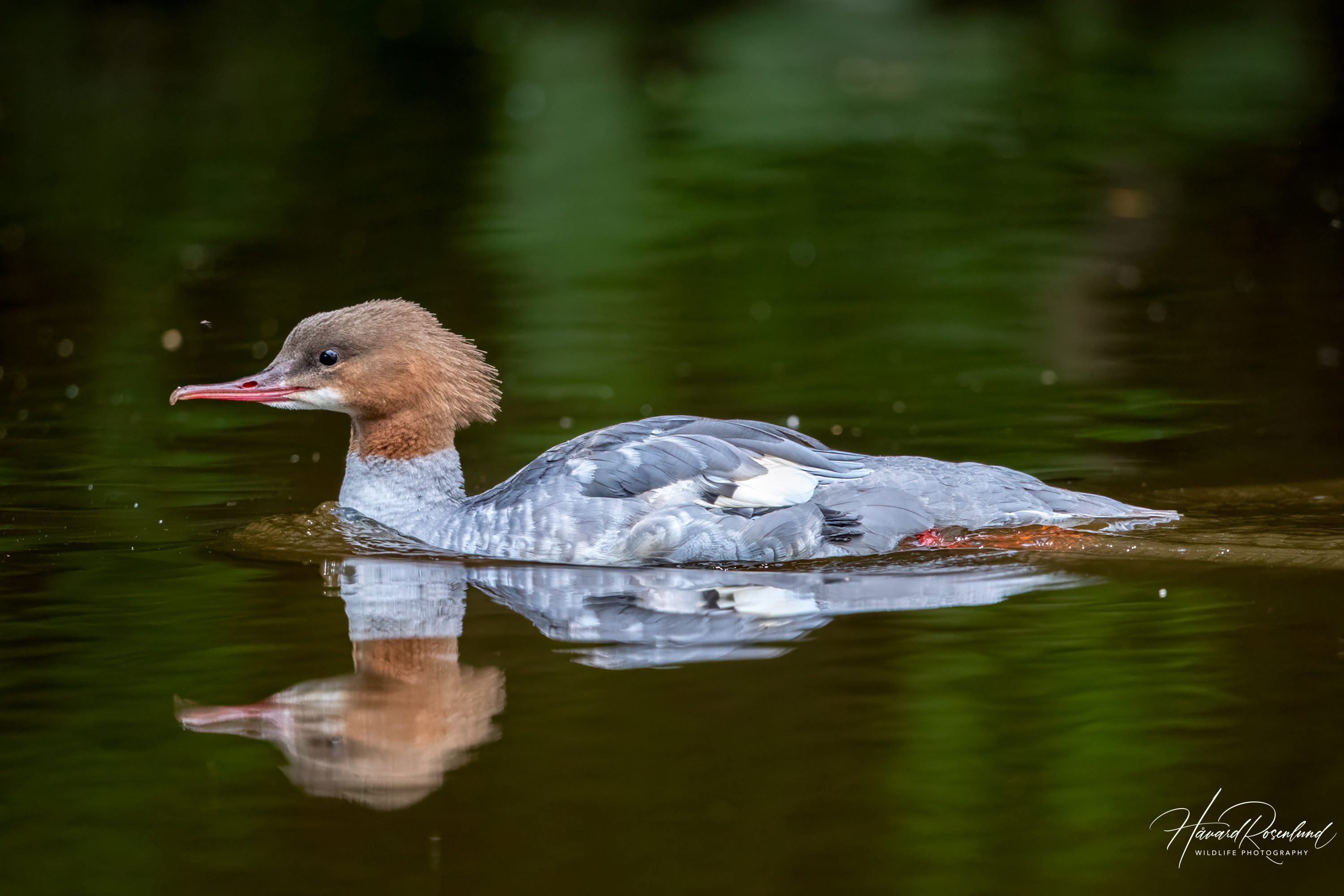
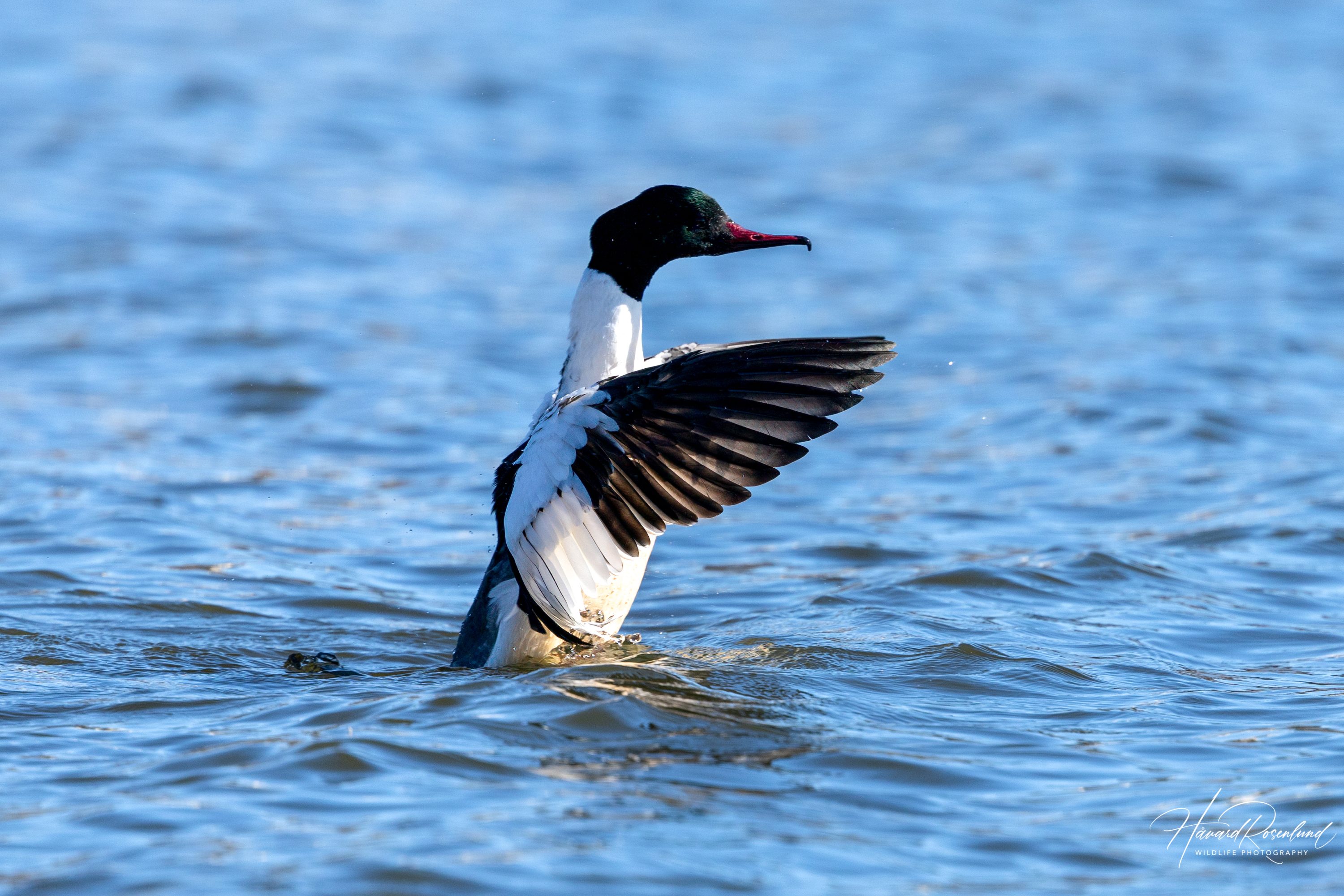
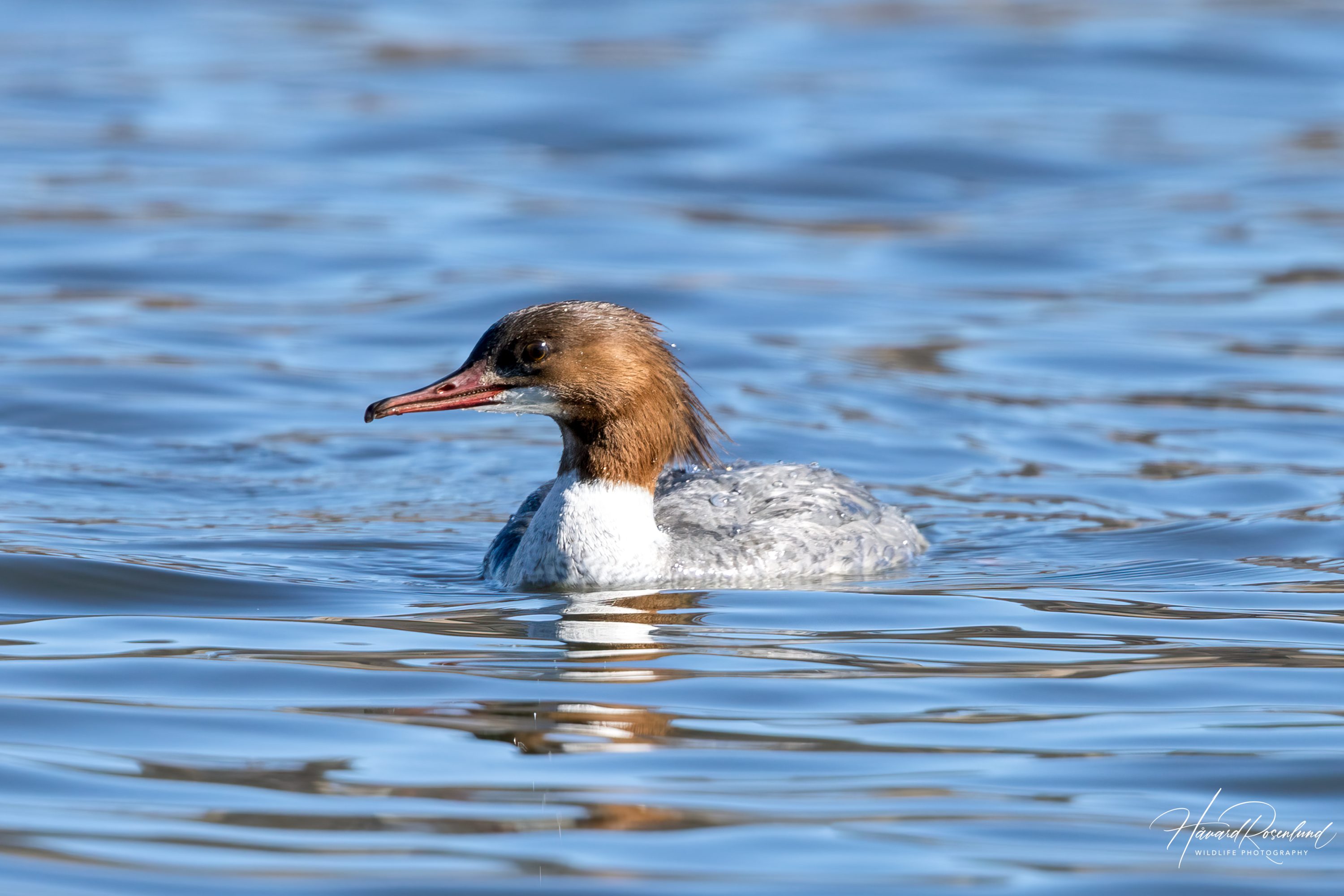
Breeding males have a dark green-black head, bright red bill and a largely white body that can show a faint salmon-pink wash. Females and non-breeding males are greyer, with a rich reddish-brown head and shaggy crest. Both sexes have a long, narrow bill with backward-pointing serrations that help grip slippery fish.
The similar red-breasted merganser (Mergus serrator) is slimmer and more strongly associated with coasts. Breeding red-breasted merganser males have a conspicuous shaggy crest and rusty breast, while female common mergansers usually show a cleaner, sharper boundary between the reddish-brown head and pale neck.
Habitat
Common mergansers are most characteristic of clear rivers, lakes and reservoirs with abundant fish. Breeding habitat often combines open freshwater with mature woodland or rocky terrain that provides cavities for nesting. They may also use artificial nest boxes and cavities in buildings.
In winter they concentrate on ice-free water. Inland lakes and rivers remain important where they stay open, but birds may also move into estuaries, sheltered bays and other coastal waters.
Diet
Fish dominate the diet of adults, but common mergansers also take aquatic insects, crustaceans, molluscs and occasionally amphibians. Young ducklings initially depend more heavily on small aquatic invertebrates before fish become increasingly important as they grow.
Hunting
Common mergansers hunt by diving and actively pursuing prey underwater by sight. The streamlined body and powerful feet provide rapid underwater propulsion, while the long, narrow bill with backward-pointing serrations gives a secure grip on slippery fish. Most dives last less than 30 seconds, although the birds can remain underwater for up to about two minutes.
Individuals often hunt alone or in small groups, but several birds can also feed cooperatively where shoaling fish are concentrated. Groups may move in a coordinated way and concentrate prey before diving through the shoal, while spreading out again when fish are more dispersed. This flexible combination of individual pursuit and group hunting allows common mergansers to exploit both broad lakes and flowing rivers where prey distribution changes quickly.
Behaviour
Common mergansers are strong swimmers, powerful divers and fast fliers. Outside the breeding season they can form sizeable flocks on productive waters and shift between active feeding areas and quieter places where birds rest and preen.
The species is otherwise fairly quiet. During courtship, males give bell-like or twanging calls, while females use harsh calls when threatened.
Migration
The species is partly migratory. Birds from northern breeding areas generally move south or towards ice-free water as lakes and rivers freeze, while populations in milder regions may remain close to their breeding range. Movement patterns differ considerably among populations.
A ringing and dye-marking study published in 1985 documented British male goosanders travelling to the Tana estuary in northern Norway to moult. Counts in Finnmark in 1982 and 1983 peaked at about 30,000 moulting males in September, the great majority in the Tana estuary, and the study suggested that almost all male goosanders in western Europe used this area for moulting. After moulting, the birds move south again.
Breeding
Courtship includes head movements, neck stretching and coordinated swimming. The female then chooses a natural tree hollow, old woodpecker cavity or another sheltered cavity near suitable water; rock crevices, buildings and nest boxes may also be used. A clutch can contain 6–17 eggs, although intermediate clutch sizes are more typical.
The female incubates alone for about 28–35 days, and the male normally leaves before the eggs hatch. The ducklings leave the nest within one or two days after hatching. Young from tree cavities jump to the ground and then follow the female to water, where they can swim and feed for themselves while remaining under her protection.
Broods can merge after reaching the water, creating large nursery groups accompanied by one or more females. Such groups may contain 40 or more ducklings from several nests.
The young typically fledge after about 60–70 days, and common mergansers usually begin breeding at two years old. Banding records from North America show that some individuals can live for at least 13 years.
Relationship with humans
Because common mergansers eat fish, they have long come into conflict with anglers and fisheries, particularly where valuable salmonids are involved. In some places this conflict has also led to deliberate killing of mergansers to protect salmon and trout fisheries. Their actual effect on fish populations varies greatly with local conditions and prey availability.
A study published in 2005 from the Tana estuary in northern Norway examined 288 goosanders from the summers of 1981 and 2000. Sand eels dominated the diet, and only one Atlantic salmon (Salmo salar) was detected in the stomach contents. Predation on salmon smolts was therefore very low in those years.
A field study from the River Halselva in northern Norway, published in 1993, found a different pattern: about a quarter of the prey found in stomach contents were salmonids. For 1989, however, the researchers estimated that goosanders took about 1% of hatchery-reared smolts and 2% of wild smolts during their seaward migration. The importance of merganser predation on salmonids therefore has to be assessed locally rather than assumed from the presence of fish-eating birds.
Status
The common merganser is classified as least concern globally. Its huge range includes large populations across Eurasia and North America, although abundance and trends differ regionally.
The species depends on productive aquatic habitats and suitable nesting cavities. River regulation, pollution, loss of mature cavity-bearing trees and disturbance can therefore reduce habitat quality locally, even though the species is not considered globally threatened.
Image gallery
Loading map and observations…
Have you seen this species?
Independent species archive
Did you find this species page useful?
Wildlife Vagabond is independently built and maintained. Voluntary support helps cover hosting, maps, data storage and continued improvements to the species archive.
Support Wildlife VagabondSpecies content will remain freely available.
References
Information about the species’ global distribution and status is based primarily on global Red List data. See the references below for details.
- Artsdatabanken. (2021). Laksand, Norsk rødliste 2021. https://lister.artsdatabanken.no/rodlisteforarter/2021/28190
- AviList. (n.d.). Common Merganser (Mergus merganser). https://explore.avilist.org/
- BirdLife International. (2026). IUCN Red List for birds. BirdLife DataZone. https://datazone.birdlife.org
- British Trust for Ornithology. (n.d.). Goosander birdfacts. https://www.bto.org/learn/about-birds/birdfacts/goosander
- Cornell Lab of Ornithology. (n.d.). Common Merganser life history. https://www.allaboutbirds.org/guide/Common_Merganser/lifehistory/
- International Union for Conservation of Nature. (n.d.). Common Merganser. The IUCN Red List of Threatened Species. https://www.iucnredlist.org/species/22680492/166211915
- Kålås, J. A., Heggberget, T. G., Bjørn, P. A., & Reitan, O. (1993). Feeding behaviour and diet of goosanders(Mergus merganser)in relation to salmonid seaward migration. Aquatic Living Resources, 6(1), 31-38. https://doi.org/10.1051/alr:1993003
- Little, B., & Furness, R. W. (1985). Long‐distance moult migration by British GoosandersMergus merganser. Ringing & Migration, 6(2), 77-82. https://doi.org/10.1080/03078698.1985.9673860
- Pearce, J. M., McCracken, K. G., Christensen, T. K., & Zhuravlev, Y. N. (2009). Migratory Patterns and Population Structure among Breeding and Wintering Red-breasted Mergansers (Mergus serrator) and Common Mergansers (M. merganser). The Auk, 126(4), 784-798. https://doi.org/10.1525/auk.2009.08182
- Svenning, M., Fagermo, S. E., Barrett, R. T., Borgstrøm, R., Vader, W., Pedersen, T., & Sandring, S. (2005). Goosander predation and its potential impact on Atlantic salmon smolts in the River Tana estuary, northern Norway. Journal of Fish Biology, 66(4), 924-937. https://doi.org/10.1111/j.0022-1112.2005.00638.x