
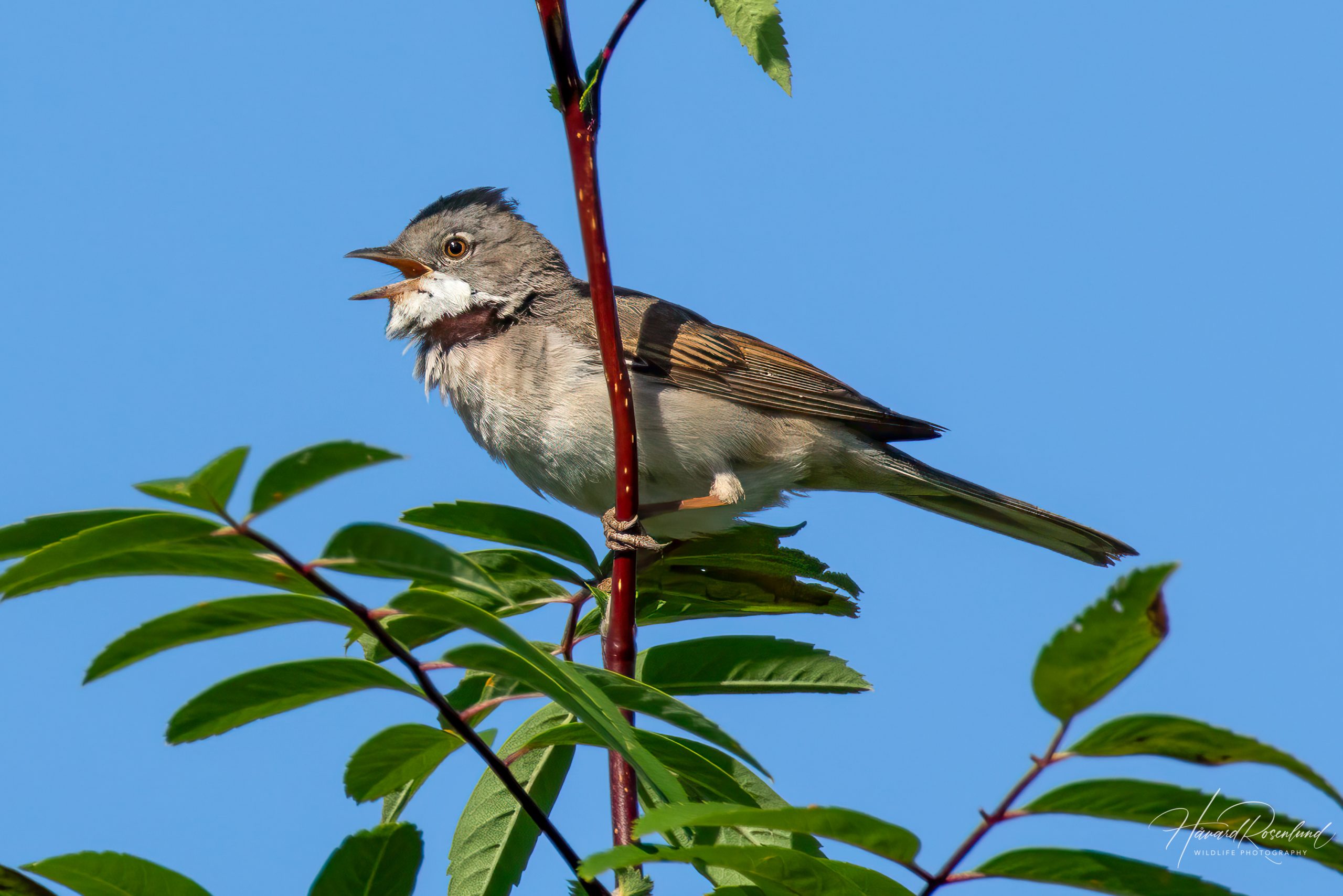
Common Whitethroat
Curruca communis
At a glance
Habitat
- Open scrub, hedgerows, bramble, tall herbs and patchy low woody vegetation
Diet
- Insects and other invertebrates in spring and summer; increasingly berries and fruit before and during migration
Activity
- Diurnal
Size
- Length: ~12.5–14 cm Weight: ~14 g
Range
- Breeds across much of Europe and western Asia; winters mainly in the Sahel and farther south in sub-Saharan Africa
Description
The common whitethroat (Curruca communis) is a small, active warbler of scrub and open countryside. Males have a grey head, conspicuously white throat, warm chestnut-brown wing panel and pinkish-buff breast, while females and young birds are browner and less strongly contrasted. Adults are roughly 12.5–14 cm long and weigh around 14 g.
The lesser whitethroat (Curruca curruca) is a frequent source of confusion but is generally greyer and more compact, with a darker mask through the eye and much less warm rufous in the wing. Song is also useful for identification: the common whitethroat gives a short, scratchy and varied phrase.
Habitat
Breeding whitethroats favour structurally varied, fairly open vegetation rather than woodland interior. Bramble, thorn scrub, hedgerows, nettles, tall herbs and scattered low bushes provide nesting cover and foraging surfaces, often within farmland, woodland edges, coastal scrub and areas in the early stages of regrowth.
A study published in 2001 from lowland England found territorial whitethroats favouring wide herbaceous field-boundary strips and low hedges. The combination of dense low cover and more open vegetation gives birds concealed nesting sites while retaining access to rich feeding areas, so uniformly close-cut boundaries can remain poor habitat even when the wider landscape still looks open and green.
Diet
During breeding, common whitethroats feed mainly on insects and other small invertebrates gleaned from foliage and stems or captured in short aerial sallies. Caterpillars, beetles, flies, spiders and other arthropods are important both for adults and for growing nestlings.
Fruit becomes increasingly important from late summer through migration and on the African non-breeding grounds. Berries and fruits provide quick, energy-rich food while birds build fat reserves before long flights. A study published in 2001 from farmland in Senegambia found whitethroats strongly associated with Guiera senegalensis, the shrub species that also supported the most caterpillars and spiders in the study, showing how strongly the distribution of winter food can depend on particular shrubs.
Behaviour
Common whitethroats spend much of their time moving through low scrub, bramble and tall herbs and can be quite retiring when not singing. Males become much more conspicuous when they sing from exposed shrubs or rise in a short, jerky song flight above the vegetation.
Song is used both to attract a mate and to defend the breeding territory. A study published in 2000 found that paired males sang much less than unmated males, while territorial males also used song in response to rivals. Outside the breeding season the species is much less conspicuous and is usually encountered alone or in loose concentrations during migration.
Migration
The common whitethroat is a long-distance migrant between Europe and Africa. European birds leave mainly from July into early autumn, cross the Mediterranean and Sahara and spend the non-breeding season south of the desert. A geolocator study published in 2022 followed six birds from a wintering site in central Nigeria. They bred across central and eastern Europe, on average about 5,150 km away. Five birds with complete data first used a non-breeding site in the Sahel for about two months before moving farther south to central Nigeria.
Conditions in the Sahel can have major effects on survival. The British breeding population crashed by around 70% between 1968 and 1969 after severe drought in the West African wintering region. Later analyses have continued to find relationships between seasonal African weather, survival and population change. Conditions during migration and winter can therefore be as important for long-term population trends as habitat on the breeding grounds.
Breeding
Males arrive before many females and use song and short display flights both around their territories and in attracting a mate. Singing usually becomes less intense once a pair has formed. The nest is a light cup concealed low in dense vegetation, often among bramble, nettles, thorny shrubs or tall herbs. Four or five eggs are typical.
Both sexes incubate for about 12 days and feed the chicks. The young normally leave the nest after roughly 12–14 days and continue to depend on adults for food and protection for a period after fledging. One or two breeding attempts may be made in a season depending on timing and conditions.
Status
The common whitethroat is classified as least concern on the IUCN Red List and remains widespread and numerous. Population trends can nevertheless fluctuate strongly because survival depends on conditions encountered across several countries and climatic zones during migration and winter.
Modern trends differ among regions. Long-term population size depends on conditions in both scrub-rich breeding landscapes and African stopover and non-breeding habitats, so changes anywhere along the annual cycle can affect the numbers returning to breed.
Image gallery
Loading map and observations…
Have you seen this species?
Independent species archive
Did you find this species page useful?
Wildlife Vagabond is independently built and maintained. Voluntary support helps cover hosting, maps, data storage and continued improvements to the species archive.
Support Wildlife VagabondSpecies content will remain freely available.
References
Information about the species’ global distribution and status is based primarily on global Red List data. See the references below for details.
- Balsby, T. J. S. (2000). The function of song in whitethroats <i>Sylvia communis</i>. Bioacoustics, 11(1), 17-30. https://doi.org/10.1080/09524622.2000.9753447
- BirdLife International. (n.d.). Common Whitethroat species factsheet. https://datazone.birdlife.org/species/factsheet/common-whitethroat-curruca-communis
- British Trust for Ornithology. (n.d.). Whitethroat BirdFacts. https://www.bto.org/learn/about-birds/birdfacts/whitethroat
- International Union for Conservation of Nature. (n.d.). Common Whitethroat. The IUCN Red List of Threatened Species. https://www.iucnredlist.org/species/22716910/155623300
- Johnston, A., Robinson, R. A., Gargallo, G., Julliard, R., van der Jeugd, H., & Baillie, S. R. (2016). Survival of Afro‐Palaearctic passerine migrants in western Europe and the impacts of seasonal weather variables. Ibis, 158(3), 465-480. https://doi.org/10.1111/ibi.12366
- Stoate, C., Morris, R., & Wilson, J. (2001). Cultural ecology of Whitethroat (Sylvia communis) habitat management by farmers: Field-boundary vegetation in lowland England. Journal of Environmental Management, 62(4), 329-341. https://doi.org/10.1006/jema.2001.0456
- Stoate, C., Morris, R., & Wilson, J. (2001). Cultural ecology of Whitethroat (Sylvia communis) habitat management by farmers: winter in farmland trees and shrubs in Senegambia. Journal of Environmental Management, 62(4), 343-356. https://doi.org/10.1006/jema.2001.0457
- Tapia-Harris, C., Izang, A., & Cresswell, W. (2022). Migratory routes, breeding locations and multiple non-breeding sites of Common Whitethroats Curruca communis revealed by geolocators. PLOS ONE, 17(9), e0274017. https://doi.org/10.1371/journal.pone.0274017
- Winstanley, D., Spencer, R., & Williamson, K. (1974). Where Have All the Whitethroats Gone? Bird Study, 21(1), 1-14. https://doi.org/10.1080/00063657409476397