
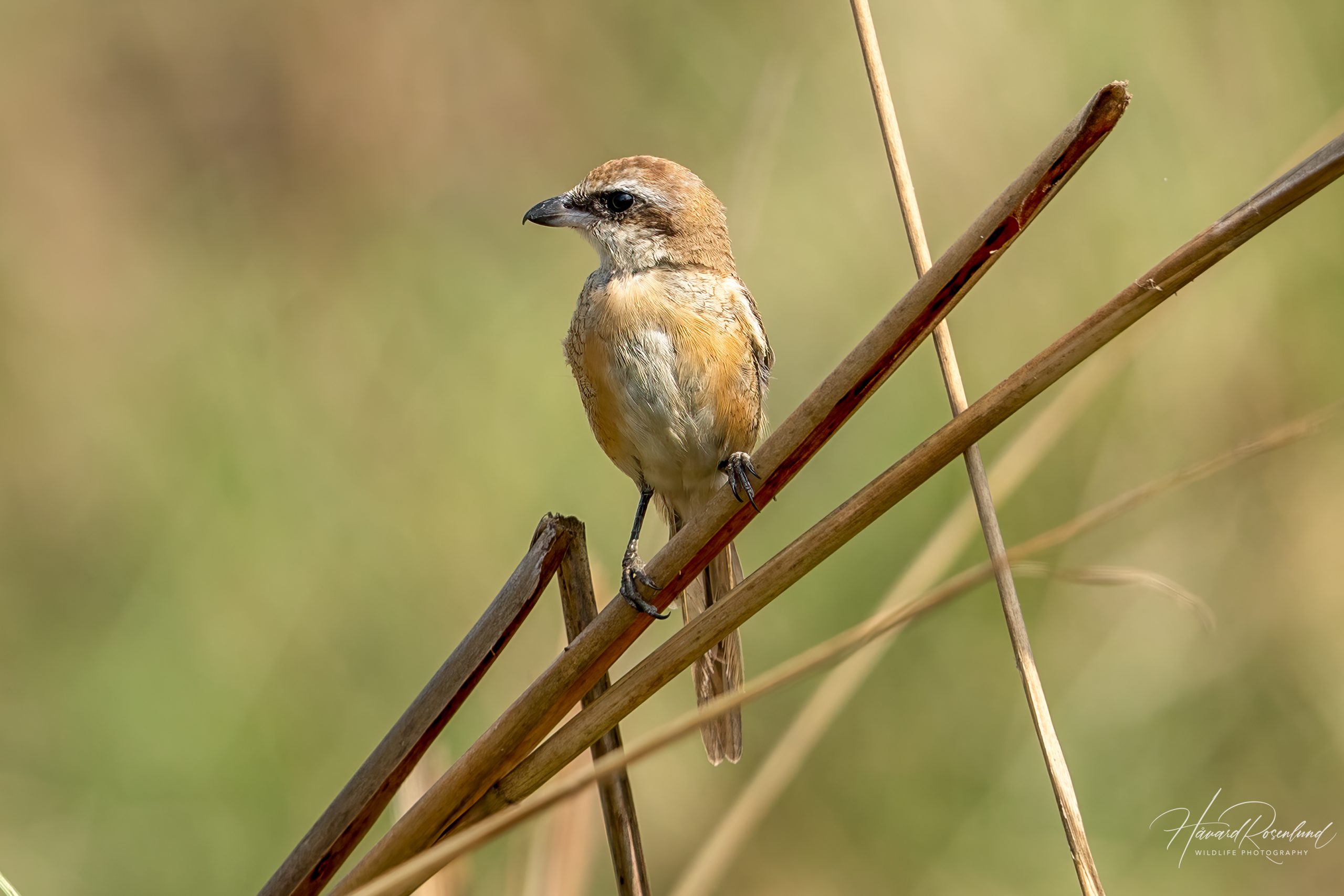
Brown Shrike
Lanius cristatus
At a glance
Habitat
- Open scrub, forest edges, grassland and farmland with scattered bushes, fences or other hunting perches
Diet
- Mostly large insects and other invertebrates, with occasional lizards, frogs, small birds and small mammals
Activity
- Diurnal
Size
- Length: 17–20 cm Weight: about 31.5 g
Range
- Breeds across eastern and north-eastern Asia and migrates south to winter across South and Southeast Asia
Description
The brown shrike (Lanius cristatus) is a medium-sized shrike of eastern Asia, about 17–20 cm long and averaging roughly 31.5 g in mass. Adults have warm brown upperparts, pale buff underparts, a strong dark eye-mask and a stout, hooked bill. The tail is fairly long, giving the bird a more elongated appearance than many similarly sized passerines.
Plumage varies among the recognised subspecies, especially in the colour of the crown, back and underparts. Females and young birds are generally duller and may show fine scaling on the flanks. The hooked bill suits this predatory hunting style: although it is a songbird, it hunts in a manner more reminiscent of a small raptor.
Habitat
Brown shrikes favour open or semi-open landscapes with a mixture of low vegetation and prominent hunting perches. Breeding habitats include scrub, forest edges, open woodland, meadow and farmland, while wintering birds frequently use fields, gardens, plantations, roadside vegetation and other human-modified habitats.
The key habitat feature is structural contrast: open ground where prey can be detected combined with bushes, wires, posts or exposed branches from which the bird can watch its surroundings.
Diet
The diet is dominated by insects and other invertebrates, including beetles, grasshoppers, crickets, caterpillars and spiders. Brown shrikes also take small vertebrates when opportunities arise, such as lizards, frogs, small birds and small mammals.
Hunting
Most prey is detected from an exposed perch. The shrike then drops to the ground or makes a short aerial attack before returning to another lookout. This sit-and-wait strategy allows a relatively small songbird to hunt prey considerably larger than the insects that make up most of its diet.
Like other true shrikes, brown shrikes can wedge larger prey into a fork or deliberately impale it on a thorn, sharp twig or wire. The fixed prey can then be torn apart with the hooked bill, compensating for the lack of the powerful grasping feet used by birds of prey.
Impaled prey can also serve as a food store that the bird returns to later. A comparative study of true shrikes published in 2005 proposed that repeated use of such larders can also contribute to territorial signalling and mate attraction, while providing food during bad weather or periods of high energetic demand.
Behaviour
Outside the breeding season, brown shrikes are usually solitary and strongly territorial. A ringing study published in 1970 from West Malaysia found wintering birds occupying restricted areas for long periods. Research in Taiwan published in 1996 showed similar site fidelity: among ringed wintering birds that returned during the autumn passage period, 80% went directly back to their previous territories. At high bird densities, territories became smaller as competition increased.
Migration
The brown shrike is a long-distance migrant. It breeds across eastern and north-eastern Asia, including parts of Russia, Mongolia, China, Korea and Japan, and migrates south after breeding to winter across the Indian subcontinent and much of Southeast Asia.
The 1970 ringing study in West Malaysia recorded arriving migrants from the first week of September to the third week of October, with September and October accounting for most captures during 1964–1968. Before northward migration, the birds underwent a premigratory moult from about February to early April and reached their highest recorded body masses in April as fat reserves accumulated for departure.
Breeding
Breeding generally takes place from late spring into summer. The pair builds a sturdy cup nest in a dense shrub or small tree, using twigs, grass stems and other plant fibres, with finer material lining the inside. Clutches commonly contain about four to six eggs, and the female performs most or all of the incubation while both parents feed the nestlings.
A study published in 2002 followed 41 active nests of the declining Japanese subspecies L. c. superciliosus in Hokkaido during 1992–1996. Mean clutch size was 5.3 eggs and overall nesting success 53.7%; predation was the main cause of failure. Common cuckoo (Cuculus canorus) parasitism was rare, and in the observed cases the shrikes either removed the cuckoo egg or abandoned the parasitised nest.
Status
The brown shrike is classified as least concern on the IUCN Red List and remains widespread across a very large breeding and wintering range.
Regional trends can nevertheless differ sharply. The Japanese L. c. superciliosus population had already undergone a severe decline in Hokkaido by the time of the 1992–1996 breeding study. Loss and alteration of open scrub and agricultural habitats, together with pressures encountered along migration routes, can therefore be important locally.
Image gallery
Loading map and observations…
Have you seen this species?
Independent species archive
Did you find this species page useful?
Wildlife Vagabond is independently built and maintained. Voluntary support helps cover hosting, maps, data storage and continued improvements to the species archive.
Support Wildlife VagabondSpecies content will remain freely available.
References
Information about the species’ global distribution and status is based primarily on global Red List data. See the references below for details.
- BirdLife International. (n.d.). Brown Shrike species factsheet. https://datazone.birdlife.org/species/factsheet/brown-shrike-lanius-cristatus
- British Trust for Ornithology. (n.d.). BirdFacts – Brown Shrike. https://www.bto.org/learn/about-birds/birdfacts/brown-shrike
- Cornell Lab of Ornithology. (n.d.). Birds of the World – Brown Shrike. https://birdsoftheworld.org/bow/species/brnshr/cur/introduction
- International Union for Conservation of Nature. (n.d.). Brown Shrike. The IUCN Red List of Threatened Species. https://www.iucnredlist.org/species/22705011/93995637
- Medway, L. (1970). A ringing study of the migratory brown shrike in West Malaysia. Ibis, 112(2), 184-198. https://doi.org/10.1111/j.1474-919X.1970.tb00092.x
- Severinghaus, L. L. (1996). Territory strategy of the migratory Brown Shrike Lanius cristatus. Ibis, 138(3), 460-465. https://doi.org/10.1111/j.1474-919X.1996.tb08065.x
- Takagi, M. (2002). Reproductive Performance and Nestling Growth of the Brown Shrike Subspecies Lanius cristatus superciliosus in Hokkaido. Journal of the Yamashina Institute for Ornithology, 34(1), 30-38. https://doi.org/10.3312/jyio1952.34.30
- Yosef, R., & Pinshow, B. (2005). Impaling in true shrikes (Laniidae): A behavioral and ontogenetic perspective. Behavioural Processes, 69(3), 363-367. https://doi.org/10.1016/j.beproc.2005.02.023