
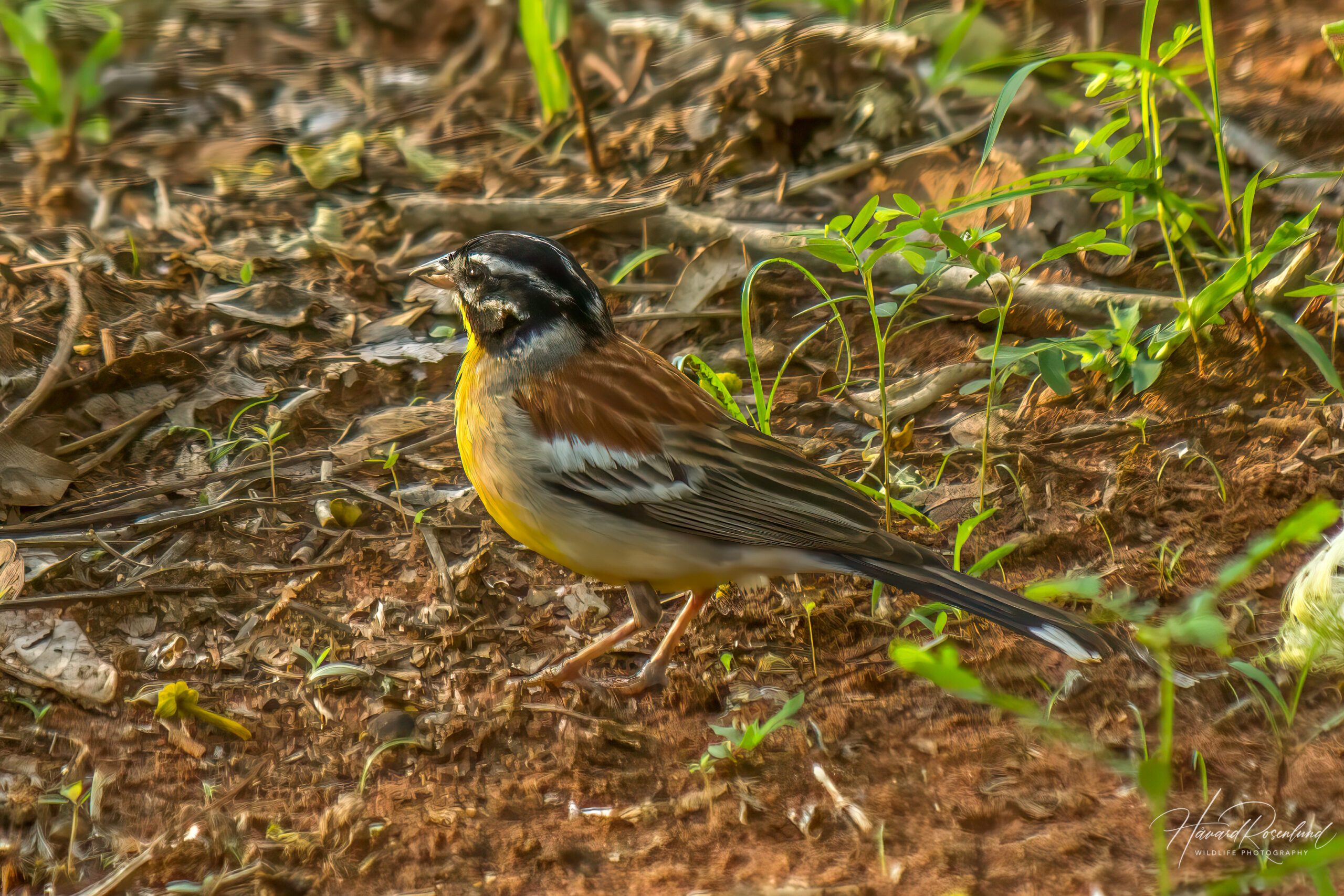
Golden-breasted Bunting
Emberiza flaviventris
At a glance
Habitat
- Open broadleaved woodland, savanna, dry riverine woodland, rocky shrubland, plantations, farmland edges and gardens
Diet
- Seeds, flower buds and insects, especially grasshoppers, beetles, termites and ants
Activity
- Diurnal; forages on the ground and in low shrubs and trees
Size
- Length: 15–16 cm Weight: About 20–30 g
Range
- Widespread across much of sub-Saharan Africa, absent from most of the equatorial forest belt and the driest southwestern regions
Description
The golden-breasted bunting (Emberiza flaviventris) is a small, brightly patterned African bunting about 15–16 cm long and usually weighing around 20–30 g. Adult males have a black head crossed by bold white crown, eyebrow and moustachial stripes, a rich golden-orange breast, yellow belly and chestnut-brown back. The wings are browner with two conspicuous white wing bars, the rump is grey and the tail grey-brown with white outer feathers. Females have the same basic pattern but are duller and browner, while juveniles are less contrasting.
The combination of strongly patterned head, golden breast and yellow belly makes adult males especially distinctive. Geographic variation occurs across the broad African range, and three subspecies are generally recognised, but all are retained within a single species in the current global taxonomy.
Habitat
Golden-breasted buntings favour open broadleaved woodland and savanna rather than dense forest. They also use dry riverine woodland, tall shrubland on rocky ground, plantations, farmyards, cropland edges and gardens. A mixture of low vegetation, patches of bare ground and nearby shrubs or trees provides feeding areas, song perches and cover.
Diet
Seeds and flower buds form an important part of the diet, supplemented by insects such as small grasshoppers, beetles, termites and ants. Birds feed on bare ground as well as in low shrubs and trees, switching readily between plant and animal food as conditions change.
Freshly burnt areas can be particularly attractive because fire exposes, injures or kills insects and makes seeds easier to reach. Golden-breasted buntings can therefore exploit the short-lived feeding opportunities created by recent burns in fire-prone savannas.
Behaviour
The species is diurnal and usually encountered alone, in pairs or in family groups. Small flocks may form outside the breeding season, sometimes together with other seed-eating birds. Most populations are resident, but local movements increase during dry periods when food and water become scarce.
Males sing from exposed branches and other prominent perches. Courtship also includes an undulating, butterfly-like display flight, while pairs become more closely associated as breeding approaches.
Breeding
Golden-breasted buntings form monogamous pairs and nest separately rather than in colonies. The female builds a loose cup of grass, flexible stems, tendrils and leaf stalks, usually placed low in the fork of a bush or small tree. The male may feed the female before mating.
Two to five eggs are laid, most often two or three, and the female incubates for about 12–13 days. Both parents feed the young with insects and seeds. The chicks leave the nest after roughly 13–17 days.
Brood parasitism by cuckoos is recorded occasionally, but does not appear to have much effect on the population as a whole.
Status
The golden-breasted bunting is globally classified as Least Concern. The current IUCN assessment was published in 2016. The species remains widespread and fairly common across much of sub-Saharan Africa.
It tolerates some modified habitats and has colonised plantations of non-native trees in formerly treeless grasslands. Illegal capture for the cage-bird trade occurs locally, but no known threat currently affects the species severely across its range.
Image gallery
Loading map and observations…
Have you seen this species?
Independent species archive
Did you find this species page useful?
Wildlife Vagabond is independently built and maintained. Voluntary support helps cover hosting, maps, data storage and continued improvements to the species archive.
Support Wildlife VagabondSpecies content will remain freely available.
References
Information about the species’ global distribution and status is based primarily on global Red List data. See the references below for details.
- AviList. (2026). The Global Avian Checklist, v2025b. https://www.avilist.org/checklist/v2025b/
- Biodiversity and Development Institute. (2024). Golden-breasted Bunting. https://thebdi.org/2024/12/10/golden-breasted-bunting-emberiza-flaviventris/
- Biodiversity Explorer. (n.d.). Golden-breasted Bunting. Iziko Museums of South Africa. https://www.biodiversityexplorer.info/birds/fringillidae/emberiza_flaviventris.htm
- BirdLife International. (n.d.). Golden-breasted Bunting species factsheet. https://datazone.birdlife.org/species/factsheet/golden-breasted-bunting-emberiza-flaviventris
- International Union for Conservation of Nature. (2016). Golden-breasted Bunting. The IUCN Red List of Threatened Species. https://www.iucnredlist.org/species/22720972/94692889