
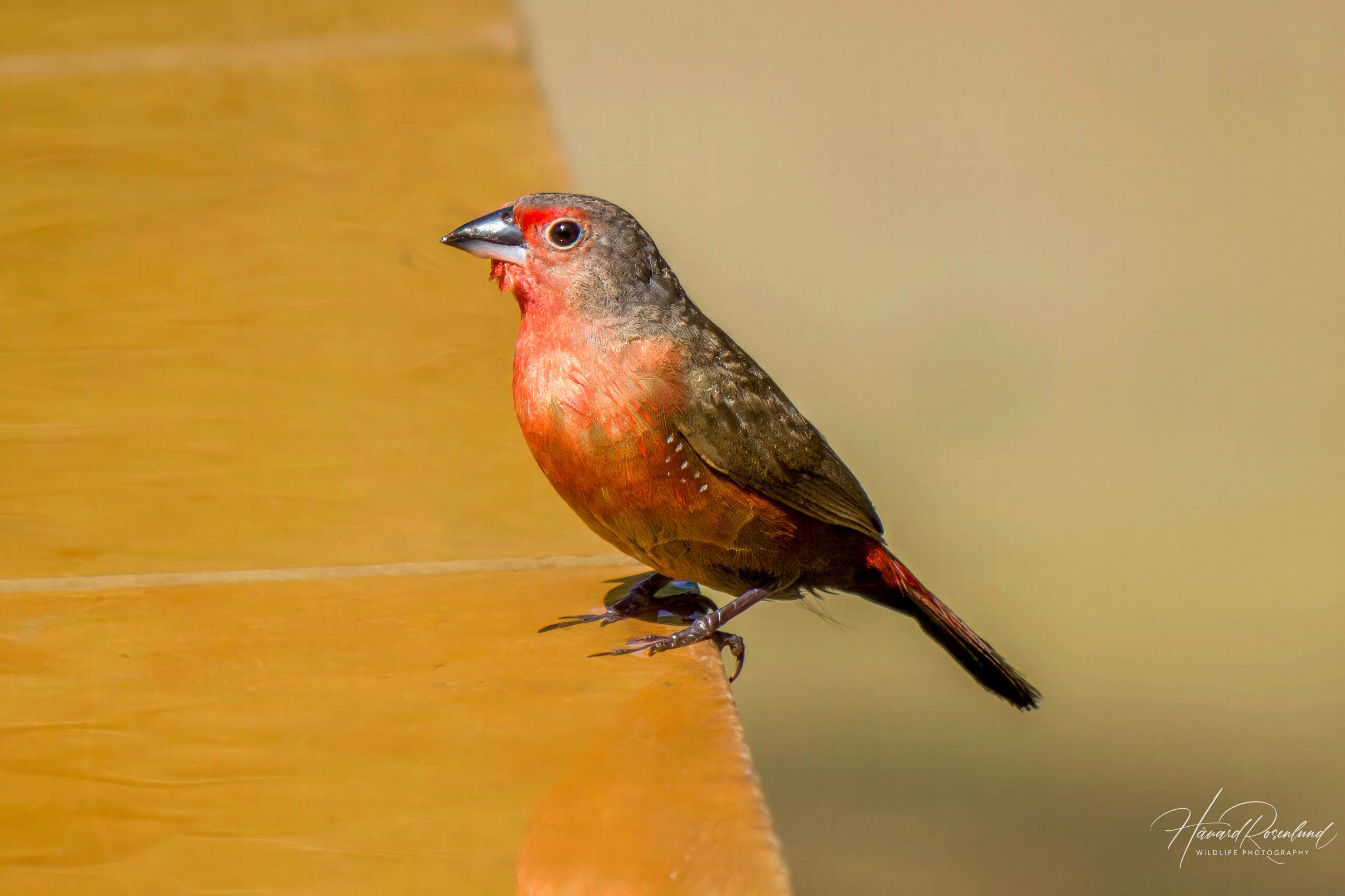
African Firefinch
Lagonosticta rubricata
At a glance
Habitat
- Moist grassland, forest edges, thickets, woodland, bracken, plantations, gardens and other habitats with dense ground vegetation
Diet
- Mostly grass and other small seeds; insects become more important during breeding
Activity
- Diurnal; forages mainly on or close to the ground
Size
- Length: 10–11 cm Weight: About 10 g
Range
- Widespread but patchy across sub-Saharan Africa, from West and East Africa south to eastern and southern South Africa
Description
The African firefinch (Lagonosticta rubricata), also called the blue-billed firefinch, is a tiny estrildid finch with a wide but patchy distribution across sub-Saharan Africa. Adults are about 10–11 cm long and weigh around 10 g.
Adult males are rich dark red over much of the head and underparts, with a dark bluish bill, brown wings and small pale spots along the flanks. In the South African nominate form, the upperparts can appear reddish-grey and the lower underparts become very dark, while females are duller and generally show more pale flank spots than males. Juveniles are duller still.
The species can be difficult to distinguish from Jameson’s firefinch (Lagonosticta rhodopareia) where their ranges overlap. African firefinch is generally darker and more deeply red, with a darker bill.
Taxonomy
Several subspecies are recognised and the species shows marked geographic variation. Birds in South Africa and Eswatini belong to the nominate form L. r. rubricata, which also extends into southern Mozambique south of the Save River.
The form L. r. haematocephala occurs farther north and east, from northeastern Africa through East Africa and parts of south-central Africa to central Mozambique.
Habitat
African firefinches use moist grassland, forest edge, thickets, open woodland, bracken, plantations, gardens and other habitats with dense vegetation close to the ground. They often remain near sheltered edges rather than spending long periods in exposed open country.
Diet
Small seeds, especially grass seeds, dominate the diet. Insects and other small invertebrates become more important during breeding, when growing chicks require additional protein.
African firefinches feed mainly on or very close to the ground, picking fallen seeds from bare patches and leaf litter, moving through low grass and taking seeds directly from low stems. Invertebrates are gleaned from vegetation and disturbed ground.
Behaviour
The species is diurnal and usually encountered in pairs or small family groups. Outside breeding, several birds may join loose local flocks, but it is not as strongly flocking as some other estrildid finches.
African firefinches tend to remain close to dense low cover and often retreat into vegetation when disturbed. Their quiet ground-feeding habits can make them surprisingly inconspicuous despite the male’s red plumage.
Breeding
The male builds a rounded nest with a side entrance, usually concealed in dense grass, bracken or other low vegetation about 0.5–2 m above the ground. Long dry grass forms the outer structure, while softer material lines the inner chamber and feathers may sometimes be added.
The female lays two to five eggs. Both parents incubate for about 11–12 days and both feed the chicks after hatching. The young normally leave the nest after roughly 14–19 days and continue to receive food from the adults for about another ten days.
Brood parasitism
African firefinches have a specialised relationship with the dusky indigobird (Vidua funerea). In southern Africa the indigobird lays its eggs in African firefinch nests, leaving the foster parents to raise the parasite chick alongside their own young.
Indigobird nestlings closely mimic the firefinch chicks’ mouth markings and begging behaviour, while adult male indigobirds learn and copy the host’s vocalisations. Females use these host-associated songs when choosing mates and when locating firefinch nests for egg-laying. This ties each specialised indigobird population closely to the host species it parasitises.
Status
The African firefinch is classified as least concern on the IUCN Red List. It has a very large but patchy distribution across sub-Saharan Africa and remains common in many suitable habitats.
Local populations can decline when dense ground vegetation is removed or woodland and forest-edge habitats are heavily altered, but no major range-wide threat is currently identified.
Image gallery
Loading map and observations…
Have you seen this species?
Independent species archive
Did you find this species page useful?
Wildlife Vagabond is independently built and maintained. Voluntary support helps cover hosting, maps, data storage and continued improvements to the species archive.
Support Wildlife VagabondSpecies content will remain freely available.
References
Information about the species’ global distribution and status is based primarily on global Red List data. See the references below for details.
- Avibase. (n.d.). Lagonosticta rubricata: subspecies and distribution. https://avibase.bsc-eoc.org/species.jsp?avibaseid=A6034D7F44F99D2B&lang=EN
- Biodiversity Explorer. (n.d.). African Firefinch Lagonosticta rubricata: natural history and breeding. Iziko Museums of South Africa. https://www.biodiversityexplorer.info/birds/estrildidae/lagonosticta_rubricata.htm
- BirdLife International. (n.d.). African Firefinch Lagonosticta rubricata species factsheet. https://datazone.birdlife.org/species/factsheet/african-firefinch-lagonosticta-rubricata
- International Union for Conservation of Nature. (n.d.). Lagonosticta rubricata (African Firefinch). The IUCN Red List of Threatened Species. https://www.iucnredlist.org/species/22731403/111147608
- Péron, G., Altwegg, R., Jamie, G. A., & Spottiswoode, C. N. (2016). Coupled range dynamics of brood parasites and their hosts responding to climate and vegetation changes. Journal of Animal Ecology, 85(5), 1191-1199. https://doi.org/10.1111/1365-2656.12546
- Sorenson, M. D., Sefc, K. M., & Payne, R. B. (2003). Speciation by host switch in brood parasitic indigobirds. Nature, 424(6951), 928-931. https://doi.org/10.1038/nature01863