
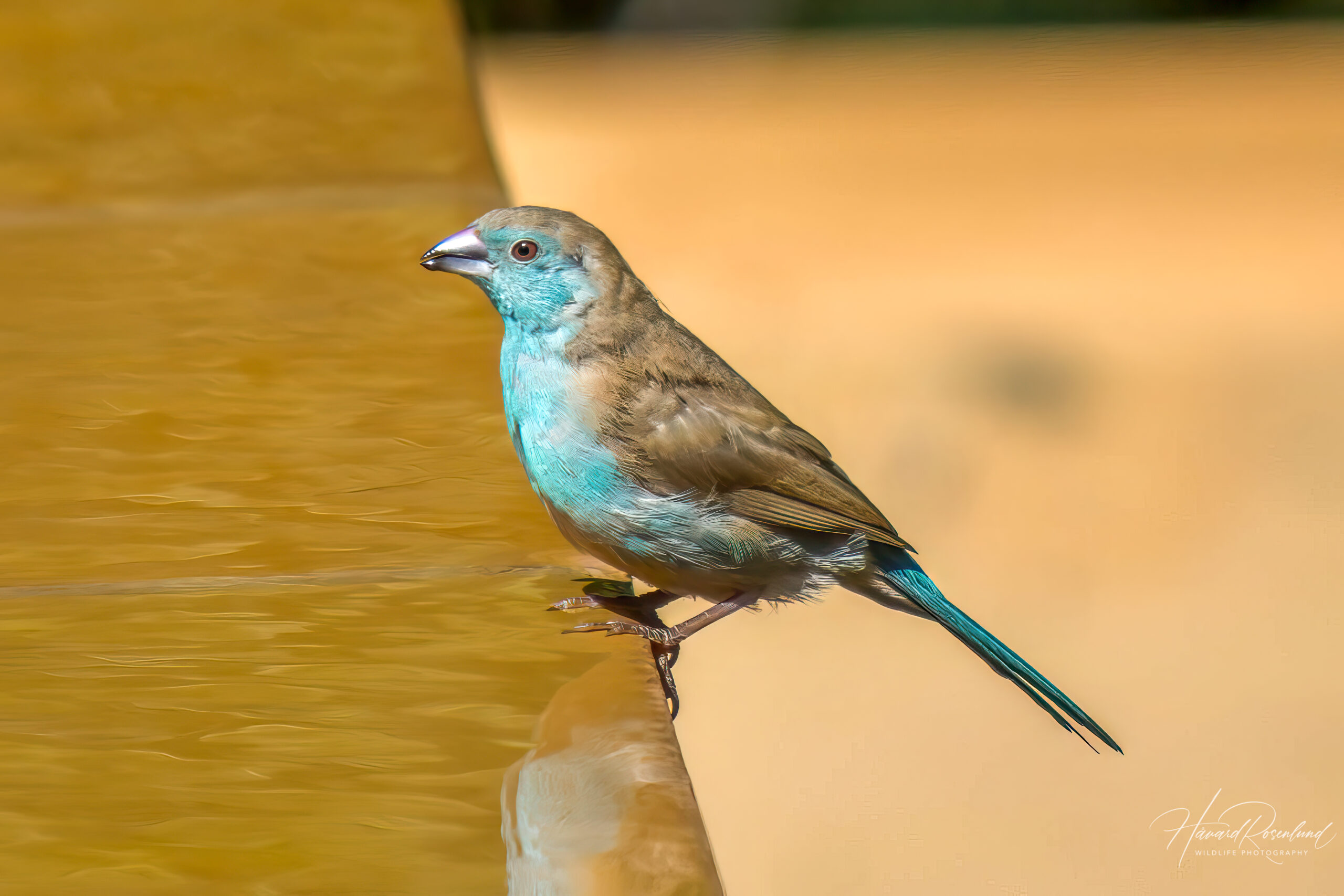
Blue Waxbill
Uraeginthus angolensis
At a glance
Habitat
- Mesic to semi-arid savanna, grassland, open woodland and cultivated areas with natural vegetation.
Diet
- Mostly grass and other small seeds, supplemented by termites, caterpillars and other small invertebrates.
Activity
- Diurnal
Size
- Length: 12-13 cm Weight: 8-13 g
Range
- Eastern and southern Africa, extending west through Zambia and Angola into parts of central Africa.
Description
The blue waxbill (Uraeginthus angolensis), also called the blue-breasted cordonbleu, is a small estrildid finch of eastern and southern Africa, extending west through Zambia and Angola into parts of central Africa. Adults are about 12–13 cm long and weigh 8–13 g.
The face, throat, breast, flanks and tail are powder blue, contrasting with grey-brown upperparts and a pale grey-brown lower belly. Males usually show more extensive and intense blue than females, while juveniles are much duller and browner, with blue largely restricted to the face, parts of the breast and tail.
Where their ranges meet, blue waxbills can be confused with red-cheeked cordon-bleus (Uraeginthus bengalus). Adult males of that species have a conspicuous red cheek patch and a pinkish bill; females lack the red cheek and can be more difficult to distinguish.
Habitat
Blue waxbills favour mesic to semi-arid savanna, grassland and open woodland, especially where shrubs and seeding grasses are abundant. They also use forest edges, gardens and cultivated landscapes that retain enough natural vegetation.
Diet
Grass and other small seeds form the bulk of the diet. Termites, caterpillars and other small invertebrates are also eaten, particularly during breeding.
Blue waxbills feed both on the ground and directly from grass seed heads, clinging to stems to remove seeds and dropping to open patches to collect fallen food. Small invertebrates are picked from vegetation or the ground and become more important while adults are feeding young.
Social behaviour
Blue waxbills are notably social and often occur in small flocks. A study published in 2011 found typical groups of about 8–40 birds, with groups around 20 especially common.
Pairs are socially monogamous and remain social even during breeding. Rather than defending large exclusive territories, breeding pairs may be loosely distributed in small colony-like groups, while small feeding parties continue to form around them.
Breeding
Both sexes build an oval grass nest with a short side entrance, usually concealed in the foliage of a bush or small tree and lined with feathers. Nests are often placed close to active wasp colonies. Why this happens is unclear. One proposed explanation is that an active wasp nest may indicate that aggressive tree-dwelling ants are absent from that particular tree; there is no direct evidence that the wasps themselves protect blue waxbill nests from predators.
Blue waxbills can also reuse old nests of other birds, including scarlet-chested sunbirds, spectacled weavers and black-chested prinias, sometimes adding a new structure on top of the original nest.
Breeding can occur through much of the year when conditions are favourable and often follows periods of good rainfall. In southern Africa, egg-laying commonly peaks around January. A clutch contains two to seven eggs, and both parents share incubation for about 11–12 days.
Both adults feed the nestlings, providing green grass seeds as well as termites and other small invertebrates. Young birds leave the nest after roughly 17–21 days, can largely fend for themselves about a week later and become fully independent after roughly another week.
Status
The blue waxbill is classified as least concern on the IUCN Red List. It remains common across a broad range and occurs in both natural and moderately altered habitats.
No major range-wide threat is currently known, although local populations can be affected by habitat degradation and changes in vegetation structure.
Image gallery
Loading map and observations…
Have you seen this species?
Independent species archive
Did you find this species page useful?
Wildlife Vagabond is independently built and maintained. Voluntary support helps cover hosting, maps, data storage and continued improvements to the species archive.
Support Wildlife VagabondSpecies content will remain freely available.
References
Information about the species’ global distribution and status is based primarily on global Red List data. See the references below for details.
- Biodiversity Explorer. (n.d.). Blue Waxbill Uraeginthus angolensis: habitat, feeding and breeding. Iziko Museums of South Africa. https://www.biodiversityexplorer.info/birds/estrildidae/uraeginthus_angolensis.htm
- BirdLife International. (n.d.). Blue Waxbill Uraeginthus angolensis species factsheet. https://datazone.birdlife.org/species/factsheet/blue-waxbill-uraeginthus-angolensis
- Goodson, J. L., & Kingsbury, M. A. (2011). Nonapeptides and the Evolution of Social Group Sizes in Birds. Frontiers in Neuroanatomy, 5. https://doi.org/10.3389/fnana.2011.00013
- International Union for Conservation of Nature. (n.d.). Uraeginthus angolensis (Blue Waxbill). The IUCN Red List of Threatened Species. https://www.iucnredlist.org/species/22719488/94629874