
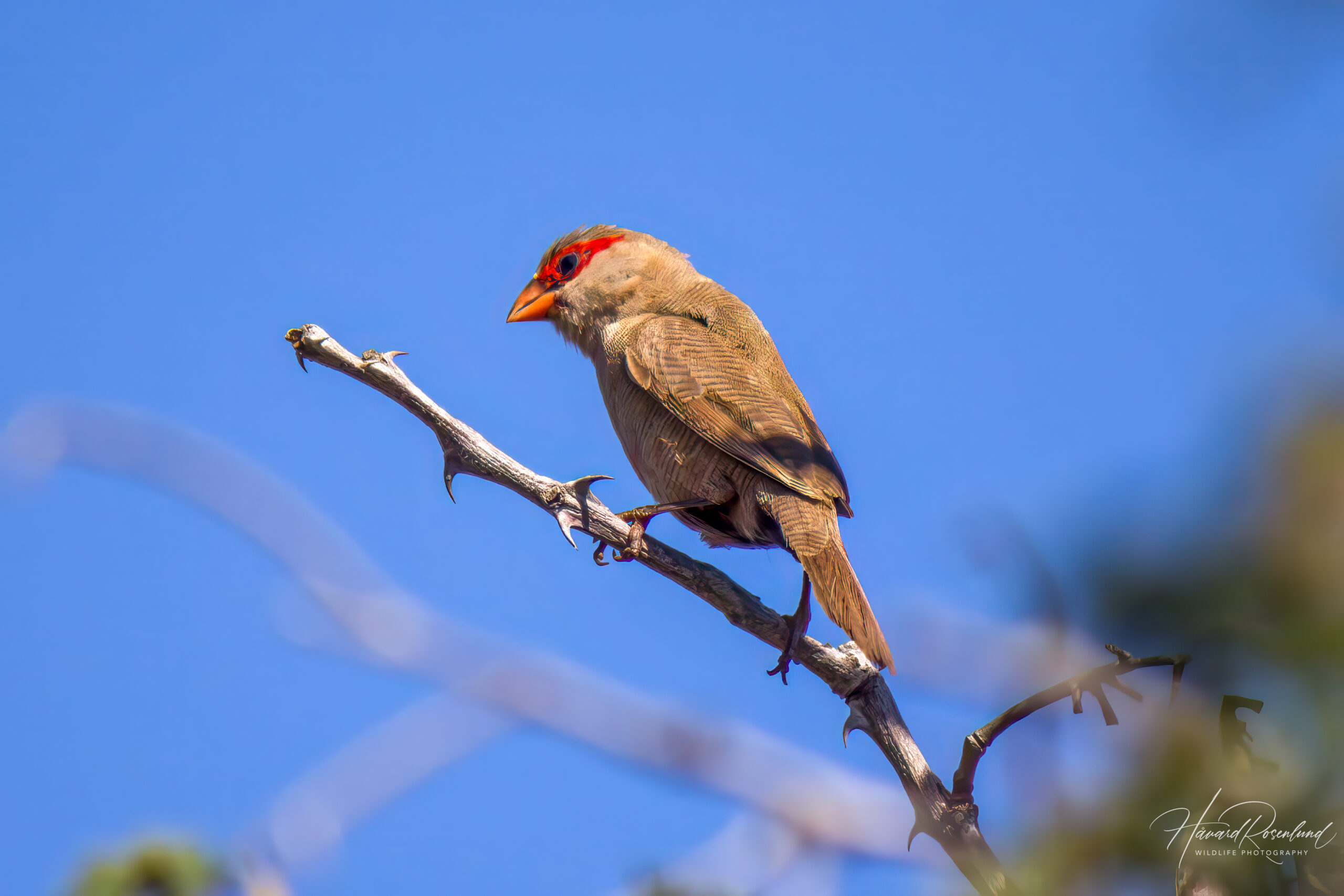
Common Waxbill
Estrilda astrild
At a glance
Habitat
- Tall grass, reedbeds, marsh edges, savanna, farmland, gardens and urban grassland
Diet
- Mainly grass seeds; also small invertebrates, especially during breeding
Activity
- Diurnal
Size
- Length: 9.5–13 cm Weight: 5–11 g
Range
- Native to much of sub-Saharan Africa; introduced populations in Europe, the Americas and many oceanic islands
Description
The common waxbill (Estrilda astrild), also known as the St Helena waxbill, is a tiny estrildid finch native to much of sub-Saharan Africa. It measures about 9.5–13 cm and weighs 5–11 g.
Adults have a bright red bill and eye-stripe, grey-brown plumage with fine dark barring, a pale throat and often a pinkish wash or red line on the belly. Males usually show stronger red colouring than females. Juveniles are duller, with weaker barring and a dark bill.
The English name “waxbill” refers to the sealing-wax colour of the adult bill and was later applied to many related finches.
Habitat
Common waxbills favour open habitats with tall grass or reeds, including grassland, savanna, marsh edges, riverbanks, farmland, parks, gardens and vacant urban ground. They often remain close to water because their dry seed diet makes regular drinking important.
Diet
Grass seeds dominate the diet. Small insects and other invertebrates become more important when adults are feeding young.
Common waxbills feed both on the ground and directly from vegetation, clinging to grass stems to strip seeds from the heads and descending to collect fallen seeds from open patches close to cover. Small invertebrates are picked from vegetation, especially during breeding.
Social behaviour
The species is highly social. Birds normally forage in groups, and non-breeding flocks may contain dozens or hundreds of individuals. Large communal roosts form in dense grass, reeds or shrubs.
Flock members maintain frequent contact and move together between feeding, drinking and roosting sites. This strong sociality is one of the most characteristic features of the species outside breeding.
Breeding
The male builds the outer rounded or pear-shaped grass structure, which has a side entrance and short tunnel and is usually hidden low in dense vegetation. The female lines the inner chamber with fine grass and feathers. A smaller extra structure may be built above the main nest and used by the male.
The female lays three to nine white eggs, usually four to six. Both adults incubate for about 11–13 days and feed the chicks, which leave the nest after roughly 17–21 days. Young birds may return to the nest or nearby vegetation to roost for several nights.
Brood parasitism
Common waxbills are the specialist host of the pin-tailed whydah (Vidua macroura) in much of Africa. The parasite lays its eggs in waxbill nests, but unlike a cuckoo chick it does not normally evict or kill the host young; parasite and waxbill nestlings are raised together.
A study published in 2020 showed how closely the parasite chicks mimic common waxbill young. The pin-tailed whydah copies the host’s elaborate mouth markings, begging calls and parts of its begging movements, helping the parasite receive food from the foster parents alongside their own chicks.
Introduced populations
The common waxbill has been transported widely through the cage-bird trade and has established populations far beyond its native African range. Important introduced populations occur on the Iberian Peninsula, in Brazil and parts of the Caribbean, and on numerous Atlantic, Indian and Pacific Ocean islands, including St Helena and Hawaii.
The Portuguese population began with an introduction from Africa in 1964 and subsequently expanded across much of Portugal and into Spain. Other introduced populations have adapted to climates and habitats that differ substantially from those occupied in Africa.
Status
The common waxbill is classified as least concern on the IUCN Red List in the BirdLife assessment published in 2018. It is widespread and locally abundant across a very large range.
No current global population estimate is available, and no major range-wide decline has been identified.
Image gallery
Loading map and observations…
Have you seen this species?
Independent species archive
Did you find this species page useful?
Wildlife Vagabond is independently built and maintained. Voluntary support helps cover hosting, maps, data storage and continued improvements to the species archive.
Support Wildlife VagabondSpecies content will remain freely available.
References
Information about the species’ global distribution and status is based primarily on global Red List data. See the references below for details.
- BirdLife International. (n.d.). Common Waxbill Estrilda astrild species factsheet. https://datazone.birdlife.org/species/factsheet/common-waxbill-estrilda-astrild
- International Union for Conservation of Nature. (2018). Estrilda astrild. The IUCN Red List of Threatened Species. https://www.iucnredlist.org/species/22719574/131995211
- Jamie, G. A., Van Belleghem, S. M., Hogan, B. G., Hamama, S., Moya, C., Troscianko, J., Stoddard, M. C., Kilner, R. M., & Spottiswoode, C. N. (2020). Multimodal mimicry of hosts in a radiation of parasitic finches*. Evolution, 74(11), 2526-2538. https://doi.org/10.1111/evo.14057
- Payne, R. B., Bonan, A., & Kirwan, G. M. (2020). Common Waxbill (Estrilda astrild). Birds of the World. https://doi.org/10.2173/bow.comwax.01
- Schuetz, J. G. (2005). Low survival of parasite chicks may result from their imperfect adaptation to hosts rather than expression of defenses against parasitism. Evolution, 59(9), 2017-2024. https://doi.org/10.1111/j.0014-3820.2005.tb01070.x
- Silva, T., Reino, L. M., & Borralho, R. (2002). A model for range expansion of an introduced species: the common waxbillEstrilda astrildin Portugal. Diversity and Distributions, 8(6), 319-326. https://doi.org/10.1046/j.1472-4642.2002.00156.x