
Pink-throated Twinspot
Hypargos margaritatus
At a glance
Habitat
- Dense dry thicket, sand forest, woodland undergrowth and coastal bush
Diet
- Mostly grass seeds, with insects and other small invertebrates as a supplement
Activity
- Diurnal
Size
- Length: 12–14 cm Weight: 10–12 g
Range
- Restricted to southeastern Africa: southern Mozambique, Eswatini and northeastern South Africa
Description
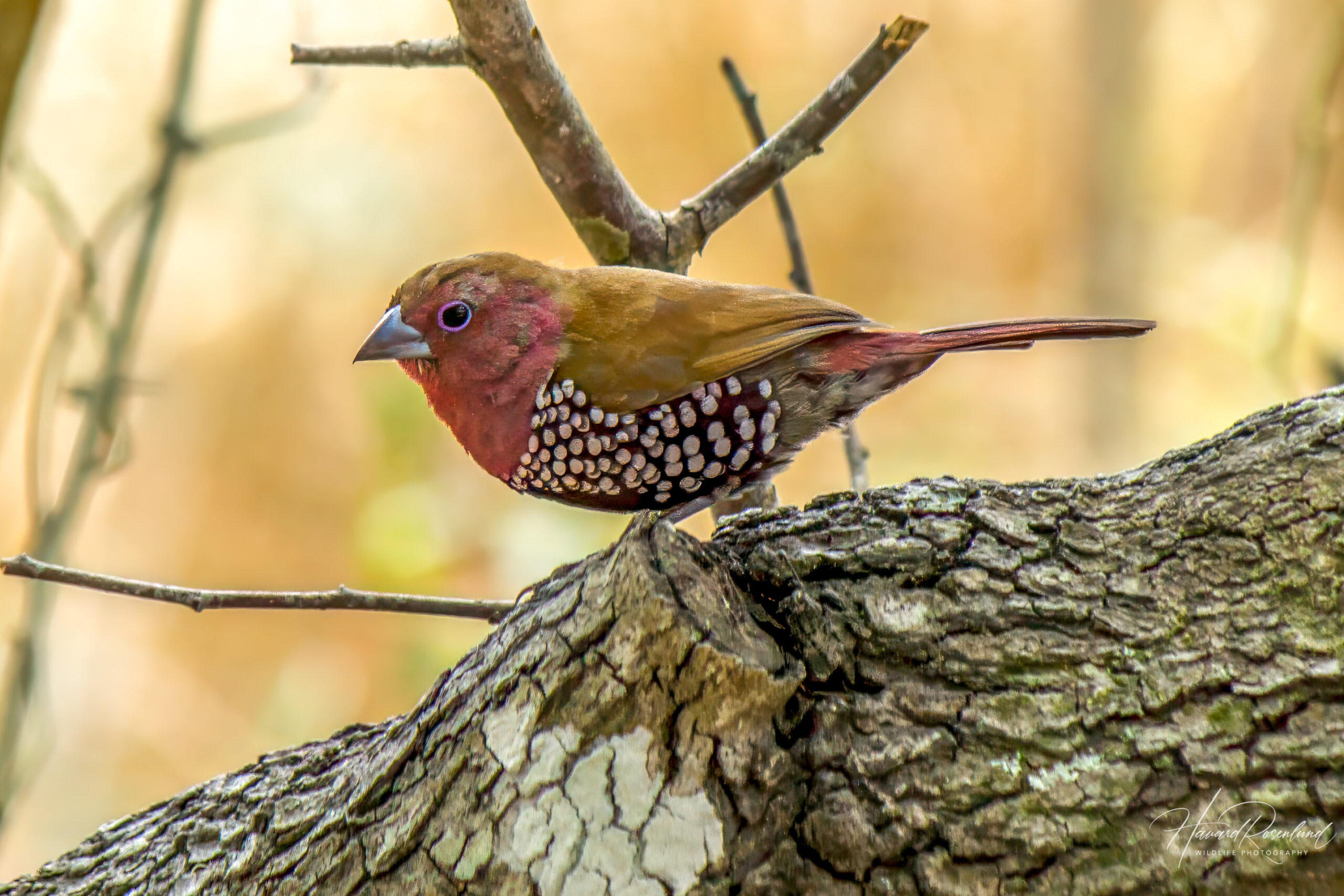
The pink-throated twinspot (Hypargos margaritatus) is a small estrildid finch restricted to southeastern Africa. Adults are roughly 12–14 cm long and weigh about 10–14 g. Males have a rich pink-red face, throat and breast, contrasting with brown upperparts and black underparts covered in conspicuous white spots. Females share the spotted underparts but have a greyer face and throat and are less intensely coloured.
It resembles the red-throated twinspot (Hypargos niveoguttatus), which occurs farther north, but adult males of that species have a deeper red rather than pink-red face and breast. The two species also differ in range and finer plumage details.
Habitat
Pink-throated twinspots are strongly associated with dense cover in a narrow belt of southeastern Africa. Typical habitats include dry thicket, sand forest, woodland with tangled undergrowth, forest edge, palm savanna and coastal bush. In South Africa the species is particularly characteristic of the Maputaland region in northeastern KwaZulu-Natal.
The birds spend much of their time close to the ground beneath thick vegetation and can remain surprisingly inconspicuous even where locally common. Loss or fragmentation of the dense understorey can therefore reduce habitat quality quickly.
Diet
Grass seeds form the main diet. Insects and other small invertebrates are also taken, although their importance in wild birds is poorly documented.
Pink-throated twinspots pick fallen seeds from the ground and from low seed heads and search methodically through leaf litter and low vegetation. Most feeding takes place under or close to dense cover, allowing the birds to retreat quickly into thickets when disturbed.
Behaviour
The species is usually encountered as pairs or small groups and is shy. Birds move quietly through dense undergrowth, often remaining hidden while giving soft contact notes; small tinkling calls can reveal birds that are otherwise difficult to see.
When disturbed, they usually disappear rapidly into thick vegetation rather than flying far across open ground. The species is considered resident, with movements mostly local rather than regular seasonal migration.
Breeding
Breeding biology in the wild remains poorly documented, and only a very small number of wild nests have been described. The nest is an untidy ball with a side entrance, built from dry grass, leaf fibres, leaf skeletons and spider web and hidden in dense vegetation or leaf litter, generally less than a metre above the ground.
The few wild nest records include a clutch of three eggs laid in January. Precise incubation and nestling periods and parental care at wild nests remain poorly known. More detailed timings come mainly from captive birds.
Status
The pink-throated twinspot is classified as least concern on the IUCN Red List. Its global range is relatively small, centred on southern Mozambique, Eswatini and northeastern South Africa.
The 2025 Regional Red Data Book for South Africa, Lesotho and Eswatini also classifies the species as least concern. The species remains closely tied to dense thicket, sand forest and forest understorey, so clearing and fragmentation can affect populations locally. Capture for the cage-bird trade has also historically been a pressure in parts of the range.
Image gallery
Loading map and observations…
Have you seen this species?
Independent species archive
Did you find this species page useful?
Wildlife Vagabond is independently built and maintained. Voluntary support helps cover hosting, maps, data storage and continued improvements to the species archive.
Support Wildlife VagabondSpecies content will remain freely available.
References
Information about the species’ global distribution and status is based primarily on global Red List data. See the references below for details.
- Biodiversity Explorer. (n.d.). Pink-throated Twinspot (Hypargos margaritatus). Iziko Museums of South Africa. https://www.biodiversityexplorer.info/birds/estrildidae/hypargos_margaritatus.htm
- BirdLife International. (n.d.). Pink-throated Twinspot species factsheet. https://datazone.birdlife.org/species/factsheet/pink-throated-twinspot-hypargos-margaritatus
- BirdLife South Africa. (n.d.). BirdLife South Africa – Regional Red Data Book of Birds 2025 assessment methods and categories. https://www.birdlife.org.za/red-data-book/our-scientific-approach-and-assessment-methods/
- BirdLife South Africa. (n.d.). iSimangaliso Wetland Park Important Bird Area. https://www.birdlife.org.za/what-we-do/important-bird-and-biodiversity-areas/what-we-do/iba-directory/isimangaliso-wetland-park
- BirdLife South Africa. (n.d.). Ndumo Game Reserve Important Bird Area. https://www.birdlife.org.za/iba-directory/ndumo-game-reserve/
- International Union for Conservation of Nature. (n.d.). Pink-throated Twinspot. The IUCN Red List of Threatened Species. https://www.iucnredlist.org/species/22719416/131993715
- SAFRING. (n.d.). Pink-throated Twinspot. https://safring.ringing.africa/species/831