
Eurasian Siskin
Spinus spinus
At a glance
Habitat
- Coniferous and mixed woodland; alder and birch stands, parks and gardens outside breeding
Diet
- Mainly tree seeds, especially conifers, alder and birch; some insects during breeding
Activity
- Diurnal
Size
- Length: 12 cm Weight: 10–18 g
Range
- Europe and northern Asia; highly mobile, with winter distribution shifting with seed crops
Description
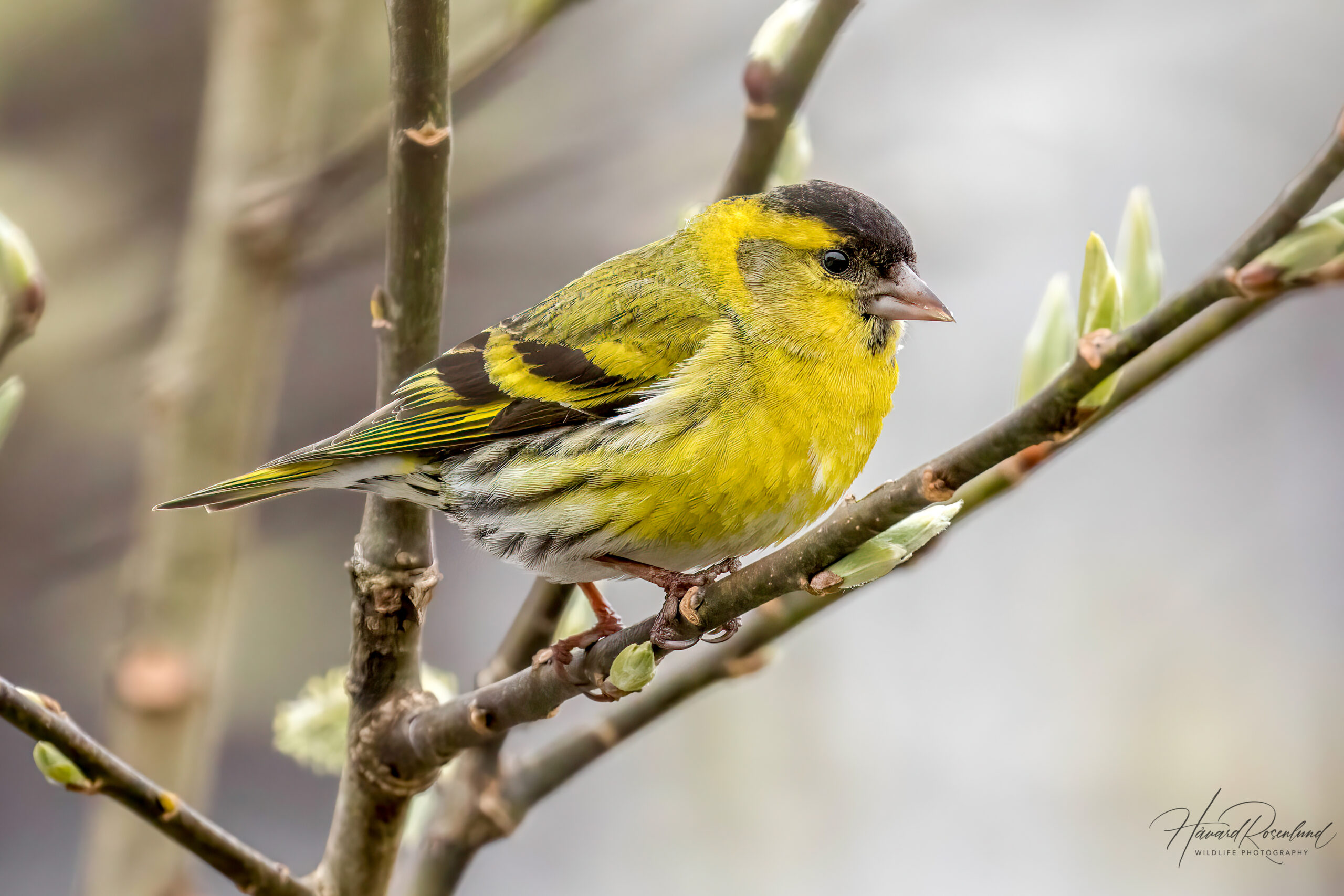
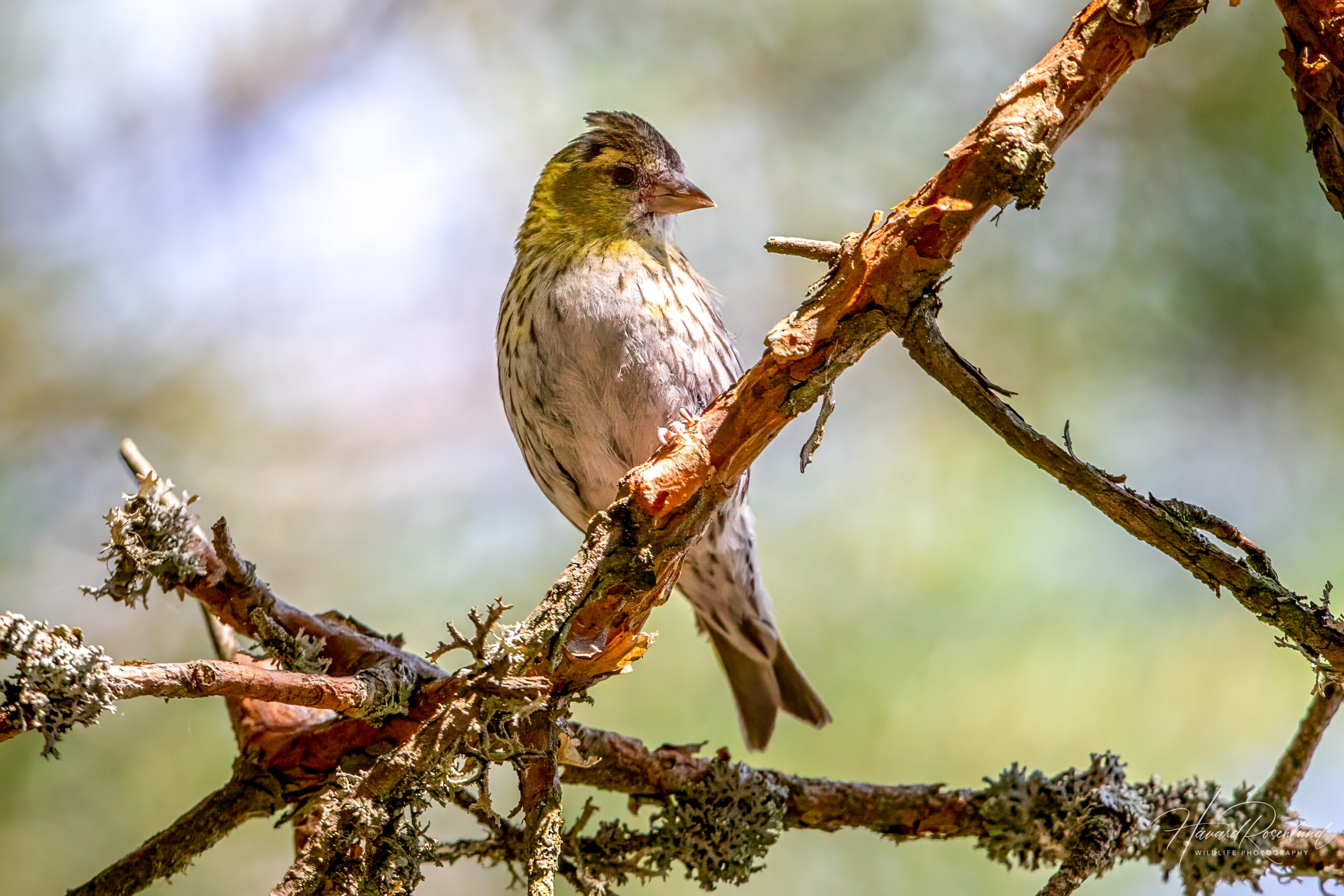
The Eurasian siskin (Spinus spinus) is a tiny, slim-billed finch specialised for extracting small seeds from cones and catkins. Adults are about 12 cm long and weigh around 13 g on average. Males are bright yellow-green with a black crown and small black bib, strongly streaked flanks and conspicuous yellow panels in the wings and tail. Females are duller and more heavily streaked and lack the male’s black crown.
In flight the yellow wing and tail markings can be striking. The species is much smaller and more delicate than the European greenfinch (Chloris chloris), with a finer pointed bill. Its small size and agile feet allow it to cling to thin twigs and hang upside down while feeding.
Habitat
Siskins breed mainly in coniferous and mixed woodland, especially where spruce, pine or other seed-producing conifers are abundant. Conifer plantations can also provide excellent breeding habitat once the trees reach a seed-producing age.
Outside the breeding season the species becomes much less tied to conifers and ranges widely through alder and birch woodland, river valleys, parks and gardens. The best habitat can therefore change dramatically through the year as different trees produce seed.
Diet
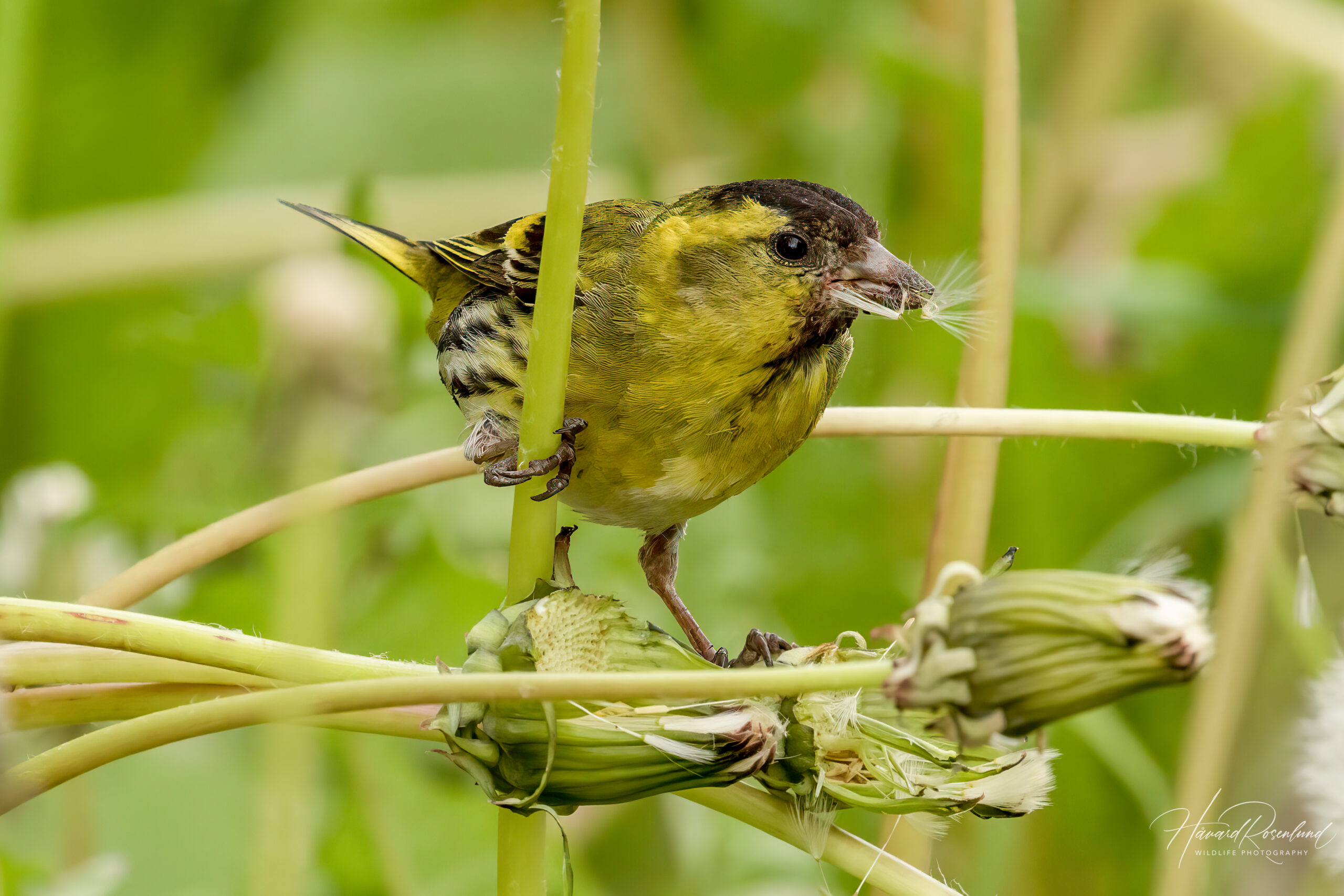
Small tree seeds dominate the diet. Conifer seed is especially important during breeding, while alder and birch become major resources later in the year. Small insects and other invertebrates are also taken in spring and summer and are particularly important for growing chicks.
The fine pointed bill and highly agile feet allow siskins to reach seeds that larger finches exploit less efficiently. Birds frequently cling sideways or upside down to cones, catkins and slender branches while extracting individual seeds. Garden feeders become increasingly attractive when natural seed crops are depleted.
Social behaviour
Outside breeding, siskins are highly social and commonly feed in mobile flocks. An experiment published in 1990 found that birds became more tolerant of familiar flock-mates as social relationships stabilised, even though the flocks retained clear dominance relationships.
The small black bib of males is more than a plumage mark. An experiment published in 1998 showed that its size can act as a badge of social status, allowing siskins to assess unfamiliar males before overt aggression occurs. Such visible signals can reduce the need for repeated conflicts around concentrated food.
Migration
Eurasian siskins combine regular seasonal migration with highly flexible, food-driven movements. Northern and eastern birds often move south and west in autumn, but the number travelling and their winter destinations vary greatly from year to year according to seed crops.
When food is abundant, many birds may remain surprisingly far north; when cone, alder or birch crops fail, invasion-like movements can carry large numbers far beyond the areas where they were common the previous year. Individual birds can also differ greatly in how nomadic they are.
A study published in 2021 in Scottish conifer plantations found that poor spruce cone crops were associated with later breeding and with birds leaving the plantations to search for alternative food, whereas heavy cone crops supported earlier breeding. Some individuals are strongly site-faithful, while others shift breeding areas between years, so the species combines nomadism with substantial individual variation.
Breeding
The female builds a small, carefully concealed cup nest high in a conifer, using fine twigs, grass, moss and plant fibres and lining it with softer material. Breeding timing is closely linked to conifer seed availability, and good seed years can bring earlier nesting.
A typical clutch contains 4–5 eggs. The female incubates for about 12–13 days while the male supplies food, and both parents feed the chicks after hatching. The young leave the nest after roughly 13–15 days. Two broods are typical where conditions and food supplies allow.
Status
The Eurasian siskin is classified as least concern on the IUCN Red List. It has a very large Eurasian range and remains numerous overall.
Numbers at any one locality can fluctuate enormously as birds redistribute themselves according to seed crops. A sharp local fall can therefore reflect movement rather than a comparable decline in the wider population.
Image gallery
Loading map and observations…
Have you seen this species?
Independent species archive
Did you find this species page useful?
Wildlife Vagabond is independently built and maintained. Voluntary support helps cover hosting, maps, data storage and continued improvements to the species archive.
Support Wildlife VagabondSpecies content will remain freely available.
References
Information about the species’ global distribution and status is based primarily on global Red List data. See the references below for details.
- BirdLife International. (n.d.). Eurasian Siskin species factsheet. https://datazone.birdlife.org/species/factsheet/eurasian-siskin-spinus-spinus
- British Trust for Ornithology. (n.d.). Siskin. https://www.bto.org/learn/about-birds/birdfacts/siskin
- Furness, E. N., & Furness, R. W. (2021). Effects of Sitka spruce masting on phenology and demography of siskins Spinus spinus. Scientific Reports, 11(1), 4921. https://doi.org/10.1038/s41598-021-84471-8
- International Union for Conservation of Nature. (n.d.). Eurasian Siskin. The IUCN Red List of Threatened Species. https://www.iucnredlist.org/species/22720354/111126041
- Senar, J. C., & Camerino, M. (1998). Status signalling and the ability to recognize dominants: an experiment with siskins (Carduelis spinus). Proceedings of the Royal Society of London. Series B: Biological Sciences, 265(1405), 1515-1520. https://doi.org/10.1098/rspb.1998.0466
- Senar, J. C., Camerino, M., & Metcalfe, N. B. (1990). Familiarity Breeds Tolerance: the Development of Social Stability in Flocking Siskins (Carduelis spinus). Ethology, 85(1), 13-24. https://doi.org/10.1111/j.1439-0310.1990.tb00381.x