
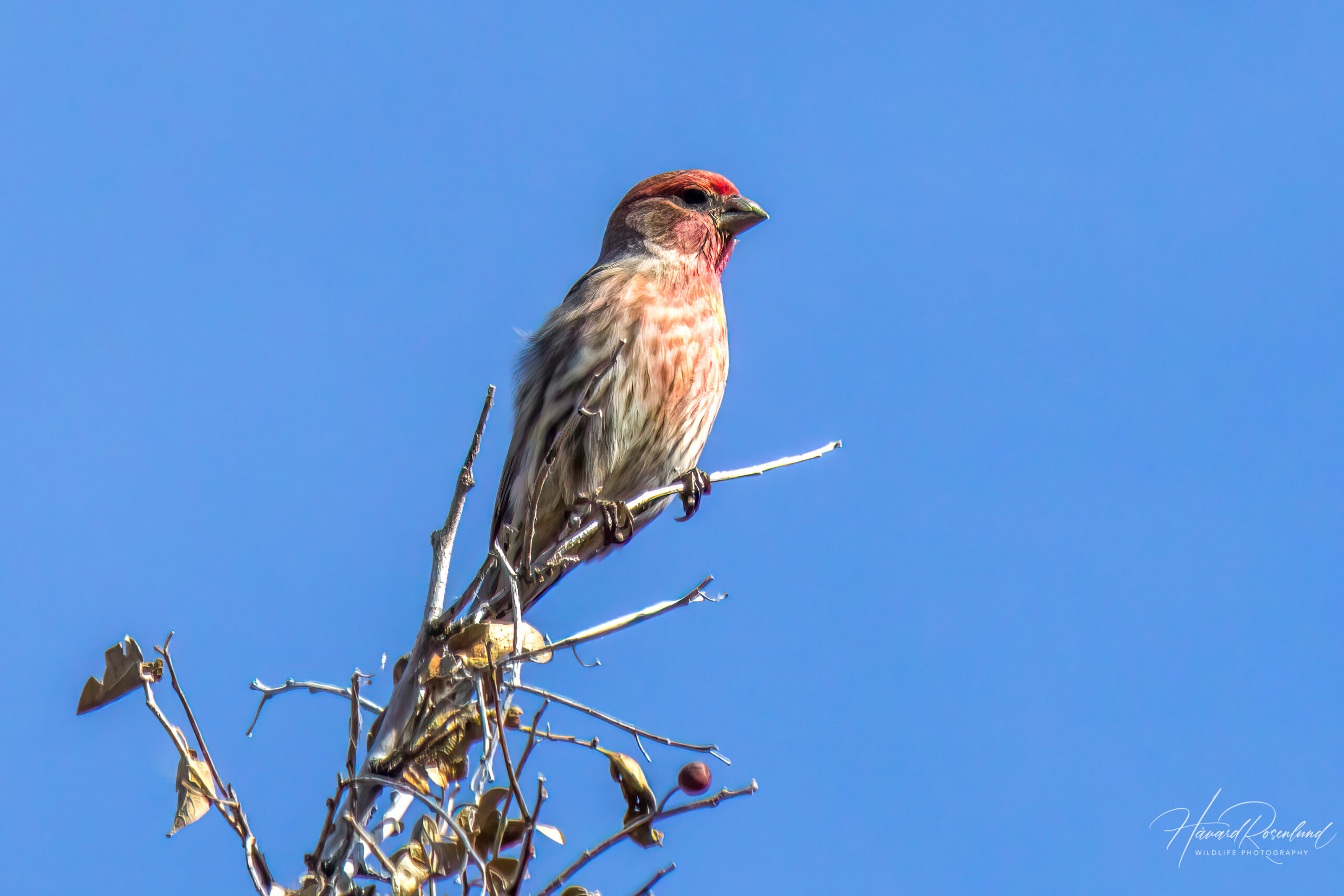
House Finch
Haemorhous mexicanus
At a glance
Habitat
- Desert, chaparral, open woodland, farms, suburbs, towns and gardens
Diet
- Mostly seeds, buds, berries and fruit; very little animal food
Activity
- Diurnal
Size
- Length: 13–14 cm Weight: 16–27 g
Range
- Native to western North America and Mexico; now widespread across most of the United States and southern Canada
Description
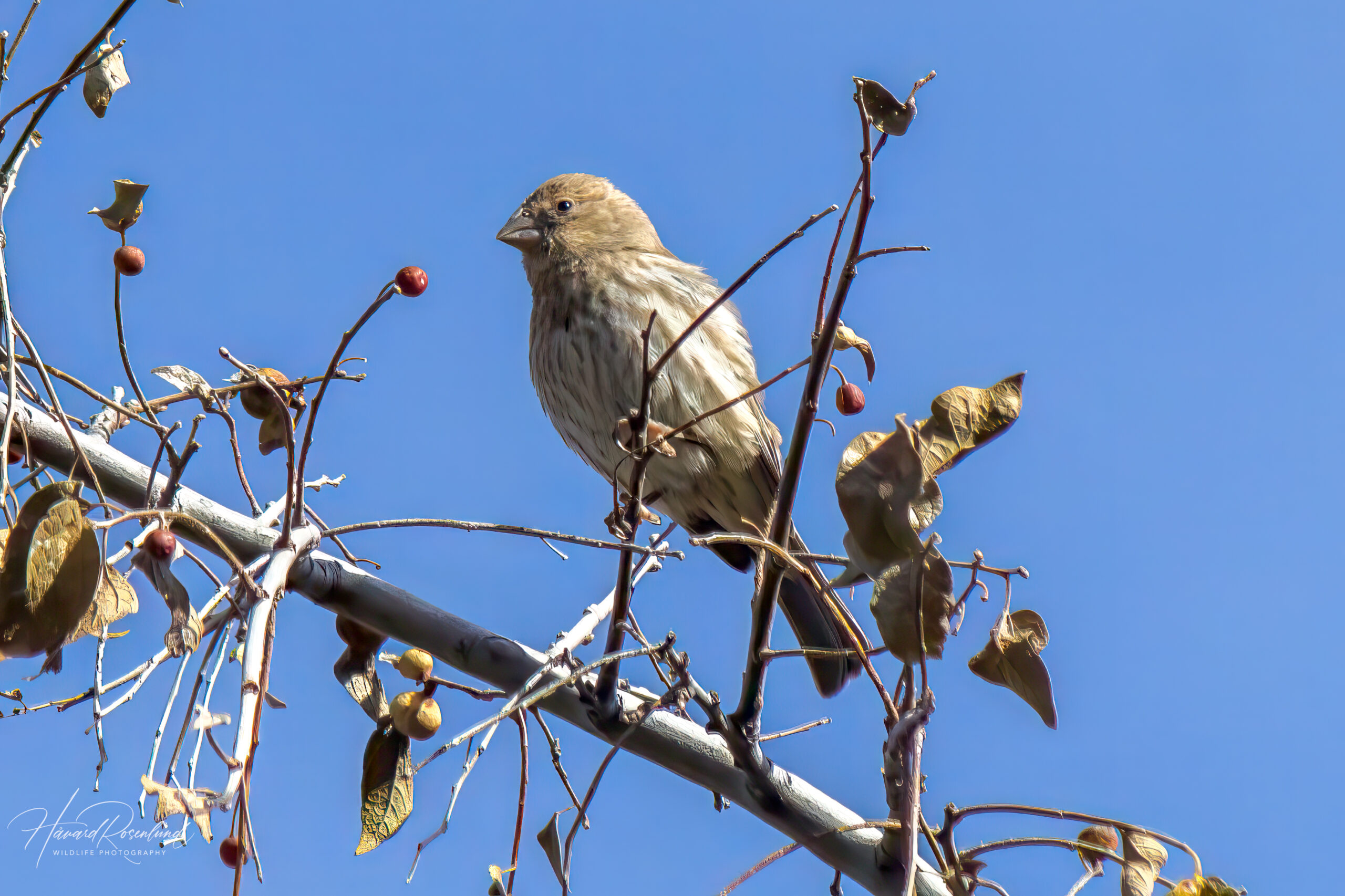
The house finch (Haemorhous mexicanus) is a small, stocky finch with a short conical bill. Adults are about 13–14 cm long, have a wingspan of roughly 20–25 cm and weigh about 16–27 g. Females and young birds are brown and heavily streaked below. Adult males have red colouring across the forehead, eyebrow, throat and upper breast, although individuals can range from deep red through orange to yellow.
The colour comes from carotenoid pigments obtained from food during moult, so diet directly influences the plumage a male can produce. A field study published in 2002 found that the carotenoids available while new feathers were growing strongly predicted their final colour. The rest of the male remains brown and streaked rather than becoming uniformly red.
Where it overlaps with the Purple Finch (Haemorhous purpureus), male House Finches usually retain more brown on the face and a distinctly streaked brown back and flanks, while male Purple Finches are more extensively washed red over the head, neck and back. Female and immature House Finches also have a plainer face and blurrier underpart streaking than Purple Finches.
Habitat
House finches are native to dry western landscapes including desert, chaparral, grassland and open woodland, but they have become exceptionally successful around people. Farms, towns, suburbs, gardens, parks and forest edges now support large populations, especially where ornamental plants and bird feeders provide food.
The species needs little specialised habitat structure and readily nests on both vegetation and buildings. This flexibility has allowed it to occupy densely settled landscapes that differ greatly from many of its original western habitats.
Diet
The diet is overwhelmingly plant-based and includes seeds, buds, berries and fruit. Sunflower and thistle seeds are readily taken at feeders, while fruits and berries also provide the carotenoid pigments used in male plumage. Animal food forms only a small part of the diet.
House finches forage in shrubs and trees, on seed-bearing plants and on the ground, and readily exploit bird feeders and other concentrated food sources around people. The short conical bill is well suited to removing and cracking small seeds, while fruit and soft plant material are taken directly from vegetation.
Unusually for a songbird, even rapidly growing nestlings are fed almost entirely plant material rather than being provisioned heavily with insects. Adults soften and regurgitate seeds and other plant foods for the young.
Behaviour
House finches are social birds. Outside breeding they often feed and move in flocks that can contain dozens or hundreds of individuals. Around feeders and fruiting trees they tolerate close contact, although small dominance disputes are common.
Song is another conspicuous part of their behaviour. Males produce long, varied warbling songs, and how much they sing changes with the social setting as well as with the male’s own plumage colour. Song therefore functions as a flexible social signal rather than simply switching on when nest building begins.
Breeding
House finches form monogamous pairs during breeding. Courtship includes a feeding display in which the male eventually regurgitates food to the female. An experiment published in 1991 showed that females generally preferred redder, more intensely coloured males, linking carotenoid-based plumage directly to sexual selection.
The female builds a cup nest in an unusually wide variety of sites, including trees, cacti, shrubs, rock ledges, hanging planters, street lamps and sheltered ledges or cavities on buildings. The nest is made from fine stems, grasses, leaves, rootlets, fibres and feathers.
Clutches contain 2–6 eggs. The female incubates for about 13–14 days, and the young remain in the nest for roughly 12–19 days. Several broods may be attempted during a long breeding season, particularly in warm regions.
Introduced populations
House finches were originally native to western North America and Mexico. Their modern eastern range began with a very small introduced population: birds taken from the West were sold illegally as cage birds around New York under the name “Hollywood finches”, and a small number were released on Long Island around 1940. They established quickly and spread across almost the entire eastern United States and southern Canada within about five decades.
A separate introduction to Hawaii occurred during the nineteenth century. The extraordinary mainland expansion illustrates how effectively the species exploits towns, gardens, farms and year-round human food sources.
Disease
In 1994, severe conjunctivitis caused by the bacterium Mycoplasma gallisepticum emerged in wild house finches in the eastern United States after the bacterium crossed from poultry into wild finches. The disease causes swollen, inflamed eyes that can interfere with feeding and predator detection. It spread rapidly across eastern North America and caused house finch abundance there to fall by roughly half.
Recent research published in 2025 shows how differently the pathogen has evolved after spreading through separate house finch populations. Virulence increased during its spread through the eastern population, whereas lineages that later reached the western United States followed a different trajectory and became less virulent. A separate 2025 study also found genetically distinct M. gallisepticum lineages in Mexican house finches, showing that the disease system continues to evolve across the species’ range.
Status
The house finch is classified as least concern on the IUCN Red List. It remains widespread and abundant across a very large North American range.
Across North America, monitoring indicates a slight long-term decline between 1966 and 2019. Regional disease effects and other population changes can therefore be substantial even though the species remains globally secure.
Image gallery
Loading map and observations…
Have you seen this species?
Independent species archive
Did you find this species page useful?
Wildlife Vagabond is independently built and maintained. Voluntary support helps cover hosting, maps, data storage and continued improvements to the species archive.
Support Wildlife VagabondSpecies content will remain freely available.
References
Information about the species’ global distribution and status is based primarily on global Red List data. See the references below for details.
- BirdLife International. (n.d.). House Finch species factsheet. https://datazone.birdlife.org/species/factsheet/house-finch-haemorhous-mexicanus
- Cornell Lab of Ornithology. (n.d.). House Finch. https://www.allaboutbirds.org/guide/House_Finch/overview
- Dhondt, A. A., Dobson, A. P., Dhondt, K. V., Hochachka, W. M., Ellner, S. P., & Hawley, D. M. (2025). Alternate evolutionary trajectories following a pathogen spillover into a novel host: The case of <i>Mycoplasma gallisepticum</i> in house finches (<i>Haemorhous mexicanus</i>). Journal of Wildlife Diseases, 61(4). https://doi.org/10.7589/JWD-D-24-00098
- Henderson, L. J., Brazeal, K. R., & Hahn, T. P. (2018). Plumage coloration and social context influence male investment in song. Biology letters, 14(7), 20180300. https://doi.org/10.1098/rsbl.2018.0300
- Hill, G. E., Inouye, C. Y., & Montgomerie, R. (2002). Dietary carotenoids predict plumage coloration in wild house finches. Proceedings of the Royal Society B, 269(1496), 1119–1124. https://doi.org/10.1098/rspb.2002.1980
- Hill, G. E. (1991). Plumage coloration is a sexually selected indicator of male quality. Nature, 350(6316), 337-339. https://doi.org/10.1038/350337a0
- International Union for Conservation of Nature. (n.d.). House Finch. The IUCN Red List of Threatened Species. https://www.iucnredlist.org/species/22720563/132001810
- Reinoso-Pérez, M. T., Díaz Ávila, L. E., García Jacobo, S., Rodríguez-García, V. M., & Dhondt, A. A. (2025). Emerging genetic diversity of Mycoplasma gallisepticum in Mexican house finches: Evidence of possible independent spillover events. Infection, Genetics and Evolution, 132, 105761. https://doi.org/10.1016/j.meegid.2025.105761