
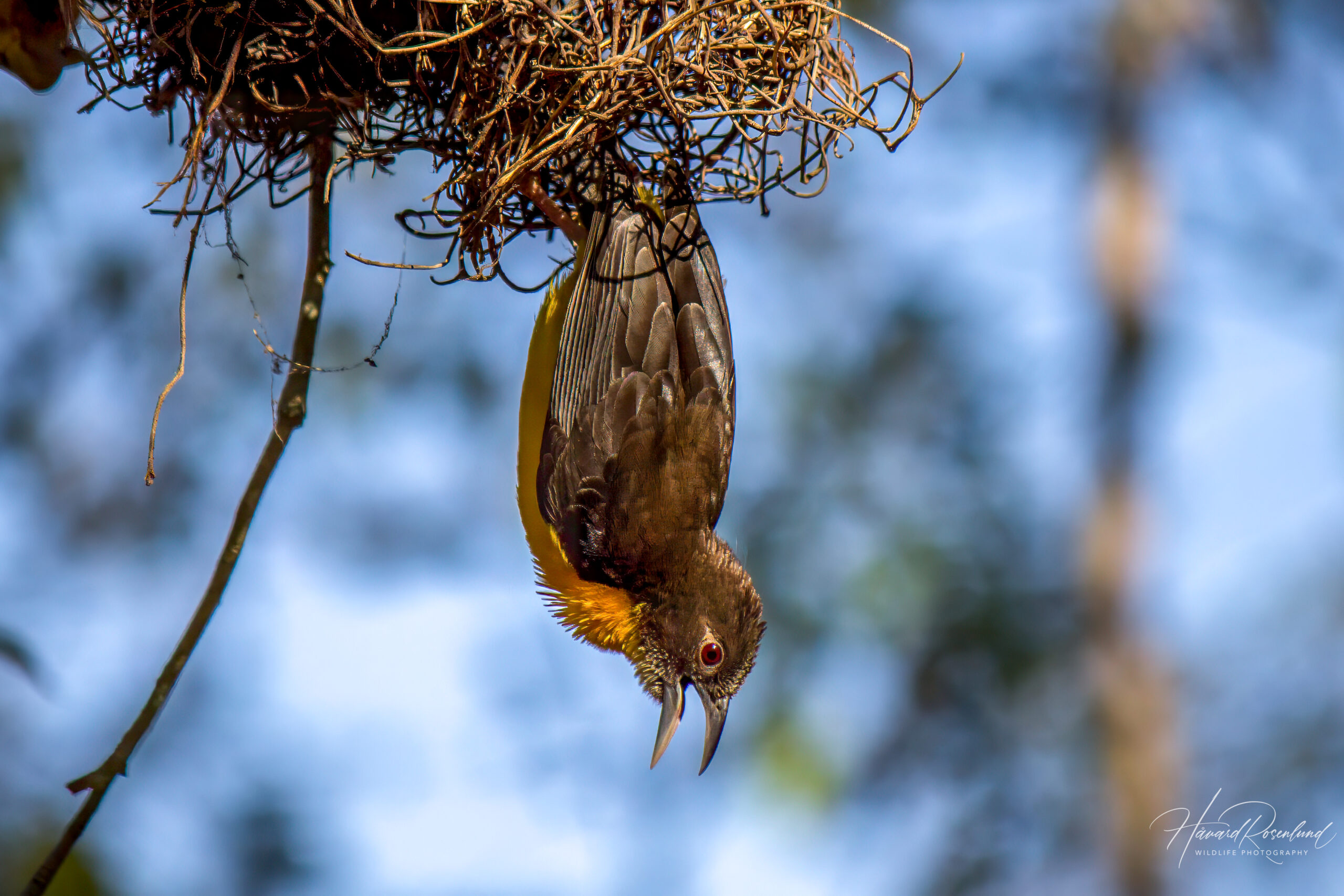
Dark-backed Weaver
Ploceus bicolor
At a glance
Habitat
- Moist lowland and montane forest, forest edge, riverine woodland, plantations and well-treed gardens
Diet
- Arthropods, supplemented with fruit, nectar and flowers
Activity
- Diurnal; mainly a canopy forager
Size
- Length: 15–17 cm Weight: about 35 g
Range
- Patchily distributed through forested parts of sub-Saharan Africa
Description
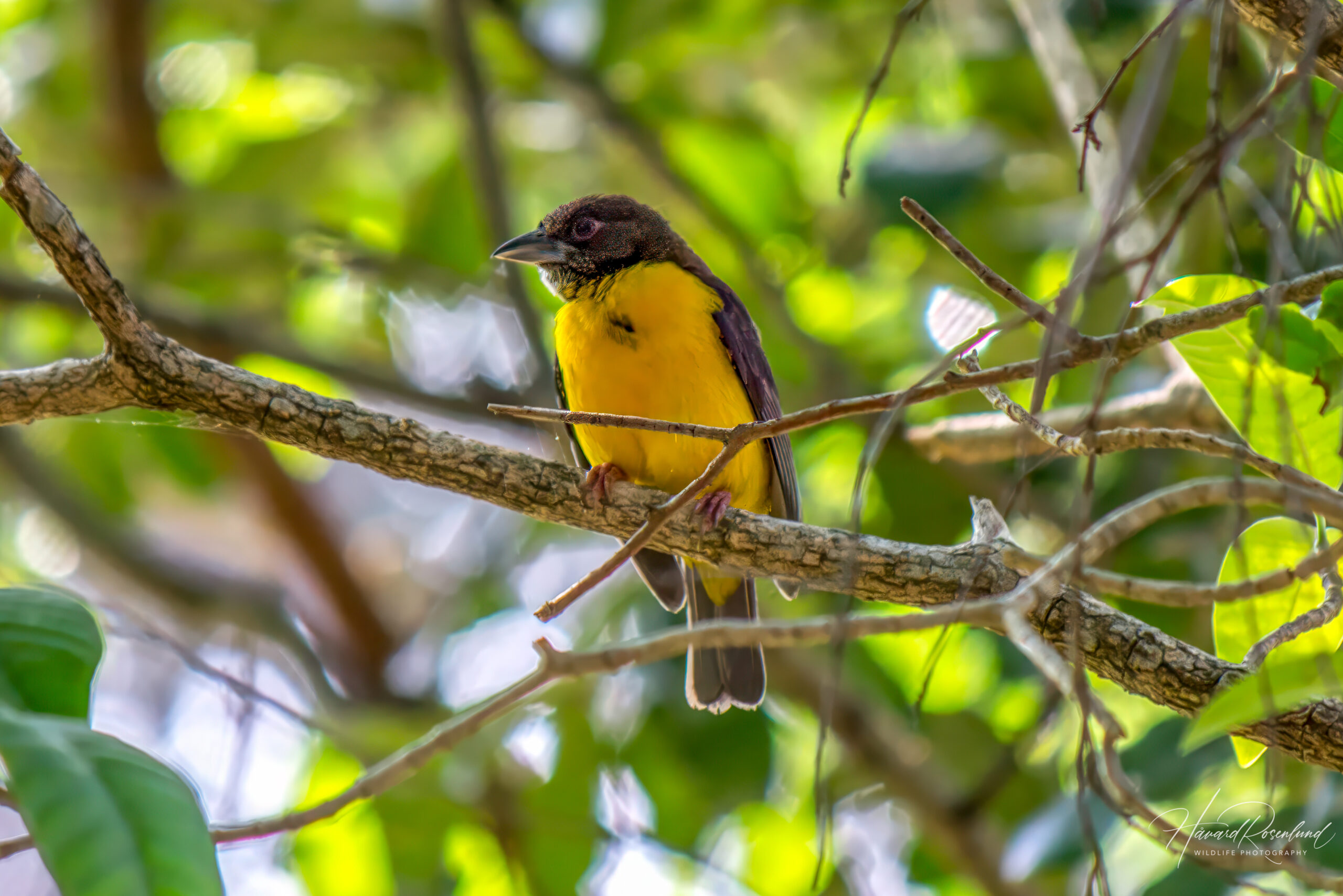
The dark-backed weaver or forest weaver (Ploceus bicolor) is a forest-dwelling weaver with a patchy distribution across sub-Saharan Africa. Adults are about 15–17 cm long and weigh around 35 g. Both sexes look similar, with a dark brown to almost black head and upperparts contrasting sharply with bright yellow underparts. The bill is fairly heavy but less conical than in many seed-eating weavers.
Habitat
Dark-backed weavers inhabit moist lowland and montane forest, forest edges, riverine woodland and other densely wooded habitats. They also use plantations and well-treed gardens where canopy cover and tangled vegetation remain.
The species is much more closely tied to woodland and forest than many familiar open-country weavers. Dense foliage provides feeding surfaces, nest sites and cover, while local clearing and fragmentation can reduce suitable habitat even where isolated trees remain.
Diet
Arthropods, especially insects and spiders, form an important part of the diet. Fruit, nectar and flowers are also taken, giving the species a flexible diet within forest canopies.
Foraging
Dark-backed weavers forage methodically through foliage, picking invertebrates from leaves, bark, branches and twigs. They often hang at unusual angles while inspecting leaf surfaces and other small crevices for prey.
They may join mixed-species feeding flocks and occasionally catch insects in short aerial sallies. Although most feeding is arboreal, birds can also descend lower into the vegetation when prey becomes locally abundant.
Behaviour
Dark-backed weavers usually occur singly or as territorial pairs rather than in the conspicuous breeding colonies associated with many other weavers. Pair bonds can persist for several years, and partners remain in close contact through calls while moving through dense vegetation.
Coordinated duetting is particularly characteristic. Pair members can deliver closely matched song elements almost simultaneously, producing a combined territorial signal that carries through forest where visual contact is often limited. The duets appear to help both maintain contact between partners and advertise an occupied territory.
Breeding
Dark-backed weavers are monogamous and normally nest as isolated pairs rather than in colonies. Breeding timing varies geographically; in southern Africa egg-laying occurs mainly from September to February, peaking in November–December. The nest is one of the species' most distinctive features: construction begins with a woven ring and develops into a retort-shaped chamber with a long, narrow entrance tube. Stiff vines, creepers and other plant fibres form the outer structure, with softer material added inside. Both members of the pair may contribute, although one bird often performs most of the weaving.
Nests are usually placed singly in forest vegetation, often several metres above the ground. Clutches contain two to four eggs. Captive observations indicate an incubation period of about 15–17 days, with both sexes taking turns incubating. Both parents feed the chicks. The young leave the nest at about 22 days but may remain dependent on the adults for several more weeks.
Status
The dark-backed weaver is classified as least concern on the IUCN Red List. It has a broad but patchy distribution across forested parts of sub-Saharan Africa and remains locally common in suitable habitat.
Its dependence on wooded vegetation means that clearing and degradation of forest and riverine habitat can reduce populations locally. The ability to use plantations and well-treed gardens provides some flexibility, but these modified habitats do not provide the same varied forest structure as native forest.
Image gallery
Loading map and observations…
Have you seen this species?
Independent species archive
Did you find this species page useful?
Wildlife Vagabond is independently built and maintained. Voluntary support helps cover hosting, maps, data storage and continued improvements to the species archive.
Support Wildlife VagabondSpecies content will remain freely available.
References
Information about the species’ global distribution and status is based primarily on global Red List data. See the references below for details.
- Biodiversity Explorer – Ploceus bicolor. (n.d.). habitat, diet and breeding, based on Roberts Birds of Southern Africa. https://www.biodiversityexplorer.info/birds/ploceidae/ploceus_bicolor.htm
- BirdLife International. (n.d.). Dark-backed Weaver species factsheet. https://datazone.birdlife.org/species/factsheet/dark-backed-weaver-ploceus-bicolor
- Birds4Africa – Dark-backed Weaver. (n.d.). pair bonds, duetting and breeding biology. https://birds4africa.org/weaver-research/weavers/790a/
- International Union for Conservation of Nature. (n.d.). Dark-backed Weaver (Ploceus bicolor). The IUCN Red List of Threatened Species. https://www.iucnredlist.org/species/22719017/132123985