
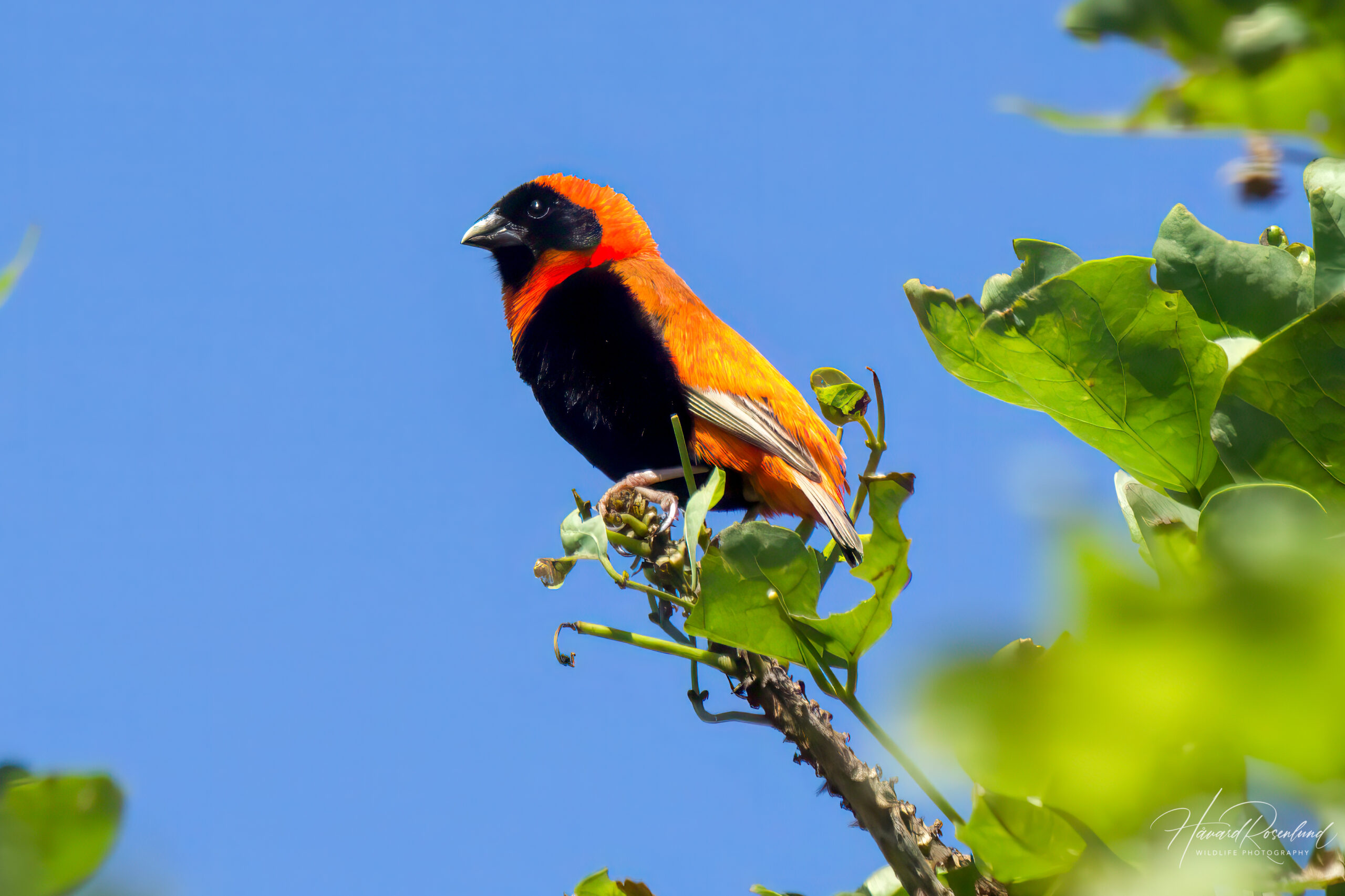
Southern Red Bishop
Euplectes orix
At a glance
Habitat
- Reedbeds, wetlands, damp grassland and other tall grassy vegetation
Diet
- Mostly grass and other seeds; insects are also taken
Activity
- Diurnal
Size
- Length: 13 cm Weight: 23 g
Range
- Eastern and southern Africa from Angola, DRC and Kenya south to South Africa
Description
The southern red bishop (Euplectes orix) is a small African weaver best known for the dramatic seasonal transformation of adult males. It is about 13 cm long and weighs around 23 g. During breeding, the male becomes bright vermilion-red with a velvety black face, throat and belly; the narrow black forehead helps distinguish it from other red bishops. Females and non-breeding males are much less conspicuous, with streaked brown plumage and a pale eyebrow.
The species is widespread across eastern and southern Africa. Outside the breeding season the sexes look much more similar, and large groups of brown-plumaged birds can be far less conspicuous than the brilliant breeding males.
Habitat
Southern red bishops are closely associated with wetlands, reedbeds, damp grassland and other habitats with tall grasses, sedges or reeds. These plants provide both food and the flexible stems used for nest construction.
Outside breeding the birds disperse more widely into grassland, scrub and cultivated areas. Breeding colonies depend especially on dense, upright vegetation where males can establish small territories and suspend multiple nests.
Diet
The diet is dominated by small grass seeds and other seeds. Insects and other small invertebrates are also taken, becoming especially important when chicks are growing.
Southern red bishops feed both on the ground and while clinging directly to grass and reed stems, removing seeds from standing seed heads as well as picking fallen food below. This allows them to exploit dense seeding vegetation without relying only on what reaches the ground.
Behaviour
Outside breeding, southern red bishops are highly social and can gather in large flocks, sometimes together with other seed-eating birds. Feeding groups move between grasslands, wetlands and cultivated areas according to local seed availability.
Breeding males become much more conspicuous. Territorial birds give a characteristic buzzing song and other calls, often from prominent stems within the colony. Courtship includes a slow, bumblebee-like display flight with the body feathers raised. Together with the vivid red-and-black plumage and repeated nest building, these displays are used to attract females and compete with neighbouring males.
Breeding
Breeding is strongly influenced by rainfall and the growth of fresh nesting vegetation. The species is colonial and polygynous, with successful males mating with several females. During breeding, males defend small territories in reedbeds or tall grass and construct multiple oval nests from fresh grass or reed strips. Nests are typically attached to reeds, sedges or bulrushes and are often suspended above water, although sites over dry ground and in crops are also used.
The male leaves the nests incomplete. Females inspect the available structures and, after choosing one, add lining and finish the nest for egg laying. A 2009 study found that males that built more nests achieved greater mating success. Earlier work on female settlement found no simple preference for males with more nests: settlement was largely consistent with random choice among available territories, although females chose already occupied territories more often than expected in three of four years.
Clutches usually contain 2–4 eggs, most often three. The female incubates alone for about 12–13 days and is responsible for feeding the chicks. Young normally leave the nest after roughly 11–15 days. A successful male may have several females nesting within his territory during the same breeding season.
Status
The southern red bishop is classified as least concern on the IUCN Red List. It has a very large range, remains common in many suitable wetland and grassland habitats across eastern and southern Africa, and the global population trend is considered stable.
The species also uses some agricultural and other human-modified landscapes, and no major threat is currently known across its range.
Image gallery
Loading map and observations…
Have you seen this species?
Independent species archive
Did you find this species page useful?
Wildlife Vagabond is independently built and maintained. Voluntary support helps cover hosting, maps, data storage and continued improvements to the species archive.
Support Wildlife VagabondSpecies content will remain freely available.
References
Information about the species’ global distribution and status is based primarily on global Red List data. See the references below for details.
- BirdLife International. (n.d.). Southern Red Bishop species factsheet. https://datazone.birdlife.org/species/factsheet/southern-red-bishop-euplectes-orix
- Friedl, T. W. P., & Klump, G. M. (2000). Nest and mate choice in the red bishop (Euplectes orix) : female settlement rules. Behavioral Ecology, 11(4), 378-386. https://doi.org/10.1093/beheco/11.4.378
- International Union for Conservation of Nature. (n.d.). Southern Red Bishop. The IUCN Red List of Threatened Species. https://www.iucnredlist.org/species/22719186/131991711
- Klump, G., Metz, M., & Friedl, T. (2009). Male nest-building behaviour and mating success in the red bishop (Euplectes orix). Behaviour, 146(6), 771-794. https://doi.org/10.1163/156853909X446208
- Oiseaux.net. (n.d.). Southern Red Bishop. https://www.oiseaux.net/en/southern.red.bishop.html
- South African National Biodiversity Institute. (n.d.). Southern Red Bishop. https://www.sanbi.org/animal-of-the-week/southern-red-bishop/