
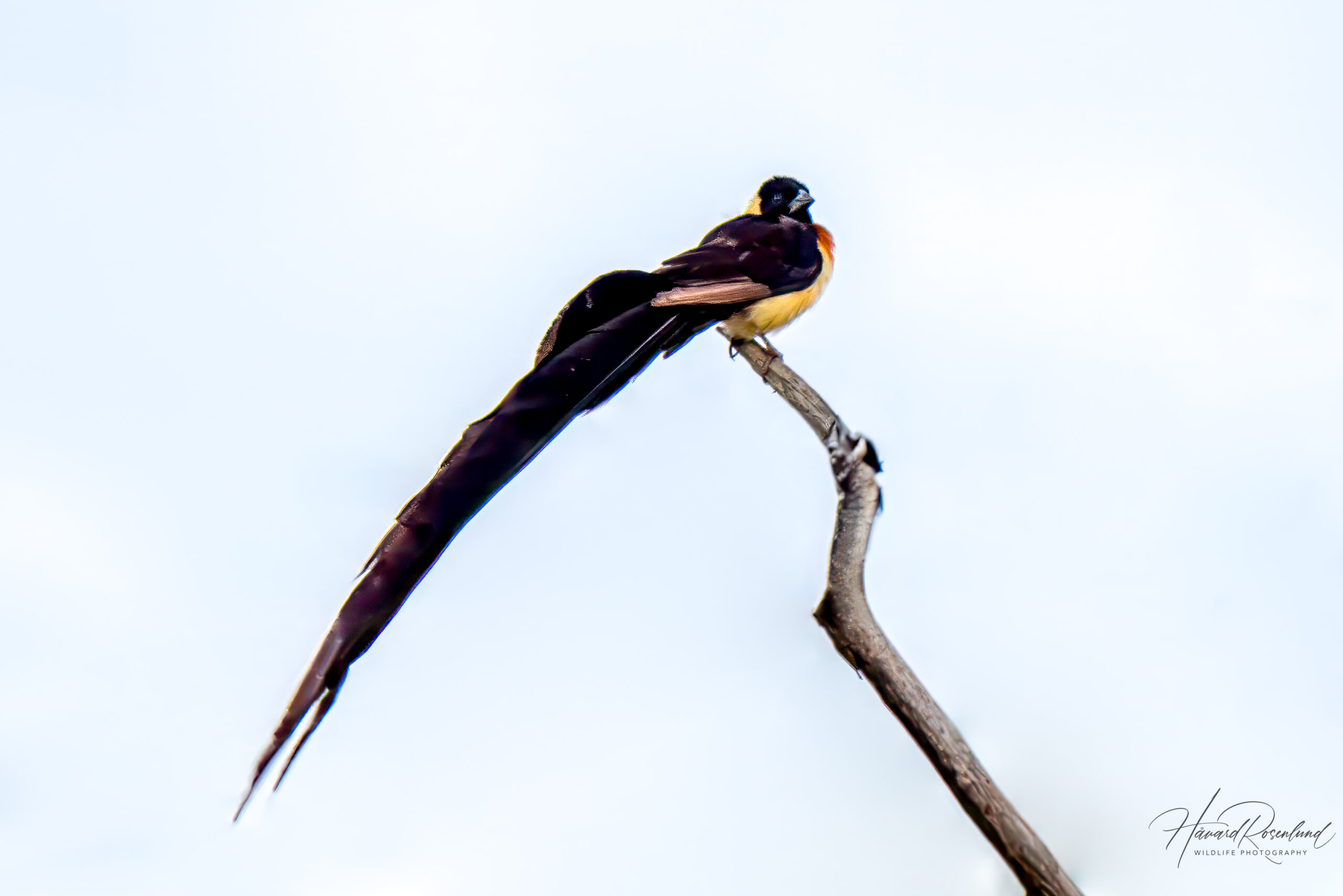
Long-tailed Paradise Whydah
Vidua paradisaea
At a glance
Habitat
- Dry savanna, grassland, shrubland and open woodland where its host occurs
Diet
- Mostly grass seeds and other small seeds; some insects
Activity
- Diurnal
Size
- Length: 13–14 cm body; breeding male tail up to 36 cm Weight: 18–24 g
Range
- Eastern and southern sub-Saharan Africa, from Ethiopia south to South Africa and west to Angola
Description
The long-tailed paradise whydah (Vidua paradisaea) is one of Africa's most spectacular brood-parasitic finches. Outside the breeding season both sexes are far less conspicuous, with streaked brown plumage and short tails. A breeding male transforms dramatically: the head and back become black, the nape golden-yellow, the breast chestnut-red and the belly pale, while four central tail feathers become enormously elongated and can reach about 36 cm.
The normal body length is roughly 13–14 cm and adults weigh about 18–24 g. Females retain cryptic brown plumage throughout the year. Females and non-breeding males can be difficult to separate from other whydahs where several species occur together, whereas the combination of colour pattern and enormously elongated tail makes a breeding male highly distinctive.
Habitat
Long-tailed paradise whydahs inhabit dry savanna, grassland, shrubland and lightly wooded country across eastern and southern Africa. They favour open landscapes with abundant grasses and scattered trees or bushes that provide feeding and display sites.
Their distribution is also tightly linked to that of their specialist host, the green-winged pytilia (Pytilia melba). Suitable vegetation alone is therefore not enough for a breeding population: females must also have access to pytilia nests in which to lay their eggs.
Diet
Adults feed mainly on small grass seeds and other seeds, with insects and other small invertebrates taken occasionally.
Most food is collected from the ground or low vegetation. Birds often forage in open patches below grass stems and around sparse cover, picking up fallen seed with the short conical bill. Outside the breeding season paradise whydahs may join loose groups with other seed-eating birds and exploit locally abundant seed crops without maintaining the conspicuous individual display territories used by breeding males.
Breeding
The long-tailed paradise whydah does not build a nest or rear its own young. It is a specialist brood parasite of the green-winged pytilia (Pytilia melba). A female lays in a host nest, where her chick is raised alongside the pytilia's own young. Unlike many brood-parasitic cuckoos, young whydahs do not normally evict or kill their foster nestmates.
Breeding males display with floating flights that emphasise the elongated tail and with songs containing remarkably accurate imitations of green-winged pytilia vocalisations. In an experiment published in 1973, females responded both to genuine pytilia song and to the males' imitations, so learned host song also becomes part of mate choice.
This connection begins during development. Young whydahs are raised by pytilias and imprint on their foster species. Later, males reproduce host-derived vocalisations and females use those signals both when choosing mates and when locating the appropriate host for their own eggs. Across Vidua, being raised by an unusual foster species can redirect later song, mate choice and host choice toward that species, showing how powerful this early learning can be.
The chicks are also adapted to living among host young. Like other specialised Vidua, they match important features of the host's conspicuous mouth and gape pattern and its begging display. Such host mimicry can involve colour, pattern, sound and movement and helps the parasitic chick receive normal parental care alongside the host brood.
Status
The long-tailed paradise whydah is classified as least concern on the IUCN Red List and has a broad distribution across eastern and southern Africa.
Its specialised breeding biology nevertheless creates a strong local dependency: reproductive populations require healthy green-winged pytilia populations as well as suitable savanna, grassland and open woodland. Changes that remove either the host or its habitat can therefore eliminate the whydah locally even when seed food remains available.
Image gallery
Loading map and observations…
Have you seen this species?
Independent species archive
Did you find this species page useful?
Wildlife Vagabond is independently built and maintained. Voluntary support helps cover hosting, maps, data storage and continued improvements to the species archive.
Support Wildlife VagabondSpecies content will remain freely available.
References
Information about the species’ global distribution and status is based primarily on global Red List data. See the references below for details.
- BirdLife International. (n.d.). Long-tailed Paradise Whydah species factsheet. https://datazone.birdlife.org/species/factsheet/long-tailed-paradise-whydah-vidua-paradisaea
- Hauber, M. E., & Kilner, R. M. (2007). Coevolution, communication, and host chick mimicry in parasitic finches: who mimics whom? Behavioral Ecology and Sociobiology, 61(4), 497-503. https://doi.org/10.1007/s00265-006-0291-0
- International Union for Conservation of Nature. (n.d.). Long-tailed Paradise Whydah. The IUCN Red List of Threatened Species. https://www.iucnredlist.org/species/22720012/132135621
- Jamie, G. A., Van Belleghem, S. M., Hogan, B. G., Hamama, S., Moya, C., Troscianko, J., Stoddard, M. C., Kilner, R. M., & Spottiswoode, C. N. (2020). Multimodal mimicry of hosts in a radiation of parasitic finches*. Evolution, 74(11), 2526-2538. https://doi.org/10.1111/evo.14057
- Payne, R. B., & Sorenson, M. D. (2004). Behavioral and Genetic Identification of a Hybrid Vidua: Maternal Origin and Mate Choice in a Brood-Parasitic Finch. The Auk, 121(1), 156–161. https://doi.org/10.1093/auk/121.1.156
- Payne, R. (1973). Vocal mimicry of the paraside whydahs (Vidua) and response of female whydahs to the songs of their hosts (Pytilia) and their mimics. Animal Behaviour, 21(4), 762-771. https://doi.org/10.1016/S0003-3472(73)80102-2
- Store norske leksikon. (n.d.). Grønnvingeastrild. https://snl.no/grønnvingeastrild
- Store norske leksikon. (n.d.). Paradisenke. https://snl.no/paradisenke