
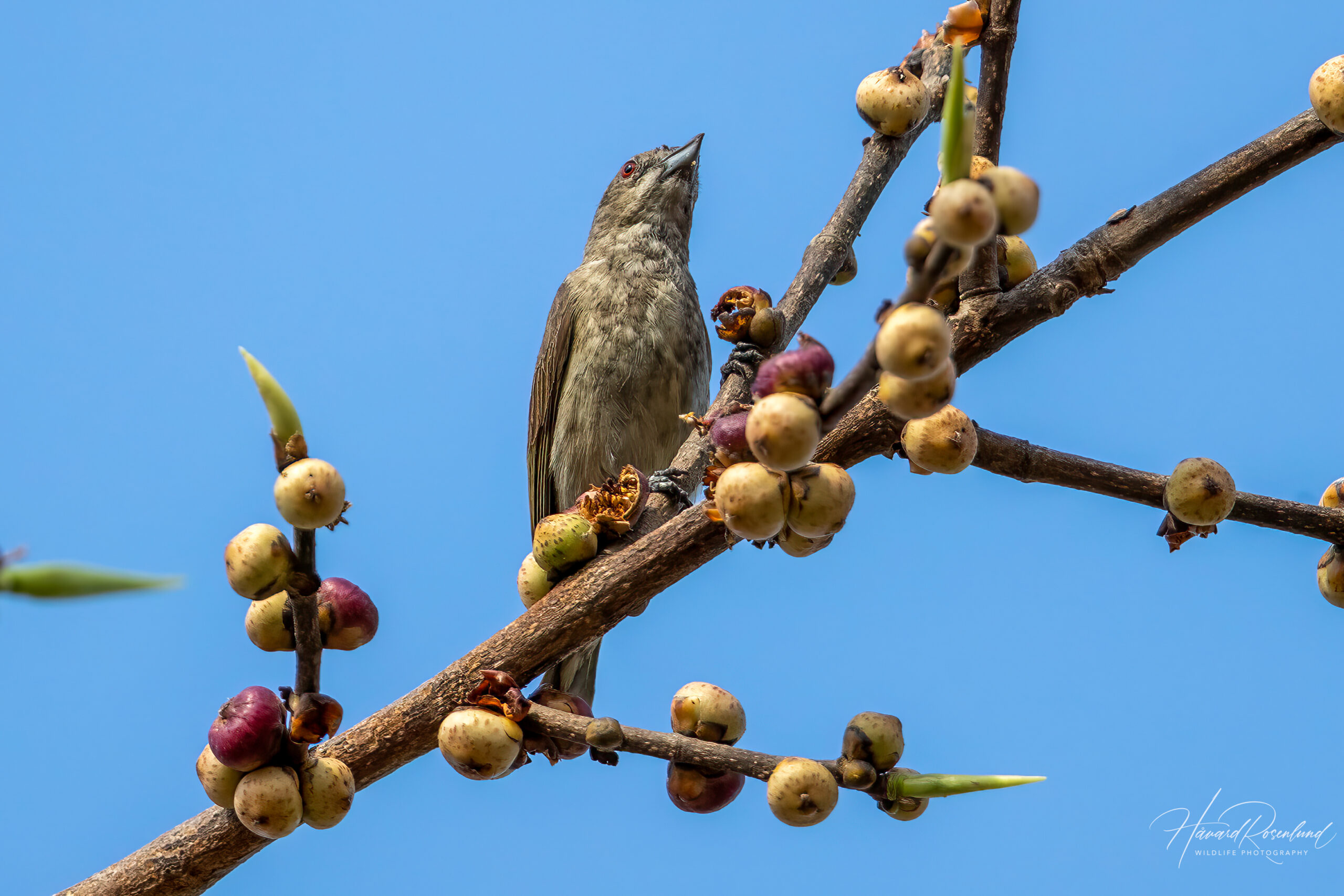
Thick-billed Flowerpecker
Pachyglossa agilis
At a glance
Habitat
- Forest, open woodland, forest edge, plantations, orchards and other well-wooded habitats
Diet
- Fruit and berries, especially mistletoe; also nectar, spiders and insects
Activity
- Diurnal
Size
- Length: 9–11 cm Weight: 8–9 g
Range
- South and Southeast Asia; current IOC/AviList treatment extends from the Indian subcontinent east through the Indo-Malayan region to the Philippines and Lesser Sundas
Description
The thick-billed flowerpecker (Pachyglossa agilis) is a tiny flowerpecker widespread across South and Southeast Asia. Adults are about 9–11 cm long and weigh roughly 8–9 g. Birds of the Indian nominate group are grey-brown to olive above and pale below with diffuse streaking, with a short tail, reddish iris and a notably stout dark bill. The sexes are very similar.
In India, one of the most likely sources of confusion is the pale-billed flowerpecker (Dicaeum erythrorhynchos). That species is generally smaller and plainer and has a conspicuously pale flesh-coloured bill, whereas the thick-billed flowerpecker has a heavier dark bill and more obvious streaking below.
Taxonomy
The species was long known as Dicaeum agile. Molecular work showed that the traditional genus Dicaeum was not a natural single lineage, and current AviList treatment places the species in the resurrected genus Pachyglossa as Pachyglossa agilis.
The species boundary has also changed. Taxa formerly treated by some authorities as the striped flowerpecker are included within the present thick-billed flowerpecker complex, so the modern species extends farther through Southeast Asia and the Philippines than the narrower treatment found in many older field guides. Older IUCN, BirdLife and research sources may therefore use both the former genus Dicaeum and somewhat different species limits.
Habitat
Thick-billed flowerpeckers use a wide range of wooded habitats, including deciduous and evergreen forest, forest edge, plantations, orchards and well-wooded gardens. They are resident across most of their range and often concentrate where fruiting trees or mistletoes are abundant.
In India the species is strongly associated with forest and plantations rather than behaving as a habitat generalist. It can use modified wooded landscapes, but still depends on sufficient tree cover and a continuing supply of fruiting and flowering plants.
Diet
Fruit and berries form the bulk of the diet, with mistletoe fruits especially important. Nectar, spiders and other small arthropods are also taken. The stout bill is well suited to handling fruit and is one of the clearest structural differences from smaller, finer-billed flowerpeckers.
Birds forage actively through the canopy and outer foliage, moving quickly among fruiting and flowering trees. Animal prey appears to supplement rather than replace the strongly fruit-based diet.
Seed dispersal
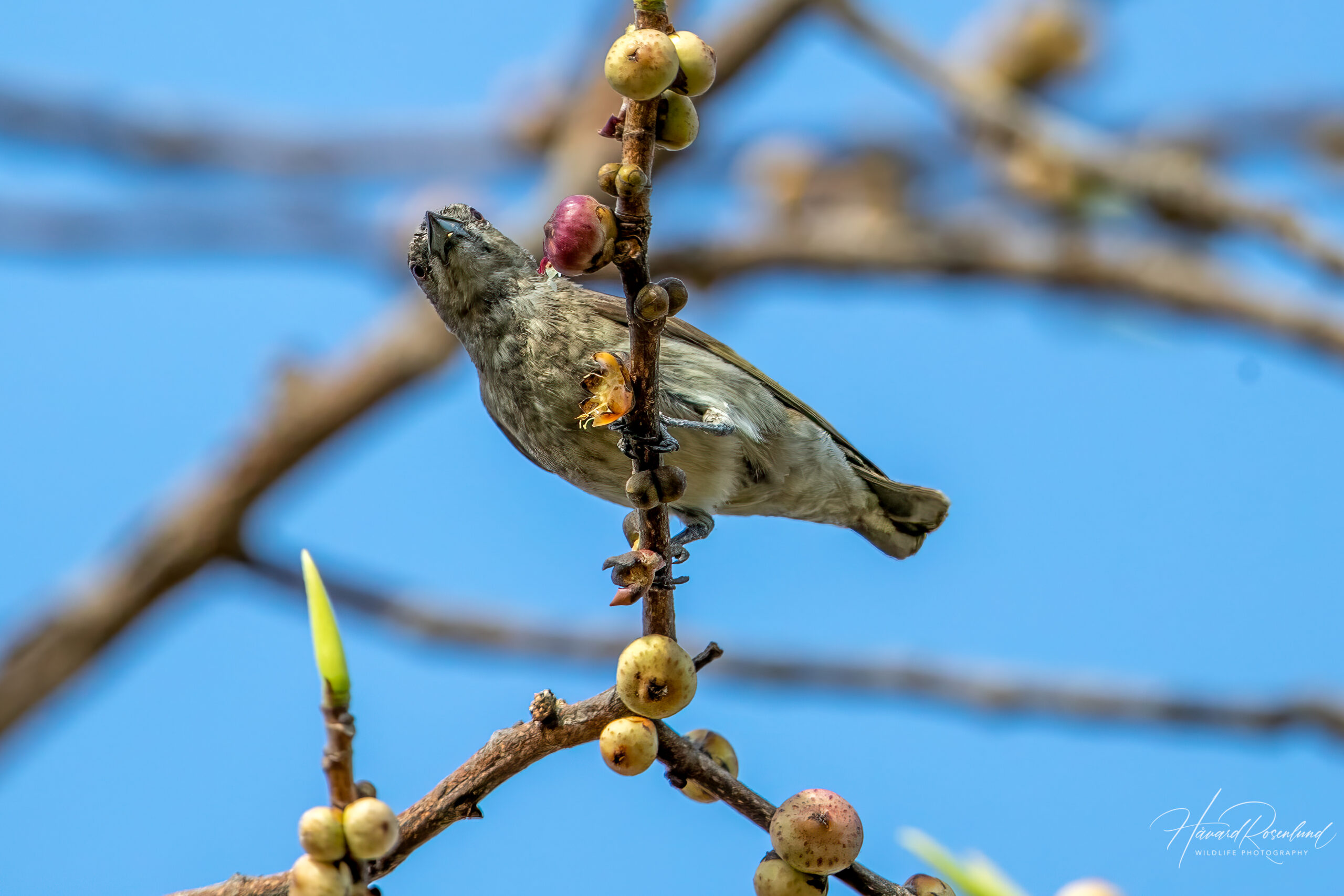
Flowerpeckers and mistletoes have an unusually close ecological relationship, and the thick-billed flowerpecker shows a distinctive way of handling their sticky fruits. Instead of always swallowing the entire fruit and later passing the seed through the gut, it may squeeze out or remove the seed while feeding and wipe it onto a nearby branch. The seed is coated in viscin, a sticky material that helps it adhere directly to a potential host branch.
This behaviour can disperse mistletoe locally within and between neighbouring trees. Other fruit-eating birds may carry swallowed mistletoe seeds farther before depositing them, so different dispersers can contribute at different spatial scales. Trees carrying mistletoe can therefore become both feeding sites for flowerpeckers and starting points for new mistletoe plants.
Breeding
Breeding timing varies across the broad range. In southern India it is centred mainly between winter and early spring, with nesting recorded more widely into the first half of the year elsewhere. The nest is a small hanging purse or oval pouch suspended from a thin branch and woven from fine plant fibres and cobwebs. Its dry-leaf-like shape can make it surprisingly inconspicuous despite an exposed position.
Both sexes can participate in nest construction. A typical clutch contains about three eggs, with two to four recorded. Incubation lasts around 13 days and the young leave the nest roughly 18 days later, although detailed breeding studies remain limited compared with many better-known passerines. Both parents feed the young in the nest and continue feeding fledglings after they leave it.
Status
The thick-billed flowerpecker is classified as least concern on the IUCN Red List. The published assessment predates the latest taxonomic treatment and was issued under the older combination Dicaeum agile, so its species limits do not map perfectly onto the broader current AviList concept.
In India the species remains in the High Conservation Priority category assigned in 2023. Updated monitoring estimates published in 2025 indicate a long-term national decline of about 57% and a recent annual decline of about 3.1%; the priority and trend categories themselves were not recalculated in the 2025 update. These Indian results apply to the older Dicaeum agile treatment rather than the entire broadened species now recognised by AviList.
Image gallery
Loading map and observations…
Have you seen this species?
Independent species archive
Did you find this species page useful?
Wildlife Vagabond is independently built and maintained. Voluntary support helps cover hosting, maps, data storage and continued improvements to the species archive.
Support Wildlife VagabondSpecies content will remain freely available.
References
Information about the species’ global distribution and status is based primarily on global Red List data. See the references below for details.
- AviList. (n.d.). v2025b – The Global Avian Checklist. https://www.avilist.org/checklist/v2025b/
- BirdLife International. (n.d.). Thick-billed Flowerpecker species factsheet. https://datazone.birdlife.org/species/factsheet/thick-billed-flowerpecker-dicaeum-agile
- BirdLife Norge. (n.d.). Norske navn på verdens fugler. https://www.birdlife.no/fuglekunnskap/navn/
- Gao, Y., Yin, S., & Zhu, L. (2021). The complete mitochondrial genome of the Thick-billed Flowerpecker (Dicaeum agile). Mitochondrial DNA Part B, 6(6), 1675-1676. https://doi.org/10.1080/23802359.2021.1927872
- India Biodiversity Portal. (n.d.). Thick-billed Flowerpecker. https://indiabiodiversity.org/species/show/239378
- International Ornithologists’ Union. (n.d.). IOC World Bird List – Proposed splits and lumps. https://www.worldbirdnames.org/new/updates/proposed-splits/
- International Ornithologists’ Union. (n.d.). IOC World Bird List – Taxonomic updates. https://www.worldbirdnames.org/new/updates/taxonomy/
- International Union for Conservation of Nature. (n.d.). Thick-billed Flowerpecker. The IUCN Red List of Threatened Species. https://www.iucnredlist.org/species/105991992/111181409
- Reid, N. (1989). Dispersal of Misteltoes by Honeyeaters and Flowerpeckers: Components of Seed Dispersal Quality. Ecology, 70(1), 137-145. https://doi.org/10.2307/1938420
- Sheldon, F. H. (1985). The Taxonomy and Biogeography of the Thick-billed Flowerpecker Complex in Borneo. The Auk, 102(3), 606-612. https://doi.org/10.1093/auk/102.3.606
- State of India's Birds. (2025). 2025 – Thick-billed Flowerpecker. https://stateofindiasbirds.in/species/rj-thbflo1/