
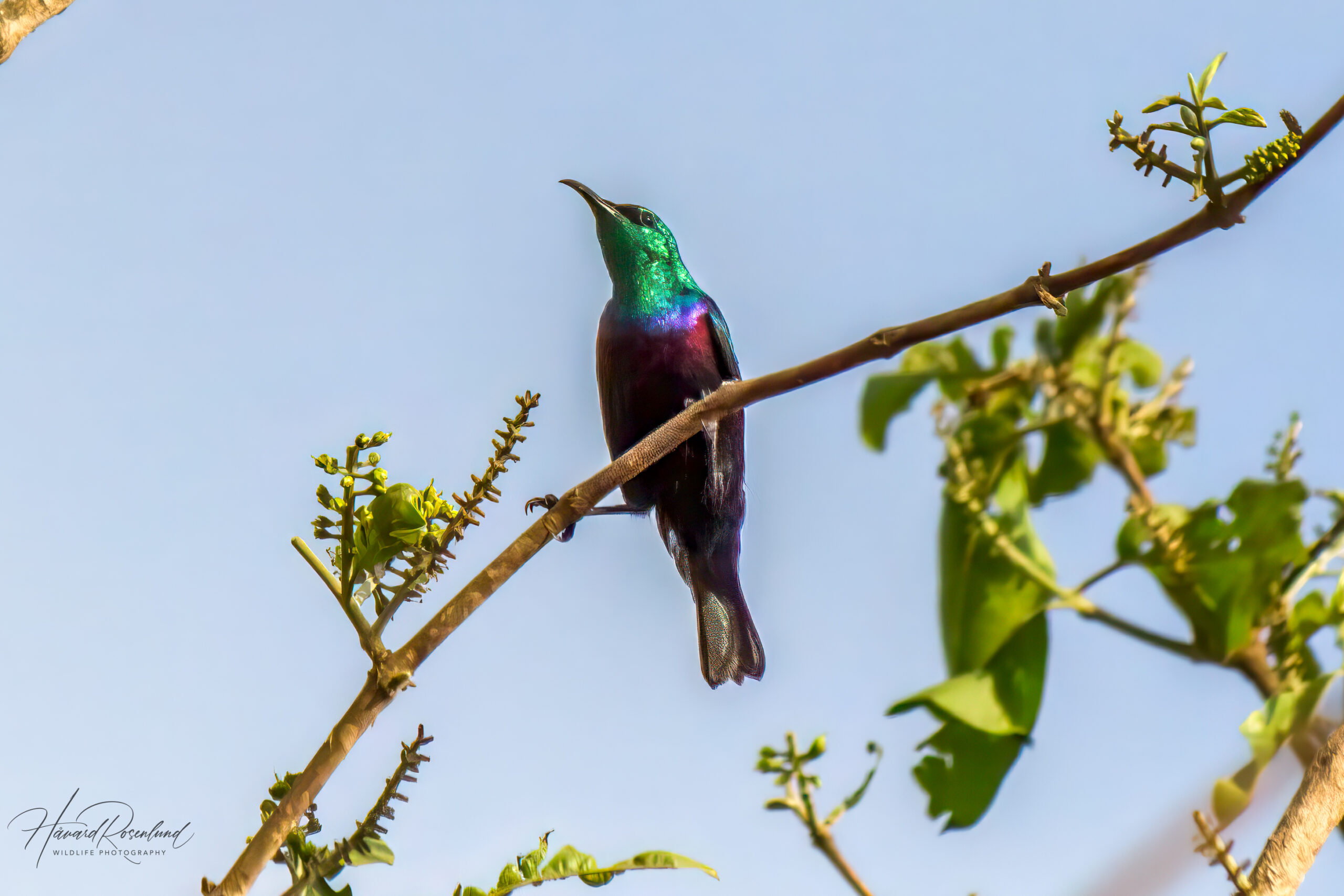
Purple-banded Sunbird
Cinnyris bifasciatus
At a glance
Habitat
- Coastal bush, woodland, riverine vegetation, mangroves, thickets and wooded gardens
Diet
- Nectar supplemented with insects and spiders
Activity
- Diurnal
Size
- Length: ~11 cm Weight: 7–9 g
Range
- Patchily distributed across sub-Saharan Africa, especially eastern and southern regions
Description
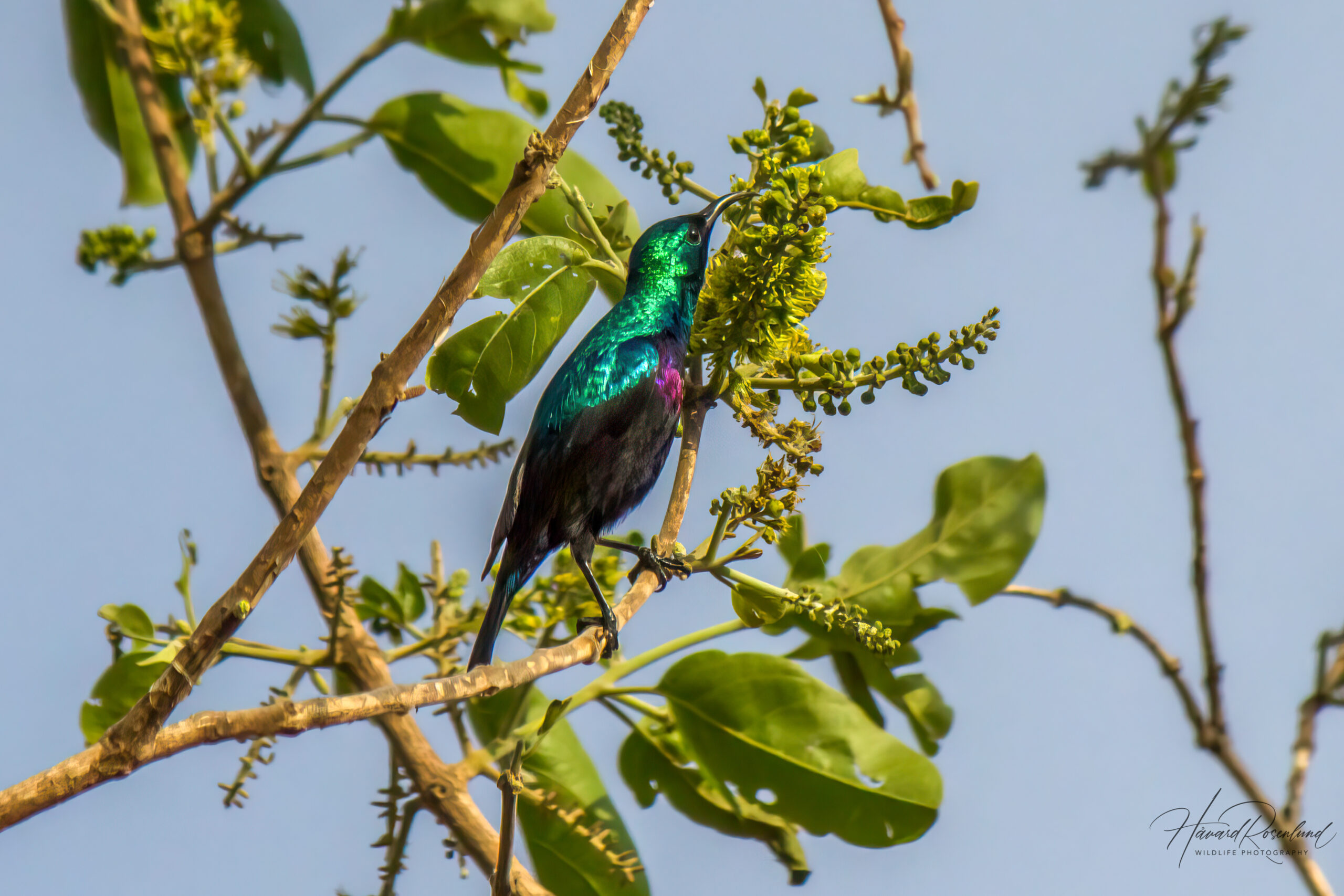
The purple-banded sunbird (Cinnyris bifasciatus) is a tiny nectar-feeding songbird with a patchy distribution across sub-Saharan Africa. Adults are about 11 cm long and weigh only around 7–9 g. Breeding males have a glossy metallic-green head and upper mantle, a narrow violet-blue breast band above a broader reddish-purple band, and dark lower underparts. Females are much duller, with olive-brown upperparts and pale greyish to yellowish underparts.
The species can be confused with the larger Marico sunbird (Cinnyris mariquensis), whose male has a broader reddish breast band and a longer, more slender bill. Two subspecies are recognised. The closely related Tsavo sunbird (Cinnyris tsavoensis), formerly included within the same complex, is now treated as a separate species.
Habitat
Purple-banded sunbirds occupy coastal bush, mangroves, forest edge, riverine woodland, thickets and well-wooded gardens, with the exact habitat varying across their discontinuous African range. In southern Africa they are especially associated with warm eastern lowlands and coastal vegetation.
The species depends on landscapes that provide a succession of flowering plants rather than on one narrow vegetation type. Gardens and other modified areas can therefore be suitable when they retain trees and shrubs that flower through different parts of the year.
Diet
Nectar is the main food and is taken from a wide variety of flowering plants, including aloes, mistletoes, waterberries and other native trees and shrubs. Small insects and spiders provide an important protein supplement and are especially important when feeding young.
Foraging
The long down-curved bill and brush-tipped tongue are adapted for extracting nectar from tubular flowers. Like most sunbirds, purple-banded sunbirds normally drink while perched and hover only briefly when a flower cannot be reached conveniently.
They also make short aerial sallies for insects and glean arthropods from foliage, switching between nectar and animal prey as food availability and breeding demands change.
Behaviour
The species is active and often conspicuous around flowering plants, usually appearing singly or in pairs rather than in large flocks. Males can defend particularly rich nectar sources and chase other sunbirds away from flowering trees or shrubs.
Both sexes also make local movements as flowering conditions change. These movements follow food availability rather than forming a regular long-distance migration, allowing birds to follow temporarily abundant nectar resources within the wider landscape.
Breeding
In southern Africa egg laying has been recorded mainly from August to March, with a peak around September and October. The female builds the nest alone. The nest is a compact pear-shaped or oval hanging structure with a side entrance, woven from plant fibres, leaf stalks, grass and lichen bound with spider silk. It is often decorated externally and lined with soft plant material and feathers.
Clutches usually contain one or two eggs, rarely three, and the female incubates alone. After hatching, both parents feed the chicks, with insects forming an important part of the food delivered to the nest.
Status
The purple-banded sunbird is classified as least concern on the IUCN Red List. It has a wide African distribution, remains locally common in suitable woodland, coastal bush and gardens with abundant flowers, and the global population trend is considered stable.
No major threat is known across the species' range. Local populations nevertheless depend on diverse flowering vegetation and on woodland, thickets and gardens that provide suitable nesting sites.
Image gallery
Loading map and observations…
Have you seen this species?
Independent species archive
Did you find this species page useful?
Wildlife Vagabond is independently built and maintained. Voluntary support helps cover hosting, maps, data storage and continued improvements to the species archive.
Support Wildlife VagabondSpecies content will remain freely available.
References
Information about the species’ global distribution and status is based primarily on global Red List data. See the references below for details.
- Avibase. (n.d.). Purple-banded Sunbird (Cinnyris bifasciatus). https://avibase.bsc-eoc.org/species.jsp?avibaseid=71C72002F8130AFC
- Biodiversity Explorer. (n.d.). Purple-banded Sunbird (Cinnyris bifasciatus). Iziko Museums of South Africa. https://www.biodiversityexplorer.info/birds/nectariniidae/cinnyris_bifasciatus.htm
- BirdLife International. (n.d.). Purple-banded Sunbird species factsheet. https://datazone.birdlife.org/species/factsheet/purple-banded-sunbird-cinnyris-bifasciatus
- International Union for Conservation of Nature. (n.d.). Purple-banded Sunbird. The IUCN Red List of Threatened Species. https://www.iucnredlist.org/species/103801419/94562143
- Oiseaux.net. (n.d.). Purple-banded Sunbird. https://www.oiseaux.net/en/purple-banded.sunbird.html