
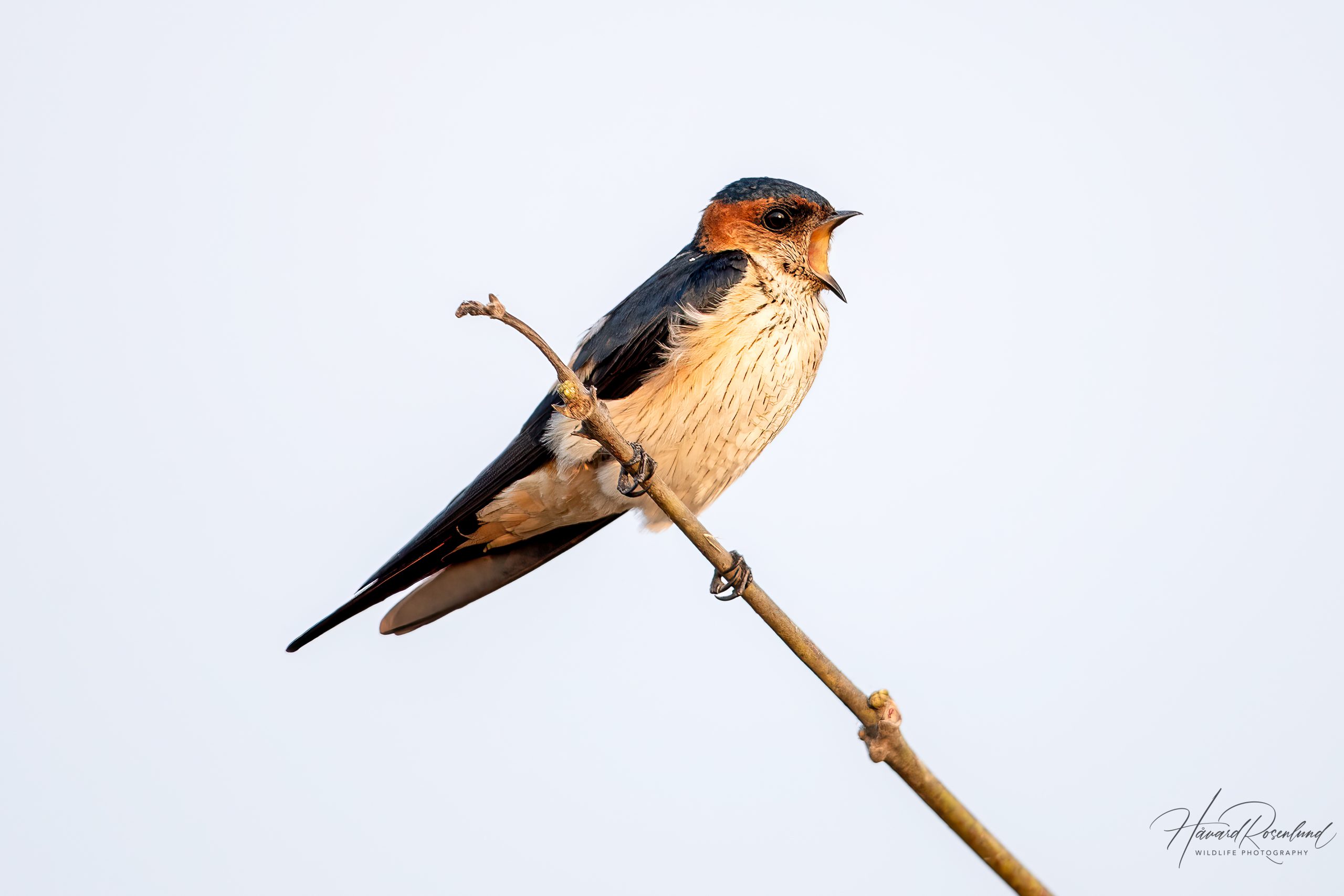
Eastern Red-rumped Swallow
Cecropis daurica
At a glance
Habitat
- Open and hilly country, farmland, wetlands, forest edge and settlements
Diet
- Flying insects and other small aerial invertebrates
Activity
- Diurnal
Size
- Length: 16–17 cm Weight: 19–29 g
Range
- Central, South, East and Southeast Asia; Daurian group largely migratory, Striated group largely resident
Description
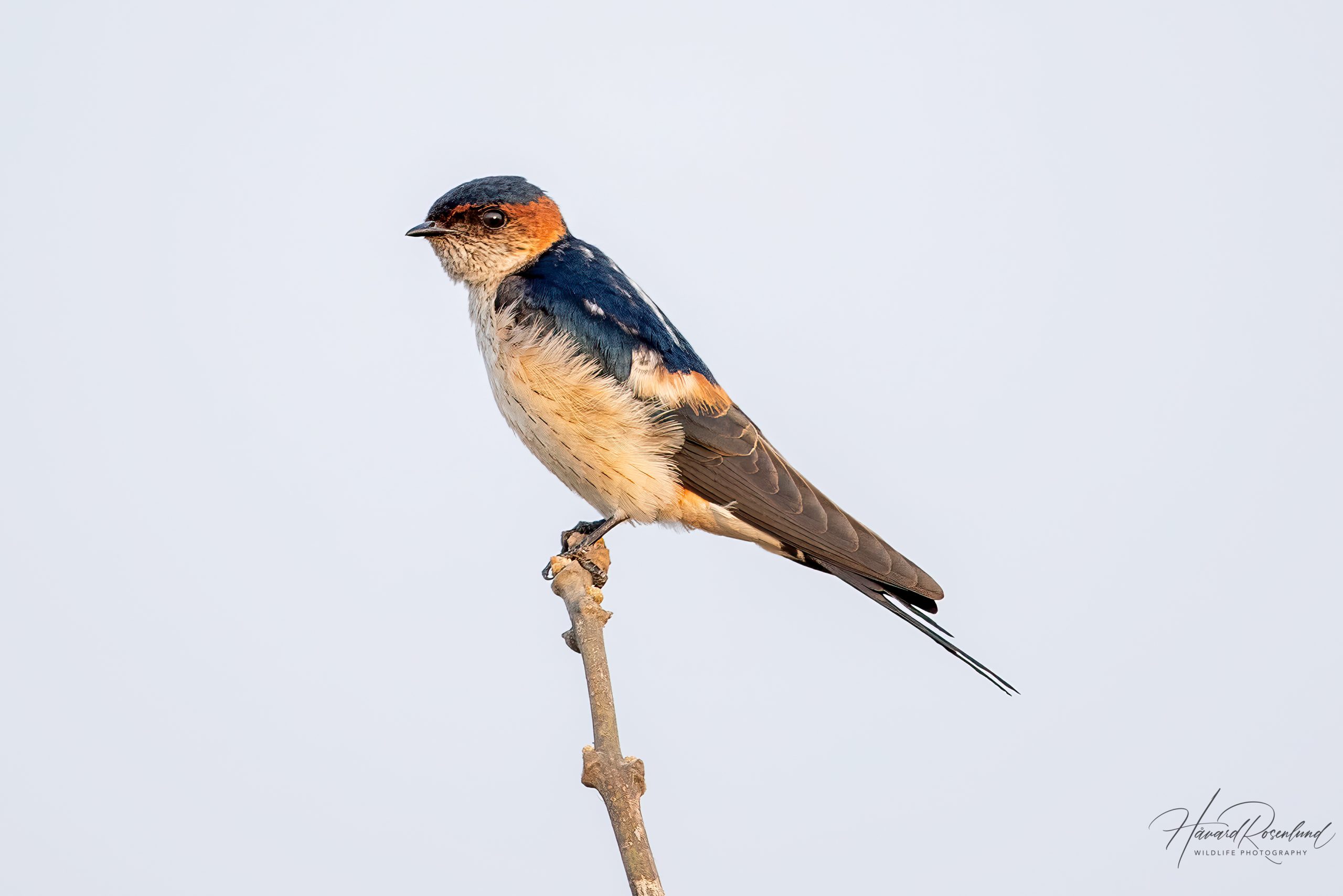
The eastern red-rumped swallow (Cecropis daurica) is a slender Asian swallow about 16–17 cm long, with a wingspan of roughly 32–34 cm and a weight of around 19–29 g. It has glossy blue-black upperparts, a warm rufous rump and sides of the head, pale underparts with fine dark streaking and a forked tail.
Plumage varies considerably within the current species boundary. In India, the combination of rufous rump, pale streaked underparts and dark crown helps separate it from barn swallow (Hirundo rustica) and wire-tailed swallow (Hirundo smithii).
Taxonomy
The former red-rumped swallow complex has been substantially revised. AviList, IOC and eBird/Clements recognise eastern red-rumped swallow (Cecropis daurica), European red-rumped swallow (C. rufula) and African red-rumped swallow (C. melanocrissus) as separate species.
At the same time, several Asian forms formerly placed in striated swallow were included within the expanded eastern species. Eight subspecies are now included in C. daurica, and eBird groups them broadly into the Daurian and Striated groups. The result is considerable geographical variation in rump colour, facial tone and the strength of streaking below.
Habitat
Eastern red-rumped swallows use open and often hilly country, farmland, grassland, wetlands, forest edge and settlements. They need open airspace for feeding but also suitable surfaces for their mud nests.
Cliffs and caves provide natural nesting sites, while bridges, culverts and buildings have greatly increased the number of artificial sites available. Nearby fields, wetlands and water bodies are particularly useful because they concentrate flying insects.
Diet
The diet consists almost entirely of small flying invertebrates, including flies, beetles, termites and other insects caught in the air. Birds often feed low over fields, roads, wetlands or water, but can also hunt high above the landscape when insects are carried upward.
Feeding height and flight pattern change constantly with weather and insect activity. Birds may make rapid turns through concentrated swarms or spend longer periods gliding and circling when prey is more widely scattered.
Behaviour
Eastern red-rumped swallows are social outside breeding and are often seen in pairs, family groups or loose feeding flocks. They frequently forage alongside other swallows and swifts when insect concentrations are high, with many birds exploiting the same temporary feeding area without forming a permanently stable flock.
Much of the species' daily behaviour takes place in flight. Individuals alternate rapid wingbeats with long glides, turn sharply after prey and remain highly mobile between feeding areas. Contact calls help birds keep track of one another in the air, while groups may settle briefly on exposed perches between feeding bouts.
Migration
Movement differs strongly between the two broad groups within the modern species. The Daurian group is largely migratory, breeding from north-eastern Kazakhstan and Xinjiang through Ladakh and the Himalayan region east to China, Korea, Japan and southern Siberia, and wintering mainly in Southeast Asia, Indonesia and northern Australia. The Striated group, which includes the former striated-swallow populations, is largely resident from peninsular India and Sri Lanka east through mainland Southeast Asia, southern China, Taiwan, the Philippines and parts of Indonesia.
India therefore holds both resident breeding populations and seasonal visitors from farther north. In the far north-west, particularly Ladakh, eastern and European red-rumped swallows can also occur close enough geographically that identification may require care.
Breeding
Breeding timing varies with latitude and climate and often falls between spring and late summer. Both adults build the distinctive bottle- or retort-shaped nest from many small pellets of mud, ending in a narrow entrance tunnel and lined inside with grass and feathers.
Mud is collected repeatedly from damp ground and carried to the nest site in small loads, so access to suitable wet soil can matter even where nesting structures themselves are abundant. Nests are attached beneath rock overhangs or to bridges, culverts and buildings and may be repaired and reused.
A study published in 2022 examined 32 nests in road culverts in Kachchh district, Gujarat. Each occupied pipe contained a single nest, and occupied sites had more cultivated land, vegetation and water nearby. Clutches usually contain four, sometimes five, white eggs, and both parents share incubation and feeding of the young. Incubation and fledging times are less certain under the modern species boundary because much older breeding information was collected under different taxonomic treatments.
Status
The IUCN Red List currently classifies the older, broader red-rumped swallow concept as least concern.
Modern checklists use different species boundaries: the European and African forms have been split off, while several former striated-swallow populations are now included in eastern red-rumped swallow. The current IUCN category therefore does not correspond exactly to the modern C. daurica presented on this page.
Image gallery
Loading map and observations…
Have you seen this species?
Independent species archive
Did you find this species page useful?
Wildlife Vagabond is independently built and maintained. Voluntary support helps cover hosting, maps, data storage and continued improvements to the species archive.
Support Wildlife VagabondSpecies content will remain freely available.
References
Information about the species’ global distribution and status is based primarily on global Red List data. See the references below for details.
- Ali, Kumar & Arun. (2022). Selection of culvert pipes for nesting by the Red-rumped Swallow Cecropis daurica in Gujarat, India. https://www.researchgate.net/publication/371256737_Selection_of_culvert_pipes_for_nesting_by_the_Red-rumped_Swallow_Cecropis_daurica_in_Gujarat_India
- Avibase. (n.d.). Eastern Red-rumped Swallow (Cecropis daurica) taxonomic concept. https://avibase.bsc-eoc.org/species.jsp?avibaseid=6FE118C6
- AviList. (n.d.). v2025 – Global avian checklist and Cecropis treatment. https://www.avilist.org/
- BirdLife International. (n.d.). Red-rumped Swallow (Cecropis daurica) under the broader IUCN taxonomic concept. https://datazone.birdlife.org/species/factsheet/red-rumped-swallow-cecropis-daurica
- Cornell Lab of Ornithology. (2024). Updates and corrections: Red-rumped Swallow complex. https://www.birds.cornell.edu/clementschecklist/updates-and-corrections-october-2024/
- eBird. (n.d.). eBird/Clements 2024 taxonomy update – Red-rumped Swallow complex. https://science.ebird.org/en/use-ebird-data/the-ebird-taxonomy/2024-ebird-taxonomy-update
- International Ornithologists’ Union. (n.d.). IOC World Bird List – proposed splits in the red-rumped swallow complex. https://www.worldbirdnames.org/new/updates/proposed-splits/
- International Union for Conservation of Nature. (n.d.). Cecropis daurica under the broader pre-split concept. The IUCN Red List of Threatened Species. https://www.iucnredlist.org/species/103812643/264559502
- Jackson, M.V. & Kyne, P.M. (2013). Red-rumped Swallow in the Northern Territory, Australia. Northern Territory Naturalist, 24, 55–60. https://ntfieldnaturalists.org.au/site/assets/files/1555/ntn24_55-60_jacksonkyne_red-rumped_swallow.pdf