
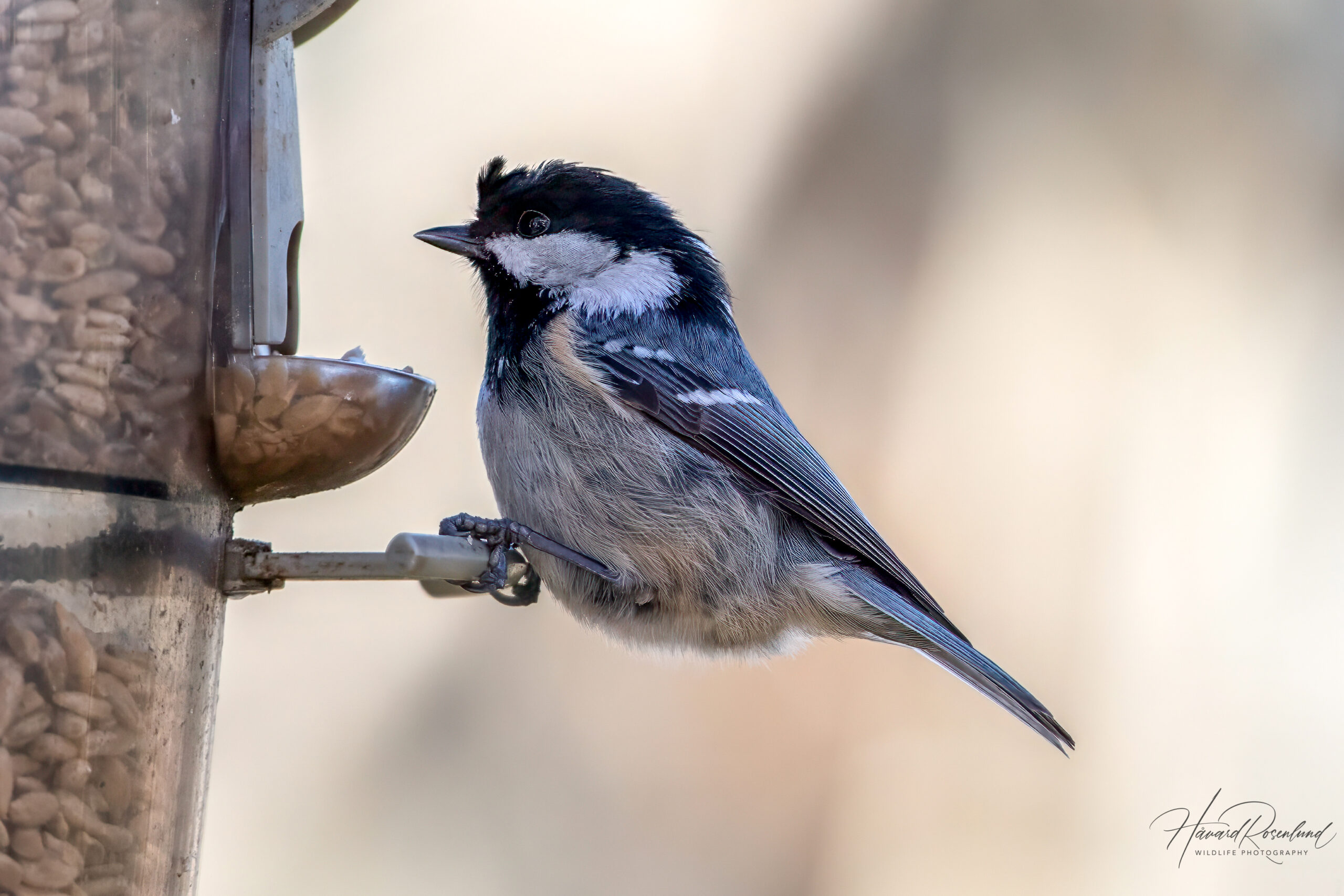
Coal Tit
Periparus ater
At a glance
Habitat
- Coniferous and mixed woodland, especially mature spruce-rich forest with dense foliage
Diet
- Insects and spiders in the warmer months; conifer seeds and other plant foods become more important in winter
Activity
- Diurnal
Size
- Length: 10–11.5 cm Weight: about 9.1 g
Range
- Widespread across Europe and temperate Asia; mostly resident, with irregular movements in some northern and continental populations
Description
The coal tit (Periparus ater) is a small Eurasian tit strongly associated with coniferous woodland. Adults are about 10–11.5 cm long and weigh around 9.1 g on average. The head and bib are glossy black, contrasting with white cheeks and a conspicuous white patch on the nape. The back is grey and the underparts buff-white, while two pale wing bars are usually visible.
The white nape patch, small size and double wing bar separate the coal tit from the larger great tit (Parus major) and from the black-capped marsh tit (Poecile palustris) and willow tit (Poecile montanus). Males and females look very similar.
Habitat
Coal tits occur in coniferous and mixed woodland across a broad altitudinal range, but they are especially characteristic of spruce-rich forest. Dense conifer foliage provides places to forage and cover, and breeding birds can reach high densities in mature stands where a productive canopy and suitable nesting cavities occur.
The species also uses plantations and mixed woodland where conifers are abundant. Most established birds are resident, although northern and continental populations can make irregular large-scale movements in years when food conditions change.
Diet
In spring and summer the diet is dominated by insects, larvae and spiders taken from needles, twigs, bark and cones. Seeds become much more important in autumn and winter, particularly seeds of spruce and other conifers.
Coal tits forage acrobatically among fine outer branches and frequently join mixed-species flocks with other tits and small woodland birds outside the breeding season. Their use of small, energy-rich seeds in winter is closely linked to the species' highly developed food-storing behaviour.
Food caching
Food storage is an important part of winter life. Coal tits hide individual seeds and other food items in many separate sites among bark, needles, twigs and small crevices rather than building one large store. Experiments show that they remember previous cache locations when deciding where to place new food and space new caches away from existing ones, which can make stored food harder for competitors to find.
Social conditions also influence caching. Field studies found that coal tits were less likely to store food when another bird was very close and that experienced resident adults tended to place caches in safer inner parts of trees more often than juveniles or transient birds. Laboratory experiments show that memory for cache sites can remain useful for weeks. Coal tits therefore store food regularly through autumn and winter rather than only in response to snow or cold.
Breeding
Coal tits are socially monogamous, although genetic parentage studies show substantial extra-pair reproduction. A Norwegian study published in 2025 found extra-pair parentage in 32% of the chicks.
They are cavity nesters and use natural tree holes, old woodpecker cavities, rotten stumps and nest boxes; nests can also occur unusually low where suitable holes exist. Moss forms much of the nest structure and the cup is lined with finer material such as hair and feathers.
A typical clutch contains about 9–10 eggs, although smaller and larger clutches occur. The female incubates for roughly 14–16 days. Both parents feed the chicks, which normally remain in the nest for about 16–19 days before fledging. One or two broods may be raised in a season. A long-running nest-box study in south-central Sweden found a mean first-clutch size of 8.55 eggs and second broods in about 13% of breeding attempts.
Status
The coal tit has a very large Eurasian range and is classified as least concern on the IUCN Red List. Broad trends vary between regions, but the species remains widespread and numerous.
In Britain, the breeding population index was 57% higher in 2024 than in 1967, largely reflecting rapid growth early in the period. The population has been fairly stable since the mid-1970s, with substantial year-to-year variation.
Image gallery
Loading map and observations…
Have you seen this species?
Independent species archive
Did you find this species page useful?
Wildlife Vagabond is independently built and maintained. Voluntary support helps cover hosting, maps, data storage and continued improvements to the species archive.
Support Wildlife VagabondSpecies content will remain freely available.
References
Information about the species’ global distribution and status is based primarily on global Red List data. See the references below for details.
- BirdLife International. (n.d.). Coal Tit species factsheet. https://datazone.birdlife.org/species/factsheet/coal-tit-periparus-ater
- Bozó, L. (2025). Occurrence of Coal Tits Periparus ater during non-breeding seasons in the Great Hungarian Plain. Ornis Svecica, 35, 43-50. https://doi.org/10.34080/os.v35.25475
- British Trust for Ornithology. (n.d.). Coal Tit. https://www.bto.org/learn/about-birds/birdfacts/coal-tit
- Brotons, L. (2000). Individual food-hoarding decisions in a nonterritorial coal tit population: the role of social context. Animal Behaviour, 60(3), 395-402. https://doi.org/10.1006/anbe.2000.1467
- International Union for Conservation of Nature. (n.d.). Coal Tit. The IUCN Red List of Threatened Species. https://www.iucnredlist.org/species/22735965/118835425
- Male, L. H., & Smulders, T. V. (2007). Memory for food caches: not just for retrieval. Behavioral Ecology, 18(2), 456-459. https://doi.org/10.1093/beheco/arl107
- Schölin, K. G., & Källander, H. (2013). The breeding biology of the Coal Tit Periparus ater in South Central Sweden. Ornis Svecica, 23(3–4), 151-158. https://doi.org/10.34080/os.v23.22567