
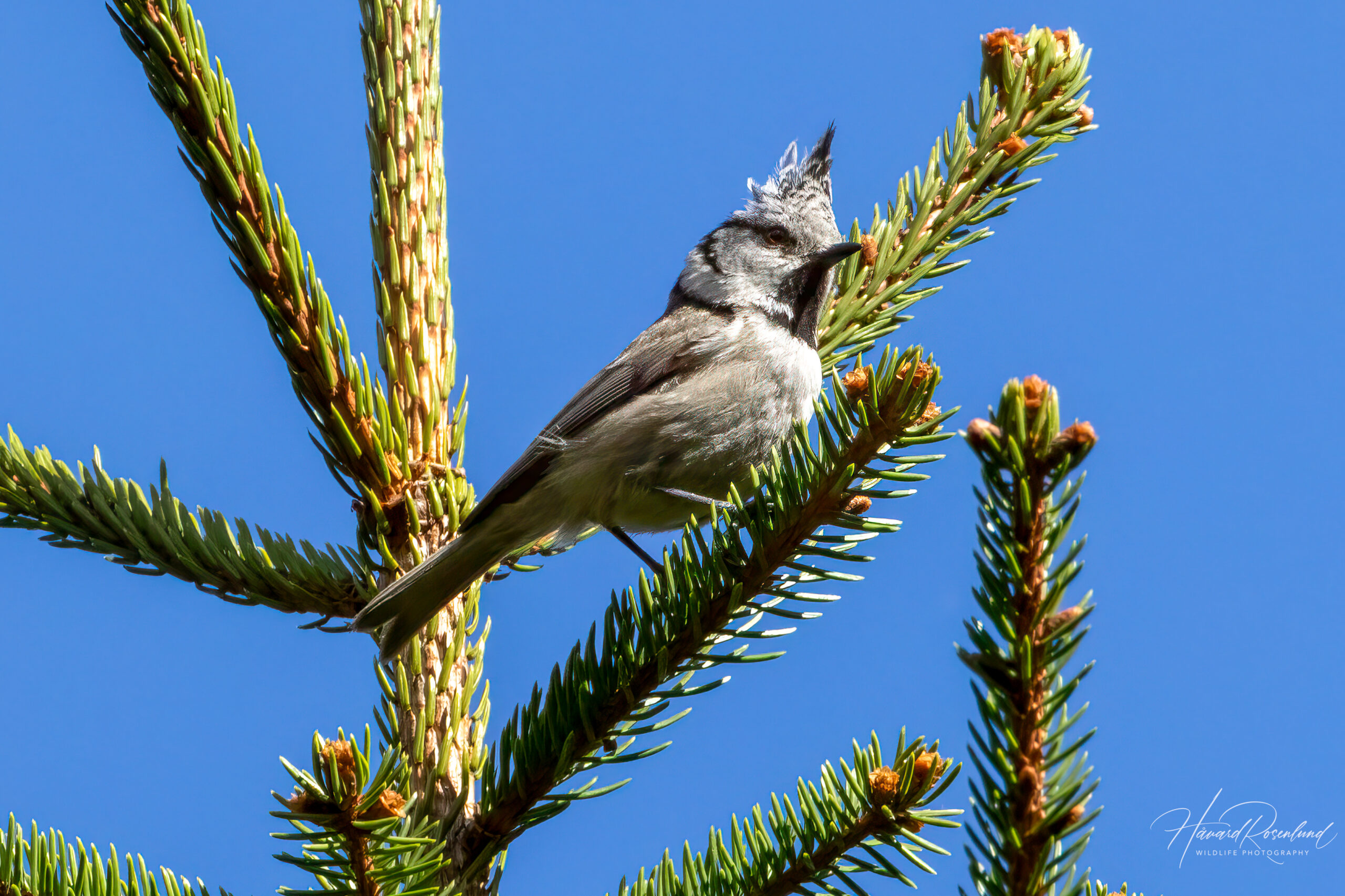
Crested Tit
Lophophanes cristatus
At a glance
Habitat
- Coniferous and mixed forest, especially pine-rich woodland with dead and decaying wood
Diet
- Insects and spiders in the warmer months; conifer seeds and other plant foods become more important in winter
Activity
- Diurnal
Size
- Length: 11.5–12.5 cm Weight: about 11.5 g
Range
- Resident across much of continental Europe, with scattered populations in the west and north
Description
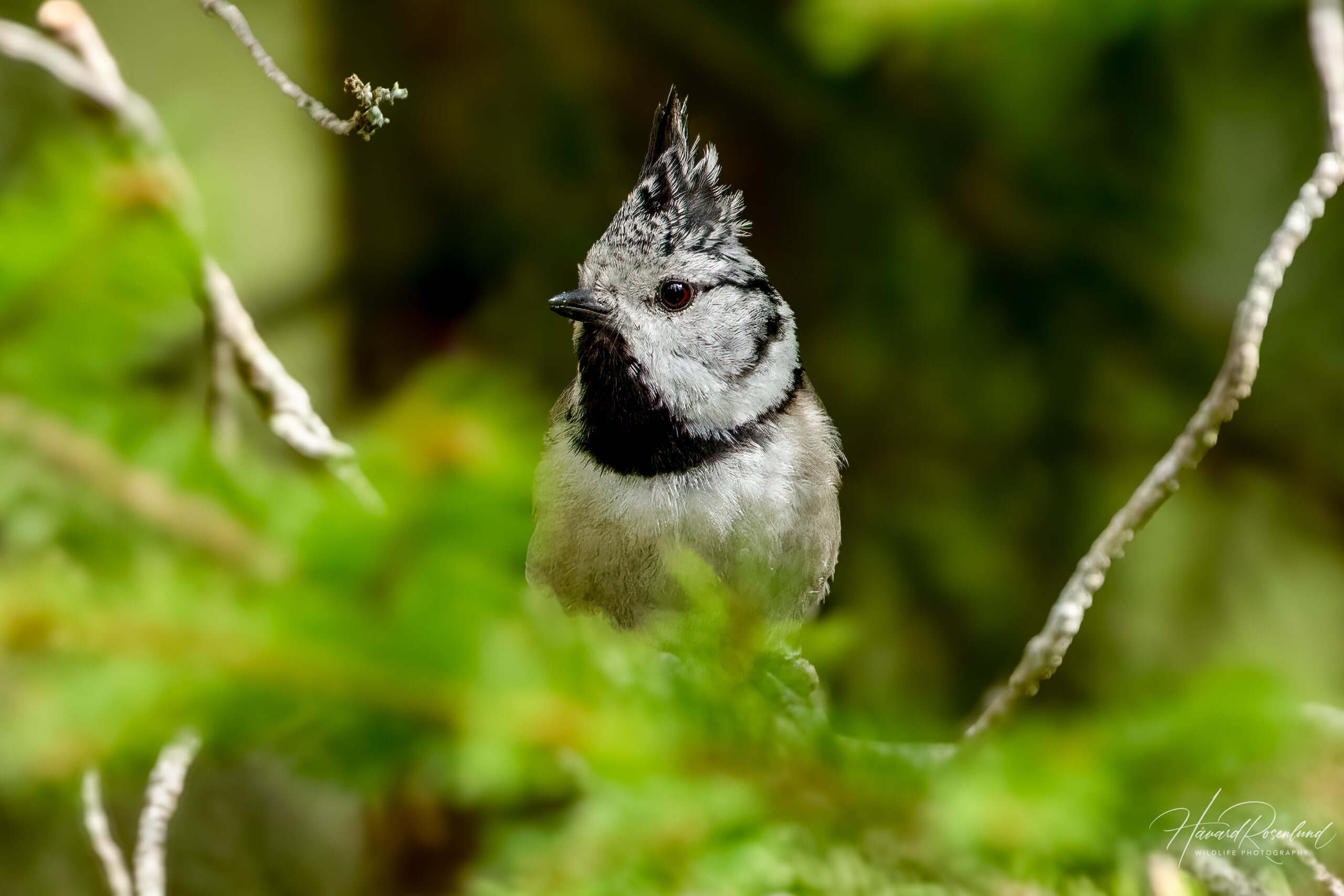
The crested tit (Lophophanes cristatus) is a small, highly distinctive tit of European coniferous forests. Adults are about 11.5–12.5 cm long and weigh around 11.5 g. The plumage is mainly grey-brown above and pale below, with a black bib and collar, boldly patterned black-and-white cheeks and an unmistakable pointed crest. Males and females are very similar.
The crest can be raised or flattened and makes the species difficult to confuse with any other European tit. Crested tits are also strongly resident: established birds remain within the same general forest territory throughout the year rather than making regular seasonal migrations.
Habitat
Crested tits are closely associated with coniferous woodland, especially pine-rich forest, although they also use mixed woodland where suitable conifers are present. Mature forest structure, dead and decaying wood and a varied tree layer provide places to forage, cover and nesting sites.
A year-round habitat study in northern Italy found that crested tits selected pure and mixed pine forest and remained strong habitat specialists in winter, when many other tits broaden their habitat use. Farmland, urban areas and woodland dominated by alien tree species were avoided, showing that the species depends on particular forest structure rather than simply on the presence of trees.
Diet
In spring and summer the diet consists mainly of insects, larvae and spiders taken from branches, bark, needles and cones. Seeds and other plant material become increasingly important in autumn and winter.
Crested tits forage throughout the tree canopy and may join mixed-species flocks with other tits and small woodland birds outside the breeding season.
Food caching
Crested tits scatter-hoard food, hiding individual seeds and other items in many separate places among bark, needles and branches. Caching is especially intensive in autumn. A comparison of populations near Stockholm, Sweden, and Antwerp, Belgium, found that the more northerly birds stored food more frequently, even though feeding rates did not differ. The difference fits the greater value of stored food where winters are harsher.
Age and social position also affect where food is stored. In a northern Belgian population, first-year birds often cached in exposed outer parts of trees, while adults consistently used more protected sites near the trunk. Young birds therefore made more movements within trees and faced greater exposure while storing food. Where crested tits store food therefore depends not only on winter climate, but also on age and competition within winter flocks.
Breeding
Pairs are socially monogamous. The crested tit is unusual among European tits because the female can excavate her own nest chamber in sufficiently soft, decaying wood. Dead trunks, rotten stumps and decayed parts of living trees are therefore important even where other cavities are available. Existing holes, including old woodpecker cavities, and nest boxes can also be used.
A typical clutch contains five to six eggs, with recorded clutches ranging from five to eight. The female incubates for about 13–16 days, while both parents feed the young. The chicks normally remain in the cavity for around 20–25 days before fledging. One or two broods may be raised in a season.
Status
The crested tit is classified as least concern on the IUCN Red List and remains widely distributed across much of continental Europe.
Regional trends differ, and the species' strong dependence on coniferous woodland structure makes forest quality important even where total woodland cover remains high. Populations can persist in managed pine forest, but loss of old trees, dead wood and structural diversity can reduce both nesting opportunities and foraging habitat.
Image gallery
Loading map and observations…
Have you seen this species?
Independent species archive
Did you find this species page useful?
Wildlife Vagabond is independently built and maintained. Voluntary support helps cover hosting, maps, data storage and continued improvements to the species archive.
Support Wildlife VagabondSpecies content will remain freely available.
References
Information about the species’ global distribution and status is based primarily on global Red List data. See the references below for details.
- Berlusconi, A., Martinoli, A., Wauters, L. A., Tesoro, G., Martini, S., Clerici, E., Guenzani, G., Pozzi, G., Rubolini, D., Morganti, M., & Martinoli, A. (2022). Year-round multi-scale habitat selection by Crested Tit (Lophophanes cristatus) in lowland mixed forests (northern Italy). Avian Research, 13, 100058. https://doi.org/10.1016/j.avrs.2022.100058
- BirdLife International. (n.d.). Crested Tit species factsheet. https://datazone.birdlife.org/species/factsheet/crested-tit-lophophanes-cristatus
- British Trust for Ornithology. (n.d.). Crested Tit. https://www.bto.org/learn/about-birds/birdfacts/crested-tit
- Brodin, A., Lens, L., & Suhonen, J. (1994). Do crested tits, Parus cristatus, store more food at northern latitudes? Animal Behaviour, 48(4), 990-993. https://doi.org/10.1006/anbe.1994.1328
- International Union for Conservation of Nature. (n.d.). Crested Tit. The IUCN Red List of Threatened Species. https://www.iucnredlist.org/species/22711810/87427182
- Lens, L., Adriaensen, F., & Dhondt, A. A. (1994). Age-Related Hoarding Strategies in the Crested Tit Parus cristatus: Should the Cost of Subordination be Re-Assessed? The Journal of Animal Ecology, 63(4), 749. https://doi.org/10.2307/5252