
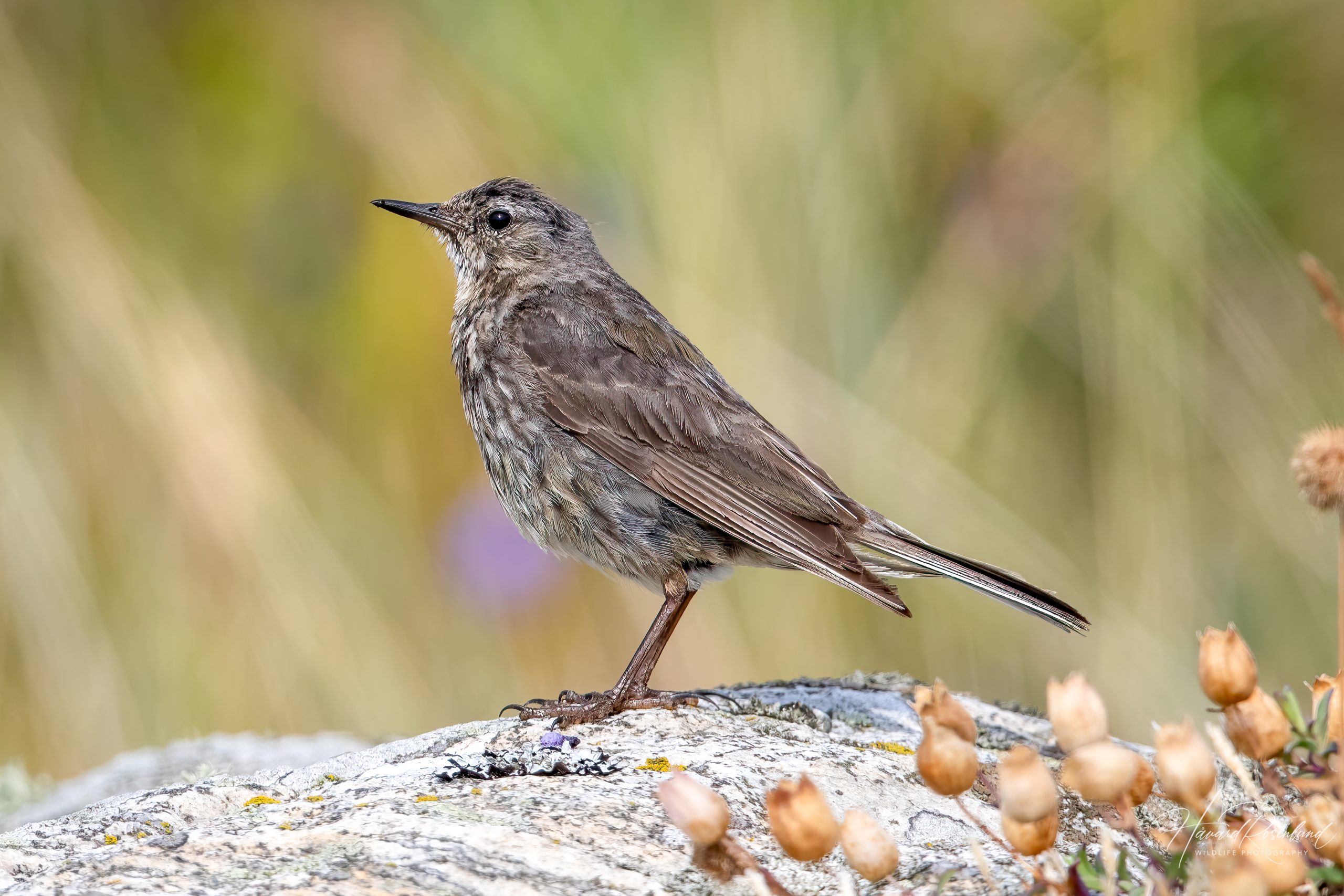
Rock Pipit
Anthus petrosus
At a glance
Habitat
- Rocky coasts, sea cliffs, islands, tidal margins and nearby coastal grassland
Diet
- Mainly insects and other small invertebrates, including marine crustaceans and prey found among seaweed
Activity
- Diurnal
Size
- Length: 16–18 cm Weight: 20–30 g
Range
- Coasts of western and northern Europe from Iceland and Scandinavia south to the Iberian Peninsula
Description
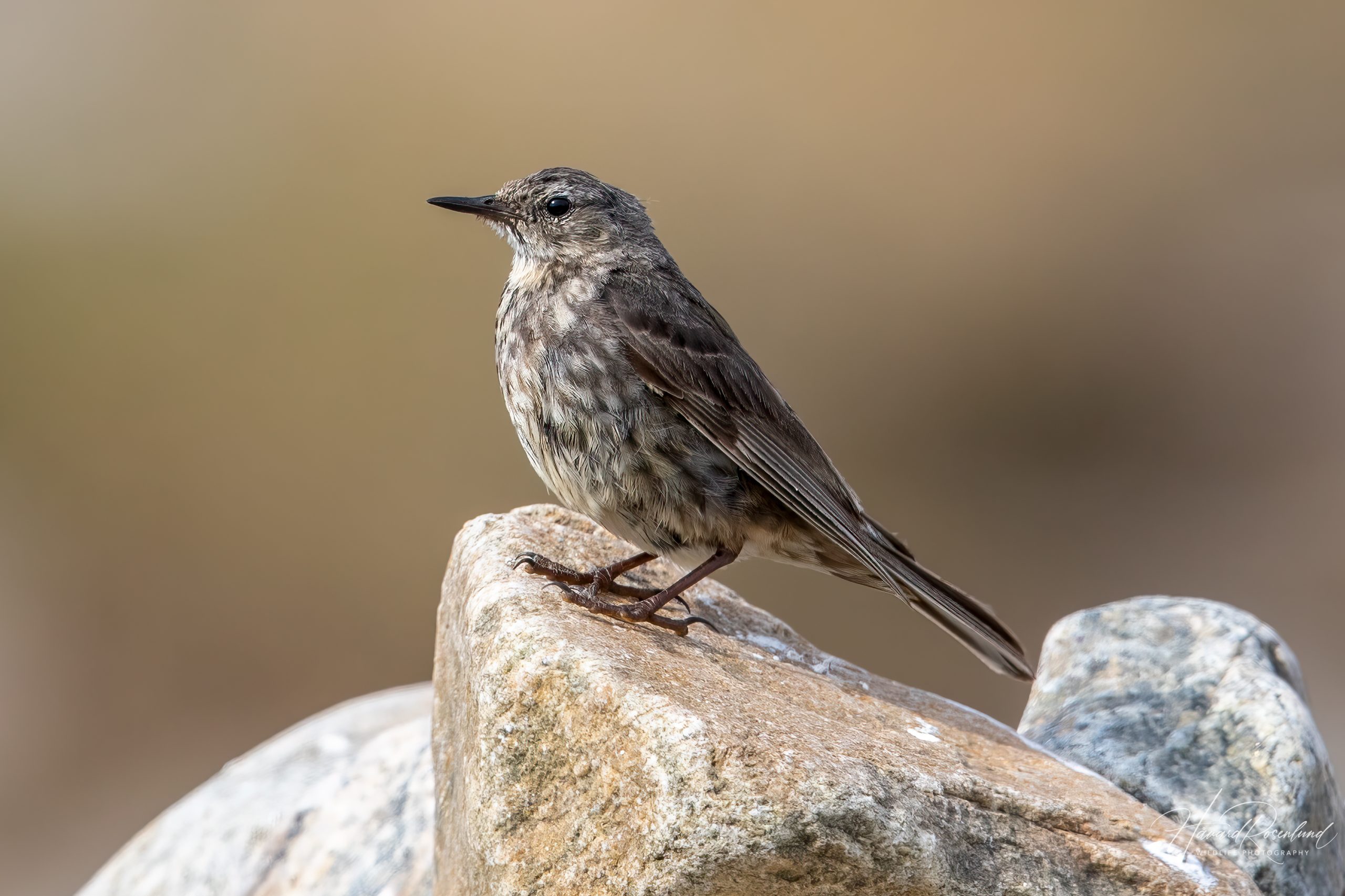
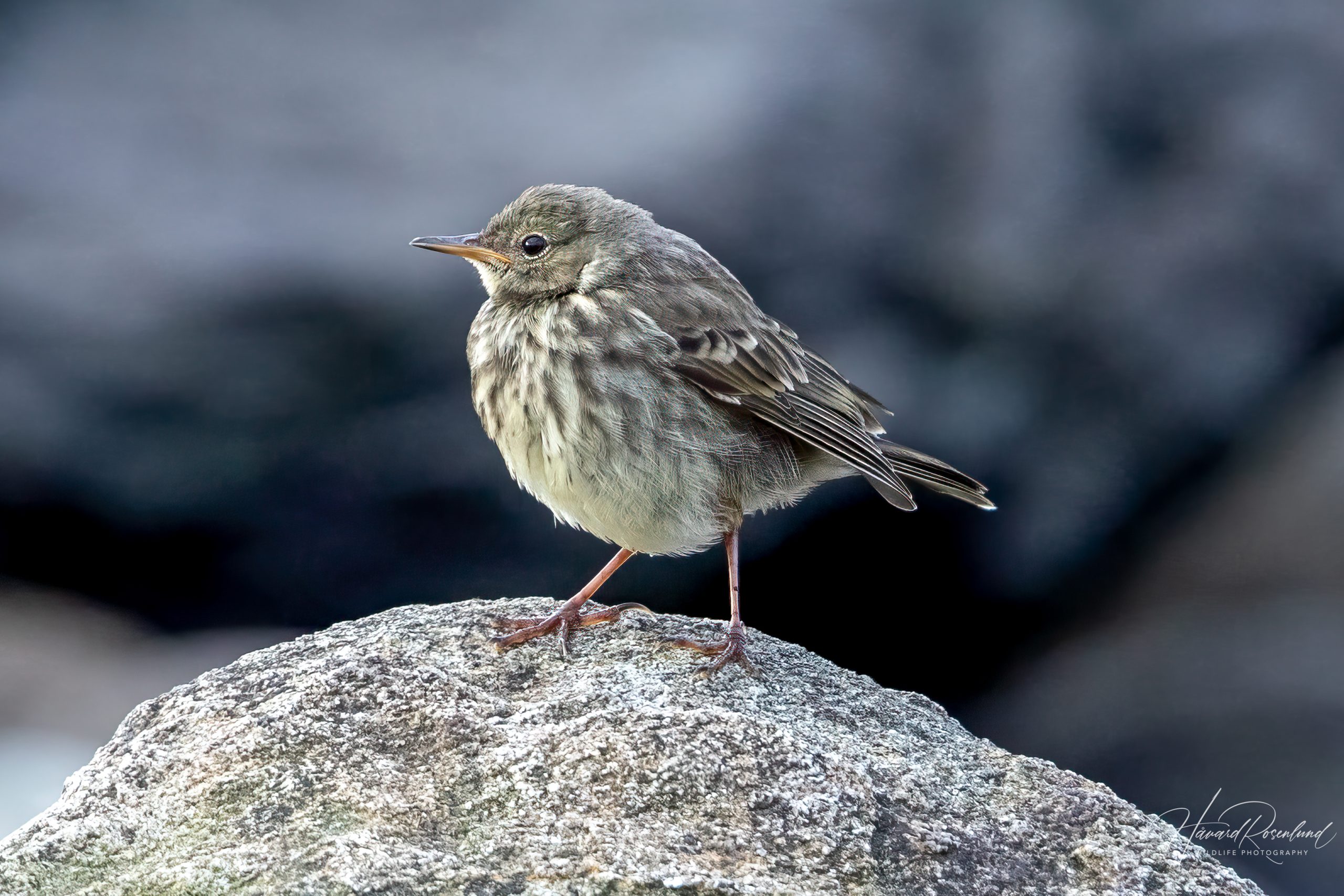
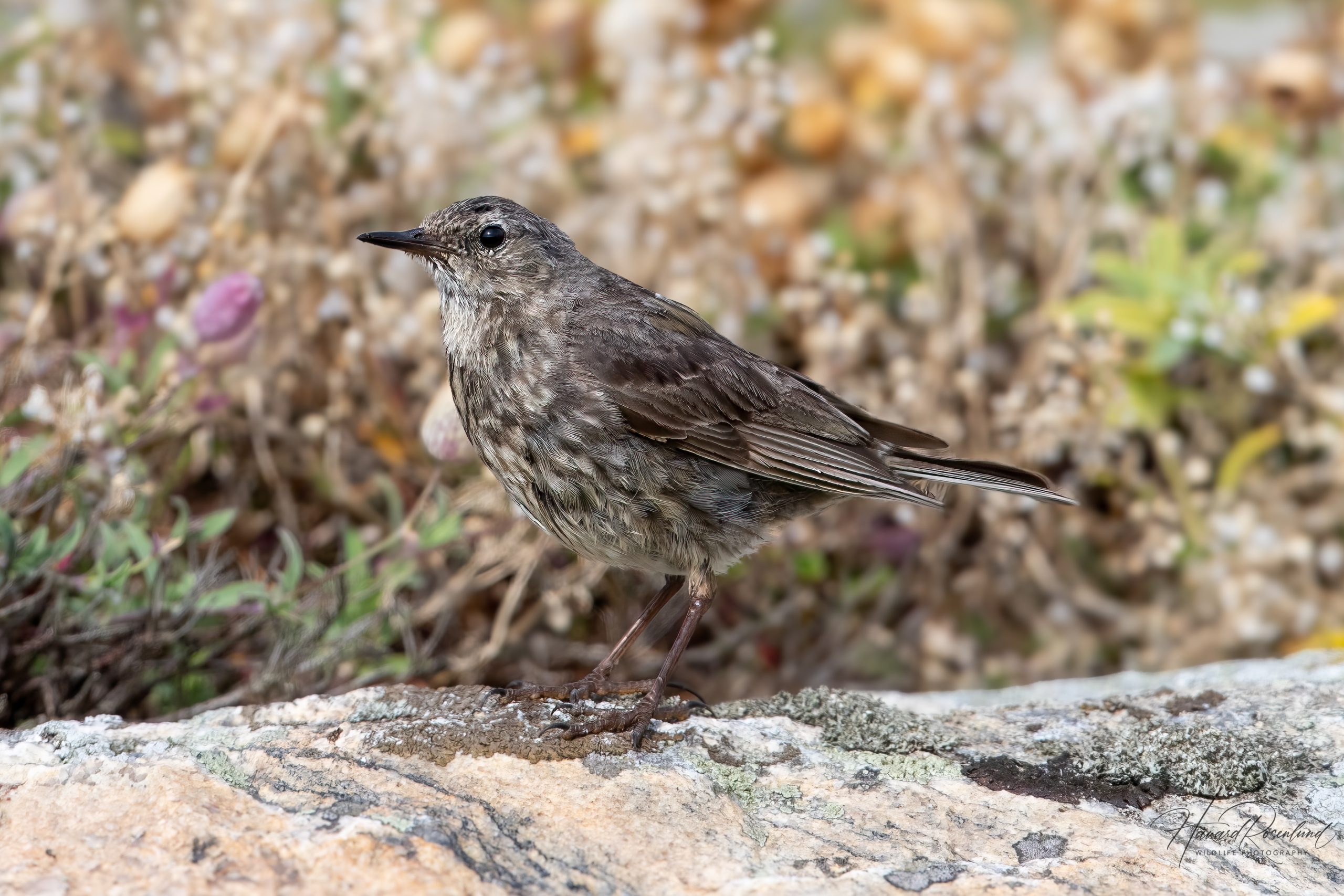
The rock pipit (Anthus petrosus) is a sturdy, dark-coloured pipit strongly associated with the coasts of western and northern Europe. Adults are about 16–18 cm long, with a wingspan of roughly 23–28 cm, and usually weigh 20–30 g. The plumage is grey-brown to olive-brown with diffuse dark streaking, the legs are dark and the bill is relatively strong.
Meadow pipit (Anthus pratensis) is usually smaller, paler and more strongly streaked, with noticeably paler legs and a stronger preference for open inland habitats. Rock pipits can still be surprisingly difficult to see against dark rocks and seaweed, where their subdued plumage provides effective camouflage.
Habitat
Rock pipits are coastal specialists. They breed on rocky shores, islands, sea cliffs and other exposed coastlines, often where crevices, boulders and low coastal vegetation provide nesting cover. They are rarely found far from salt water during the breeding season.
Outside breeding they use a somewhat wider range of coastal habitats, including tidal rocks, strandlines, saltmarsh edges, harbours and nearby wet grassland. They are particularly well adapted to foraging in the narrow zone where land and sea meet, including places regularly exposed to spray and tides.
Diet
The diet consists mainly of small invertebrates, including insects, spiders, worms and marine crustaceans. Rock pipits search among stones, in rock pools and through washed-up seaweed, and also pick prey from short coastal vegetation. Seeds and other plant material are taken in smaller amounts.
Foraging is mostly carried out while walking and running along the ground, with short flights between feeding patches. The tide continually changes which parts of the shore are accessible, so birds shift their feeding areas through the day as rocks, pools and seaweed are exposed or covered.
Behaviour
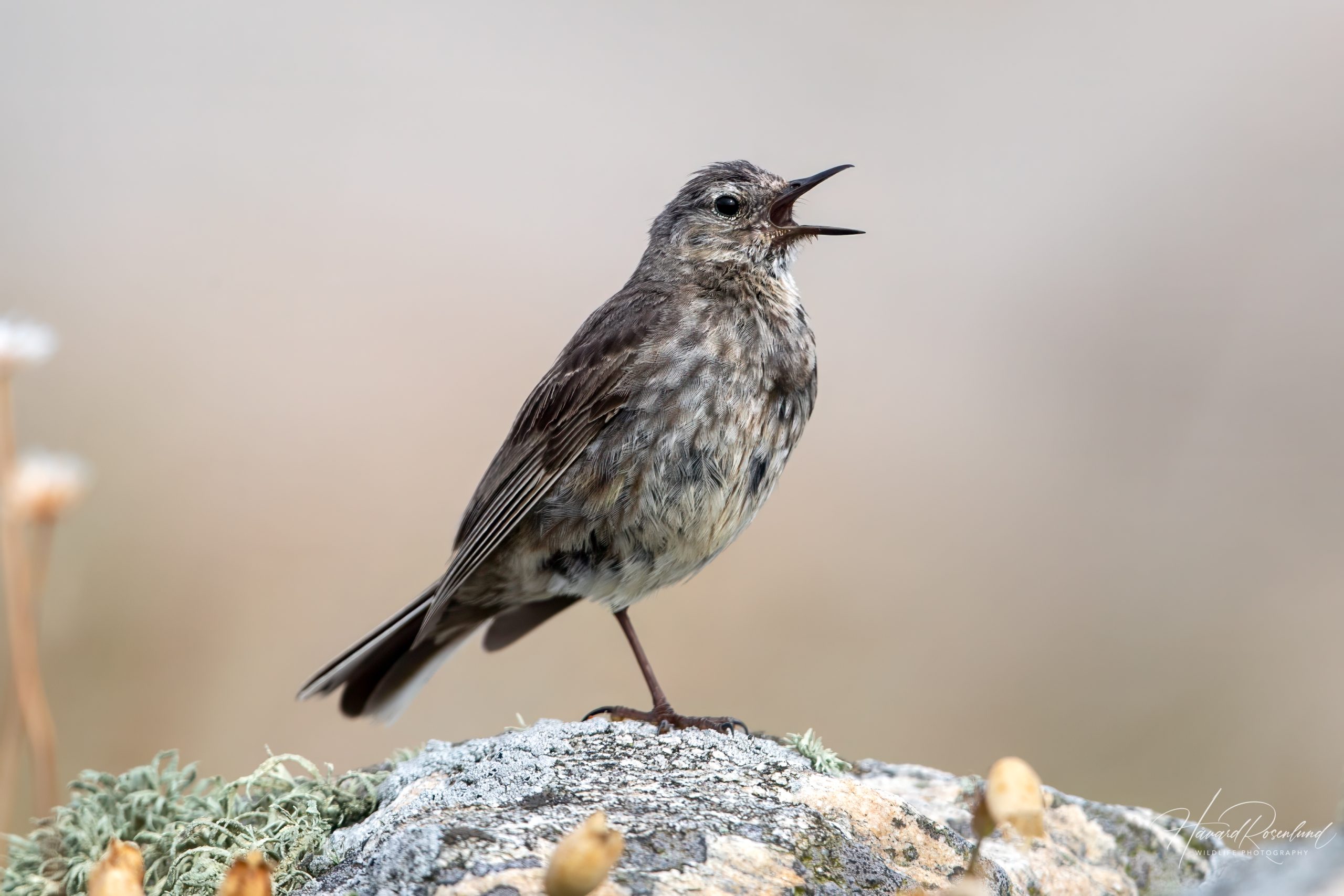
Rock pipits are strongly territorial, and territoriality is not restricted to the immediate nesting period. During breeding, males defend stretches of coast and sing from rocks and fence posts as well as during short song flights. Winter feeding territories have also been documented, with their size closely linked to how much food the shore can provide. Where food becomes concentrated, however, several birds may still forage relatively close together.
Relations between neighbouring territory holders can be surprisingly flexible. A field study published in 1997 found that familiar neighbours sometimes stopped fighting each other when an unfamiliar male appeared near their shared boundary and instead joined in driving the stranger away. This temporary "armistice" may help both established birds avoid having to negotiate a new boundary with an unfamiliar neighbour.
Migration
The rock pipit is a partial migrant. Birds in milder parts of western Europe are often resident, while many northern and Scandinavian birds move south after breeding. Wintering birds from northern Europe can travel much farther than the largely sedentary populations of Britain and Ireland.
Most movements remain coastal, reflecting the species' specialised habitat. Ringing data show that resident birds may move very little during their lives, whereas migratory individuals can cover thousands of kilometres between northern breeding areas and wintering coasts farther south.
Breeding
The nest is usually placed close to the sea in a rock crevice, beneath a stone, under dense vegetation or in another sheltered cavity. Holes and crevices in walls and other man-made structures are also sometimes used. The female builds the nest from grasses and other plant material. Four or five eggs are typical.
The female performs the incubation, which usually lasts about 14–15 days. Both parents feed the chicks, which normally fledge after about 15–16 days. One or two broods can be raised in a season, depending on timing and conditions.
Status
The rock pipit is classified as least concern on the IUCN Red List and remains widespread around suitable European coastlines. Population trends are nevertheless poorly quantified in parts of the range.
In Britain, long-term population change is difficult to measure reliably because the species is not well covered by several standard monitoring schemes. Local coastal development, disturbance, pollution and changes to shoreline habitats can still affect breeding and feeding areas, although no major range-wide decline is currently indicated.
Image gallery
Loading map and observations…
Have you seen this species?
Independent species archive
Did you find this species page useful?
Wildlife Vagabond is independently built and maintained. Voluntary support helps cover hosting, maps, data storage and continued improvements to the species archive.
Support Wildlife VagabondSpecies content will remain freely available.
References
Information about the species’ global distribution and status is based primarily on global Red List data. See the references below for details.
- Artsdatabanken. (2021). Skjærpiplerke, Norsk rødliste 2021. https://lister.artsdatabanken.no/rodlisteforarter/2021/28481
- Artsdatabanken. (n.d.). Skjærpiplerke Anthus petrosus. https://artsdatabanken.no/arter/takson/4232
- BirdLife International. (n.d.). Rock Pipit species factsheet. https://datazone.birdlife.org/species/factsheet/rock-pipit-anthus-petrosus
- British Trust for Ornithology. (n.d.). BirdFacts – Rock Pipit (Anthus petrosus). https://www.bto.org/learn/about-birds/birdfacts/rock-pipit
- Elfström, S. (1997). Fighting behaviour and strategy of rock pipit,Anthus petrosus, neighbours: cooperative defence. Animal Behaviour, 54(3), 535-542. https://doi.org/10.1006/anbe.1996.0492
- Gibb, J. (1956). Food, feeding habits and territory of the rock pipit <i>Anthus spinoletta</i>. Ibis, 98(3), 506-530. https://doi.org/10.1111/j.1474-919X.1956.tb01437.x
- International Union for Conservation of Nature. (n.d.). Rock Pipit. The IUCN Red List of Threatened Species. https://www.iucnredlist.org/species/22718567/131987689
- Royal Society for the Protection of Birds. (n.d.). Rock Pipit (Anthus petrosus). https://www.rspb.org.uk/birds-and-wildlife/rock-pipit