
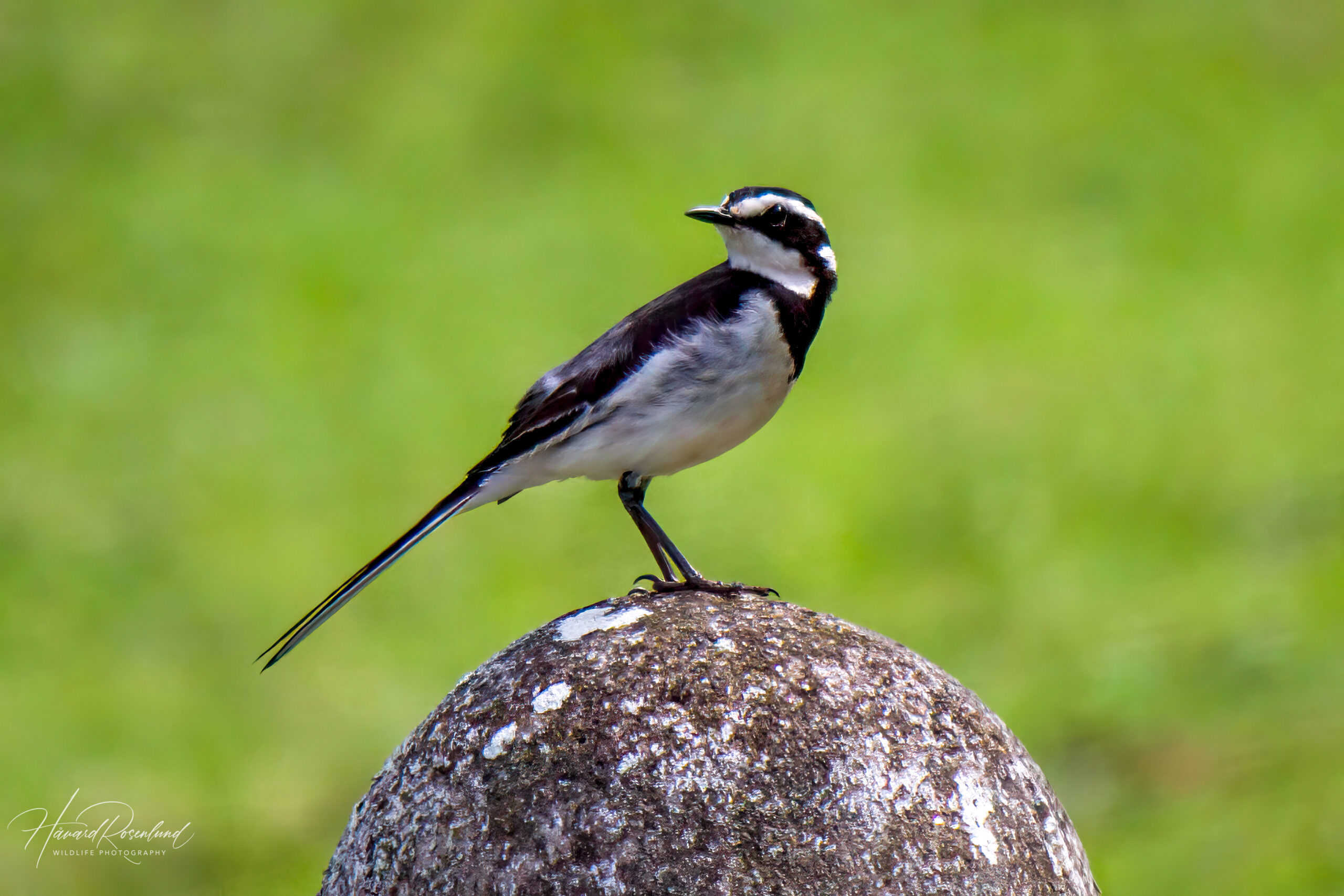
African Pied Wagtail
Motacilla aguimp
At a glance
Habitat
- Riverbanks, lakeshores, wetlands, sewage works, lawns, parks and other open areas near water
Diet
- Mostly insects and other invertebrates; also seeds, tadpoles, small fish and food scraps
Activity
- Diurnal
Size
- Length: ~20 cm Weight: 22–33 g
Range
- Widespread across sub-Saharan Africa, extending north along the Nile into southern Egypt
Description
The African pied wagtail (Motacilla aguimp) is a striking black-and-white wagtail widespread across sub-Saharan Africa and extending north along the Nile into southern Egypt. Adults are about 20 cm long and weigh roughly 22–33 g. The black head and upperparts contrast with a broad white eyebrow, white wing panels and white underparts broken by a prominent black breast band. Juveniles are duller and browner.
Two subspecies are generally recognised. M. a. aguimp occupies the far south of the range, while the more widespread M. a. vidua extends from West and East Africa south into eastern parts of southern Africa. The species differs from the white wagtail (Motacilla alba) by its much blacker upperparts and bold white supercilium, while the very similar Mekong wagtail (Motacilla samveasnae) is restricted to mainland Southeast Asia.
Habitat
African pied wagtails are strongly associated with water but are highly adaptable. They frequent riverbanks, sandy shores, lakes, marshes, rocky coastlines, dams, sewage works and flooded ground, as well as lawns, parks, golf courses and urban settlements where open feeding areas occur near water.
They often benefit from human-created water bodies and short vegetation, provided that nearby structures, banks or vegetation offer safe places for resting and nesting. This flexibility helps the species persist in both natural wetlands and densely settled landscapes.
Diet
The diet is dominated by insects and other invertebrates, including flies and their larvae, beetles, grasshoppers, dragonflies, ants, termites, worms and small crabs. Grass seeds, tadpoles, small fish and human food scraps are also taken.
African pied wagtails usually run or walk rapidly across open ground, stopping abruptly to peck at prey. They also make short aerial sallies and skim low over water to catch flying insects. This mixture of ground feeding and agile aerial pursuit allows them to exploit prey wherever it becomes concentrated along water margins.
Behaviour
The species is typically encountered singly, in pairs or in family groups. The characteristic tail-wagging continues while a bird walks and when it pauses between periods of activity. Birds also use a range of sharp calls for contact, alarm and territorial interactions.
Pairs can be strongly territorial and chase other wagtails from feeding and nesting areas. Individuals are even known to attack their own reflection in windows or vehicle mirrors, apparently responding to the image as a rival bird. Outside the breeding period, local family groups may remain together for some time before young birds disperse.
Most populations are sedentary rather than regular migrants. Dispersal can nevertheless be substantial: a ringing recovery from Lake Nasser documented a bird about 155 km from its natal area nearly two years later. Local movements also follow changing water levels and food conditions.
Breeding
Breeding timing varies geographically and is closely linked to local rainfall. A study in Blantyre, Malawi, recorded breeding across about six months of the year, with activity peaking before and during the rains, while birds at Lake Nasser in southern Egypt laid mainly from March to May. More than one brood can be raised in a season.
Both sexes help build the deep cup nest from dry grass, roots, stems, leaves and other plant material, lining it with finer grass, hair and feathers. Natural sites are usually sheltered and close to water, but ledges, bridges, roofs, wall cavities and even boats may also be used. Clutches usually contain two to five eggs.
The Malawi study found that the female incubated while both parents fed the young; in some other populations, males may also contribute to incubation. Incubation lasts roughly 12–15 days, and young leave the nest after about 15–18 days, remaining dependent on the parents for around another two weeks.
Status
The African pied wagtail is classified as least concern on the IUCN Red List. It has a very large range, remains common in many suitable habitats across sub-Saharan Africa, and the global population trend is considered stable.
Its ability to use dams, sewage works, gardens and other human-modified habitats gives the species considerable ecological flexibility. Local populations can still be affected by degradation and pollution of wetlands and riversides, but no major threat is known across the species' range.
Image gallery
Loading map and observations…
Have you seen this species?
Independent species archive
Did you find this species page useful?
Wildlife Vagabond is independently built and maintained. Voluntary support helps cover hosting, maps, data storage and continued improvements to the species archive.
Support Wildlife VagabondSpecies content will remain freely available.
References
Information about the species’ global distribution and status is based primarily on global Red List data. See the references below for details.
- Biodiversity Explorer. (n.d.). African Pied Wagtail (Motacilla aguimp). Iziko Museums of South Africa. https://www.biodiversityexplorer.info/birds/motacillidae/motacilla_aguimp.htm
- BirdLife International. (n.d.). African Pied Wagtail species factsheet. https://datazone.birdlife.org/species/factsheet/african-pied-wagtail-motacilla-aguimp
- Hering, J., Fischer, S., Geiter, O., Siegel, S., Eilts, H.-J., Fuchs, E., Habib, M. I., & Winter, M. (2019). Breeding population of African Pied Wagtail at Lake Nasser, Egypt. Dutch Birding, 41(4), 238–244. https://www.researchgate.net/publication/335174402_Breeding_population_of_African_Pied_Wagtail_at_lake_Nasser_Egypt
- International Union for Conservation of Nature. (n.d.). African Pied Wagtail. The IUCN Red List of Threatened Species. https://www.iucnredlist.org/species/22718366/132117671
- Nhlane, M. E. D. (1990). Breeding biology of the African pied wagtail <i>Motacilla aguimp</i> in Blantyre, Malaŵi. Ostrich, 61(1-2), 1-4. https://doi.org/10.1080/00306525.1990.9633929