
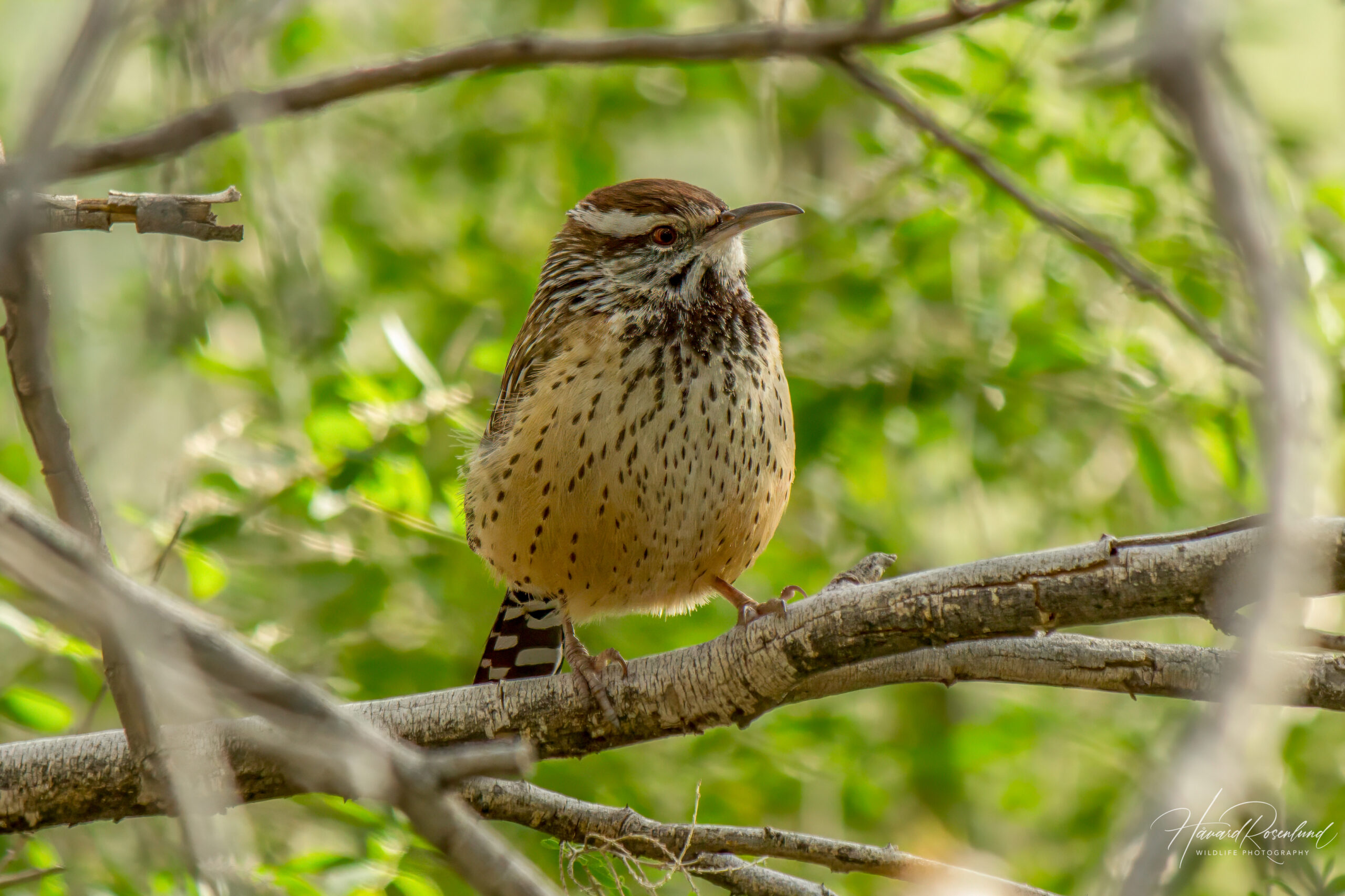
Cactus Wren
Campylorhynchus brunneicapillus
At a glance
Habitat
- Desert scrub and other arid landscapes with cholla, prickly-pear, mesquite, yucca and thorny shrubs
Diet
- Mostly insects and spiders, supplemented by cactus fruit, seeds and other plant material
Activity
- Diurnal
Size
- Length: 18–22 cm Weight: 32–47 g
Range
- Deserts and dry scrub of the southwestern United States and northern to central Mexico
Description
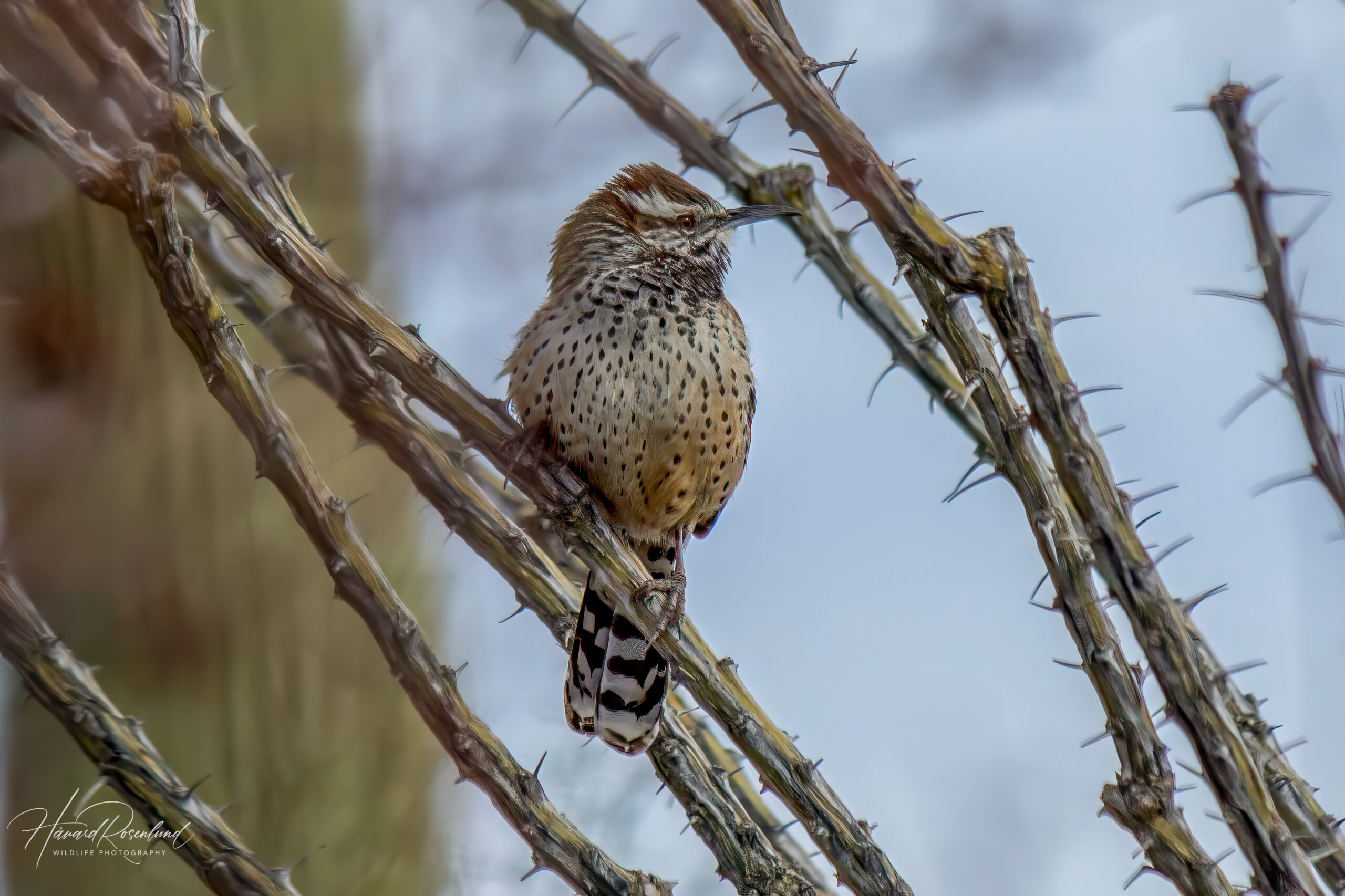
The cactus wren (Campylorhynchus brunneicapillus) is the largest wren in the United States, measuring about 18–22 cm and weighing roughly 32–47 g. It is a boldly marked desert bird with a long white eyebrow, brown crown, heavily spotted underparts, barred wings and tail and a fairly long, slightly curved bill. Males and females look alike.
The species is strongly associated with arid landscapes of the southwestern United States and Mexico and is especially characteristic of cactus-rich desert scrub.
Habitat
Cactus wrens inhabit desert scrub, thorn scrub and other arid landscapes with cholla, prickly-pear and saguaro cacti, mesquite, acacia, yucca and similar vegetation. Cholla is especially valuable because its dense spines provide protected sites for the species' enclosed nests.
Thorny shrubs and desert trees are also used, and pairs require enough structural vegetation within a territory to provide feeding areas, shade and several potential nest or roost sites.
Diet
Cactus wrens eat mainly insects and spiders, including beetles, ants, wasps, grasshoppers, caterpillars and many other invertebrates. Fruit, especially cactus fruit, and some seeds or other plant material supplement the diet.
Most water is obtained from food, and the birds rarely need to drink free-standing water.
Foraging
Cactus wrens forage mostly on or close to the ground, searching leaf litter, bark, shrubs and cactus surfaces for food. They move actively through low vegetation, probing and picking prey from sheltered surfaces rather than relying on long aerial pursuits.
During extreme heat they shift more feeding activity into shade, reducing exposure to the hottest conditions while continuing to search within sheltered vegetation.
Behaviour
Cactus wrens live in strongly territorial pairs and defend the same area throughout the year. Their harsh, mechanical song is one of the characteristic sounds of Sonoran Desert scrub and is delivered conspicuously from elevated cacti and shrubs.
Cactus wrens also use nests outside the breeding season. A pair may maintain several enclosed structures within its territory and return to them at night for shelter. Adults are assertive defenders, spreading the tail, fluffing the plumage, scolding and chasing intruders and mobbing snakes and other nest predators.
The species can also destroy nests of other birds. Experimental and field observations have documented cactus wrens puncturing or removing eggs and damaging neighbouring nests, behaviour that can locally reduce the breeding density of smaller species such as verdins (Auriparus flaviceps).
Breeding
Breeding can begin in late winter and continue into summer. In favourable years a pair may raise as many as three broods, while severe drought can cause some pairs to skip breeding entirely. Pair interactions during courtship include short growling displays with the wings and tail spread, followed by gentler pecking or touching between the birds.
Both members of the pair build the large football-shaped nest, usually 1–3 m above the ground inside a cholla cactus or other thorny vegetation. A narrow side entrance leads through a short tunnel into a chamber lined with soft material such as grass and feathers, providing shade and some protection from predators.
Clutches contain two to seven eggs. Incubation lasts about 16–17 days and the young remain in the nest for roughly 17–23 days. Juveniles begin imitating nest construction soon after fledging, picking up plant material while they are still dependent on their parents.
Cultural significance
The cactus wren is the official state bird of Arizona. It was designated in 1931 and has become a familiar symbol of the state's desert landscapes, where its close association with cholla, saguaro and other thorny vegetation makes it particularly representative of the Sonoran Desert.
Status
The cactus wren is classified as least concern on the IUCN Red List, but the global category masks a substantial long-term decline in the United States. North American Breeding Bird Survey data indicate a cumulative decline of about 51% between 1966 and 2019.
Loss and fragmentation of cactus-rich desert scrub are important pressures, particularly where urban and agricultural development removes cholla and other nesting vegetation. Coastal cactus wren populations in southern California are especially fragmented and isolated from one another.
Image gallery
Loading map and observations…
Have you seen this species?
Independent species archive
Did you find this species page useful?
Wildlife Vagabond is independently built and maintained. Voluntary support helps cover hosting, maps, data storage and continued improvements to the species archive.
Support Wildlife VagabondSpecies content will remain freely available.
References
Information about the species’ global distribution and status is based primarily on global Red List data. See the references below for details.
- Anderson & Anderson. (1990). Experimental studies of nest-destroying behavior by Cactus Wrens. https://academic.oup.com/condor/article/92/4/855/5185334
- Arizona State Library. (n.d.). Cactus Wren as Arizona's state bird. https://azlibrary.gov/state-bird/7089
- BirdLife International. (n.d.). Cactus Wren species factsheet. https://datazone.birdlife.org/species/factsheet/cactus-wren-campylorhynchus-brunneicapillus
- Cornell Lab of Ornithology. (n.d.). Cactus Wren Life History. https://www.allaboutbirds.org/guide/Cactus_Wren/lifehistory
- International Union for Conservation of Nature. (n.d.). Cactus Wren. The IUCN Red List of Threatened Species. https://www.iucnredlist.org/species/22711287/137608630
- Smith, E. K., O'Neill, J. J., Gerson, A. R., McKechnie, A. E., & Wolf, B. O. (2017). Avian thermoregulation in the heat: resting metabolism, evaporative cooling, and heat tolerance in Sonoran Desert songbirds. Journal of Experimental Biology, jeb.161141. https://doi.org/10.1242/jeb.161141
- U.S. Geological Survey. (n.d.). Distribution and habitat characteristics of Coastal Cactus Wrens. https://www.usgs.gov/publications/distribution-abundance-and-habitat-characteristics-coastal-cactus-wrens