
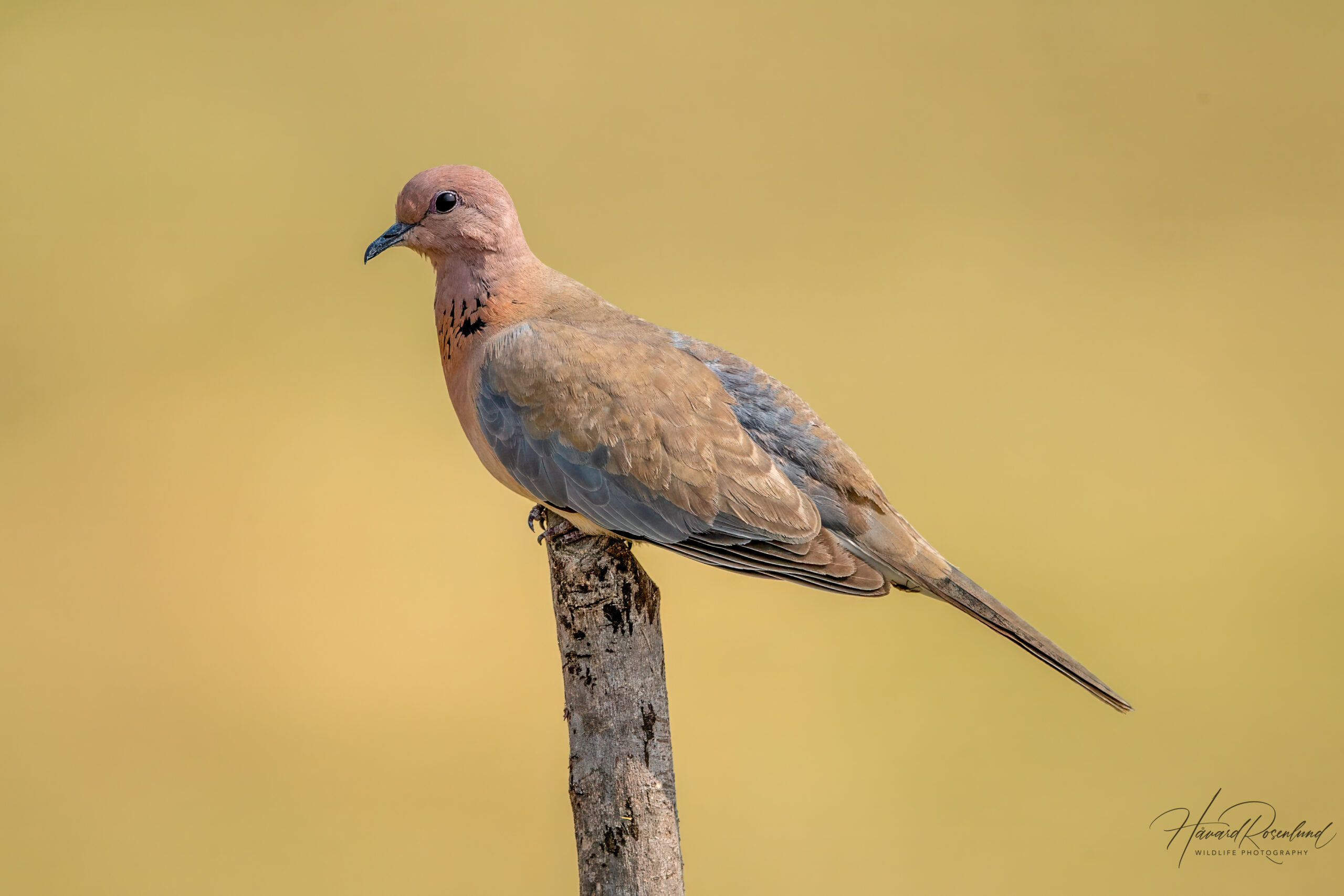
Laughing Dove
Spilopelia senegalensis
At a glance
Habitat
- Dry woodland, scrub, savanna, farmland, gardens and urban areas
Diet
- Mainly grass and other seeds; also grains, fruit, plant matter and small invertebrates
Activity
- Diurnal; feeds mainly on the ground
Size
- Length: 25–27 cm Weight: 72–139 g
Range
- Africa, the Middle East, Central and South Asia; introduced populations also occur in Australia
Description
The laughing dove (Spilopelia senegalensis) is a small, slender and long-tailed dove found across much of Africa, the Middle East and South Asia, extending into parts of Central Asia. Established introduced populations also occur in Australia. Adults are about 25–27 cm long and typically weigh 72–139 g.
The plumage is mostly warm pinkish brown, with a mauve-pink wash on the head and breast and richer reddish-brown upperparts. Its most distinctive feature is the rufous patch on the front and sides of the neck, densely speckled with black. The long tail has conspicuous white outer feathers that become especially obvious in flight. The feet are deep red. The sexes look similar, while juveniles are duller and have a less developed neck pattern.
Habitat
Laughing doves favour relatively open and dry habitats, including scrub, savanna, open woodland, farmland and semi-arid country. They usually require access to trees or shrubs for resting and nesting even where much of the surrounding landscape is open.
The species also readily lives alongside people and is common in villages, gardens, parks and urban or suburban areas where seeds, drinking water and sheltered nesting sites are readily available.
Diet
Grass seeds and other small seeds form the bulk of the diet. Grain, fallen fruit, green plant material and occasional small invertebrates are also eaten.
Most feeding takes place on the ground, where laughing doves walk steadily across open patches and pick individual seeds and other small food items from bare soil, short vegetation and paths. Small groups can gather at rich seed sources or around water.
Behaviour
The species is diurnal and generally unobtrusive, but males become conspicuous when calling from exposed branches, wires or buildings. The characteristic song is a low, rhythmic series of coos with a chuckling or laughing quality, the source of the English name.
Laughing doves are usually encountered alone or in pairs rather than in large permanent flocks. They are primarily resident across much of the range, although local movements follow changing food and water availability.
Breeding
Breeding seasons vary across the enormous range and can extend through much of the year in warm regions. The nest is a sparse platform of twigs and stems typical of doves, usually placed in a tree or shrub but sometimes on ledges and other human-made structures. Laughing doves are monogamous, and both parents take part in nest building, incubation and feeding the young.
A clutch normally contains two pale eggs. A study published in 2023 in Taif, Saudi Arabia, found an average incubation period of 14.5 days, with observed nests ranging from 13 to 17 days. The chicks are altricial, hatching helpless and dependent on their parents. During their first days they are fed crop milk by both parents, a nutrient-rich secretion produced in the crop. In the Taif study they remained in the nest for roughly 17–20 days. Exact timing varies among regions, but the short cycle allows pairs to breed repeatedly when conditions remain favourable.
Status
The laughing dove is classified as least concern on the IUCN Red List. It has an exceptionally broad range and remains common across much of it, including heavily modified landscapes.
No major threat is known to affect the species throughout its range. Local abundance can nevertheless change with habitat conditions, food supply, disturbance and nest predation.
Image gallery
Loading map and observations…
Have you seen this species?
Independent species archive
Did you find this species page useful?
Wildlife Vagabond is independently built and maintained. Voluntary support helps cover hosting, maps, data storage and continued improvements to the species archive.
Support Wildlife VagabondSpecies content will remain freely available.
References
Information about the species’ global distribution and status is based primarily on global Red List data. See the references below for details.
- Almalki, M. (2023). Breeding ecology of the laughing dove (Streptopelia senegalensis) in the Taif City, Kingdom of Saudi Arabia. Brazilian Journal of Biology, 83, e272328. https://doi.org/10.1590/1519-6984.272328
- BirdLife International. (n.d.). Laughing Dove species factsheet. https://datazone.birdlife.org/species/factsheet/laughing-dove-spilopelia-senegalensis
- International Union for Conservation of Nature. (n.d.). Laughing Dove. The IUCN Red List of Threatened Species. https://www.iucnredlist.org/species/22690445/132060894
- Naturalis Biodiversity Center. (n.d.). Laughing Dove species data. https://bris.linnaeus.naturalis.nl/linnaeus_ng/app/views/species/nsr_taxon.php?id=112389