
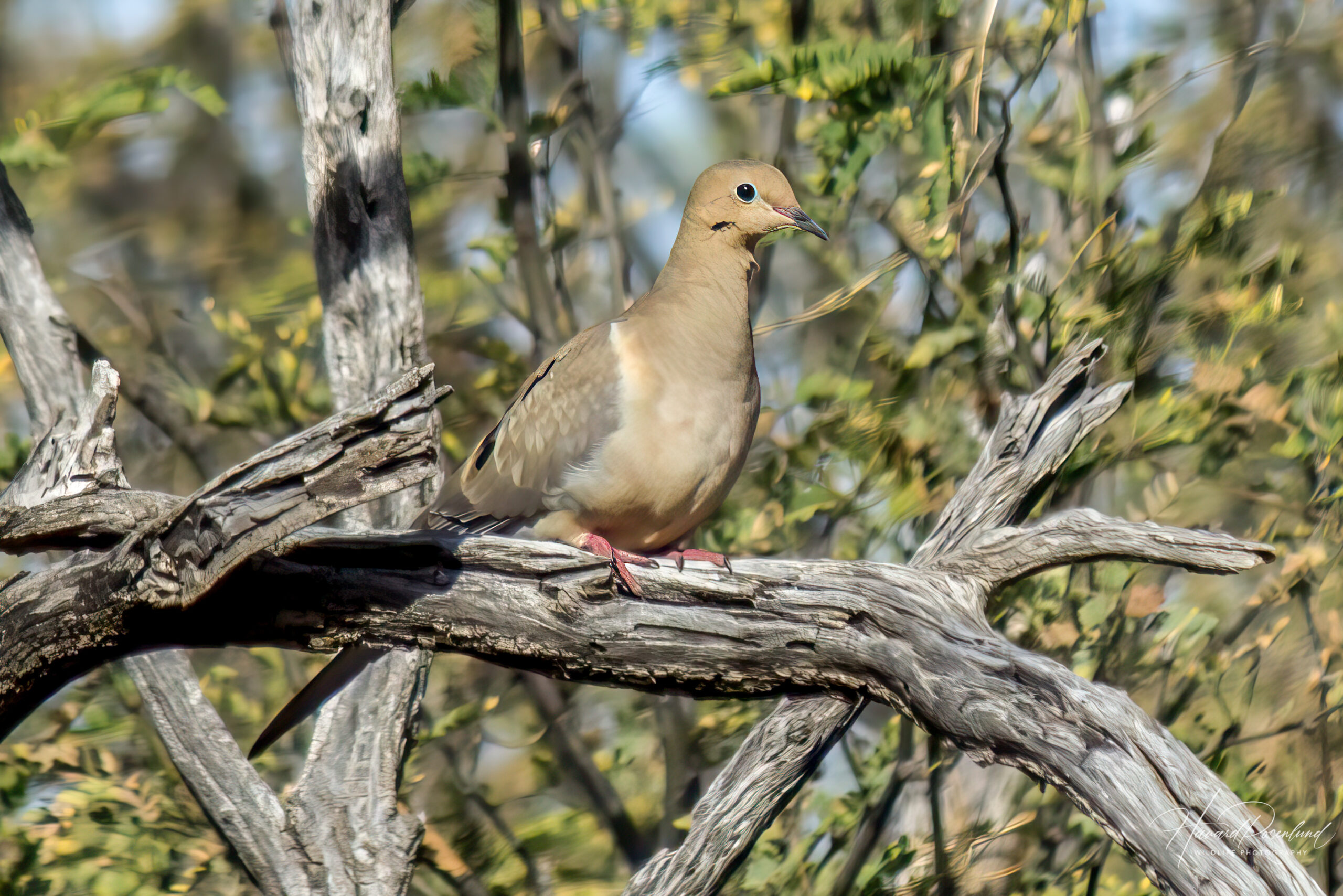
Mourning Dove
Zenaida macroura
At a glance
Habitat
- Open woodland, grassland, farmland, desert scrub, suburbs and other open country
Diet
- Almost entirely seeds from wild plants and crops
Activity
- Diurnal
Size
- Length: 23–34 cm Weight: 86–170 g
Range
- Across most of North America through Mexico and Central America, with northern populations migratory
Description
The mourning dove (Zenaida macroura) is a slender, small-headed dove common across much of North America. Adults are about 23–34 cm long and weigh roughly 86–170 g. The plumage is soft grey-brown to buff, with black spots on the wings, a small black mark on the cheek and a long pointed tail whose outer feathers end in conspicuous white tips.
The species takes its English name from the male’s soft, drawn-out cooing. In flight, the long pointed wings and tail give the bird a fast, streamlined appearance, and the wings produce a characteristic mechanical whistle that is especially noticeable during sudden take-off. In fast flight, mourning doves can reach around 88 km/h (55 mph).
Habitat
Mourning doves favour open country with scattered trees or other perches, including grassland, farmland, desert scrub, roadsides, woodland edges, suburbs and gardens. They generally avoid extensive closed forest. Much of their feeding takes place on bare or sparsely vegetated ground.
The species has adapted very well to human-modified landscapes because farms, gardens, roadsides and towns can provide both seed-rich feeding areas and trees, wires or buildings for perching and nesting.
Diet
Seeds make up about 99% of the diet. Seeds from wild grasses and weeds, cultivated grain and other small plants are swallowed whole and can be stored temporarily in the crop before digestion. Small amounts of berries or snails may also be taken.
Mourning doves feed mainly on the ground and pick seeds from the surface rather than scratching through the soil. They often fill the crop quickly at a productive feeding site and then move to a safer perch where the food can be digested more slowly.
Behaviour
Mourning doves usually walk rather than hop. Like other pigeons, their apparent head-bobbing during walking consists of alternating phases in which the head is briefly held almost still and then thrust forward. This stabilises the visual scene while the body moves. Outside breeding, mourning doves commonly gather in loose feeding and roosting flocks.
Vocal communication is conspicuous, particularly the male’s repeated cooing from a perch. The familiar mournful coo is used in social and territorial contexts and is especially prominent during the breeding season.
The wings also produce a non-vocal whistle during flight. An experiment published in 2008 found that the sharper whistle produced during sudden escape flights made both mourning doves and other birds more vigilant than ordinary take-off sounds. The sound can therefore provide information about danger without necessarily functioning as a deliberately given alarm call.
Migration
Migration varies strongly with latitude. Birds breeding in Canada and the northern United States are largely migratory and move south in autumn, while many populations in the southern United States, Mexico and Central America remain year-round.
Wintering birds can travel hundreds or thousands of kilometres, but the species does not have one single migration strategy across its range. Large autumn and winter concentrations may form where food and safe roosts are abundant.
Breeding
Mourning doves can breed repeatedly through a long season. The male gathers twigs while the female assembles the characteristically simple platform nest, usually in a tree, shrub or other elevated site but sometimes on the ground or on buildings. A clutch almost always contains two white eggs.
Both parents incubate for about 14 days. After hatching, both produce nutrient-rich crop milk from the lining of the crop and feed it directly to the young. Crop milk dominates the first days of life before increasing amounts of softened seed are added. Young normally leave the nest after about 12–15 days. They often remain nearby, and the male commonly continues feeding them for another one to two weeks.
The combination of small clutches and a very short nesting cycle allows successful pairs to raise several broods in a favourable year, compensating for the high mortality typical of a small, heavily preyed-upon dove.
Relationship with humans
Mourning doves are among the most heavily hunted migratory game birds in North America, and the annual harvest can exceed 20 million birds. Populations in the United States are therefore followed closely through breeding counts, banding and hunting records, and hunting seasons and harvest limits are adjusted accordingly.
Tens of thousands of mourning doves are banded each year, and the resulting recoveries provide detailed information about survival and movements. This gives the species an unusual place in North American birdlife: it is both a familiar backyard bird and a major quarry species whose populations are followed closely over time.
Status
The mourning dove is classified as least concern on the IUCN Red List. The global population is estimated at roughly 120–140 million mature individuals, and the overall population trend is decreasing.
The species nevertheless remains extremely numerous and widespread. Regional trends vary, and changes in land use, food availability, weather and hunting can affect populations differently across the continent.
Image gallery
Loading map and observations…
Have you seen this species?
Independent species archive
Did you find this species page useful?
Wildlife Vagabond is independently built and maintained. Voluntary support helps cover hosting, maps, data storage and continued improvements to the species archive.
Support Wildlife VagabondSpecies content will remain freely available.
References
Information about the species’ global distribution and status is based primarily on global Red List data. See the references below for details.
- BirdLife International. (n.d.). Mourning Dove species factsheet. https://datazone.birdlife.org/species/factsheet/mourning-dove-zenaida-macroura
- Coleman, S. W. (2008). Mourning dove (Zenaida macroura) wing-whistles may contain threat-related information for con- and hetero-specifics. Naturwissenschaften, 95(10), 981-986. https://doi.org/10.1007/s00114-008-0404-x
- Cornell Lab of Ornithology. (n.d.). Mourning Dove. https://www.allaboutbirds.org/guide/Mourning_Dove/overview
- International Union for Conservation of Nature. (n.d.). Mourning Dove. The IUCN Red List of Threatened Species. https://www.iucnredlist.org/species/22690736/95215602
- Troje, N. F., & Frost, B. J. (2000). Head-Bobbing in Pigeons: How Stable is the Hold Phase? Journal of Experimental Biology, 203(5), 935-940. https://doi.org/10.1242/jeb.203.5.935
- U.S. Fish & Wildlife Service. (n.d.). Mourning Dove Population Status, 2025. https://www.fws.gov/rivers/media/mourning-dove-population-status-2025