
Oriental Turtle Dove
Streptopelia orientalis
At a glance
Habitat
- Woodland edges, scrub, farmland, parks and other semi-open habitats with trees nearby
Diet
- Mainly seeds and grain, with berries and other plant foods also taken
Activity
- Diurnal
Size
- Length: 33–35 cm Weight: about 160–300 g
Range
- Breeds across central and eastern Asia; northern populations migrate south to the Indian subcontinent and Southeast Asia
Description
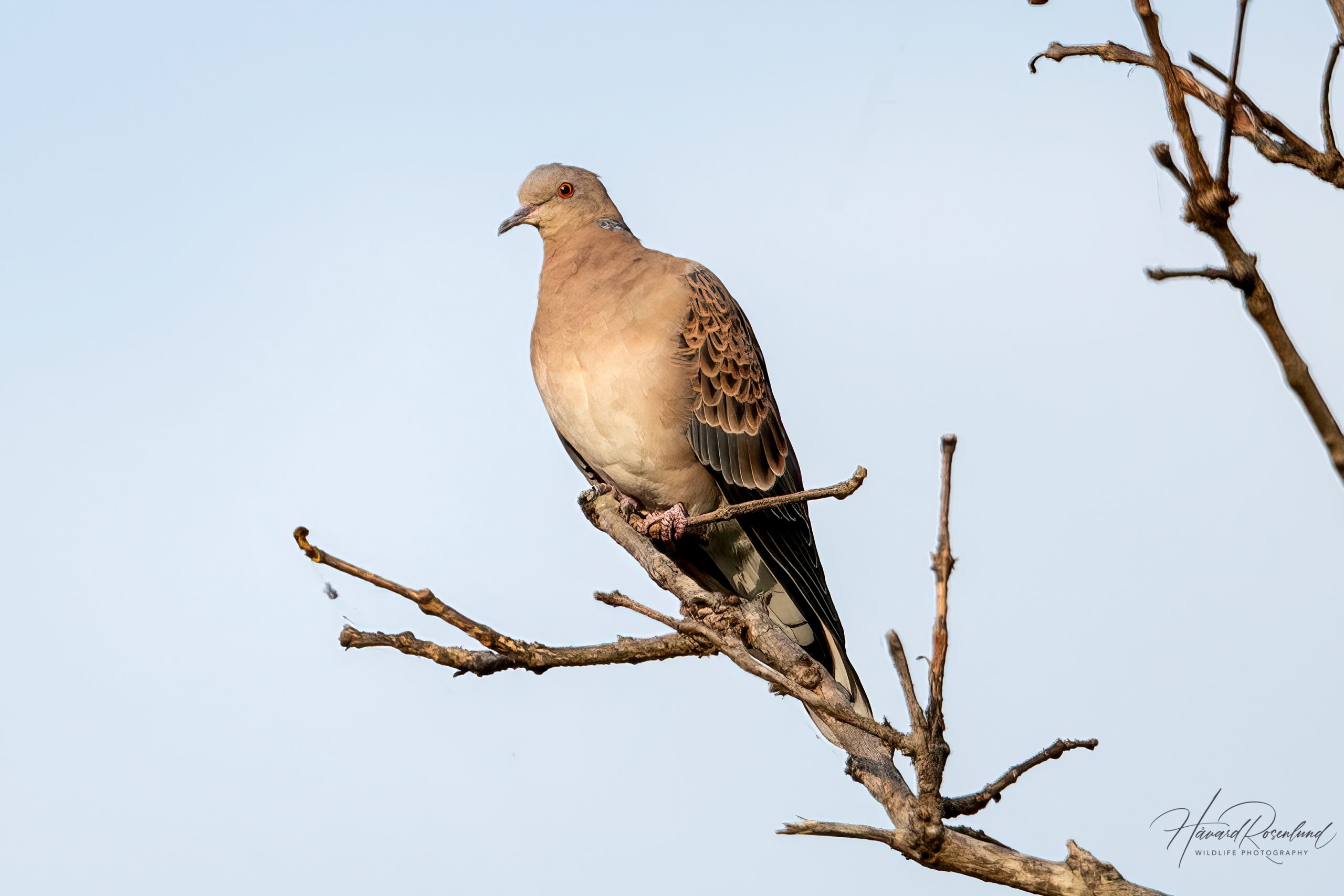
The Oriental turtle dove (Streptopelia orientalis) is a medium-sized dove widespread across Asia. Adults are about 33–35 cm long and weigh roughly 160–300 g. The warm brown upperparts have dark centres and pale reddish edges that create a strongly scaled pattern, while the sides of the neck carry a distinctive patch of black-and-white stripes.
The head and underparts are softer pinkish brown, and the long rounded tail has broad pale tips. The species resembles the European turtle dove (Streptopelia turtur) but is larger, darker and more heavily scaled above.
Habitat
Oriental turtle doves use a wide range of semi-open, tree-rich habitats. Woodland edges, open forest, scrub, farmland, villages, gardens and parks can all be suitable, and populations occur from lowland plains to mountain valleys and forested slopes.
They need both trees or shrubs for nesting and open ground where seeds can be collected. This combination allows the species to live in many agricultural and partly urban landscapes as well as more natural forest edges.
Diet
Seeds form most of the diet. The birds feed on seeds of wild grasses and herbs as well as grain and other cultivated plants, and also take berries and other plant foods. Small invertebrates may occasionally be eaten but are much less important.
Most feeding takes place on the ground. Birds walk slowly over bare soil, short vegetation, stubble fields and tracks, picking individual seeds with the bill. Where food is concentrated, several doves can gather into loose feeding flocks.
Behaviour
Oriental turtle doves spend much of the day feeding on the ground or resting quietly in trees. Larger groups become more common outside breeding and during migration. When disturbed, the birds launch into fast, direct flight with rapid wingbeats.
They often travel between safe tree cover and open feeding areas, so rows of trees, wooded field margins and scattered groves can be valuable even in heavily farmed landscapes.
Migration
The species ranges from resident to strongly migratory. Birds breeding in northern and central Asia move south in autumn, while populations in warmer areas can remain in the same general region throughout the year. Important wintering areas include the Indian subcontinent, southern China and Southeast Asia.
Movement within India is also substantial, with strong seasonal changes in where birds are recorded. Japanese ringing data likewise show regular movements between breeding and wintering areas, including recoveries close to 1,000 km from the ringing site.
In Norway, the Oriental turtle dove is a rare visitor from Asia. A complete review published in 2024 of Norwegian records through 2023 found that 19 birds could be assigned to the western subspecies meena, six to the eastern orientalis, while 18 could not be assigned safely to subspecies. Meena is therefore the more frequent form among Norwegian records.
Breeding
Breeding timing varies with latitude and local climate. Pairs defend the area around the nest, and the low repeated cooing song is commonly delivered from a tree or other raised perch during the breeding period. The pair builds a simple platform of twigs in a tree or shrub, often so loosely constructed that the eggs can sometimes be seen from below. Two white eggs are typical.
Both parents incubate and feed the young. A Hokkaido study published in 1984 found an incubation period of 14–17 days and a nestling period of 14–19 days. Clutches in this material contained one or two eggs, with a mean clutch size of 1.9 eggs across 57 nests. During the first days the chicks receive crop milk, a highly nutritious fluid produced in the parents’ crops. Seeds and other plant material become increasingly important as the chicks grow, and the parents continue feeding them for a short time after they leave the nest.
Status
The Oriental turtle dove is classified as least concern on the IUCN Red List. It has an enormous Asian range and remains common in many regions.
Both the long-term and recent population trends in India are uncertain. Habitat loss and hunting can affect local populations, but the species’ broad range and ability to use woodland edges, farmland and other modified landscapes give it considerable flexibility.
Image gallery
Loading map and observations…
Have you seen this species?
Independent species archive
Did you find this species page useful?
Wildlife Vagabond is independently built and maintained. Voluntary support helps cover hosting, maps, data storage and continued improvements to the species archive.
Support Wildlife VagabondSpecies content will remain freely available.
References
Information about the species’ global distribution and status is based primarily on global Red List data. See the references below for details.
- Biodiversity Center of Japan. (n.d.). Oriental Turtle Dove ringing recoveries. https://www.biodic.go.jp/birdRinging_en/atlas/Streptopelia_orientalis/Streptopelia_orientalis_en.html
- BirdLife International. (n.d.). Oriental Turtle Dove species factsheet. https://datazone.birdlife.org/species/factsheet/oriental-turtle-dove-streptopelia-orientalis
- BirdLife Norge. (2024). revision of Norwegian Oriental Turtle Dove records. https://www.birdlife.no/organisasjonen/nyheter/?id=3470
- Cornell Lab of Ornithology. (n.d.). Birds of the World – Oriental Turtle-Dove. https://birdsoftheworld.org/bow/species/ortdov/cur/introduction
- International Union for Conservation of Nature. (n.d.). Oriental Turtle Dove. The IUCN Red List of Threatened Species. https://www.iucnredlist.org/species/22690439/93273750
- Nakao, H. (1984). Fluctuations in population density and breeding performance of the Rufous Turtle Dove, Streptopelia orientalis, in Hokkaido. Japanese journal of applied entomology and zoology, 28(4), 193-200. https://doi.org/10.1303/jjaez.28.193
- State of India's Birds. (2025). State of India’s Birds 2025 – Oriental Turtle Dove. https://stateofindiasbirds.in/species/ortdov/