
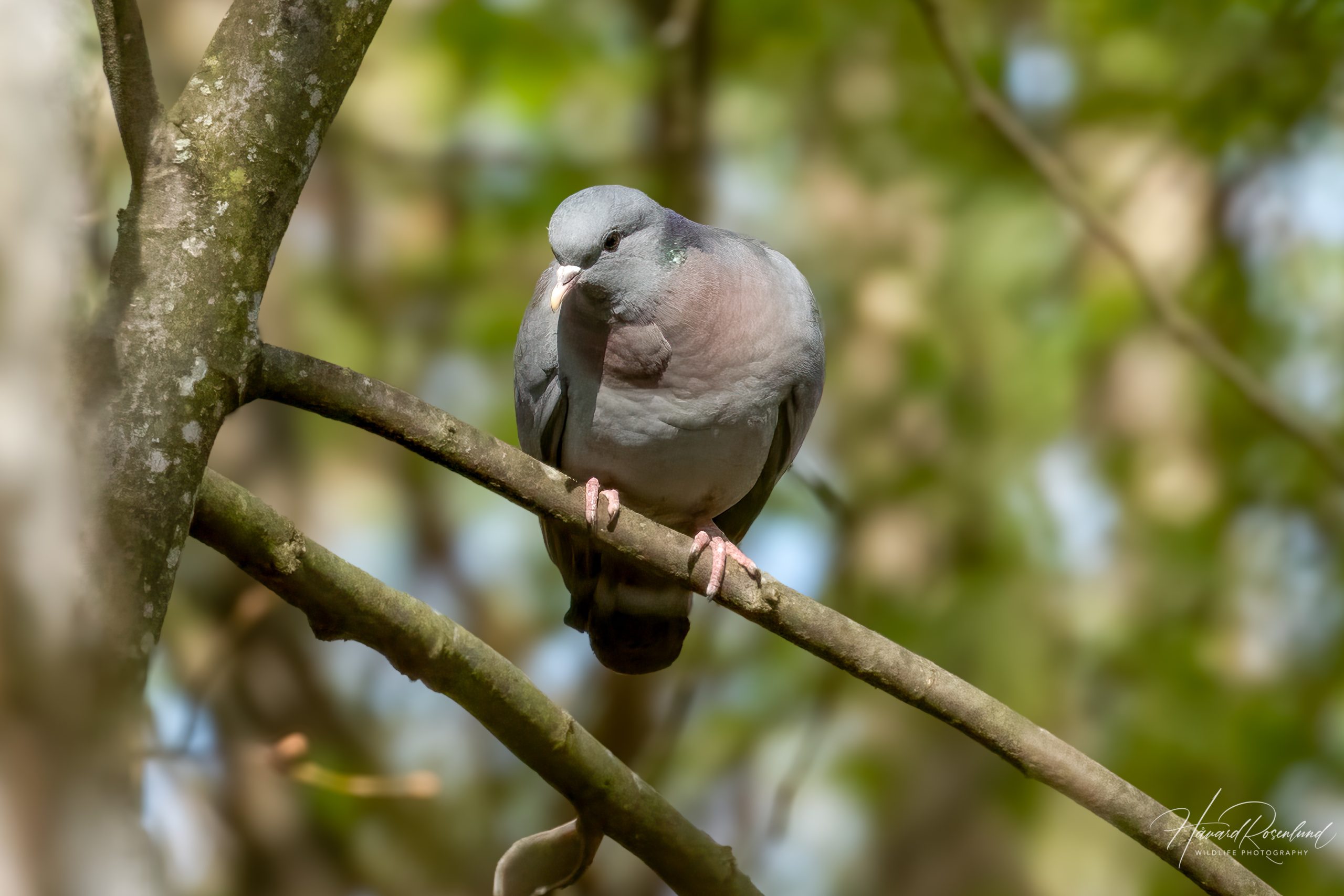
Stock Dove
Columba oenas
At a glance
Habitat
- Mature woodland, wooded farmland, parkland, orchards and forest edges
Diet
- Seeds, grain, weeds, buds, leaves and berries
Activity
- Diurnal
Size
- Length: 32–34 cm Weight: ~326 g
Range
- Europe and western Asia
Description
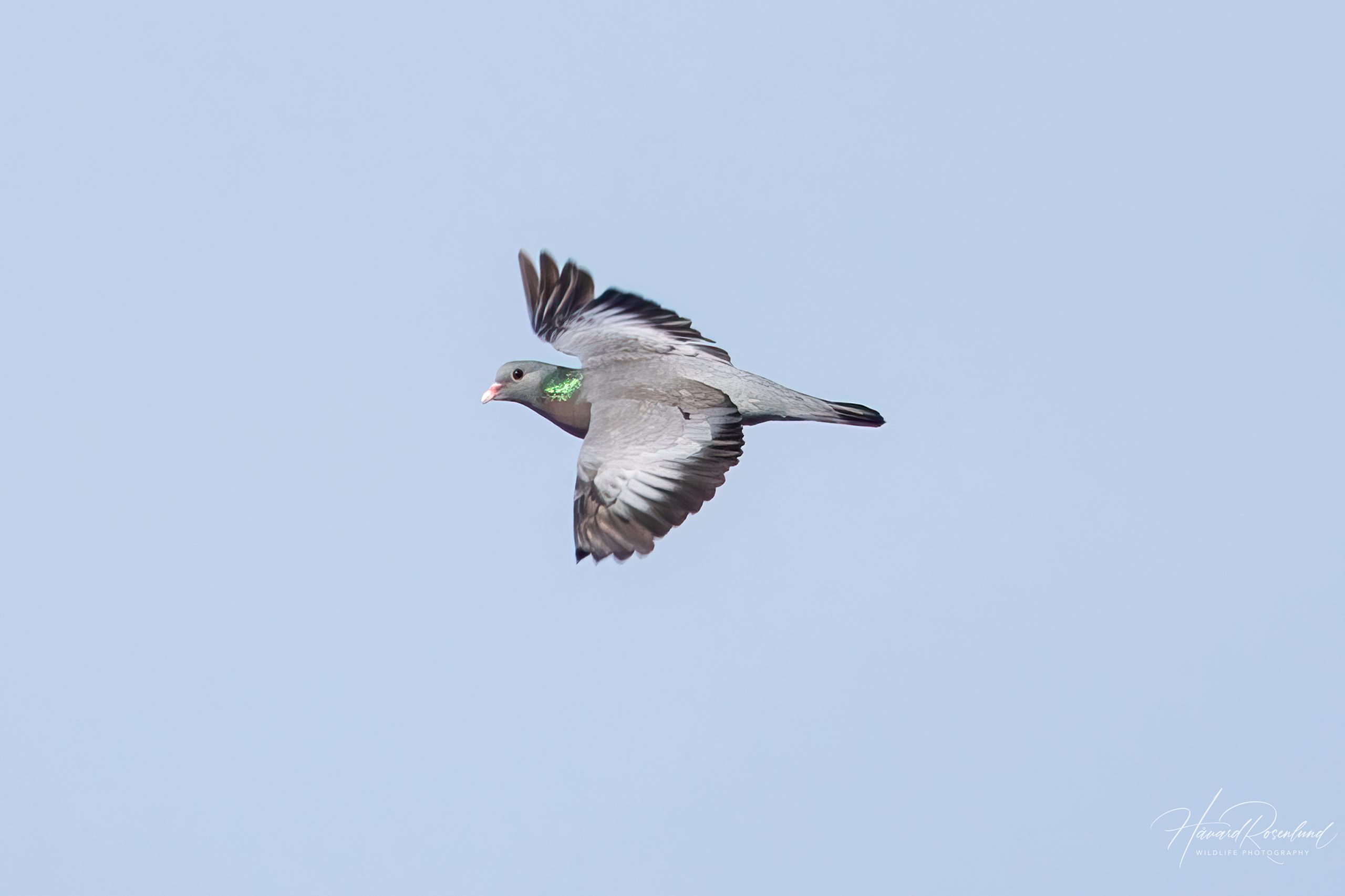
The stock dove (Columba oenas) is a medium-sized blue-grey pigeon found across much of Europe and western Asia. Adults are about 32–34 cm long, have a wingspan of roughly 60–66 cm and weigh around 326 g. The plumage is comparatively plain, with a soft blue-grey body, green iridescence on the neck and two short black bars across the folded wing. The eye is dark and the bill pinkish with a paler tip.
The larger common woodpigeon (Columba palumbus) has conspicuous white neck patches and broad white wing bands that the stock dove lacks. Stock doves also have a neater, more compact profile and a soft rolling song that is quite different from the woodpigeon's familiar five-note rhythm.
Habitat
Stock doves need a combination of feeding grounds and secure nesting cavities. They use mature deciduous and mixed woodland, wooded farmland, old parkland, orchards and forest edges, while feeding frequently takes place in nearby fields, pastures and other open ground.
Large old trees are particularly valuable because the species cannot excavate its own nest hole. Natural cavities and old Black Woodpecker holes can provide nesting opportunities for many years, making the retention of mature trees with suitable cavities important even in otherwise productive agricultural landscapes.
Diet
The diet consists mainly of plant material gathered on the ground. Seeds from grasses, weeds and cultivated plants are important, together with grain, buds, leaves and berries. Stock doves often forage in flocks outside the breeding season and may mix with woodpigeons and other pigeons on stubble fields and other rich feeding areas.
The species benefits from landscapes that retain seed-rich field margins, fallow patches and other sources of naturally occurring seeds. Small invertebrates may be taken occasionally but make up only a minor part of the diet.
Migration
Stock doves are partial migrants. Birds in mild western and southern Europe are often resident or move only short distances, while populations from northern and eastern parts of the range migrate southwest in autumn and return in spring. Autumn passage is concentrated from September to November, while northern birds return mainly from March into April.
Movements are therefore strongly regional rather than following one uniform migration strategy. Large flocks may gather at productive feeding sites during migration and winter, while pairs reoccupy breeding areas as conditions improve in late winter and spring.
Breeding
Stock doves nest in cavities they do not excavate themselves. They use natural hollows in old trees, holes made previously by Black Woodpeckers and other large cavities, and they also accept suitable nest boxes. Buildings, cliffs and other sheltered cavities are used locally. Egg-laying can begin in late March or early April and continue through August.
A study published in 2010 across seven forest sites in western Poland recorded 98 Stock Dove pairs and found a strong relationship between Stock Dove density and the abundance of cavities made by Black Woodpeckers. Eighty-four percent of Black Woodpecker cavities were in beech trees, and Stock Doves particularly used cavities in beech. Black Woodpeckers and mature beech can therefore be key resources for breeding Stock Doves in managed woodland.
Two white eggs are typical. Both parents incubate for roughly 17–22 days, while the chicks remain in the cavity for roughly 28–29 days. One or two broods are usual, and successful nest sites may be reused in later years.
Status
The stock dove is classified as least concern on the IUCN Red List and remains widespread across Europe. Regional trends are not uniform. In the UK the breeding population increased by 57% between 1995 and 2024. This follows an earlier population crash linked to organochlorine seed dressings used in the 1950s and early 1960s; numbers recovered strongly after that source of poisoning declined.
Potential local constraints include loss of mature trees with nesting cavities, shortage of nest holes, changes in farmland food availability, pesticides, hunting and nest predation. Because the species depends simultaneously on secure cavities and productive open feeding habitat, deterioration of either can reduce local breeding populations.
Image gallery
Loading map and observations…
Have you seen this species?
Independent species archive
Did you find this species page useful?
Wildlife Vagabond is independently built and maintained. Voluntary support helps cover hosting, maps, data storage and continued improvements to the species archive.
Support Wildlife VagabondSpecies content will remain freely available.
References
Information about the species’ global distribution and status is based primarily on global Red List data. See the references below for details.
- BirdLife International. (n.d.). Stock Dove species factsheet. https://datazone.birdlife.org/species/factsheet/stock-dove-columba-oenas
- British Trust for Ornithology. (n.d.). Stock Dove BirdFacts. https://www.bto.org/learn/about-birds/birdfacts/stock-dove
- International Union for Conservation of Nature. (n.d.). Stock Dove. The IUCN Red List of Threatened Species. https://www.iucnredlist.org/species/22690088/86074207
- Kosiński, Z., Bilińska, E., Dereziński, J., & Kempa, M. (2011). Nest-Sites used by Stock DovesColumba oenas: What Determines their Occupancy? Acta Ornithologica, 46(2), 155-163. https://doi.org/10.3161/000164511X625928
- Kosiński, Z., Bilińska, E., Dereziński, J., Jeleń, J., & Kempa, M. (2010). The Black Woodpecker Dryocopus martius and the European Beech Fagus sylvatica as keystone species for the Stock Dove Columba oenas in western Poland. Ornis Polonica, 51(1), 1–13. https://doi.org/10.12657/ornis.2010.1.1