
Crested Treeswift
Hemiprocne coronata
At a glance
Habitat
- Light woodland, forest edge, groves, wooded savanna and tree-rich plantations
Diet
- Flying insects caught almost entirely in the air
Activity
- Diurnal
Size
- Length: about 23–25 cm Weight: about 29 g
Range
- Resident from the Indian subcontinent through mainland Southeast Asia to southern China
Description
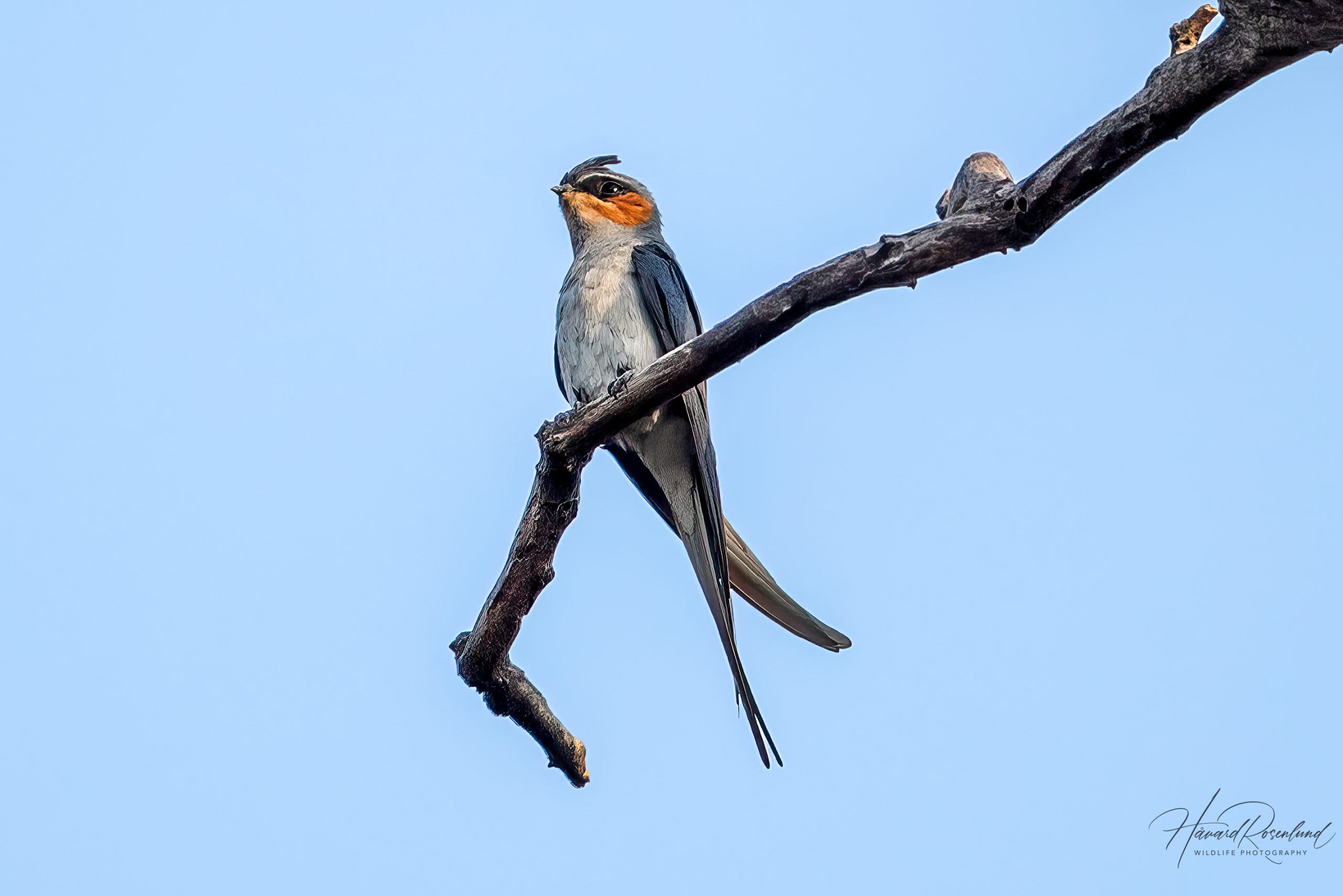
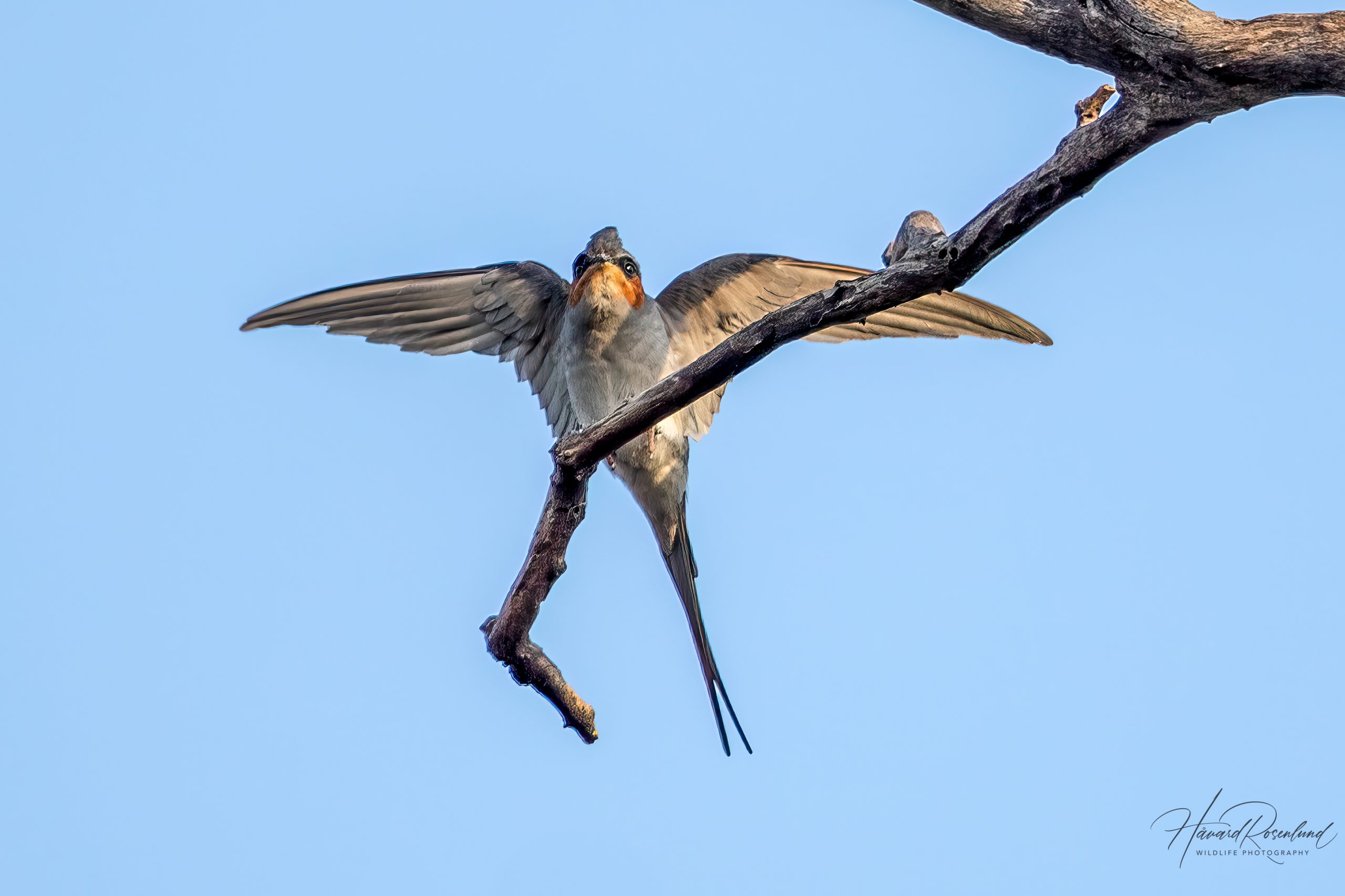
The crested treeswift (Hemiprocne coronata) is a slender, long-winged aerial bird of South and Southeast Asia. Adults are about 23–25 cm long and weigh around 29 g. The plumage is mainly cool blue-grey with darker wings, a long deeply forked tail and a prominent swept-back crest. Adult males have rich chestnut on the cheek and ear-coverts, while females instead show a darker facial mask bordered by pale markings.
Treeswifts are close relatives of the true swifts but differ in an important way: their feet are adapted for perching, so they regularly sit upright on exposed branches between feeding flights. The crested treeswift is currently treated as a monotypic species, with no recognised subspecies.
Habitat
Crested treeswifts favour lightly wooded country rather than either treeless plains or dense wet forest. They occur along forest edges, in open deciduous woodland, groves, wooded savanna and plantations where tall exposed trees provide both lookout perches and nest sites.
The birds often spend long periods on bare outer branches with a clear view of surrounding airspace. This open woodland structure is important because it combines elevated perches with unobstructed flying space for aerial feeding.
Diet
The diet consists almost entirely of flying insects caught on the wing. Birds launch from exposed branches or remain airborne over the canopy and open ground, taking small insects directly from the air with the broad gape typical of swifts and their relatives.
Feeding height changes with local insect activity and weather. Individuals may hunt above the canopy or much lower around clearings and woodland edges, repeatedly returning to a favoured exposed perch between sorties.
Behaviour
Crested treeswifts combine highly agile flight with far more regular perching than true swifts. They are frequently seen sitting upright on exposed branches, from which they launch into sweeping aerial sallies before returning to the same or a nearby perch.
They are commonly encountered as pairs or small groups, although looser feeding gatherings can form where insects are concentrated. Their long pointed wings and deeply forked tail provide excellent manoeuvrability, while their ability to perch allows them to alternate efficiently between active aerial feeding and resting on exposed perches.
Breeding
In India, breeding has been recorded mainly during the hot season from about March to July. The nest is one of the most remarkable features of the species. Both adults help construct a tiny, shallow nest cup of bark, feathers, plant material and saliva fixed to the upper surface of an exposed horizontal branch. Treeswift nests can be only a few centimetres across — barely large enough to hold the single egg.
Because the nest is too small for the adult to sit inside it, the incubating bird perches along the branch and covers the egg with its belly feathers. Both sexes incubate. The chick soon becomes too large for the nest itself and rests lengthwise along the supporting branch, where its cryptic plumage helps it blend with bark while the parents continue to bring aerial insects.
Status
The crested treeswift is classified as least concern on the IUCN Red List. It has a broad range across the Indian subcontinent and mainland Southeast Asia and remains widespread in suitable lightly wooded habitat.
In India, however, State of India’s Birds 2025 estimates a long-term decline of about 70.27%. The more recent annual estimate is about −1.02%, but its uncertainty interval includes both decline and slight increase, so there is no clear recent change. Its use of forest edges, groves and tree-rich plantations gives the species some flexibility in modified landscapes, but large exposed branches remain important for resting and nesting and wooded landscapes support the aerial insects on which it feeds.
Image gallery
Loading map and observations…
Have you seen this species?
Independent species archive
Did you find this species page useful?
Wildlife Vagabond is independently built and maintained. Voluntary support helps cover hosting, maps, data storage and continued improvements to the species archive.
Support Wildlife VagabondSpecies content will remain freely available.
References
Information about the species’ global distribution and status is based primarily on global Red List data. See the references below for details.
- Animal Diversity Web. (n.d.). Hemiprocnidae. https://animaldiversity.org/accounts/Hemiprocnidae/
- BirdLife International. (n.d.). Crested Treeswift species factsheet. https://datazone.birdlife.org/species/factsheet/crested-treeswift-hemiprocne-coronata
- International Union for Conservation of Nature. (n.d.). Crested Treeswift. The IUCN Red List of Threatened Species. https://www.iucnredlist.org/species/22686891/130112154
- State of India's Birds. (2025). State of India’s Birds 2025 – Crested Treeswift. https://stateofindiasbirds.in/species/cretre1/
- Tobias, J. A., Sheard, C., Pigot, A. L., Devenish, A. J. M., Yang, J., Sayol, F., Neate‐Clegg, M. H. C., Alioravainen, N., Weeks, T. L., Barber, R. A., Walkden, P. A., MacGregor, H. E. A., Jones, S. E. I., Vincent, C., Phillips, A. G., Marples, N. M., Montaño‐Centellas, F. A., Leandro‐Silva, V., Claramunt, S., … Schleuning, M. (2022). AVONET: morphological, ecological and geographical data for all birds. Ecology Letters, 25(3), 581-597. https://doi.org/10.1111/ele.13898
- Wells, D., & Kirwan, G. M. (2020). Crested Treeswift (Hemiprocne coronata). In Birds of the World. Cornell Lab of Ornithology. https://doi.org/10.2173/bow.cretre1.01