
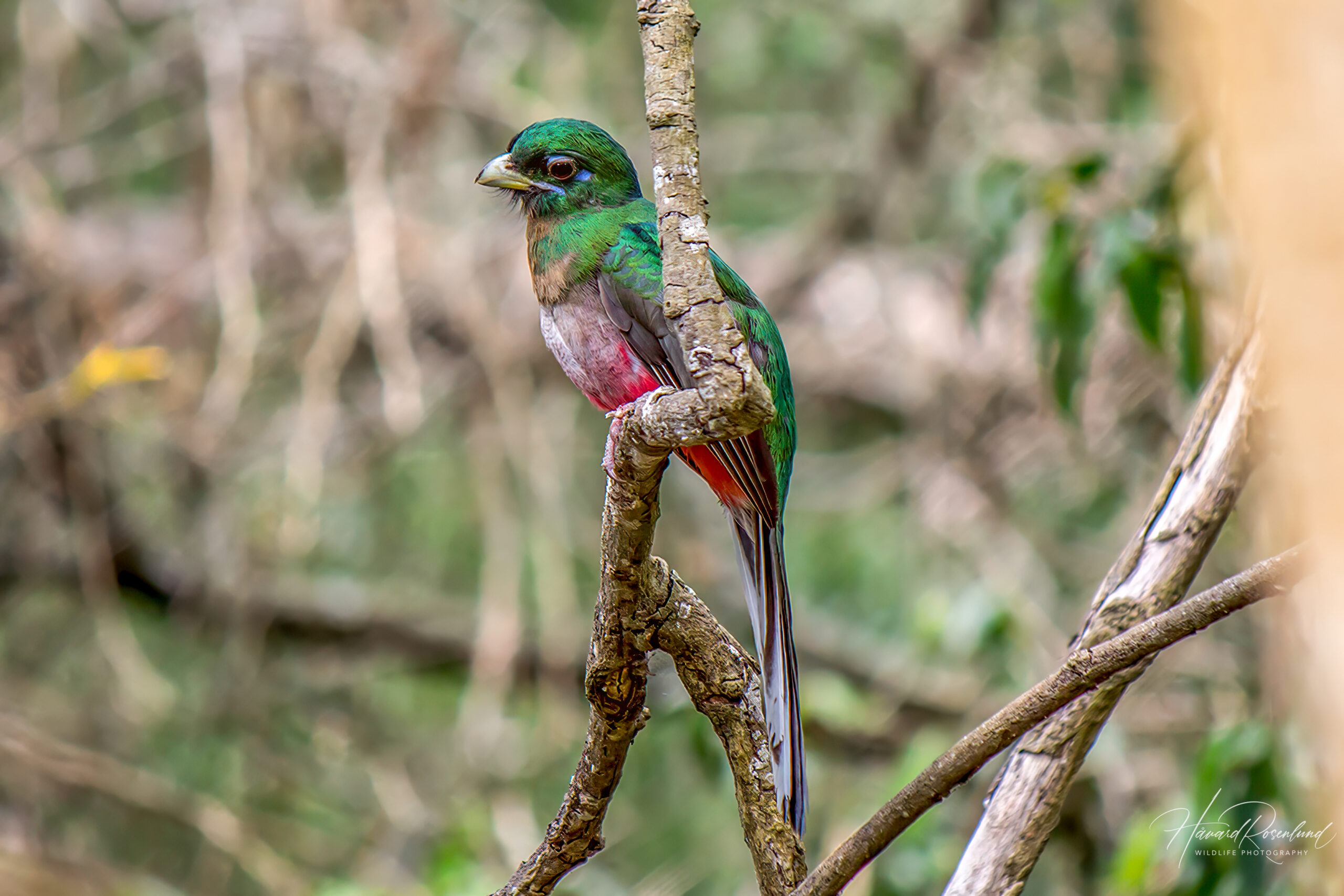
Narina Trogon
Apaloderma narina
At a glance
Habitat
- Forest, riverine woodland, wooded savanna and dense thickets
Diet
- Mainly invertebrates, especially caterpillars; occasional small reptiles
Activity
- Diurnal; perch-and-wait forager
Size
- Length: 30–34 cm Weight: about 68 g
Range
- Widely but patchily distributed across sub-Saharan Africa
Description
The Narina trogon (Apaloderma narina) is a medium-sized African trogon, roughly 30–34 cm long and weighing about 68 g. Males have brilliant metallic-green upperparts, head and breast, contrasting with a deep crimson belly. Females are more subdued, with a brown face, throat and breast and red confined mainly to the lower underparts. Juveniles resemble females before young males acquire the full green-and-red adult plumage.
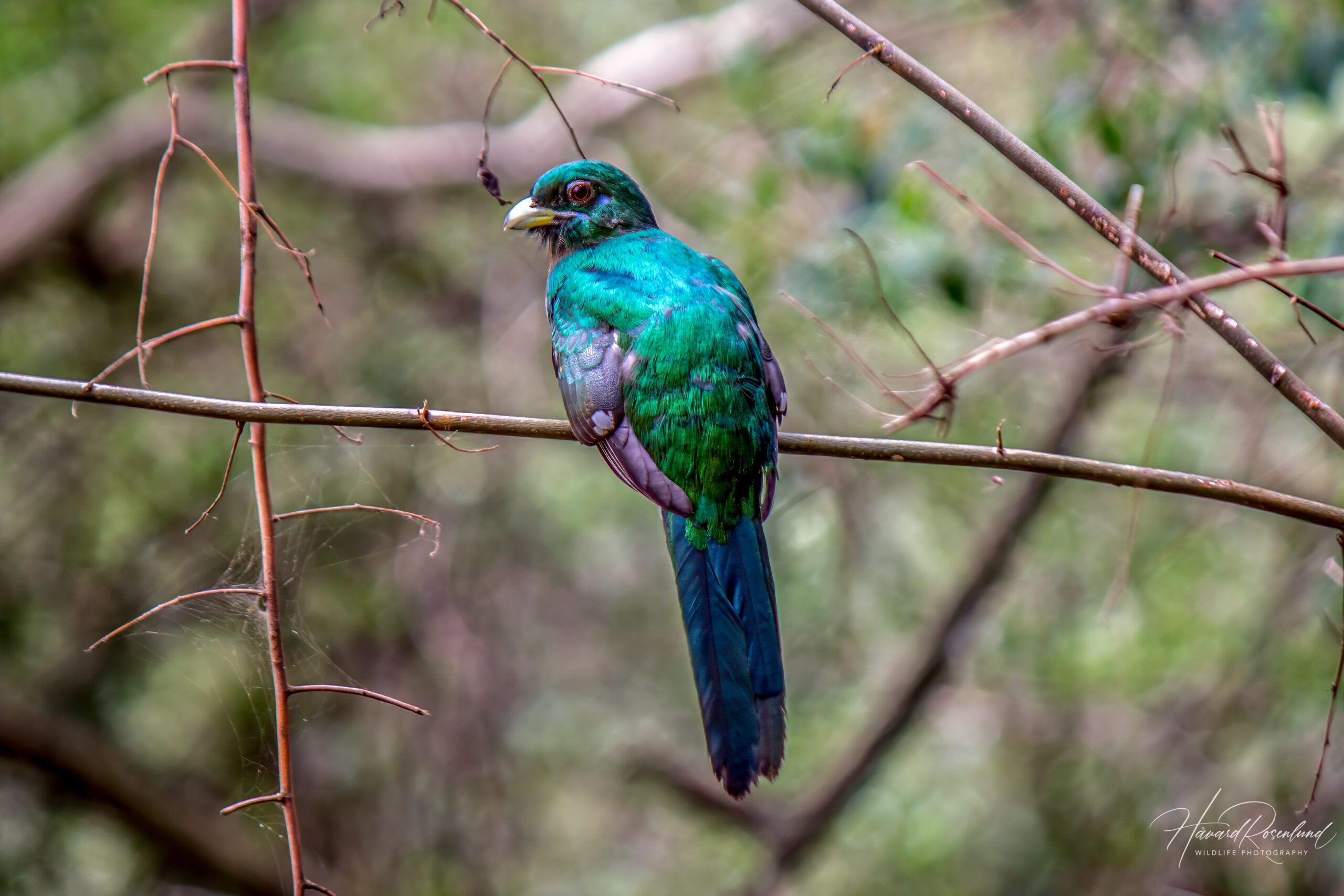
Like many trogons, the species can appear far less conspicuous in the forest than its colours suggest. The green upperparts blend into shaded foliage, while the red underparts are often hidden when the bird sits quietly on a horizontal branch. The long tail ends squarely and has conspicuous white outer feathers that are especially obvious in flight.
The name “Narina” has an unusual historical origin. The French explorer and ornithologist François Le Vaillant used it for the bird after a Khoikhoi woman with whom he formed a romantic attachment during his travels in southern Africa. According to historical accounts, the name she adopted at his suggestion came from a Khoikhoi word meaning “flower”. The scientific name was formally published by James Francis Stephens in 1815.
Habitat
Narina trogons occupy a broad range of wooded habitats, from humid lowland and montane forest to riverine woodland, dense thickets and wooded savanna. Their distribution is extensive but often patchy because suitable closed or semi-closed tree cover is unevenly distributed across sub-Saharan Africa.
They are most often associated with areas that provide a shaded interior, good perches and enough mature trees to supply natural nesting cavities. Forest edges and riverine strips can therefore be important even where continuous forest is absent.
Diet
The species feeds mainly on invertebrates, particularly caterpillars, but also takes spiders, mantises, beetles, cicadas and other relatively large arthropods. Small reptiles are taken occasionally.
Hunting
Hunting is typically from a perch. A bird may sit almost motionless for long periods while watching the surrounding foliage before making a rapid sally to seize prey and returning to cover. Much of the hunting therefore takes place from inside vegetation rather than in open air.
Behaviour
Despite their vivid colours, Narina trogons can be remarkably difficult to see. They often sit quietly inside foliage with the green back facing outward, and the male's low, repeated hooting call is frequently the first sign that a bird is present.
Adults are usually encountered alone or in pairs outside brief social interactions. When handled or closely threatened they can release a strong-smelling secretion from the preen gland. Its precise defensive value is not well understood, but the behaviour may make a captured bird less attractive to a predator.
Breeding
Narina trogons are monogamous cavity nesters. Males become more conspicuous during the breeding season, using repeated calls in territorial and courtship behaviour and exposing a turquoise-blue bare throat patch while displaying. Temporary groups of displaying males have also been reported during courtship.
The nest is placed in a natural tree hollow rather than in a constructed open nest. Both parents take part in incubation and chick care, although southern African observations indicate that the male delivers most of the food to the chicks. Clutches most commonly contain two or three eggs, incubation lasts about 16–20 days and the young remain in the cavity for roughly 25–28 days.
After fledging, juveniles can remain with the adults for several months and continue to receive food even after they are able to forage for themselves.
Status
The Narina trogon is classified as least concern on the IUCN Red List. It has a very large range and remains locally common in suitable habitat, with the global population trend regarded as stable.
Forest and riverine woodland clearance can reduce habitat locally, while the loss of mature or decaying trees also removes nesting cavities. Local populations are therefore sensitive to the loss of well-wooded habitat even though the species remains widespread across sub-Saharan Africa.
Image gallery
Loading map and observations…
Have you seen this species?
Independent species archive
Did you find this species page useful?
Wildlife Vagabond is independently built and maintained. Voluntary support helps cover hosting, maps, data storage and continued improvements to the species archive.
Support Wildlife VagabondSpecies content will remain freely available.
References
Information about the species’ global distribution and status is based primarily on global Red List data. See the references below for details.
- Biodiversity Explorer – Apaloderma narina. (n.d.). food, breeding and habitat, based on Roberts Birds of Southern Africa. https://www.biodiversityexplorer.info/birds/trogonidae/apaloderma_narina.htm
- BirdLife International. (n.d.). Narina Trogon species factsheet. https://datazone.birdlife.org/species/factsheet/narina-trogon-apaloderma-narina
- BirdLife South Africa / African Birdlife. (2026). January’s calendar bird – Narina Trogon. https://africanbirdlife.org.za/2026/01/12/januarys-calendar-bird-narina-trogon/
- Dictionary of South African English – Narina. (n.d.). historical origin of the name. https://dsae.co.za/entry/narina/e05077
- International Union for Conservation of Nature. (n.d.). Narina Trogon (Apaloderma narina). The IUCN Red List of Threatened Species. https://www.iucnredlist.org/species/22682715/92957651
- Newman’s Birds. (n.d.). Newman's Birds of Southern Africa – Narina Trogon. https://newmansbirds.com/birds/narina-trogon/
- Şahin Arslan, N., & Martin, T. E. (2024). Comparative reproductive ecology of Old and New World Trogons, an order in decline across the world. Ecology and Evolution, 14(4), e11273. https://doi.org/10.1002/ece3.11273