
Livingstone’s Turaco
Tauraco livingstonii
At a glance
Habitat
- Moist coastal and montane evergreen forest, forest edges and wooded valleys
Diet
- Mostly fruit; occasionally leaves, flowers and small invertebrates
Activity
- Diurnal
Size
- Length: 45–46 cm Weight: 260–380 g
Range
- Southeastern Africa, from Tanzania and Malawi through Mozambique and eastern Zimbabwe to northeastern South Africa
Description
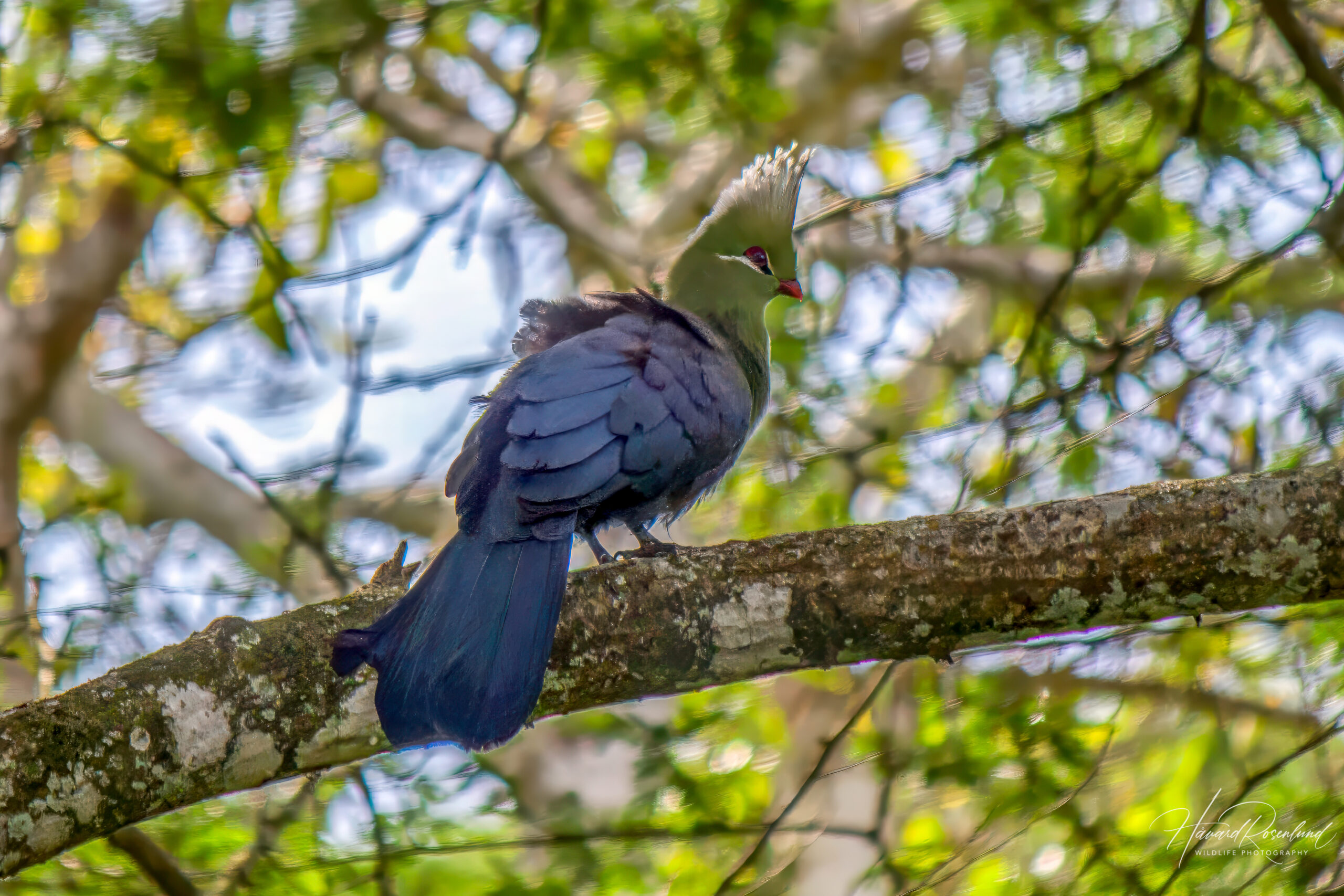
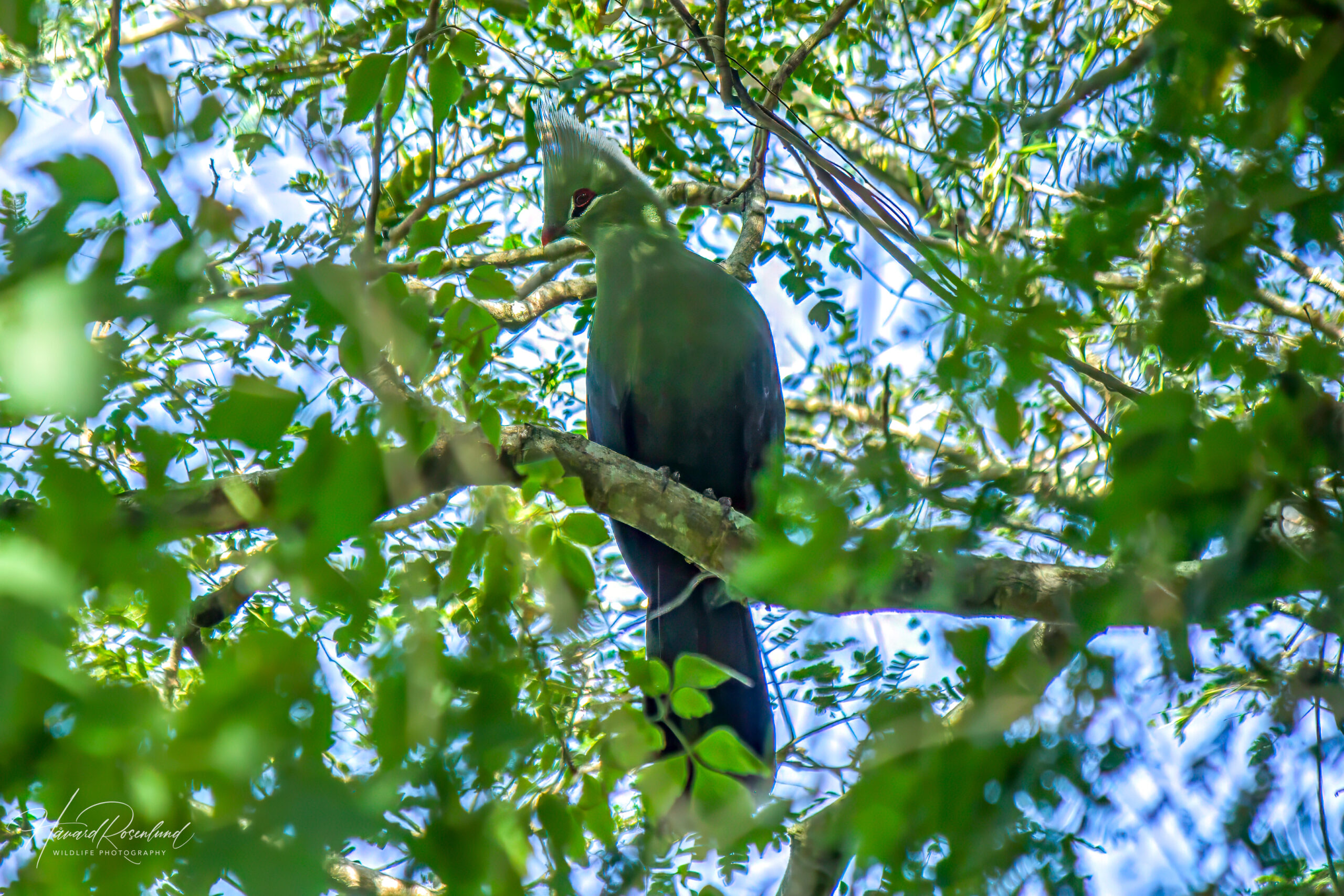
Livingstone's turaco (Tauraco livingstonii) is a large green turaco of southeastern Africa. Its range extends from southern Tanzania through Malawi, Mozambique and eastern Zimbabwe to northeastern South Africa, with an isolated population in Burundi. Adults measure about 45–46 cm and weigh roughly 260–380 g. The body is rich green, the tail darker blue-green, and the tall pointed crest is tipped with white. The face combines a deep red eye-ring with contrasting black and white markings, while the short bill is dark red.
The brilliant crimson primaries are mostly hidden when the wing is folded but become conspicuous in flight. Turacos are unusual among birds because their characteristic colours include true pigments: the green plumage contains the copper-bearing pigment turacoverdin, while the crimson flight feathers contain the related pigment turacin.
Livingstone's turaco closely resembles the Knysna turaco (Tauraco corythaix) and Schalow's turaco (Tauraco schalowi), which largely replace it elsewhere in the region. Knysna turaco generally has a shorter, rounder crest, while Schalow's has a longer and more slender pointed crest. Livingstone's is intermediate, and identification is safest when crest shape, facial pattern, voice and range are considered together.
Habitat
The species is closely associated with moist evergreen forest, including coastal lowland forest, montane forest and wooded valleys. It occurs from near sea level into mountain forests and also uses forest edges where mature fruiting trees remain.
Dense tree cover is important not only for food but also for concealment and movement. In the southern part of the range, including northeastern South Africa, it is particularly associated with humid coastal and scarp forest rather than the more open savannas that dominate much of the surrounding landscape.
Diet
Livingstone's turacos are strongly frugivorous. Fruit dominates the diet, while leaves, flowers and occasional small invertebrates are taken in smaller amounts.
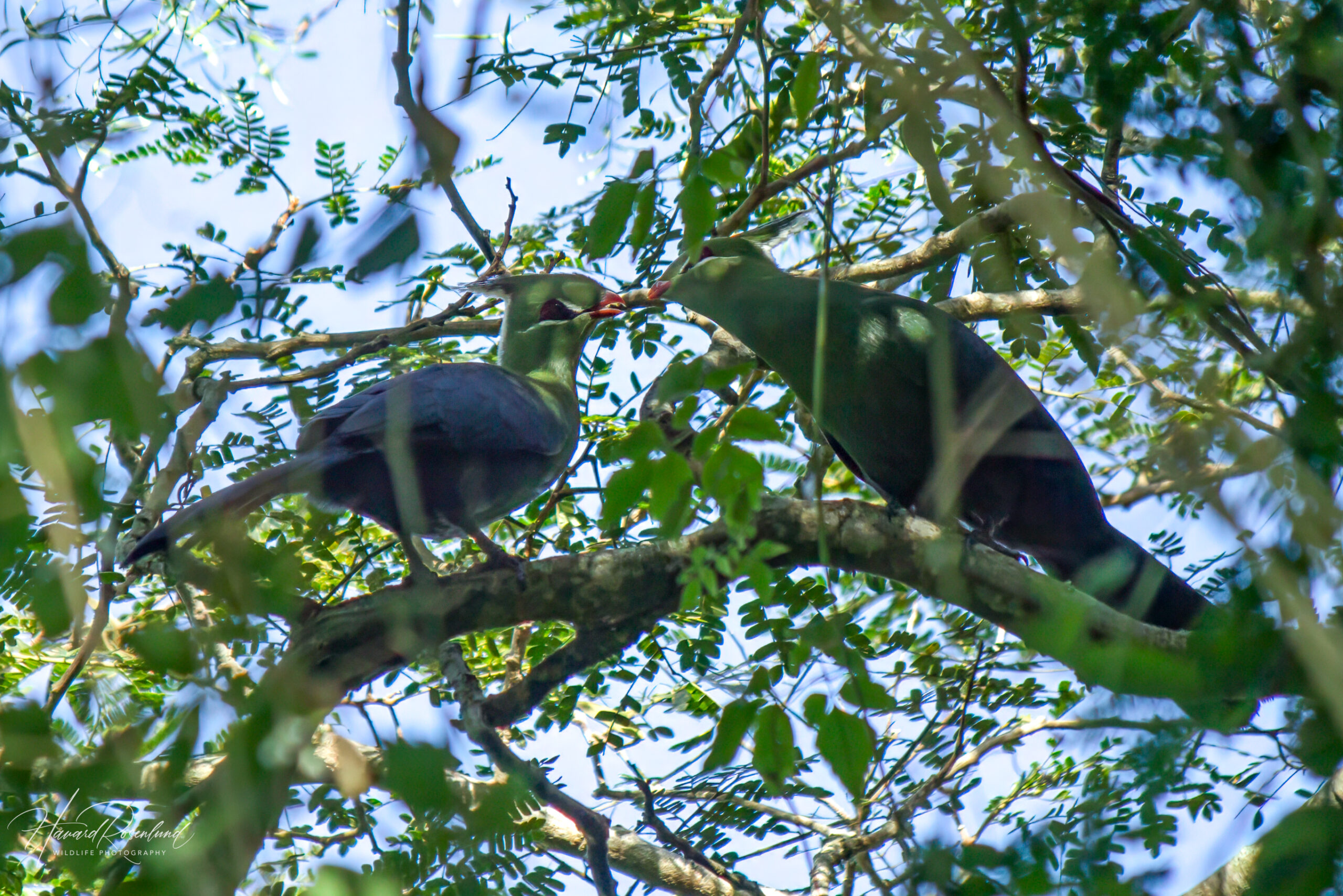
They search the canopy and understorey for ripe fruit and can move rapidly through a fruiting tree by running and hopping along branches. The patchy distribution of ripe fruit helps shape their daily movements through the forest. Several birds may converge on a heavily fruiting tree and form temporary feeding groups even though the species is more commonly encountered in pairs or small family parties.
Behaviour
Livingstone's turacos are resident and largely sedentary, although they may make local movements in response to fruiting trees. They spend much of their active time inside the canopy and usually make only short, direct flights between nearby trees or forest patches, revealing the otherwise hidden crimson wing feathers.
The species is highly vocal. Its loud series of harsh calls carries through dense forest and often reveals the birds long before they are seen. Pairs and neighbouring birds may answer one another, so calls help maintain contact and advertise territories in vegetation where visual communication is restricted.
Breeding
Livingstone's turacos are monogamous, territorial and nest as isolated pairs. Breeding timing varies geographically and is often associated with wetter periods and good food availability. In the southern part of the range, egg laying is recorded mainly from September into February. The nest is a loose, shallow platform of twigs placed in dense foliage, typically several metres above the ground.
One or two eggs are laid and both parents take part in incubation and later care for the young. Turaco chicks are unusually capable climbers before they can fly well: they can leave the open nest platform and move through nearby branches using their feet and wings while still dependent on their parents.
Status
Livingstone's turaco is classified as least concern on the IUCN Red List. It has a fairly broad but fragmented distribution, and the global population trend is considered decreasing.
Its dependence on moist forest makes the species sensitive to local forest loss and fragmentation. Continuous coastal and montane forest with mature fruiting trees is therefore particularly important across its range.
Image gallery
Loading map and observations…
Have you seen this species?
Independent species archive
Did you find this species page useful?
Wildlife Vagabond is independently built and maintained. Voluntary support helps cover hosting, maps, data storage and continued improvements to the species archive.
Support Wildlife VagabondSpecies content will remain freely available.
References
Information about the species’ global distribution and status is based primarily on global Red List data. See the references below for details.
- BirdForum. (n.d.). Livingstone's Turaco. BirdForum Opus. https://www.birdforum.net/opus/Livingstone%27s_Turaco
- BirdLife International. (n.d.). Livingstone's Turaco species factsheet. https://datazone.birdlife.org/species/factsheet/livingstones-turaco-tauraco-livingstonii
- International Turaco Society. (n.d.). Livingstone's Turaco. https://www.turacos.org/livingstones.htm
- International Union for Conservation of Nature. (n.d.). Livingstone's Turaco. The IUCN Red List of Threatened Species. https://www.iucnredlist.org/species/22688331/130124606
- Oiseaux.net. (2026). Livingstone's Turaco. https://www.oiseaux.net/birds/livingstone.s.turaco.html
- Store norske leksikon. (n.d.). Grønnturako. https://snl.no/grønnturako
- Store norske leksikon. (n.d.). Turakoer. https://snl.no/turakoer