
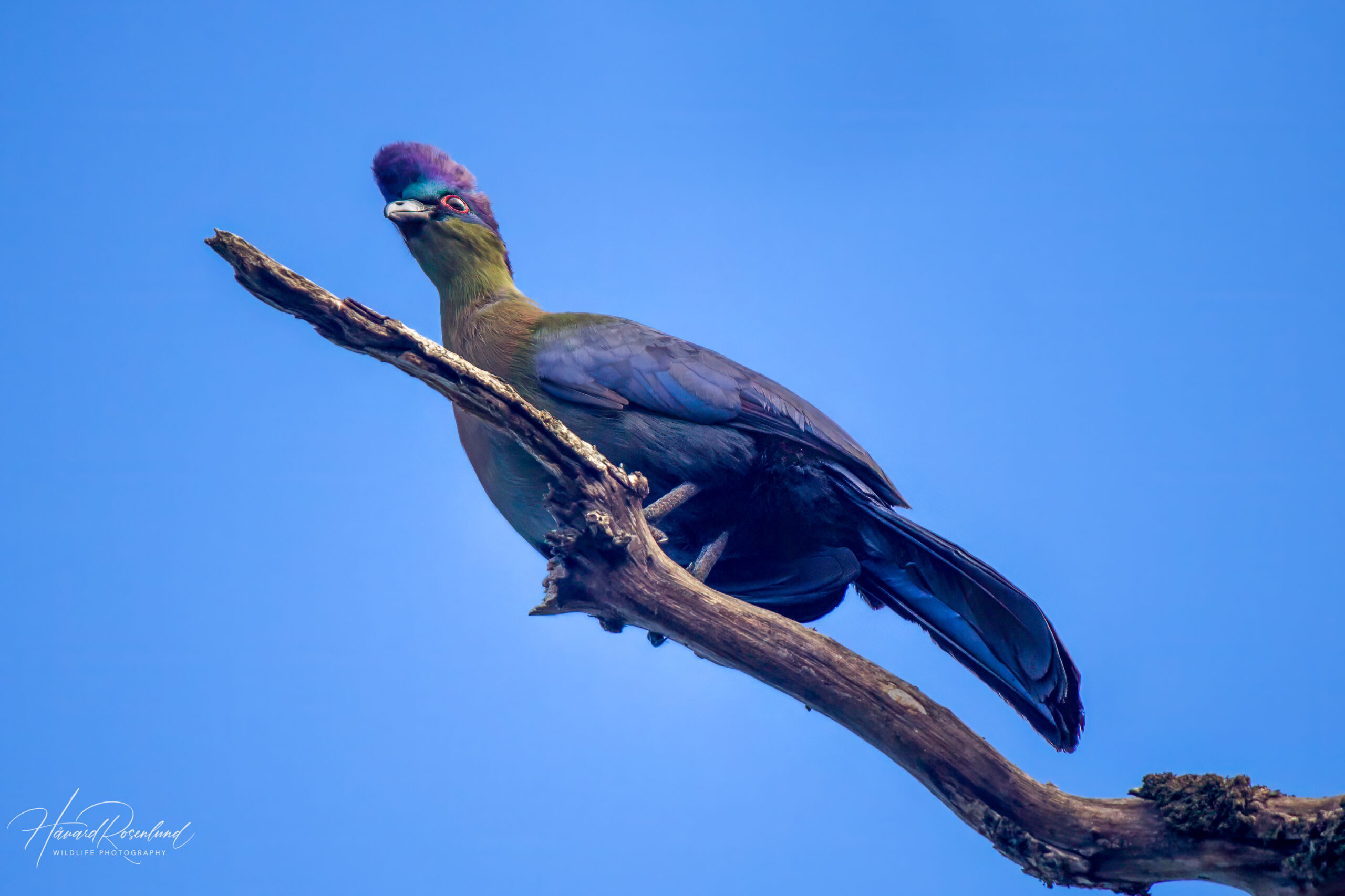
Purple-crested Turaco
Gallirex porphyreolophus
At a glance
Habitat
- Coastal and riverine forest, dense woodland, thickets and well-treed gardens
Diet
- Mostly fruit; also flowers, leaves and occasional invertebrates
Activity
- Diurnal and strongly arboreal
Size
- Length: 40–42 cm Weight: about 280 g
Range
- Eastern and southeastern Africa, from Kenya and Tanzania south to South Africa
Description
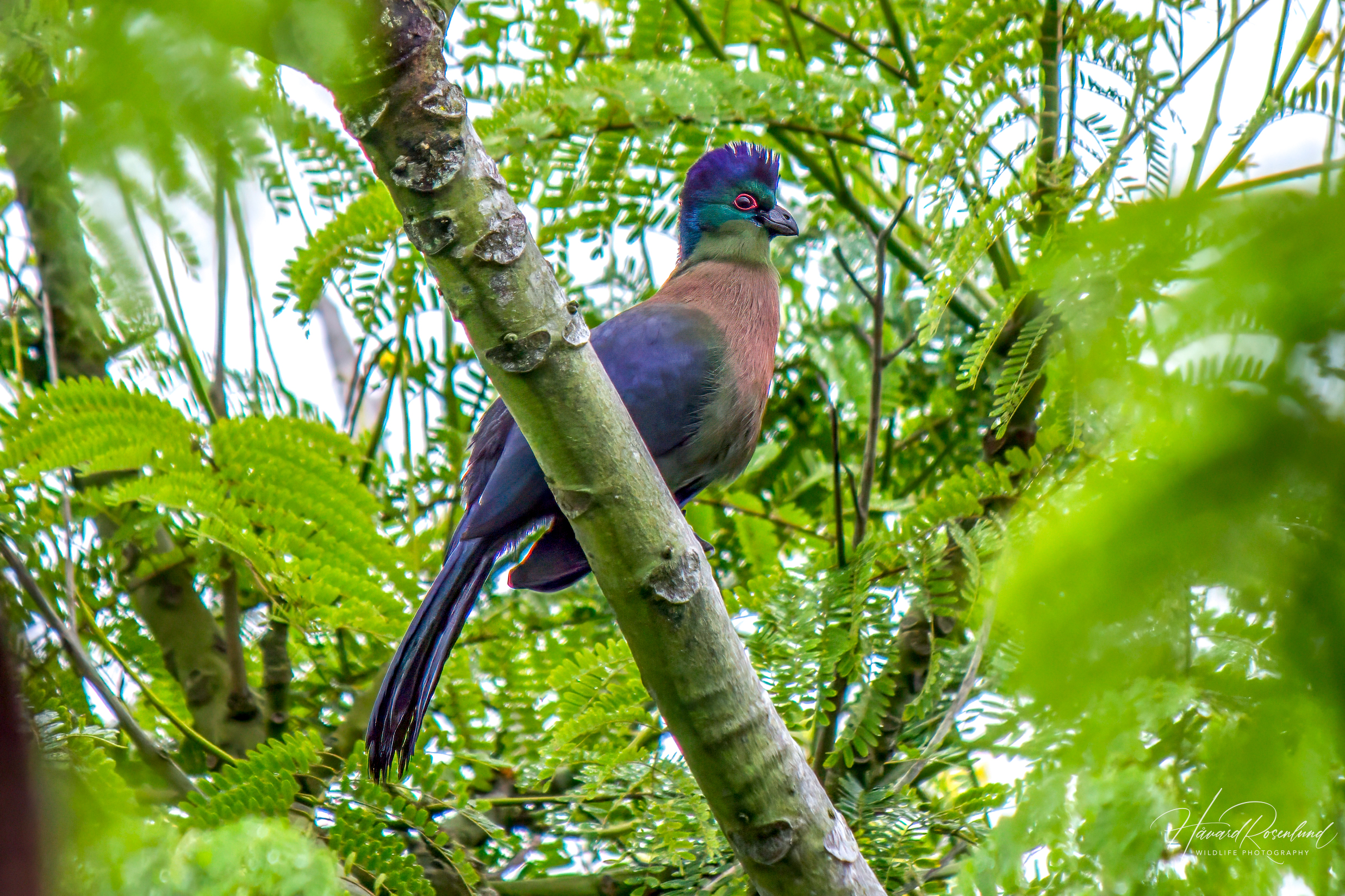
The purple-crested turaco (Gallirex porphyreolophus) is a striking arboreal bird of eastern and southeastern Africa. Adults are about 40–42 cm long and weigh around 280 g. The crest is glossy purple and the face and throat are green, while the mantle and breast have pinkish-orange tones and the back, wings and tail are bluish-purple. The crimson flight feathers become especially conspicuous in flight. The sexes are similar.
Turacos are biochemically unusual birds. Their red flight feathers contain turacin and much of the green plumage contains turacoverdin, copper-containing pigments characteristic of the family rather than the structural greens found in many other birds. Older sources often place this species in Tauraco as Tauraco porphyreolophus, whereas modern classifications place it in Gallirex.
Habitat
Purple-crested turacos favour coastal and riverine forest, dense woodland, thickets and other tree-rich habitats. They also use mature suburban gardens and wooded parks where a continuous canopy and fruiting trees remain.
The species is strongly arboreal and spends most of its time moving through the middle and upper canopy. Broad feet and strong toes allow it to run and hop confidently along branches, while most flights are short movements between nearby trees.
Diet
Fruit dominates the diet, including figs and many other wild and cultivated fruits. Flowers, buds, leaves and occasional invertebrates provide additional food.
Purple-crested turacos search for food almost entirely in trees, moving through the canopy and repeatedly travelling between fruiting trees as fruit ripens. Small fruits are often swallowed whole, while larger fruits are handled and eaten in pieces. Several birds may gather temporarily at an especially productive fruiting tree before dispersing again as the fruit is depleted.
Behaviour
Purple-crested turacos are usually encountered in pairs or small family groups and are highly vocal. Their deep, croaking calls carry through dense vegetation, and one bird often triggers responses from nearby individuals until several are calling in sequence. Calling is especially conspicuous around dawn and during territorial encounters.
Despite their vivid colours, stationary birds can be surprisingly difficult to detect in dense foliage. Much of the day is spent running and hopping through branches rather than flying openly, and the bright crimson primaries are often hidden until the bird takes flight.
Breeding
Purple-crested turacos are monogamous and both parents take part in breeding. They build a loose platform of twigs in dense vegetation, usually concealed within a tree or large shrub. Breeding timing varies geographically; in southern Africa breeding occurs mainly in spring and summer, with egg-laying especially from August to January. The clutch usually contains two eggs, although clutches of up to four have been recorded, and both adults incubate for about 22 days.
The chicks hatch with open eyes and a dense covering of down and soon become capable climbers. Before they can sustain normal flight they move through nearby branches using their feet and small claws on the wings. They usually leave the nest at around 21 days old, but do not make their first proper flight until about 38 days. Both parents feed them by regurgitation, and the young remain dependent for some time after leaving the nest.
Seed dispersal
As a large fruit-eating bird, the purple-crested turaco is an important seed disperser. Many seeds pass through the digestive tract intact and are deposited away from the parent plant.
A South African study published in 2015 found that seeds from four invasive alien plant species, including guava and mulberry, germinated more successfully after passing through purple-crested and Knysna turacos (Tauraco corythaix) than when left inside whole fruits. Germination was similar to that of seeds from which the fruit pulp had been removed manually, showing how feeding by turacos can aid germination while the birds disperse the seeds. This role is important for the regeneration and spread of native plants, but the same process can also help invasive plants spread.
Cultural significance
The purple-crested turaco is the national bird of Eswatini, where it is known in siSwati as ligwalagwala. Its crimson flight feathers also have a tangible place in the country's royal traditions and have traditionally formed part of ceremonial royal headdresses and regalia.
Status
The purple-crested turaco is classified as least concern on the IUCN Red List. It remains widespread and locally common across much of its range and can persist in wooded suburban landscapes as well as natural forest and woodland.
Local populations can decline where tree cover and fruiting vegetation are removed.
Image gallery
Loading map and observations…
Have you seen this species?
Independent species archive
Did you find this species page useful?
Wildlife Vagabond is independently built and maintained. Voluntary support helps cover hosting, maps, data storage and continued improvements to the species archive.
Support Wildlife VagabondSpecies content will remain freely available.
References
Information about the species’ global distribution and status is based primarily on global Red List data. See the references below for details.
- African Bird Club – Eswatini. (n.d.). Purple-crested Turaco as national bird. https://www.africanbirdclub.org/countries/eswatini/swaziland-introduction/
- Biodiversity Explorer. (n.d.). Gallirex porphyreolophus, based on Roberts Birds of Southern Africa. Iziko Museums of South Africa. https://www.biodiversityexplorer.info/birds/musophagidae/gallirex_porphyreolophus.htm
- BirdLife International. (n.d.). Purple-crested Turaco species factsheet. https://datazone.birdlife.org/species/factsheet/purple-crested-turaco-gallirex-porphyreolophus
- Goldsmith. (1965). The red-yolked egg of the touraco: biochemical discussion of turacin and turacoverdin. https://elischolar.library.yale.edu/peabody_museum_natural_history_postilla/91/
- International Union for Conservation of Nature. (n.d.). Purple-crested Turaco (Gallirex porphyreolophus). The IUCN Red List of Threatened Species. https://www.iucnredlist.org/species/22688380/93195329
- Perktaş, U., Groth, J. G., & Barrowclough, G. F. (2020). Phylogeography, Species Limits, Phylogeny, and Classification of the Turacos (Aves: Musophagidae) Based on Mitochondrial and Nuclear DNA Sequences. American Museum Novitates, 2020(3949), 1. https://doi.org/10.1206/3949.1
- Symes. (2018). Cycad seed dispersal: the importance of large frugivorous birds. https://journals.uct.ac.za/index.php/BO/article/view/503
- Thabethe, V., Wilson, A.-L., Hart, L. A., & Downs, C. T. (2015). Ingestion by an invasive parakeet species reduces germination success of invasive alien plants relative to ingestion by indigenous turaco species in South Africa. Biological Invasions, 17(10), 3029–3039. https://doi.org/10.1007/s10530-015-0932-1