
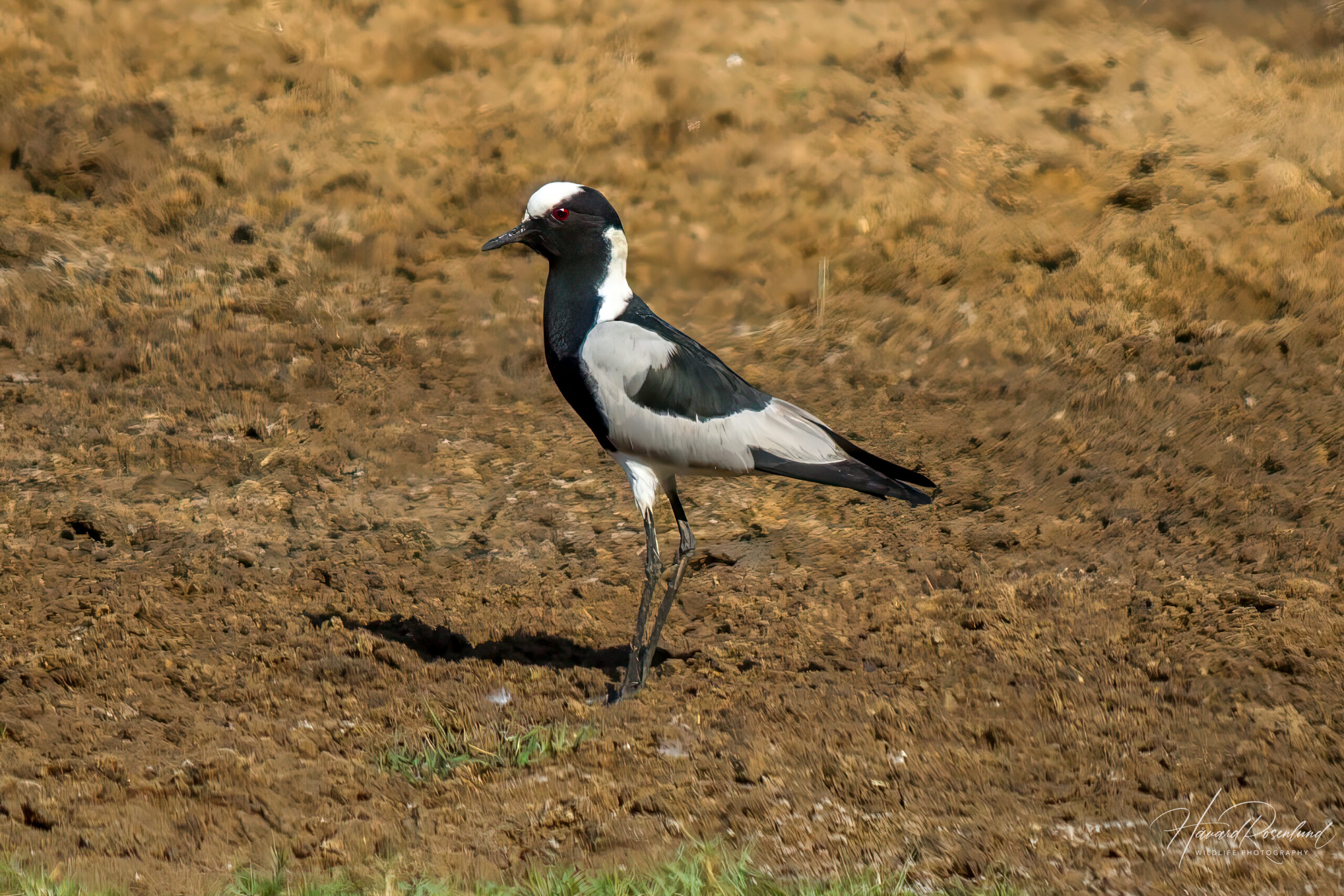
Blacksmith Lapwing
Vanellus armatus
At a glance
Habitat
- Wetlands, mudflats, riverbanks, flooded grassland, dams, lawns and sports fields
Diet
- Aquatic and terrestrial invertebrates, including insects, worms, molluscs and crustaceans
Activity
- Mainly diurnal
Size
- Length: 29–31 cm Weight: 114–213 g
Range
- Eastern and southern Africa, especially south of the equator
Description
The blacksmith lapwing (Vanellus armatus) is a distinctive black, white and pale-grey lapwing of eastern and southern Africa. Adults are about 29–31 cm long and weigh roughly 114–213 g. The black head, throat, breast and back contrast sharply with a white forehead, neck and belly, while the wings are largely pale grey. The eyes are deep red, and both sexes have small sharp spurs at the bend of the wing.
The English name comes from the loud metallic tink-tink-tink calls, which have been compared to a blacksmith striking an anvil. The species is monotypic, with no recognised subspecies.
Habitat
Blacksmith lapwings are closely associated with open ground near water: mudflats, marshes, lake and river margins, seasonally flooded grassland, sewage ponds, reservoirs and estuaries. They also make extensive use of artificial habitats such as irrigated fields, lawns, parks, golf courses and sports grounds.
This adaptability helped the species expand markedly during the twentieth century, especially in drier regions where dams, irrigated land and large lawns created new wetland-like feeding and nesting habitat. In KwaZulu-Natal, blacksmith lapwings can also persist and reproduce in urban mosaic landscapes where short grass and water remain available.
Diet
The diet consists mainly of aquatic and terrestrial invertebrates, including beetles and other insects, worms, molluscs and crustaceans.
Foraging
Blacksmith lapwings forage by walking, pausing and pecking at prey on or just below the surface and may also search dung for insect larvae. A study published in 2019 showed that the species has a narrow binocular visual field adapted to precise pecking, with the bill directed close to the centre of that field.
The birds can also tremble one foot against the substrate. This movement is thought to flush hidden prey into motion, after which it can be detected visually and seized with the bill.
Behaviour
Outside breeding, blacksmith lapwings occur singly, in pairs or in small loose groups. They are conspicuous and vocal birds, using metallic ringing calls for contact and alarm; the speed and intensity of the calls increase when birds are disturbed.
Movement patterns are flexible. Some populations are largely sedentary, while others become locally nomadic when rainfall and water levels change. Birds can shift between wetlands, flooded grassland and artificial water bodies as feeding conditions improve or deteriorate.
Breeding
Blacksmith lapwings are usually monogamous and territorial when breeding. Egg laying can occur through much of the year, but in southern Africa it peaks mainly from July to October and varies with rainfall and local water conditions.
The nest is a shallow scrape, hoofprint or small depression on open ground, usually close to water and lined with grass, stones or dry mud flakes. On wet ground the pair may build a raised mound to keep the eggs above the water. Clutches contain one to four eggs, usually three or four, and both sexes incubate in alternating shifts for roughly 26–33 days.
Pairs defend eggs and chicks vigorously. Adults give loud alarm calls, rush or dive at intruders and may use the small wing spurs in close confrontations. The chicks hatch well developed, leave the nest within hours and feed for themselves under close parental protection. When warned by the adults they crouch and freeze, relying on their cryptic plumage. Young become capable of flight at about 40 days and usually remain with their parents for several weeks longer.
Status
The blacksmith lapwing is classified as least concern on the IUCN Red List. It is widespread and common through much of eastern and southern Africa, and the global population trend is considered increasing.
Its ability to exploit dams, irrigated land, sewage ponds, lawns and other modified open habitats allows the species to prosper in many human-dominated landscapes. Ground nesting still exposes local populations to disturbance, predators and changes in water level, but no major range-wide threat is currently known.
Image gallery
Loading map and observations…
Have you seen this species?
Independent species archive
Did you find this species page useful?
Wildlife Vagabond is independently built and maintained. Voluntary support helps cover hosting, maps, data storage and continued improvements to the species archive.
Support Wildlife VagabondSpecies content will remain freely available.
References
Information about the species’ global distribution and status is based primarily on global Red List data. See the references below for details.
- Biodiversity Explorer. (n.d.). Blacksmith Lapwing (Vanellus armatus). Iziko Museums of South Africa. https://www.biodiversityexplorer.info/birds/charadriidae/vanellus_armatus.htm
- BirdLife International. (n.d.). Blacksmith Lapwing species factsheet. https://datazone.birdlife.org/species/factsheet/blacksmith-lapwing-vanellus-armatus
- Cantlay, J. C., Portugal, S. J., & Martin, G. R. (2019). Visual fields and foraging ecology of Blacksmith Lapwings Vanellus armatus. Ibis, 161(4), 895-900. https://doi.org/10.1111/ibi.12725
- International Union for Conservation of Nature. (n.d.). Blacksmith Lapwing. The IUCN Red List of Threatened Species. https://www.iucnredlist.org/species/22693978/93432296
- Phoswa, F., Gumede, S. T., & Downs, C. T. (2025). Occurrence and persistence of Blacksmith Lapwings Vanellus armatus and Crowned Lapwings V. coronatus and their reproductive success in an urban mosaic landscape. Ostrich, 96(2), 103-112. https://doi.org/10.2989/00306525.2025.2521415
- South African National Biodiversity Institute. (n.d.). Blacksmith Lapwing. https://www.sanbi.org/animal-of-the-week/blacksmith-lapwing/