
Red-wattled Lapwing
Vanellus indicus
At a glance
Habitat
- Open wetlands, riverbanks, wet grassland, farmland, fallow ground, parks and other open human-modified landscapes
Diet
- Mainly insects and other small invertebrates picked from the ground; occasionally other small prey and plant material
Activity
- Mostly diurnal, but also active and foraging at night
Size
- Length: 32–35 cm Weight: 170–230 g
Range
- From the Middle East through the Indian subcontinent to mainland Southeast Asia and southwestern China
Description
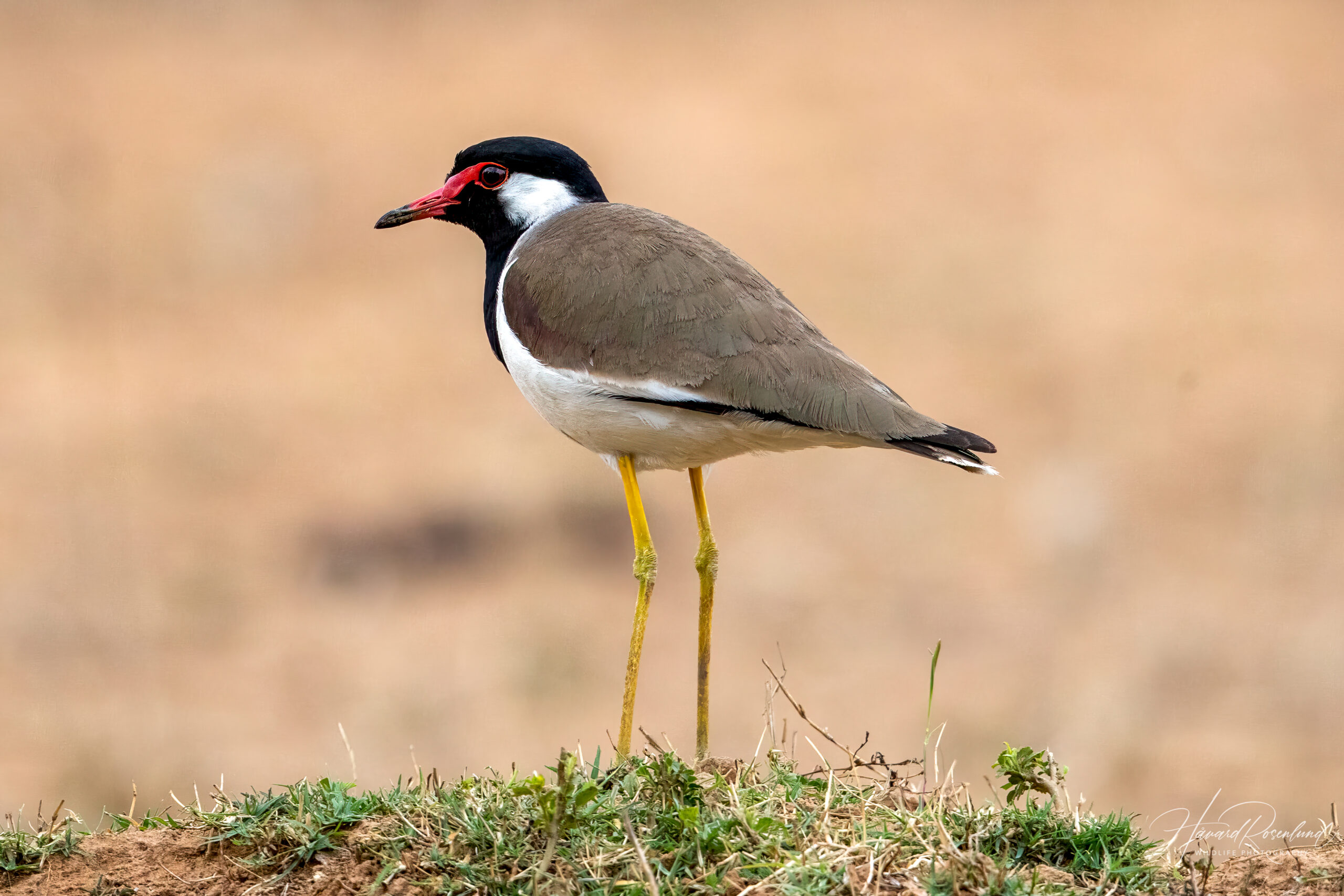
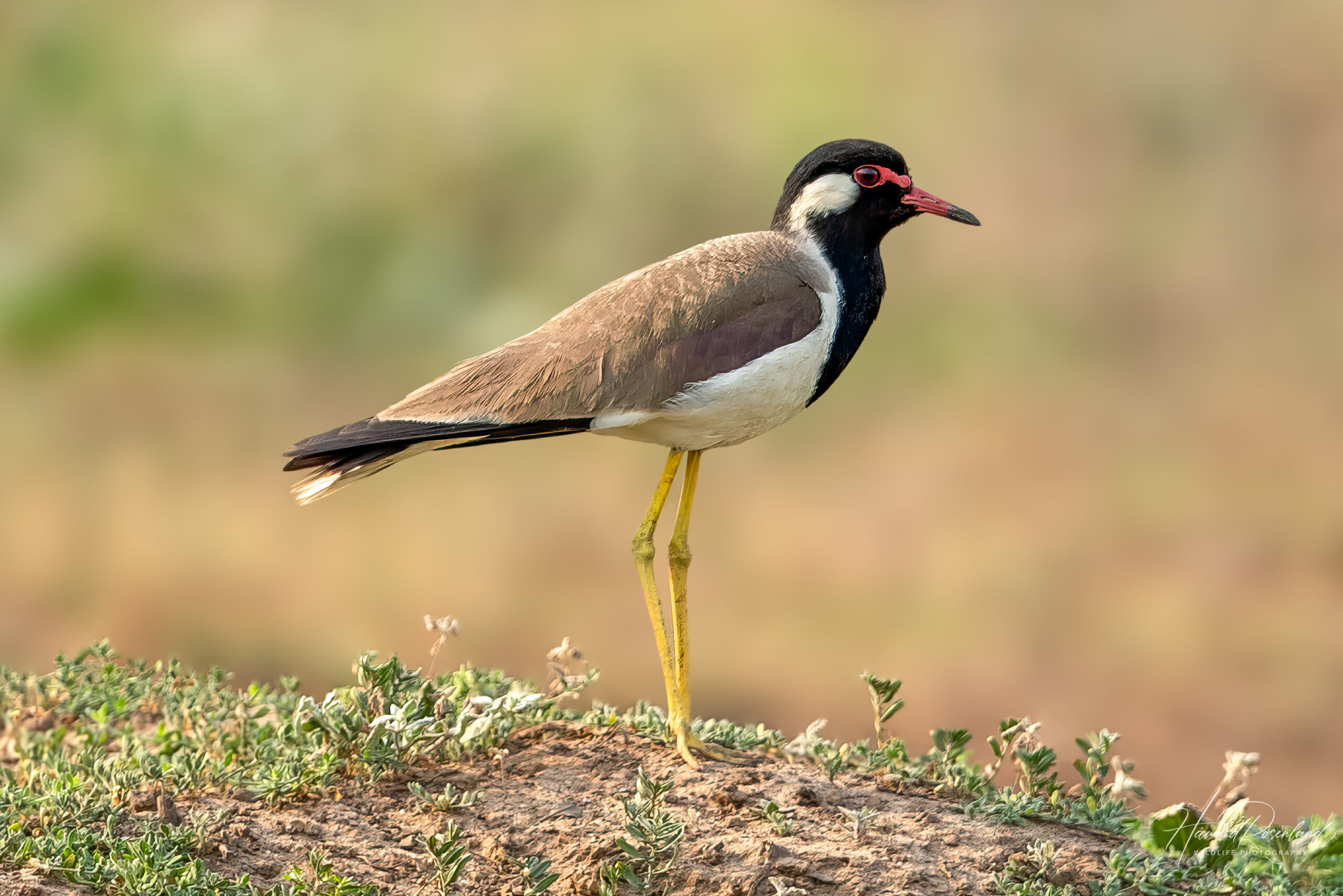
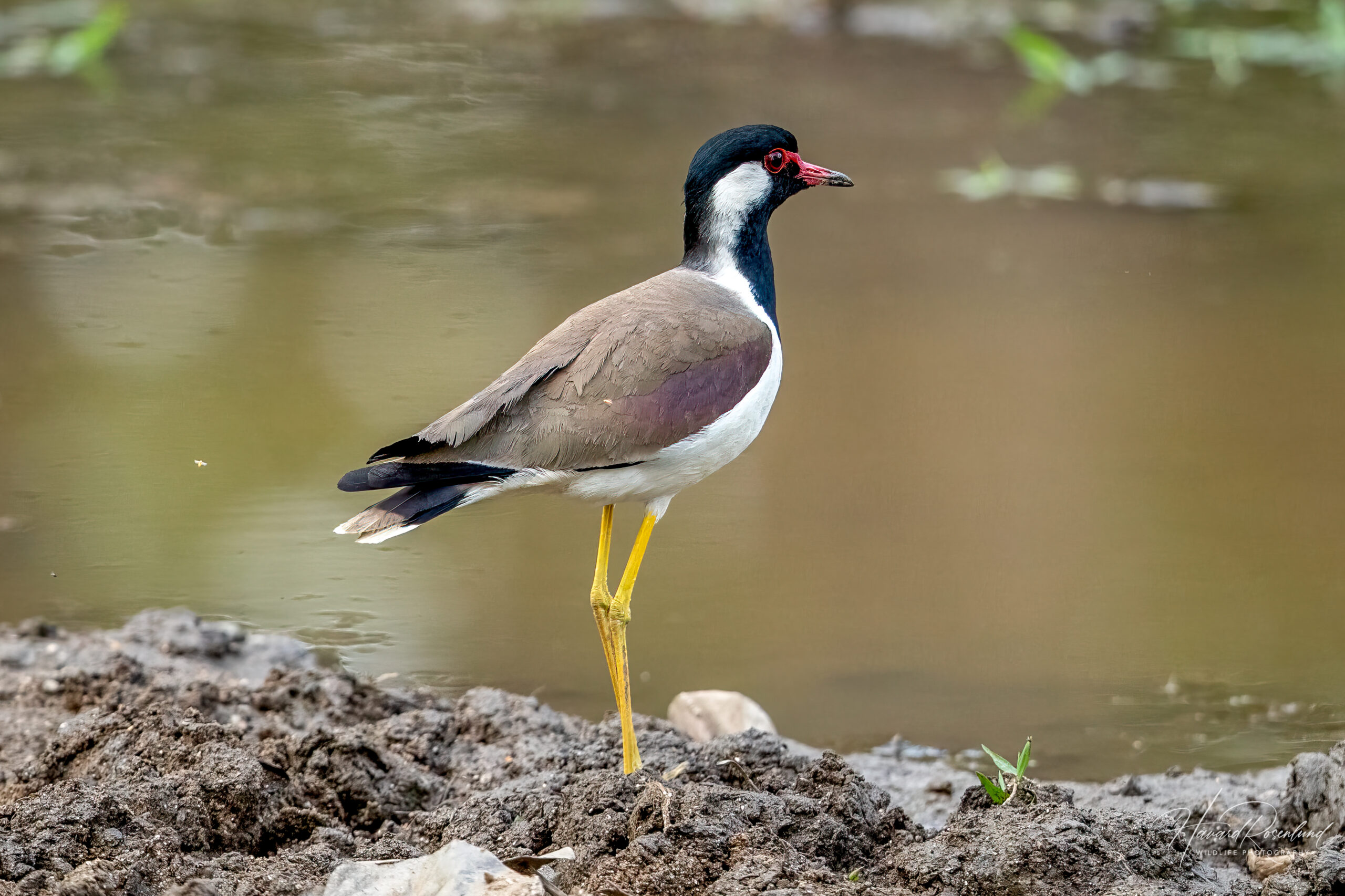
The red-wattled lapwing (Vanellus indicus) is a large, conspicuous lapwing found from the Middle East across the Indian subcontinent into mainland Southeast Asia and southwestern China. Adults are about 32–35 cm long and weigh roughly 170–230 g. The black head, throat and breast contrast sharply with white cheeks and underparts, while the back and wings are brown. Long yellow legs, a red bill with a black tip and the fleshy red wattles in front of the eyes make the species particularly distinctive.
The sexes are very similar, although males tend to have slightly larger facial wattles. In flight, broad white wing bars and a white rump contrast with the dark flight feathers and tail. The smaller yellow-wattled lapwing (Vanellus malabaricus) differs in its sandy-brown plumage, black cap and yellow facial wattles.
Habitat
Red-wattled lapwings favour open ground with short vegetation and often occur near water. Typical habitats include riverbanks, lake margins, wet grassland, cultivated fields, fallow land, grazing areas, parks, large gardens and open ground around settlements.
They are remarkably tolerant of human-modified landscapes and can remain common in densely populated regions as long as suitable open feeding and nesting sites remain.
Diet
The diet consists mainly of ground-dwelling invertebrates, including beetles, ants, termites, other insects, snails and worms. Birds walk across open ground, pausing to pick prey from the surface or disturb small prey from soft soil. Other small animals and some seeds, grain and other plant material are taken occasionally.
Behaviour
Outside breeding, red-wattled lapwings are commonly seen in pairs or small groups, although larger loose flocks can gather at favourable feeding sites. They are vigilant and exceptionally vocal, giving repeated alarm calls when people, mammals or birds of prey enter their surroundings.
The species is active not only by day but also after dark. A study published in 2012 at Indian Air Force stations documented substantial nocturnal activity, particularly around the full moon.
Breeding
Breeding timing varies geographically and with rainfall, but much nesting across northern India occurs during spring and the early monsoon period. The usual nest is a shallow scrape on bare or sparsely vegetated ground, sometimes lined or ringed with pebbles, dry plant material or other nearby objects. A typical clutch contains three or four strongly mottled eggs, and both parents incubate for roughly 27–30 days.
The chicks are precocial, meaning they hatch well developed and leave the nest shortly afterwards while remaining under close parental protection. In hot weather, adults have been observed soaking the belly feathers and wetting the eggs, behaviour that can help manage heat and moisture at exposed nests.
Parents defend eggs and chicks vigorously. Studies have documented mobbing, close aerial attacks, loud circling, running away and distraction displays, with the response changing according to predator type and stage of the breeding cycle. This active defence complements the camouflage of the eggs and chicks when they remain still.
Nest-site choice can be remarkably flexible in human-dominated landscapes. A 2026 study in Indore, Madhya Pradesh, India, found many urban nests on rooftops. Rooftops reduced exposure to some terrestrial predators but introduced other problems, including human disturbance and extreme heat; nesting success there was lower than at rural and peri-urban sites.
Relationship with humans
Red-wattled lapwings have adapted unusually well to human-dominated landscapes and frequently live alongside people in farmland, parks, campuses, roadside open ground and other developed areas. Their tolerance of routine human activity helps them persist in densely settled regions, although close approaches can trigger the conspicuous alarm calling for which the species is well known.
The species can also create a practical conflict around airfields. Its use of open ground, combined with substantial activity after dark, increases the risk of collisions with aircraft.
Status
The red-wattled lapwing is classified as least concern on the IUCN Red List. It has a very large range and remains common across much of South Asia, including agricultural and urbanising landscapes.
State of India's Birds lists the species as a low conservation priority. Its 2025 update shows a clearly positive long-term national trend and a positive recent annual trend.
Image gallery
Loading map and observations…
Have you seen this species?
Independent species archive
Did you find this species page useful?
Wildlife Vagabond is independently built and maintained. Voluntary support helps cover hosting, maps, data storage and continued improvements to the species archive.
Support Wildlife VagabondSpecies content will remain freely available.
References
Information about the species’ global distribution and status is based primarily on global Red List data. See the references below for details.
- BirdLife International. (n.d.). Red-wattled Lapwing species factsheet. https://datazone.birdlife.org/species/factsheet/red-wattled-lapwing-vanellus-indicus
- Cornell Lab of Ornithology. (n.d.). Birds of the World – Red-wattled Lapwing. https://birdsoftheworld.org/bow/species/rewlap1/cur/introduction
- eBird. (n.d.). Red-wattled Lapwing. Cornell Lab of Ornithology. https://ebird.org/species/rewlap1
- International Union for Conservation of Nature. (n.d.). Red-wattled Lapwing. The IUCN Red List of Threatened Species. https://www.iucnredlist.org/species/22694013/89569039
- Kumar, C., Thind, S. K., Joshua, & Kaleka, A. S. (2020). Breeding behaviour of Red-wattled Lapwing, Vanellus indicus, in agricultural landscape of Punjab. Uttar Pradesh Journal of Zoology, 41(8), 27–51. https://www.mbimph.com/index.php/UPJOZ/article/view/1544
- Mishra, H., & Kumar, A. (2022). Diagnosing nest predators and anti-predator response of red wattled lapwing, Vanellus indicus (Boddaert, 1783). Acta Ecologica Sinica, 42(1), 6-10. https://doi.org/10.1016/j.chnaes.2020.11.004
- Patidar, K., & Sharma, V. K. (2026). Nesting dynamics of Red-wattled Lapwing <i>Vanellus indicus</i> Boddaert, 1783 in urban and rural regions of Indore, India. Journal of Threatened Taxa, 18(2), 28378-28386. https://doi.org/10.11609/jott.10146.18.2.28378-28386
- Sharma & Srinidhi. (2012). Bird strikes to aircraft at night and their management, focusing on Red-wattled Lapwing Vanellus indicus. Journal of the Bombay Natural History Society, 109(1&2), 140–142. https://bnhsjournal.in/index.php/bnhs/article/view/156200
- State of India's Birds. (2025). 2025 – Red-wattled Lapwing. https://stateofindiasbirds.in/species/rewlap1/
- Sundararaman. (1989). Belly-soaking and nest wetting behaviour of Redwattled Lapwing, Vanellus indicus. Journal of the Bombay Natural History Society, 86(2), 242. https://www.biodiversitylibrary.org/itemdetails/191352
- Tobias, J. A., Sheard, C., Pigot, A. L., Devenish, A. J. M., Yang, J., Sayol, F., Neate‐Clegg, M. H. C., Alioravainen, N., Weeks, T. L., Barber, R. A., Walkden, P. A., MacGregor, H. E. A., Jones, S. E. I., Vincent, C., Phillips, A. G., Marples, N. M., Montaño‐Centellas, F. A., Leandro‐Silva, V., Claramunt, S., … Schleuning, M. (2022). AVONET: morphological, ecological and geographical data for all birds. Ecology Letters, 25(3), 581-597. https://doi.org/10.1111/ele.13898