
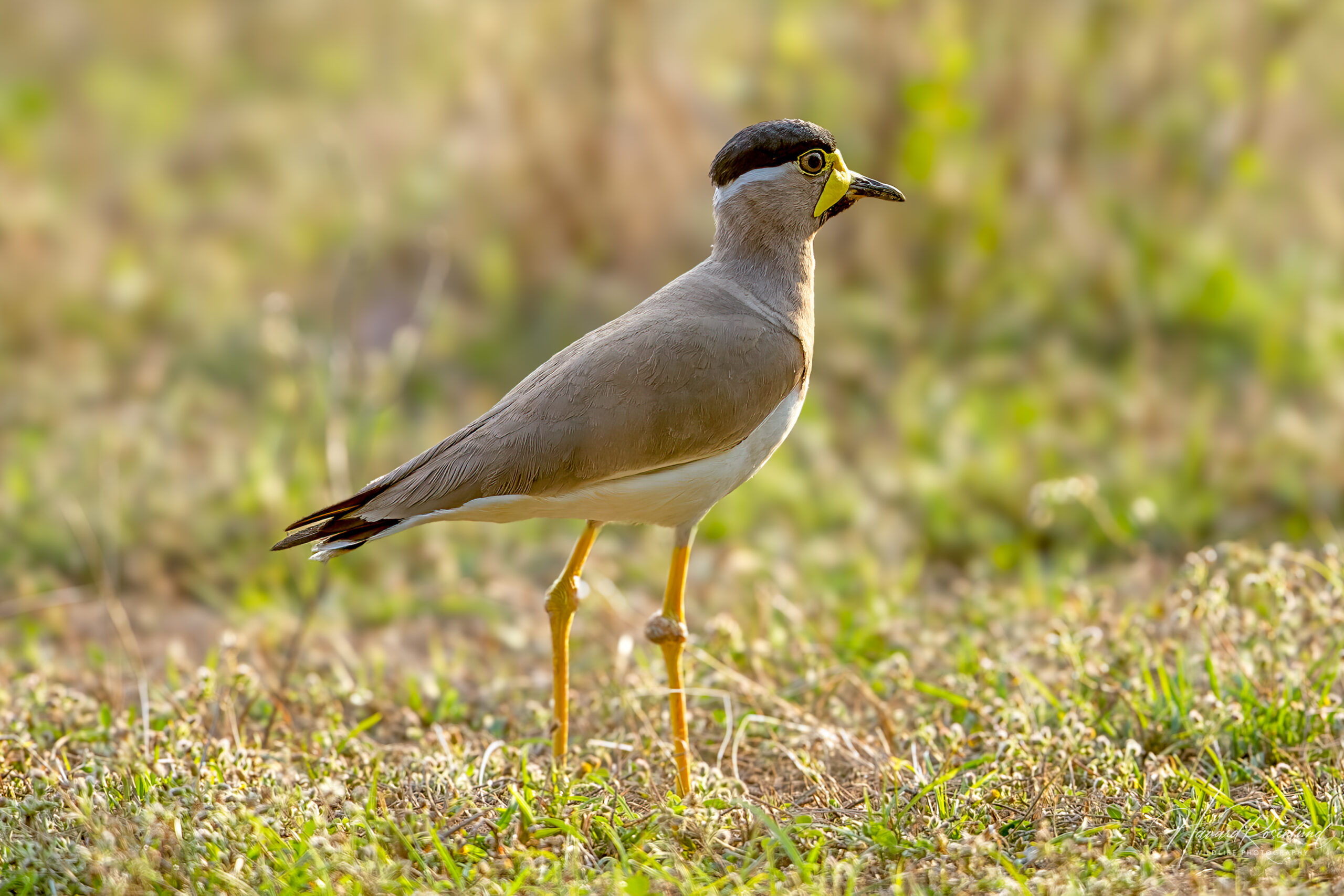
Yellow-wattled Lapwing
Vanellus malabaricus
At a glance
Habitat
- Dry grassland, fallow and uncultivated ground, open scrub and lightly cultivated landscapes
Diet
- Mostly arthropods, especially beetles and insect larvae; other small invertebrates are also taken
Activity
- Diurnal, with feeding activity strongest in morning and evening
Size
- Length: 26–28 cm Weight: 129–145 g
Range
- Indian subcontinent, mainly Pakistan, India, Nepal and Sri Lanka
Description
The yellow-wattled lapwing (Vanellus malabaricus) is a distinctive ground-dwelling wader of the Indian subcontinent. Adults are about 26–28 cm long and weigh roughly 129–145 g. The upperparts are sandy brown, the underparts mostly white, and the head carries a black cap contrasting with a broad white eyebrow. Bright yellow legs and the fleshy yellow wattles in front of the eyes are the most conspicuous field marks.
It is smaller and more strongly associated with dry open ground than the widespread red-wattled lapwing (Vanellus indicus). When alarmed it becomes conspicuous and vocal, but at rest the muted brown upperparts blend effectively into dry soil and short grass.
Habitat
Yellow-wattled lapwings are specialists of open, relatively dry landscapes. They use short grassland, fallow fields, uncultivated ground, sparse scrub, playgrounds and lightly cultivated land, sometimes close to ponds or river margins but without the strong dependence on wet ground shown by many other waders.
A five-year study carried out in 2019–2023 in Lucknow District, Uttar Pradesh, India, and published in 2025 found uncultivated ground to be used most heavily, while river habitats held the fewest birds. This preference helps explain why apparently rough or unused open ground can be important habitat for the species.
Diet
A diet study published in 2024 from Lucknow District found a strongly arthropod-based diet, with beetles and insect larvae especially important alongside flies, cockroaches and other small invertebrates. Prey availability varied with season and habitat.
Behaviour
Yellow-wattled lapwings usually forage by walking across open ground, pausing to inspect the surface and pecking at visible prey. A study published in 2024 from Lucknow District found this foraging pattern to dominate across habitat types, with feeding success highest in uncultivated habitat where prey was most abundant. Foraging activity showed distinct morning and evening peaks.
The species is often seen in pairs or small groups, with small flocks occurring particularly outside the breeding season.
Breeding
Yellow-wattled lapwings nest on the ground in exposed open habitat. The nest is a shallow scrape, often surrounded or lined with small stones, dry plant material or other locally available debris, and the mottled eggs are well camouflaged against the substrate. Both adults participate in incubation and nest defence, and breeding pairs become much more territorial around eggs and chicks.
A five-year study carried out in 2020–2024 in Lucknow District, Uttar Pradesh, India, and published in 2026 recorded 189 nests. The average clutch contained 3.43 eggs and incubation averaged just under 29 days. Nesting and hatching success were highest in uncultivated habitat, while predation and agricultural activity were important causes of failure. Other regional studies likewise show that three or four eggs are typical.
The chicks are precocial, meaning they hatch well developed and leave the scrape soon afterwards. They feed for themselves under close parental protection, while the adults use alarm calls, aggressive approaches and distraction behaviour to draw potential predators away from eggs or young.
Status
The yellow-wattled lapwing is classified as least concern on the IUCN Red List and remains widespread across the Indian subcontinent.
State of India's Birds lists the species as a low conservation priority. Its 2025 update shows a long-term national decline of about 32%, while the more recent annual trend is stable. As an open-habitat specialist, however, it can be affected locally when uncultivated ground and short natural grassland are converted to intensive agriculture, urban development or denser tree cover.
Image gallery
Loading map and observations…
Have you seen this species?
Independent species archive
Did you find this species page useful?
Wildlife Vagabond is independently built and maintained. Voluntary support helps cover hosting, maps, data storage and continued improvements to the species archive.
Support Wildlife VagabondSpecies content will remain freely available.
References
Information about the species’ global distribution and status is based primarily on global Red List data. See the references below for details.
- BirdLife International. (n.d.). Yellow-wattled Lapwing species factsheet. https://datazone.birdlife.org/species/factsheet/yellow-wattled-lapwing-vanellus-malabaricus
- Choudhary, N. L., Gehlot, H., Sharma, A. K., Philip, R., & Chishty, N. (2025). Nesting Ecology, Behaviour and Factors Influencing the Survival of Yellow-Wattled Lapwing in Udaipur District, Rajasthan. Indian Journal of Applied & Pure Biology, 40(2), 983–994. https://biology-journal.org/journal/volume40/issue83/ijapb40-2-20.html
- eBird. (n.d.). Yellow-wattled Lapwing. Cornell Lab of Ornithology. https://ebird.org/species/yewlap2
- International Union for Conservation of Nature. (n.d.). Yellow-wattled Lapwing. The IUCN Red List of Threatened Species. https://www.iucnredlist.org/species/22693959/93431644
- Kumar. (2015). First record of a regularly occupied nesting ground of Yellow-wattled Lapwing in agricultural environs of Punjab with notes on its biology. Journal of Entomology and Zoology Studies, 3(1), 129–134. https://www.entomoljournal.com/archives/?ArticleId=60&issue=1&vol=3&year=2015
- Prateek, Mishra, H., Kumar, V., & Kumar, A. (2024). Comparative Analysis of Diet and Prey Preference of Yellow-wattled Lapwing, <i>Vanellus malabaricus</i> (Boddaert, 1783). Current Science, 127(7), 841. https://doi.org/10.18520/cs/v127/i7/841-848
- Prateek, Mishra, H., Kumar, V., & Kumar, A. (2024). Temporal pattern in foraging behaviour of Vanellus malabaricus in relation to different seasons and habitats. Avian Biology Research, 17(1-2), 22-30. https://doi.org/10.1177/17581559241237725
- Prateek, Mishra, H., Kumar, V., & Kumar, A. (2025). Population structure, distribution pattern and habitat utilization of Yellow-wattled Lapwing, Vanellus malabaricus (Boddaert, 1783), in Northern India. BMC zoology, 10(1), 1. https://doi.org/10.1186/s40850-025-00222-6
- Prateek, Mishra, H., Kumar, V., & Kumar, A. (2026). Breeding ecology of yellow-wattled lapwing, Vanellus malabaricus in Northern India: insights into nesting and hatching success. Biologia, 81(4), 107. https://doi.org/10.1007/s11756-026-02153-0
- State of India's Birds. (2025). 2025 – Yellow-wattled Lapwing. https://stateofindiasbirds.in/species/yewlap2/
- Tobias, J. A., Sheard, C., Pigot, A. L., Devenish, A. J. M., Yang, J., Sayol, F., Neate‐Clegg, M. H. C., Alioravainen, N., Weeks, T. L., Barber, R. A., Walkden, P. A., MacGregor, H. E. A., Jones, S. E. I., Vincent, C., Phillips, A. G., Marples, N. M., Montaño‐Centellas, F. A., Leandro‐Silva, V., Claramunt, S., … Schleuning, M. (2022). AVONET: morphological, ecological and geographical data for all birds. Ecology Letters, 25(3), 581-597. https://doi.org/10.1111/ele.13898