
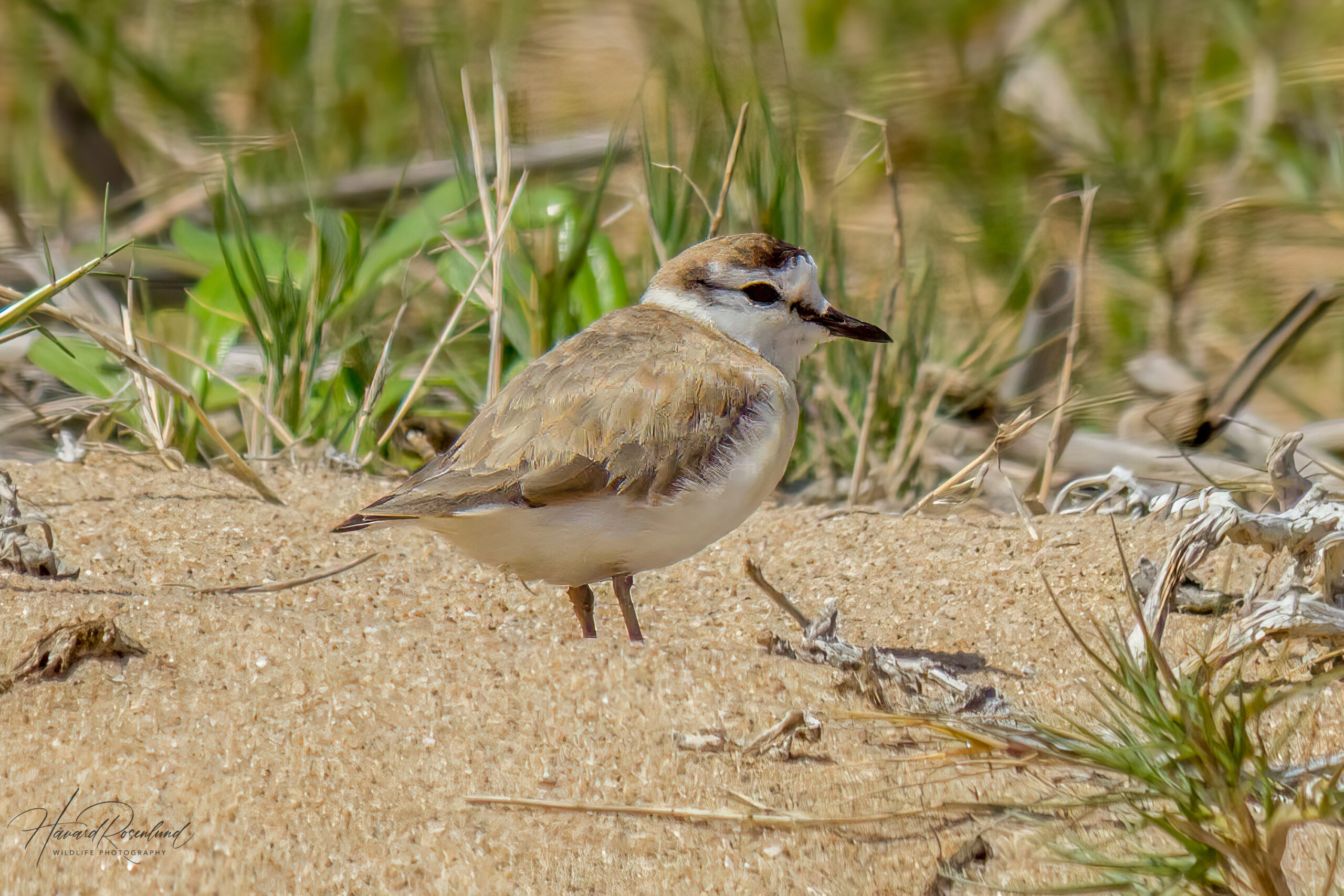
White-fronted Plover
Anarhynchus marginatus
At a glance
Habitat
- Sandy beaches and dunes, mudflats, estuaries, lagoons, saltpans and sandy shores of rivers and lakes
Diet
- Small invertebrates including insects, worms, molluscs and crustaceans
Activity
- Active mainly on foot along open shorelines, using rapid run-stop-search feeding
Size
- Length: About 18 cm Weight: 42–55 g
Range
- Sub-Saharan Africa and Madagascar, mainly along coasts but also inland around rivers and lakes
Description
The white-fronted plover (Anarhynchus marginatus) is a small, pale shorebird of sub-Saharan Africa and Madagascar. It is about 18 cm long and usually weighs 42–55 g. Sandy grey-brown upperparts, white underparts and a white forehead provide excellent camouflage on beaches and dry shorelines. Adults have a dark line behind the eye and a narrow dark crown band, usually less distinct in females. Juveniles are duller and lack the stronger crown marking.
Habitat
White-fronted plovers are strongly associated with open shorelines. They use sandy beaches and dunes, mudflats, estuaries, lagoons and saltpans, as well as sandy margins of inland rivers and lakes.
The shoreline can change constantly with tides, storms, rainfall and changing river levels, so the birds depend on a shifting combination of exposed feeding ground and relatively undisturbed sand or gravel for resting and nesting.
Diet
Small invertebrates form most of the diet, including insects such as sand flies, grasshoppers, termites and mosquitoes, together with worms, molluscs and small crustaceans. Prey is taken from the surface or from just beneath sand, mud and other soft shoreline substrates.
Foraging
Foraging usually follows the characteristic plover pattern of rapid runs separated by abrupt stops: the bird scans the substrate, darts forward and picks exposed prey before moving again. It can also use foot-trembling, rapidly vibrating one foot against the substrate to disturb concealed invertebrates.
Individuals may defend good feeding areas, while at other times birds gather loosely where prey is abundant.
Behaviour
White-fronted plovers spend much of their time on foot and rely strongly on camouflage when resting. Coastal populations are generally resident, whereas inland birds can make local movements as rivers, pans and dams change with rainfall and flooding.
Breeding
The nest is little more than a shallow scrape in sand or gravel, often beside driftwood, vegetation or another object that breaks up the open background. It is usually unlined but may contain a few pebbles, shell fragments, pieces of seaweed or twigs. Coastal birds can breed through much of the year when conditions are suitable. Clutches contain one to three eggs, usually two, and both parents incubate for about 29 days.
The eggs and chicks are exceptionally well camouflaged, but breeding on open shorelines leaves them exposed to disturbance and weather. When an incubating bird is forced from the nest by an approaching intruder, it may rapidly sweep sand over the eggs before leaving. People, dogs and vehicles can also cause adults to leave nests temporarily, while storms can flood or reshape nesting areas.
The chicks can move and feed for themselves soon after hatching but remain dependent on their parents for protection and guidance. How quickly they become capable of flight varies among populations. Field studies in Madagascar found most chicks flying at about 28–30 days, whereas southern African birds are generally reported to fledge at about 35–38 days.
Relationship with humans
Beach recreation creates one of the clearest points of contact between white-fronted plovers and people. Walkers, dogs and vehicles can repeatedly displace adults from feeding or nesting areas, although responses vary with local habitat and with how accustomed the birds are to regular human activity.
Studies of breeding birds show that some individuals become less responsive to repeated disturbance, but busy beaches can still disrupt feeding and nesting. Undisturbed sections of upper beach provide breeding pairs with places to nest and care for their chicks away from frequent people, dogs and vehicles.
Status
The white-fronted plover is classified as least concern on the IUCN Red List. The most recent global assessment estimates roughly 66,000–90,000 individuals, while the overall trend remains uncertain because populations differ among regions.
South Africa's 2025 regional assessment also lists the species as least concern but indicates a small regional decline. Beach disturbance, habitat degradation, severe storms and changes in river flow remain important local pressures.
Image gallery
Loading map and observations…
Have you seen this species?
Independent species archive
Did you find this species page useful?
Wildlife Vagabond is independently built and maintained. Voluntary support helps cover hosting, maps, data storage and continued improvements to the species archive.
Support Wildlife VagabondSpecies content will remain freely available.
References
Information about the species’ global distribution and status is based primarily on global Red List data. See the references below for details.
- Baudains, T. P., & Lloyd, P. (2007). Habituation and habitat changes can moderate the impacts of human disturbance on shorebird breeding performance. Animal Conservation, 10(3), 400–407. https://doi.org/10.1111/j.1469-1795.2007.00126.x
- BirdLife International. (n.d.). White-fronted Plover species factsheet. https://datazone.birdlife.org/species/factsheet/white-fronted-plover-anarhynchus-marginatus
- BirdLife South Africa. (2025). White-fronted Plover regional Red List assessment. https://www.birdlife.org.za/red-list/white-fronted-plover/
- International Union for Conservation of Nature. (n.d.). White-fronted Plover. The IUCN Red List of Threatened Species. https://www.iucnredlist.org/species/22693828/265007237
- Parra, J. E., Beltrán, M., Zefania, S., Dos Remedios, N., & Székely, T. (2014). Experimental assessment of mating opportunities in three shorebird species. Animal Behaviour, 90, 83–90. https://doi.org/10.1016/j.anbehav.2013.12.030
- Summers, R. W., & Hockey, P. A. R. (1981). Egg-covering behaviour of the White-fronted Plover Charadrius marginatus. Ornis Scandinavica, 12(3), 240–243.
- Summers, R. W., & Hockey, P. A. (1980). Breeding biology of the White-fronted Plover (Charadrius marginatus) in the south-western cape, South Africa. Journal of Natural History, 14(3), 433-445. https://doi.org/10.1080/00222938000770371
- Tanner, C. E., Jones, W., Kubelka, V., Caspers, B. A., Krueger, O., Mijoro, T. J., Sandercock, B. K., Zefania, S., & Székely, T. (2024). Variation in nest survival of three species of tropical plovers in Madagascar with clutch size, age of nest, year and El Niño effect. Ecology and Evolution, 14(9), e70269. https://doi.org/10.1002/ece3.70269