
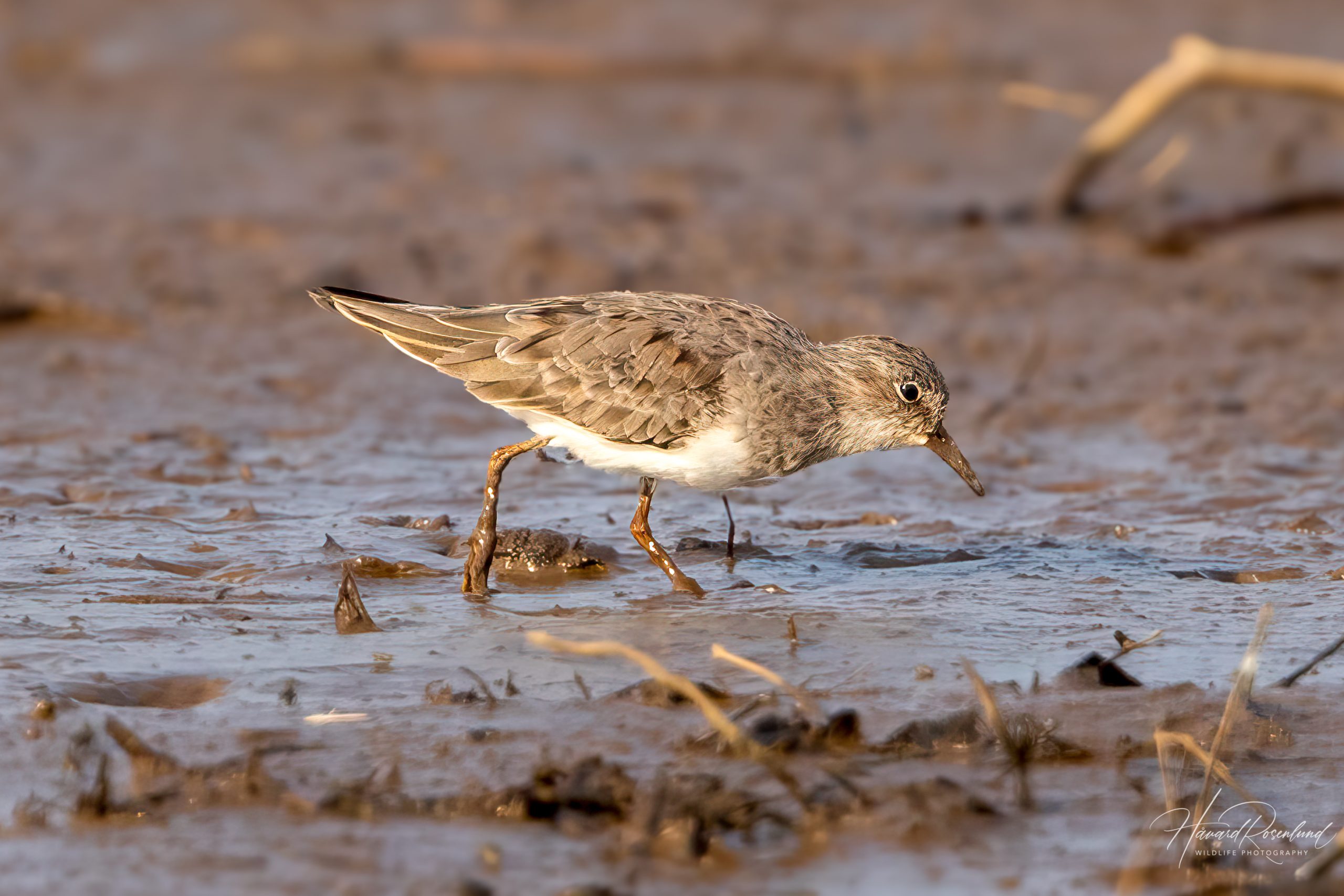
Temminck’s Stint
Calidris temminckii
At a glance
Habitat
- Sparse wet tundra and alpine freshwater margins when breeding; shallow freshwater wetlands on migration and in winter
Diet
- Mainly insects and other small invertebrates picked from mud, vegetation and shallow water
Activity
- Mainly diurnal
Size
- Length: 13–15 cm Weight: about 23 g
Range
- Breeds across northern Eurasia; winters from Africa east through South and Southeast Asia
Description
Temminck's stint (Calidris temminckii) is one of the smallest sandpipers, breeding across northern Eurasia and migrating south to Africa and Asia for the non-breeding season. Adults are about 13–15 cm long and weigh around 23 g.
The species is a subdued grey-brown wader with white underparts, a short straight bill and short yellowish to greenish legs. Breeding adults show warmer brown and rufous tones on the upperparts, while non-breeding birds become plainer grey-brown. It can resemble the little stint (Calidris minuta), but Temminck's stint usually looks longer-bodied and more muted, with pale legs and white outer tail feathers rather than the little stint's darker legs and greyer tail sides.
Habitat
On the breeding grounds, Temminck's stints use sparsely vegetated wet tundra, alpine freshwater margins, bogs, marshes and wet meadows. Bare or nearly bare ground close to pools, rivers and lakes is especially characteristic.
During migration and winter they favour shallow freshwater wetlands such as muddy pool edges, lake shores, riverbanks, flooded fields and marshes. They use tidal mudflats less regularly than many other small sandpipers.
Diet
The diet consists mainly of insects and other small invertebrates, including crustaceans and molluscs. On the breeding grounds, insects are particularly important.
Birds pick visible prey from mud, low vegetation and shallow water and also probe lightly into soft substrate. The feeding style is characteristically slow and deliberate, with birds creeping steadily along wet margins rather than running rapidly between feeding spots.
Behaviour
Temminck's stints are often solitary or occur in small, loose groups, even during migration, and are less prone to forming large compact flocks than many other small Calidris waders. They usually move quietly along wet margins, alternating short bouts of feeding with pauses to scan their surroundings.
Outside the breeding season the species is generally unobtrusive, with muted plumage, a low posture and measured movements.
Migration
Temminck's stint is a long-distance migrant. Birds breeding from Scandinavia east across northern Russia leave after the short northern summer and winter from Africa east through the Indian subcontinent and parts of Southeast Asia.
A geolocator study published in 2015 followed six birds breeding at Finse in southern Norway. Five migrated south-west through continental western Europe, while one headed south-east towards the Balkan Peninsula. The southbound journey to north-west Africa took about 10–27 days and included one to four relatively short stopovers. The three birds that could be followed farther spent 11–20 days at stopover sites in North Africa before crossing the Sahara, then remained for more than 215 days around the Niger River in Mali. Rather than carrying exceptionally large fuel reserves for only a few long jumps, they relied on a chain of wetlands where they could pause and refuel.
Breeding
Breeding begins during the brief northern summer, generally from late May or June. Males perform aerial song displays over breeding areas, while the nest itself is a shallow scrape on the ground, usually lined with vegetation. Four eggs are typical, with two to four recorded. Incubation lasts about 21–22 days, and the precocial chicks begin flying at roughly 15–18 days.
The mating system is unusually flexible. A three-year study around Finse in southern Norway, published in 1989, documented six cases of females laying successive clutches. Females changed partners between clutches: the first clutch was incubated by a male, while the female later incubated her final clutch herself. Both sexes could therefore mate with more than one partner in succession, allowing more than one breeding attempt within the short northern summer.
Status
Temminck's stint is classified as least concern on the IUCN Red List. Its breeding range is enormous, and the species remains widespread across northern Eurasia.
The species nevertheless depends on a chain of suitable wet habitats throughout the year. Drainage, degradation and disturbance of shallow freshwater wetlands can therefore affect birds at breeding sites, migration stopovers and wintering areas even when the global extinction risk remains low.
Image gallery
Loading map and observations…
Have you seen this species?
Independent species archive
Did you find this species page useful?
Wildlife Vagabond is independently built and maintained. Voluntary support helps cover hosting, maps, data storage and continued improvements to the species archive.
Support Wildlife VagabondSpecies content will remain freely available.
References
Information about the species’ global distribution and status is based primarily on global Red List data. See the references below for details.
- AviList. (n.d.). Calidris temminckii taxonomy. https://explore.avilist.org/
- BirdLife International. (n.d.). Temminck's Stint species factsheet. https://datazone.birdlife.org/species/factsheet/temmincks-stint-calidris-temminckii
- Breiehagen, T. (1989). Nesting biology and mating system in an alpine population of Temminck's Stint Calidris temminckii. Ibis, 131(3), 389-402. https://doi.org/10.1111/j.1474-919X.1989.tb02787.x
- British Trust for Ornithology. (n.d.). BirdFacts – Temminck's Stint. https://www.bto.org/learn/about-birds/birdfacts/temmincks-stint
- International Union for Conservation of Nature. (n.d.). Calidris temminckii. The IUCN Red List of Threatened Species. https://www.iucnredlist.org/species/22693388/146637675
- Lislevand, T., & Hahn, S. (2015). Skipping‐type migration in a small Arctic wader, the Temminck's stint Calidris temminckii. Journal of Avian Biology, 46(4), 419-424. https://doi.org/10.1111/jav.00653