
Water Thick-knee
Burhinus vermiculatus
At a glance
Habitat
- Riverbanks, lake shores, estuaries, mangroves and other wetlands
Diet
- Invertebrates, frogs, small reptiles and other small prey
Activity
- Mostly nocturnal
Size
- Length: 38–41 cm Weight: 280–430 g
Range
- Sub-Saharan Africa, closely associated with freshwater and coastal wetlands
Description
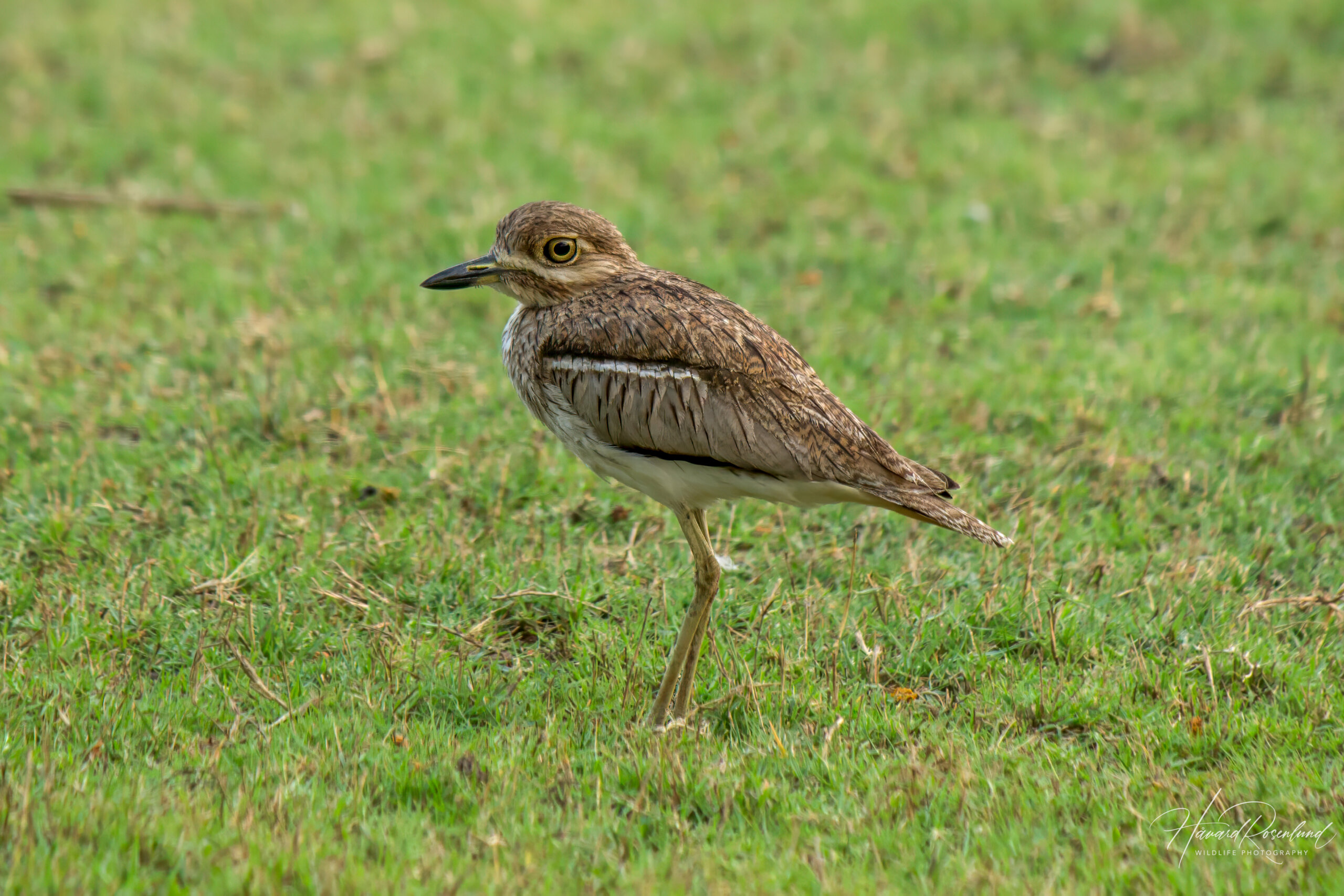
The water thick-knee (Burhinus vermiculatus) is a medium-sized African wader of the thick-knee family, about 38–41 cm long and weighing roughly 280–430 g. Its mottled brown plumage provides excellent camouflage, while the large yellow eyes are well suited to its mainly nocturnal lifestyle. It has a stout bill, long legs and conspicuously thickened ankle joints, the feature that gives thick-knees their English name.
Where ranges overlap, it can be confused with the Senegal thick-knee (Burhinus senegalensis) and Eurasian thick-knee (Burhinus oedicnemus). On the folded wing, the water thick-knee has a broad pale-grey panel with a narrow white bar above it and a darker bar above the white. The Senegal thick-knee lacks the distinct white bar, while the Eurasian thick-knee has a white bar bordered by dark bands both above and below.
Habitat
The water thick-knee is strongly associated with water and occurs along riverbanks, lake shores, dams, estuaries, mangroves and other wetlands with exposed ground, sandbanks or sheltered margins. It uses both freshwater and coastal habitats and can also occupy artificial reservoirs where suitable shoreline remains available. Birds usually remain close to water even while feeding and are typically found within about 1 km of it.
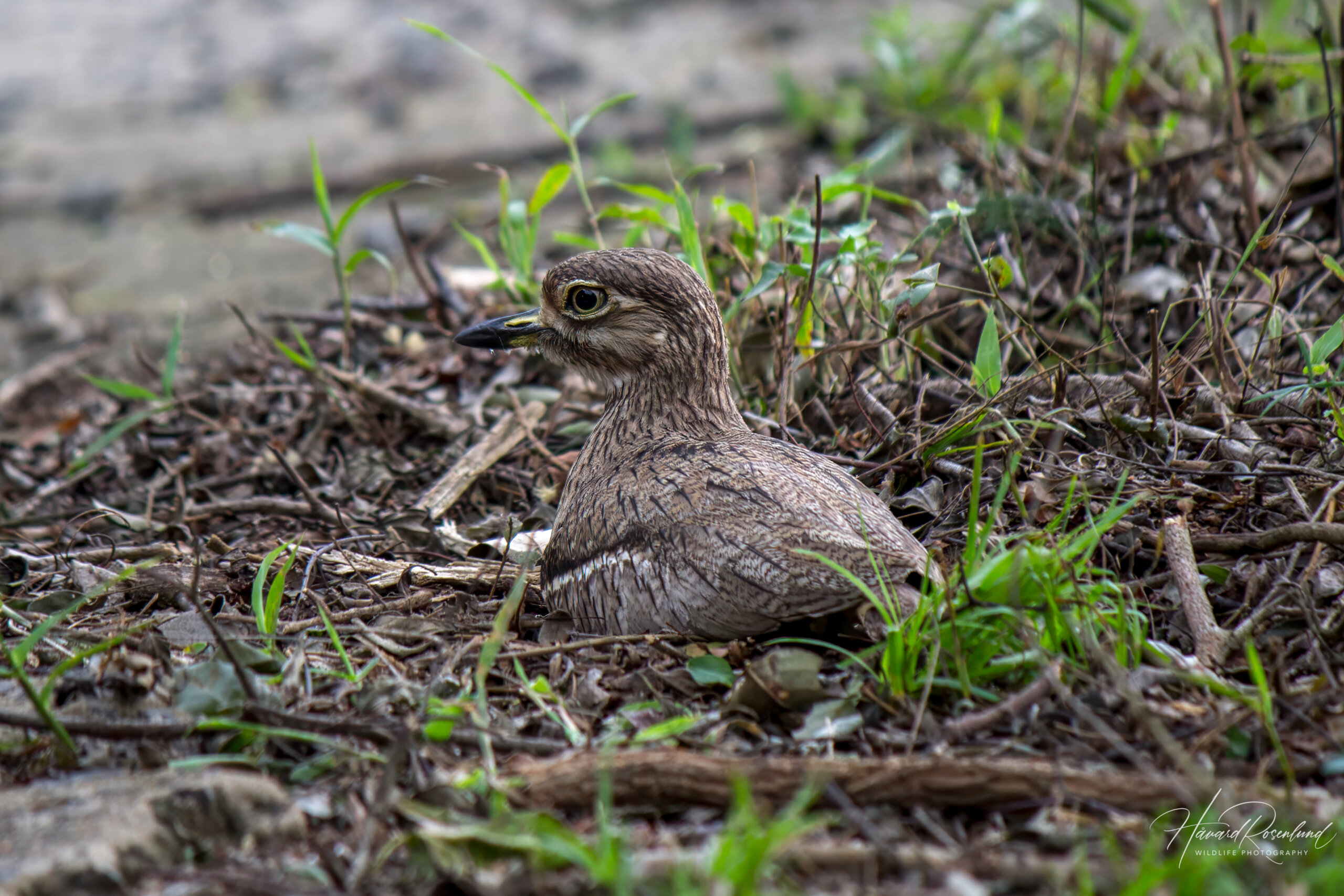
Unlike many waders it is not restricted to open mudflats. Birds often rest among vegetation, rocks, driftwood or other cover immediately beside the water, where their cryptic plumage makes them difficult to detect during the day.
Diet
The diet consists mainly of small animal prey taken on or close to the ground. Insects such as aquatic beetles, grasshoppers and termites are important, together with crabs and other crustaceans, molluscs, worms, millipedes and other invertebrates. Frogs, tadpoles, small reptiles and occasional small fish may also be eaten.
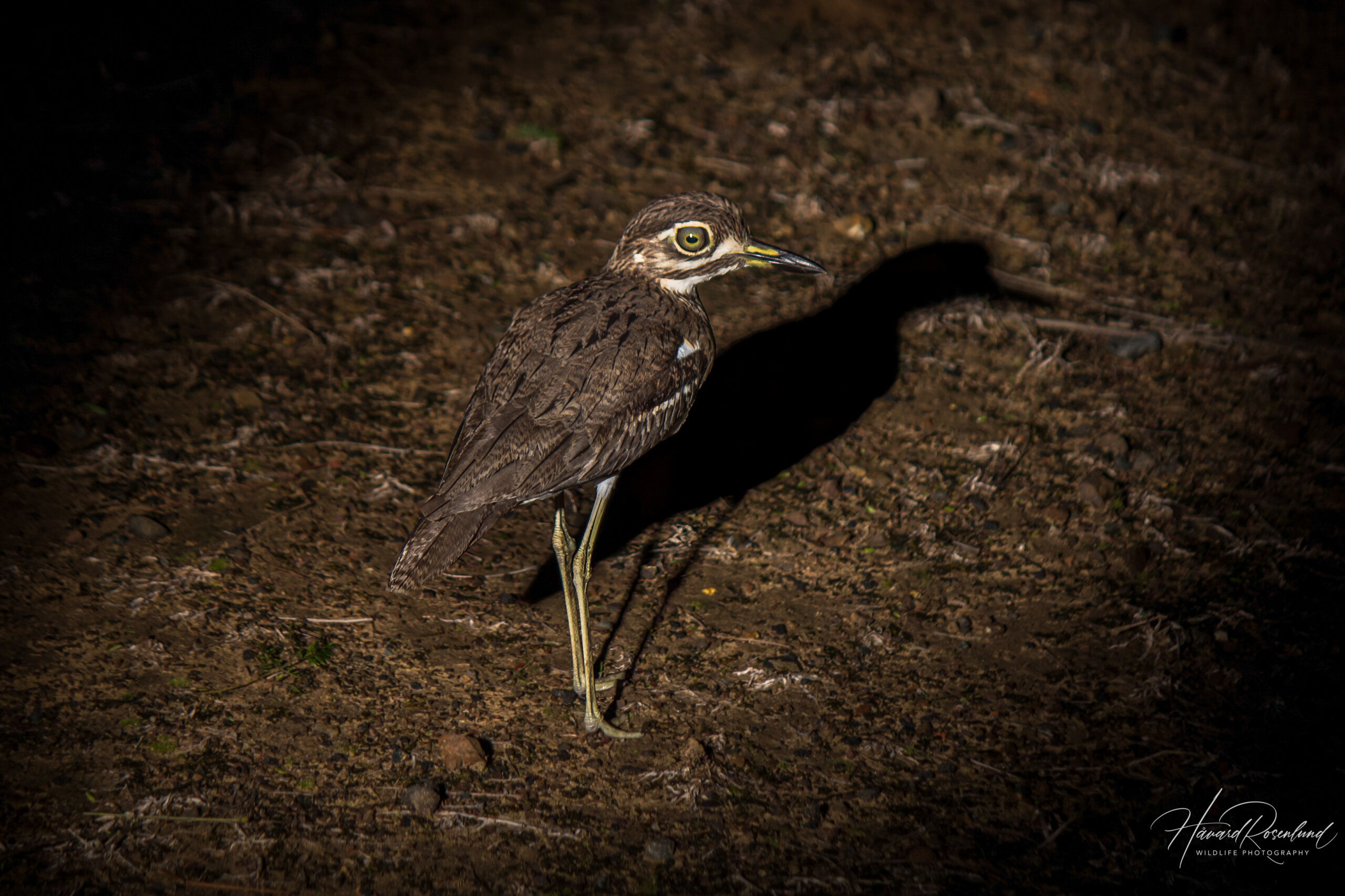
Most feeding takes place from dusk through the night as birds walk slowly along shorelines and wetland edges, picking prey from the surface and shallow margins.
Behaviour
Water thick-knees are mainly nocturnal. During the day they usually rest quietly close to water and may remain almost motionless until activity increases toward dusk. They are nevertheless seen in daylight more often than many other thick-knees, especially in quiet areas with little disturbance.
Birds are usually encountered alone or in pairs and sometimes forage in small groups. At night they can reveal their presence with loud, far-carrying whistled calls even when the birds themselves remain difficult to see.
Breeding
Breeding timing varies across the range and is often linked to local rainfall and water levels. Water thick-knees form monogamous pairs and nest on the ground, usually close to water. The nest is little more than a shallow scrape, sometimes placed beside a conspicuous object such as driftwood, a bush or animal dung.
One to three well-camouflaged eggs may be laid, and both adults take part in incubation. Incubation lasts roughly 22–25 days. The cryptic plumage of the adults and the mottled eggs make an exposed nesting site surprisingly difficult to detect. Development after hatching is poorly documented, but the young appear to fledge at about 60–63 days.
Status
The water thick-knee is widespread across much of sub-Saharan Africa and is globally classified as Least Concern on the IUCN Red List. No major threat is known to affect the species across its entire range.
Wetland disturbance, shoreline development and changes to water levels can affect local populations, while artificial reservoirs may provide additional habitat where quiet banks and sufficient prey remain available.
Image gallery
Loading map and observations…
Have you seen this species?
Independent species archive
Did you find this species page useful?
Wildlife Vagabond is independently built and maintained. Voluntary support helps cover hosting, maps, data storage and continued improvements to the species archive.
Support Wildlife VagabondSpecies content will remain freely available.
References
Information about the species’ global distribution and status is based primarily on global Red List data. See the references below for details.
- BirdLife International. (n.d.). Water Thick-knee species factsheet. https://datazone.birdlife.org/species/factsheet/water-thick-knee-burhinus-vermiculatus
- Hume, R., Kirwan, G. M., & Boesman, P. F. D. (2021). Water Thick-knee (Burhinus vermiculatus). Birds of the World. https://doi.org/10.2173/bow.watkne1.01.1
- International Union for Conservation of Nature. (n.d.). Water Thick-knee. The IUCN Red List of Threatened Species. https://www.iucnredlist.org/species/22693584/93413917
- Southern African Bird Atlas Project 2. (n.d.). SABAP1 species account – Water Thick-knee (Burhinus vermiculatus). https://sabap2.birdmap.africa/docs/sabap1/298.pdf