
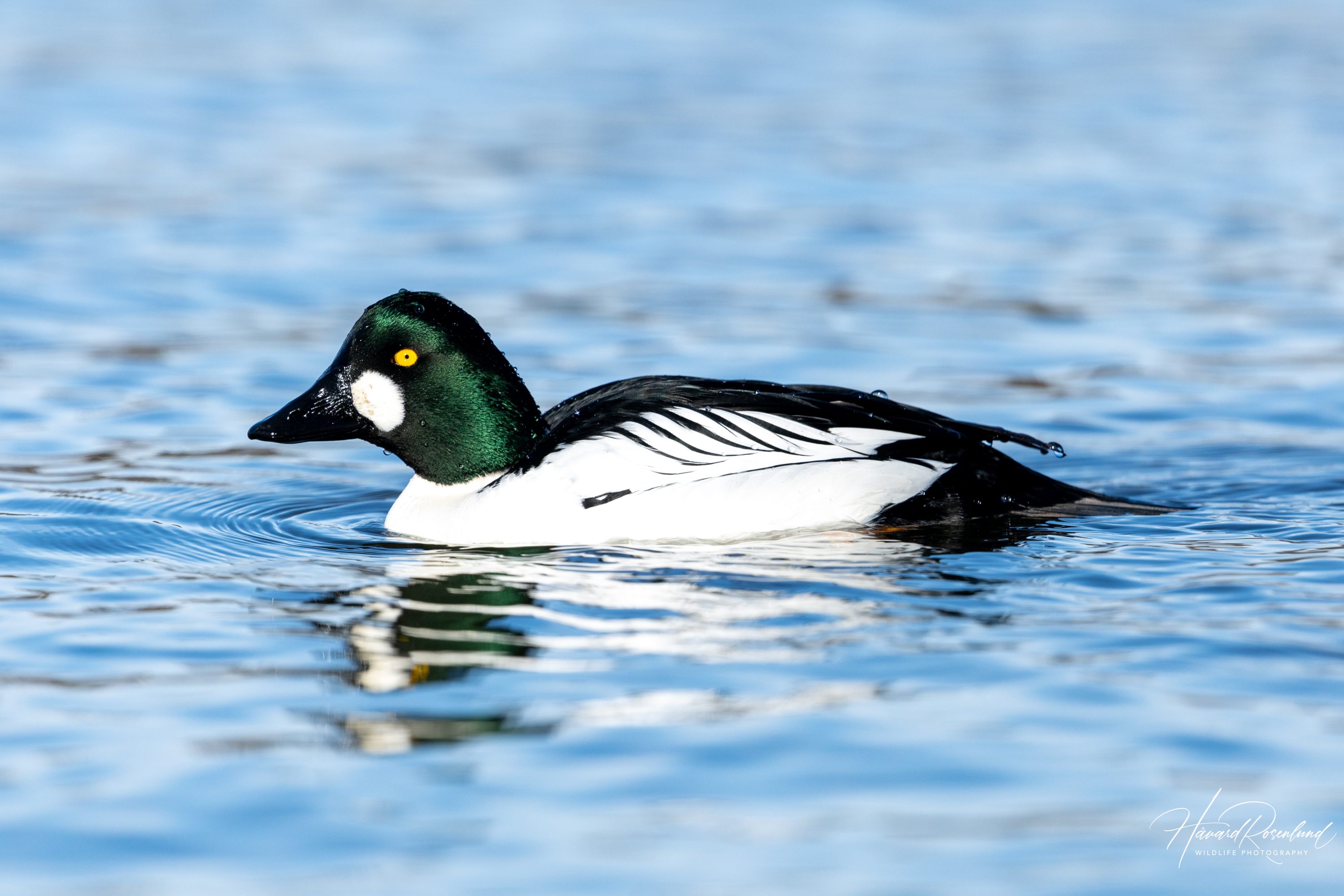
Common Goldeneye
Bucephala clangula
At a glance
Habitat
- Boreal forest lakes and slow rivers when breeding; open lakes, rivers and coasts in winter
Diet
- Aquatic invertebrates, crustaceans, molluscs, amphibians and small fish
Activity
- Diurnal
Size
- Length: 40–51 cm Weight: 600–1,300 g
Range
- Boreal Eurasia and North America; winters farther south on ice-free waters
Description
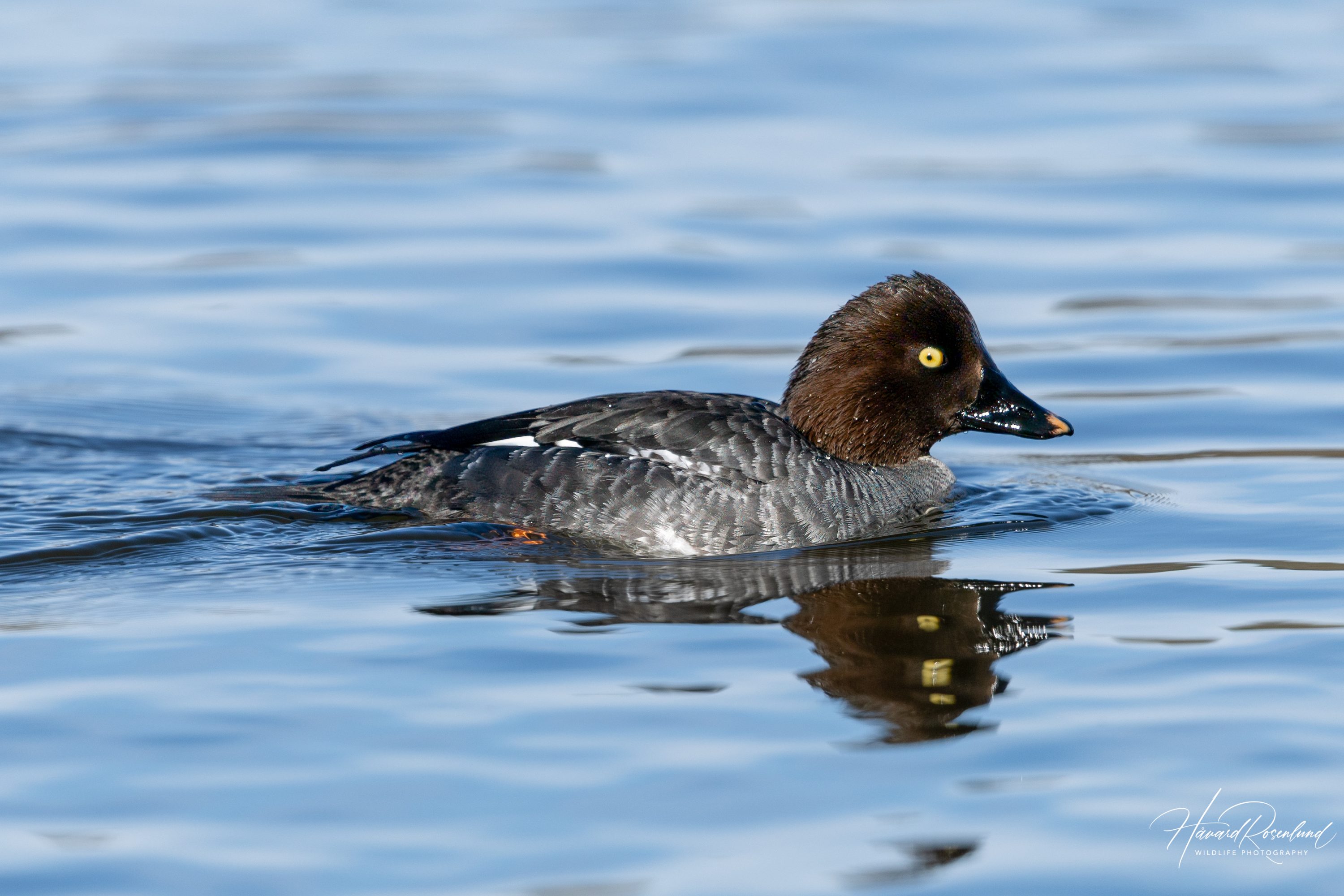
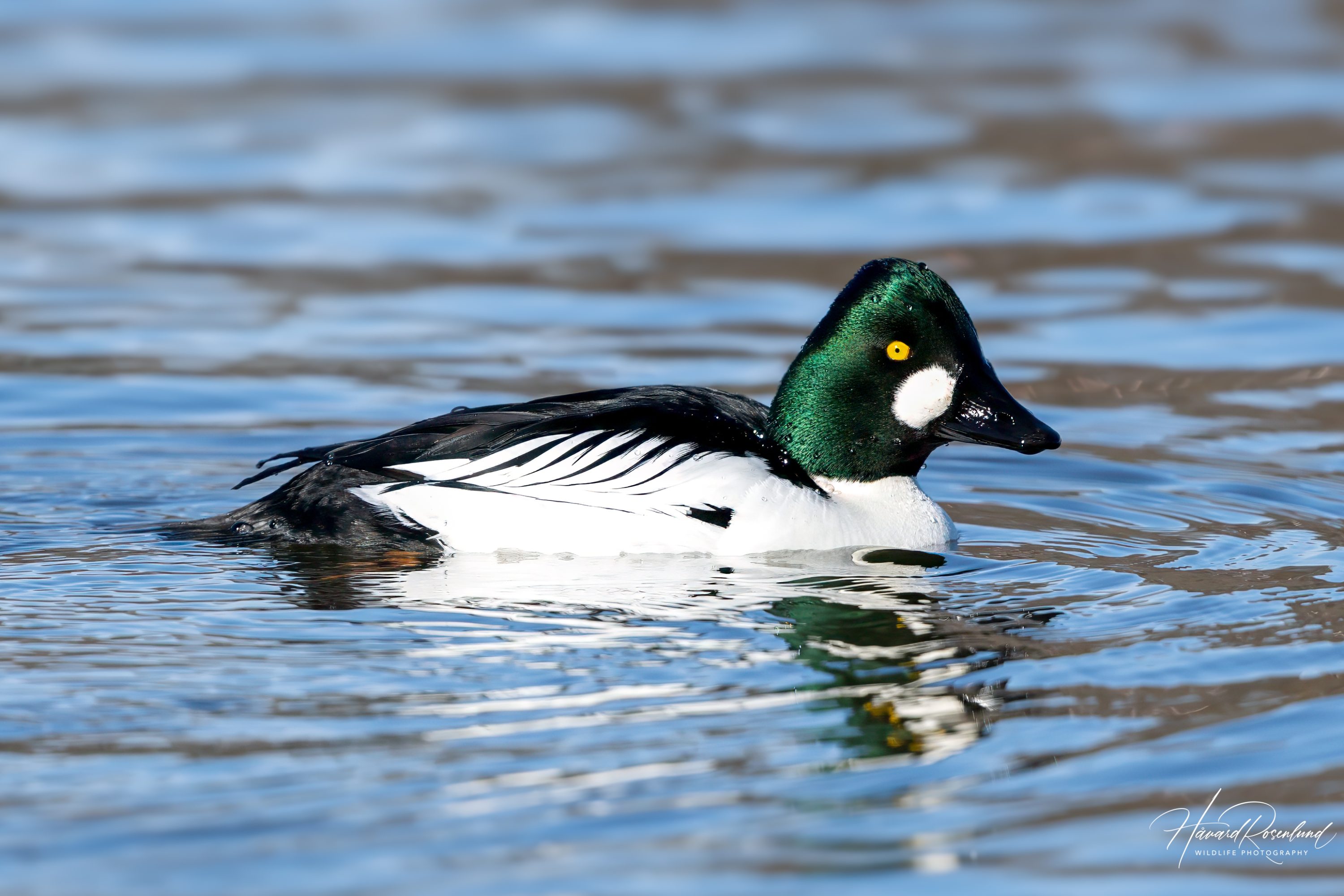
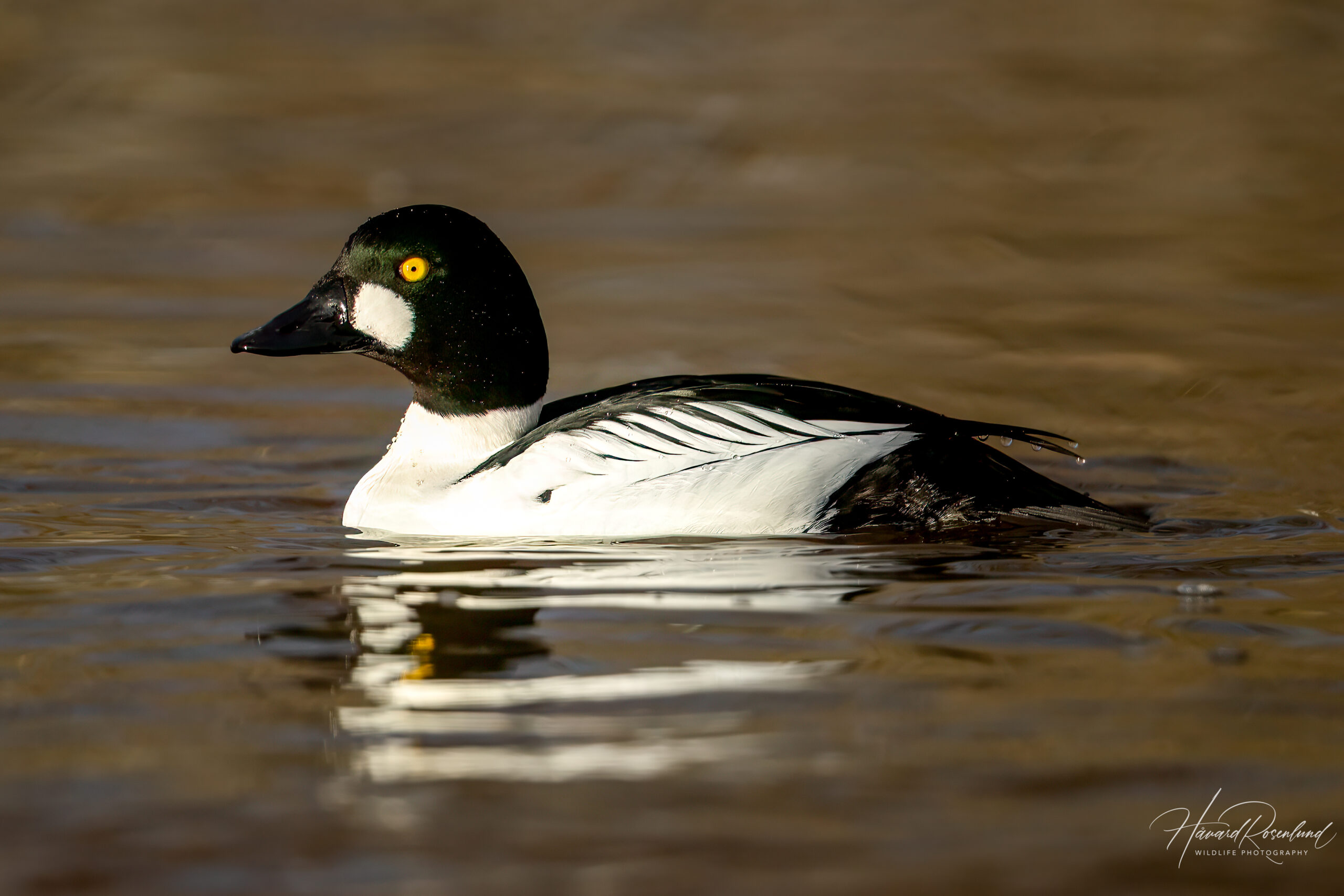
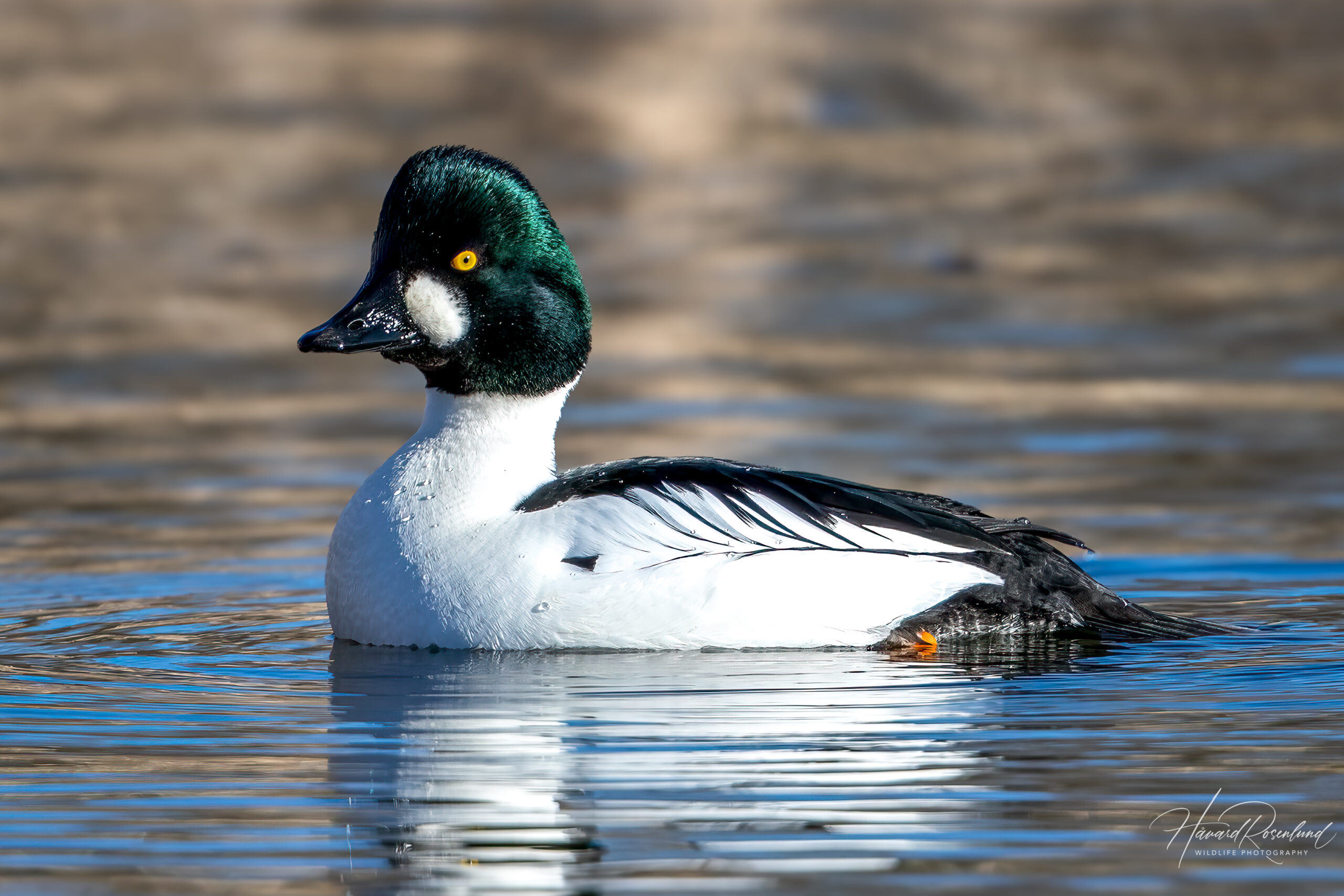
The common goldeneye (Bucephala clangula) is a medium-sized diving duck with a broad, triangular head and compact body. It breeds across the boreal regions of Eurasia and North America and winters farther south wherever open water remains available. Adult males are strikingly black and white, with a glossy dark-green head, a round white patch between the eye and bill and a bright yellow eye. Females have a warm brown head and grey body. Adults are roughly 40–51 cm long and weigh about 600–1,300 g.
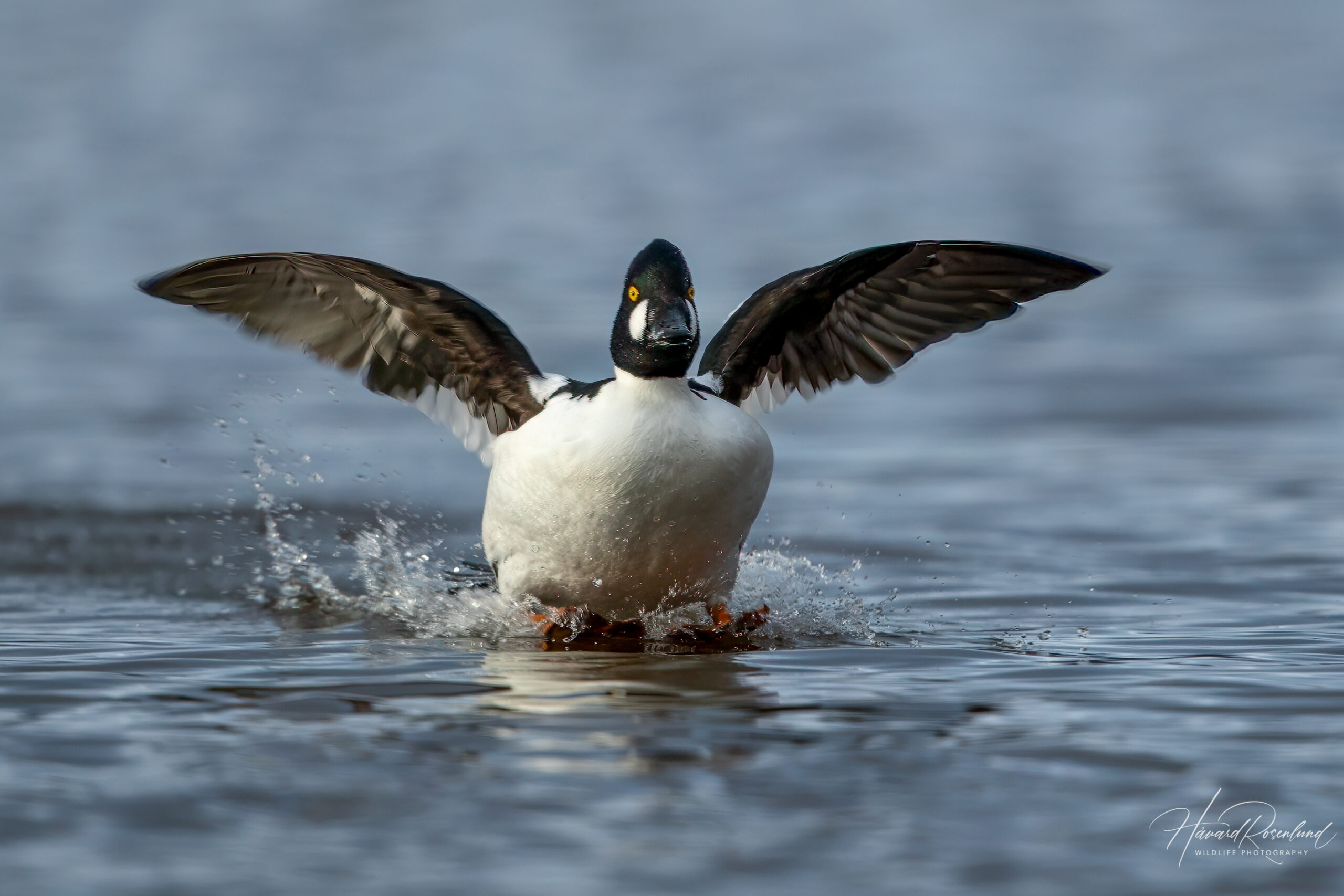
In flight the rapidly beating wings produce a distinctive whistling sound, particularly in males. This, together with the large head, short neck and fast direct flight, gives goldeneyes a characteristic appearance and sound even at some distance.
Habitat
Common goldeneyes breed mainly on lakes and slow-flowing rivers in boreal forest, where mature trees provide suitable nesting cavities close to water. Small forest lakes, sheltered river reaches and larger inland waters can all be used if feeding conditions and nest sites are suitable.
Outside the breeding season they move to larger lakes, rivers, estuaries and sheltered coastal waters. Ice-free water is the main requirement in winter, and flocks may gather wherever productive shallow feeding areas remain open.
Diet
Common goldeneyes eat mainly aquatic insects and their larvae, crustaceans and molluscs, with amphibians, small fish, fish eggs and smaller amounts of plant material also taken. The balance changes seasonally and among habitats: invertebrates are especially important on boreal breeding waters, while fish and benthic prey can become more prominent in winter.
Foraging
Goldeneyes feed by diving and propel themselves underwater mainly with their feet while the wings remain folded against the body. Much feeding takes place in relatively shallow open water, although birds use deeper or faster-flowing sites when profitable prey is concentrated there. Prey is normally swallowed underwater.
A field study on the coast of southern Sweden recorded wintering goldeneyes feeding at depths of up to about 6 m. Foraging often occurs in small groups, and nearby birds may synchronise their dives so that much of a flock disappears and resurfaces in quick succession. Winter studies in Scotland also found that adult males made longer dives than females, particularly in estuarine feeding areas, consistent with the larger males being better able to exploit concentrated bottom prey in deeper or stronger-flowing water.
Migration
Populations breeding where lakes and rivers freeze are migratory. They move toward ice-free lakes, large rivers, estuaries and coasts in autumn and return north early in spring as inland waters reopen. Migration distance varies considerably, from relatively short regional movements to journeys of hundreds or thousands of kilometres.
Winter flocks often contain several birds and can become much larger at particularly rich feeding sites. Seasonal movements are therefore closely tied to ice conditions and food availability rather than to one fixed migration distance throughout the species’ range.
Breeding
Common goldeneyes are cavity nesters and depend on large tree holes, often excavated previously by woodpeckers, although they readily use suitable nest boxes. Courtship begins well before nesting and is conspicuous: males repeatedly throw the head backward, thrust it forward, kick water and give display calls while females respond with their own postures. Pairs normally form during winter or early spring.
Nest cavities can limit how many pairs are able to breed. A long-term nest-box experiment in southern Finland found that adding boxes increased the number of breeding pairs on experimental lakes, but did not increase the number of broods or fledged young, suggesting that other limits became important once the shortage of nest sites was reduced.
Clutch size varies across the range; European data typically show 8–11 eggs. The female incubates alone for about 29–30 days. The ducklings are precocial, hatching downy, alert and mobile, and leave the nest roughly a day later. From nests high in trees they simply jump from the entrance to the ground, then follow the female to water and begin feeding for themselves while she provides protection. They become capable of flight after about 57–66 days.
Goldeneyes also show brood parasitism within the species. Some females lay eggs in the nests of other goldeneyes. A study published in 2006 found that parasitic females used information from previously active nests to target nest sites that had proved safer, linking nest-site prospecting directly to where parasitic eggs were laid.
Status
The common goldeneye remains classified as least concern on the IUCN Red List. It has a very large Holarctic range and remains numerous across both Eurasia and North America.
Locally, the species depends on a combination of productive waters and suitable nesting cavities. Forestry that removes large old or dead trees can reduce natural nest sites, while nest boxes can partly compensate where cavities are scarce. Good water quality and abundant aquatic invertebrates are also important for maintaining productive breeding and wintering areas.
Image gallery
Loading map and observations…
Have you seen this species?
Independent species archive
Did you find this species page useful?
Wildlife Vagabond is independently built and maintained. Voluntary support helps cover hosting, maps, data storage and continued improvements to the species archive.
Support Wildlife VagabondSpecies content will remain freely available.
References
Information about the species’ global distribution and status is based primarily on global Red List data. See the references below for details.
- BirdLife International. (n.d.). Common Goldeneye species factsheet. https://datazone.birdlife.org/species/factsheet/common-goldeneye-bucephala-clangula
- British Trust for Ornithology. (n.d.). Goldeneye. https://www.bto.org/learn/about-birds/birdfacts/goldeneye
- Cornell Lab of Ornithology. (n.d.). Common Goldeneye. https://www.allaboutbirds.org/guide/Common_Goldeneye/overview
- Duncan & Marquiss. (1993). The sex-age ratio, diving behaviour and habitat use of Goldeneye Bucephala clangula wintering in northeast Scotland. Wildfowl, 44, 111–120. https://tidsskrift.dk/Wildfowl/article/view/154691
- International Union for Conservation of Nature. (n.d.). Common Goldeneye. The IUCN Red List of Threatened Species. https://www.iucnredlist.org/species/22680455/132529366
- Nilsson, L. (1972). Habitat Selection, Food Choice, and Feeding Habits of Diving Ducks in Coastal Waters of South Sweden during the Non-Breeding Season. Ornis Scandinavica, 3(1), 55. https://doi.org/10.2307/3676166
- Pöysä, H., & Pöysä, S. (2002). Nest‐site limitation and density dependence of reproductive output in the common goldeneyeBucephala clangula: implications for the management of cavity‐nesting birds. Journal of Applied Ecology, 39(3), 502-510. https://doi.org/10.1046/j.1365-2664.2002.00726.x
- Pöysä, H. (2006). Public information and conspecific nest parasitism in goldeneyes: targeting safe nests by parasites. Behavioral Ecology, 17(3), 459-465. https://doi.org/10.1093/beheco/arj049