
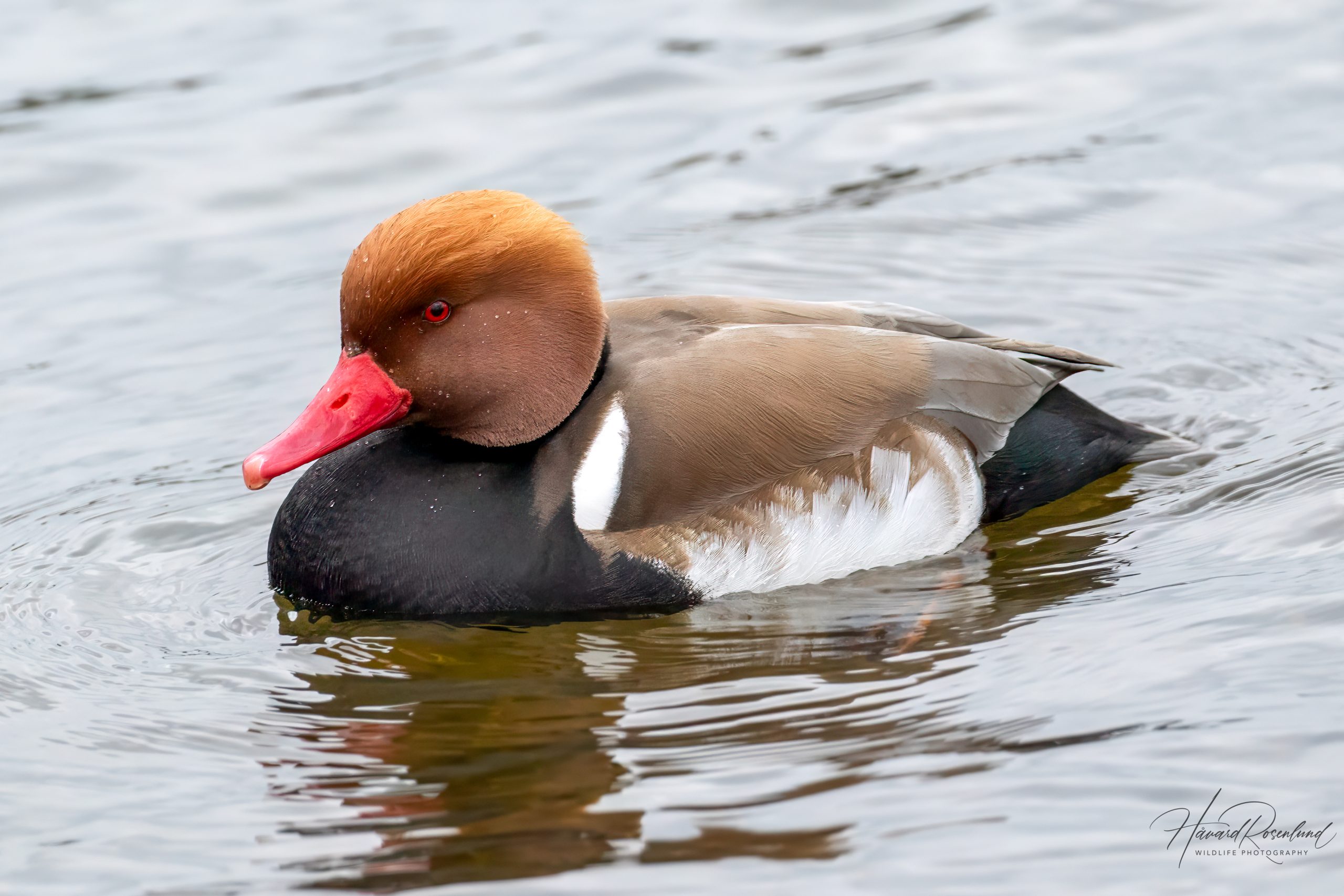
Red-crested Pochard
Netta rufina
At a glance
Habitat
- Shallow lakes, marshes, lagoons and reservoirs with rich aquatic vegetation
Diet
- Mostly aquatic plants and seeds; also aquatic invertebrates
Activity
- Mostly diurnal, with feeding also around dawn and dusk
Size
- Length: 53–57 cm Weight: ~1.1 kg
Range
- Scattered breeding range from western Europe through Central Asia; winters south to North Africa and South Asia
Description
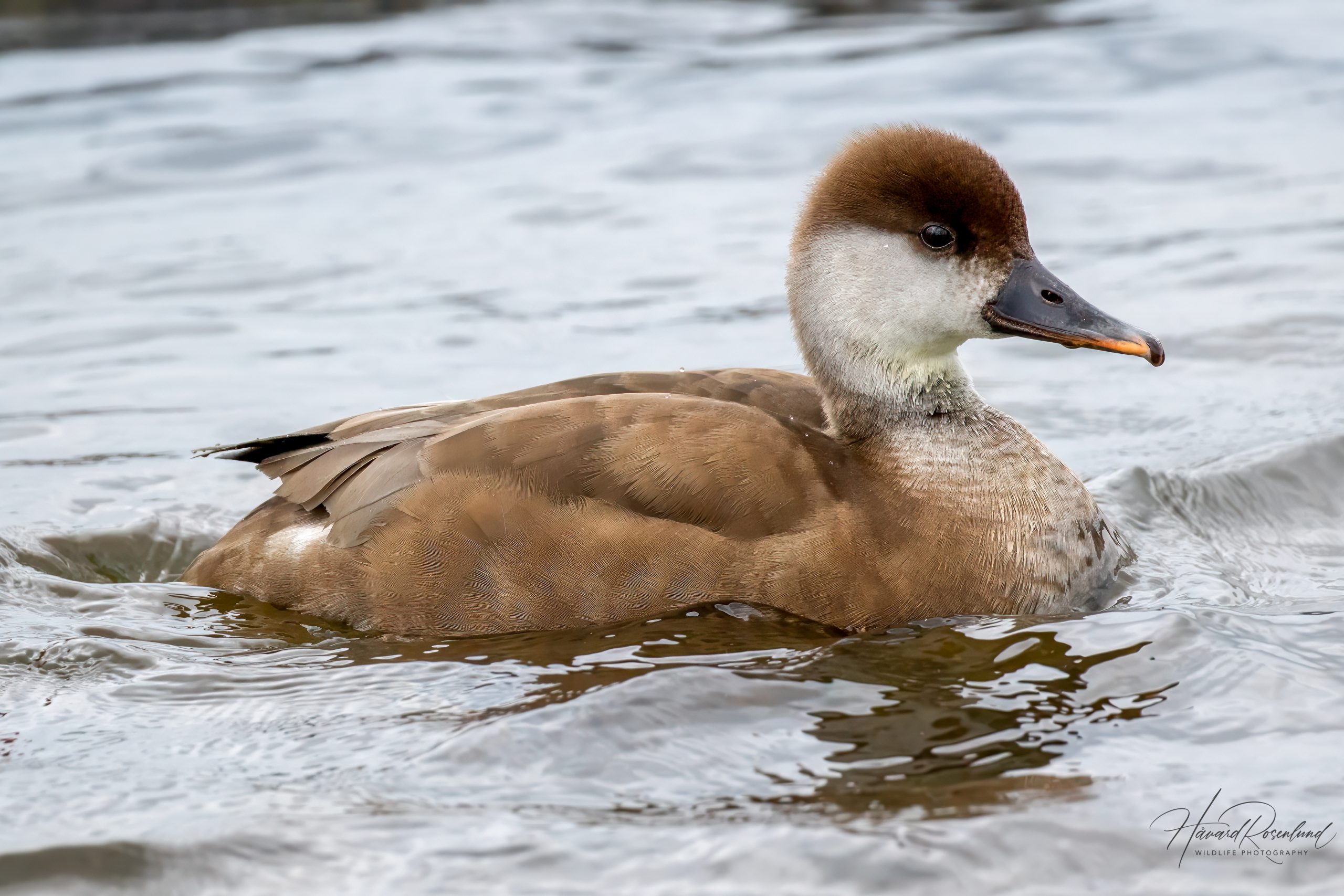
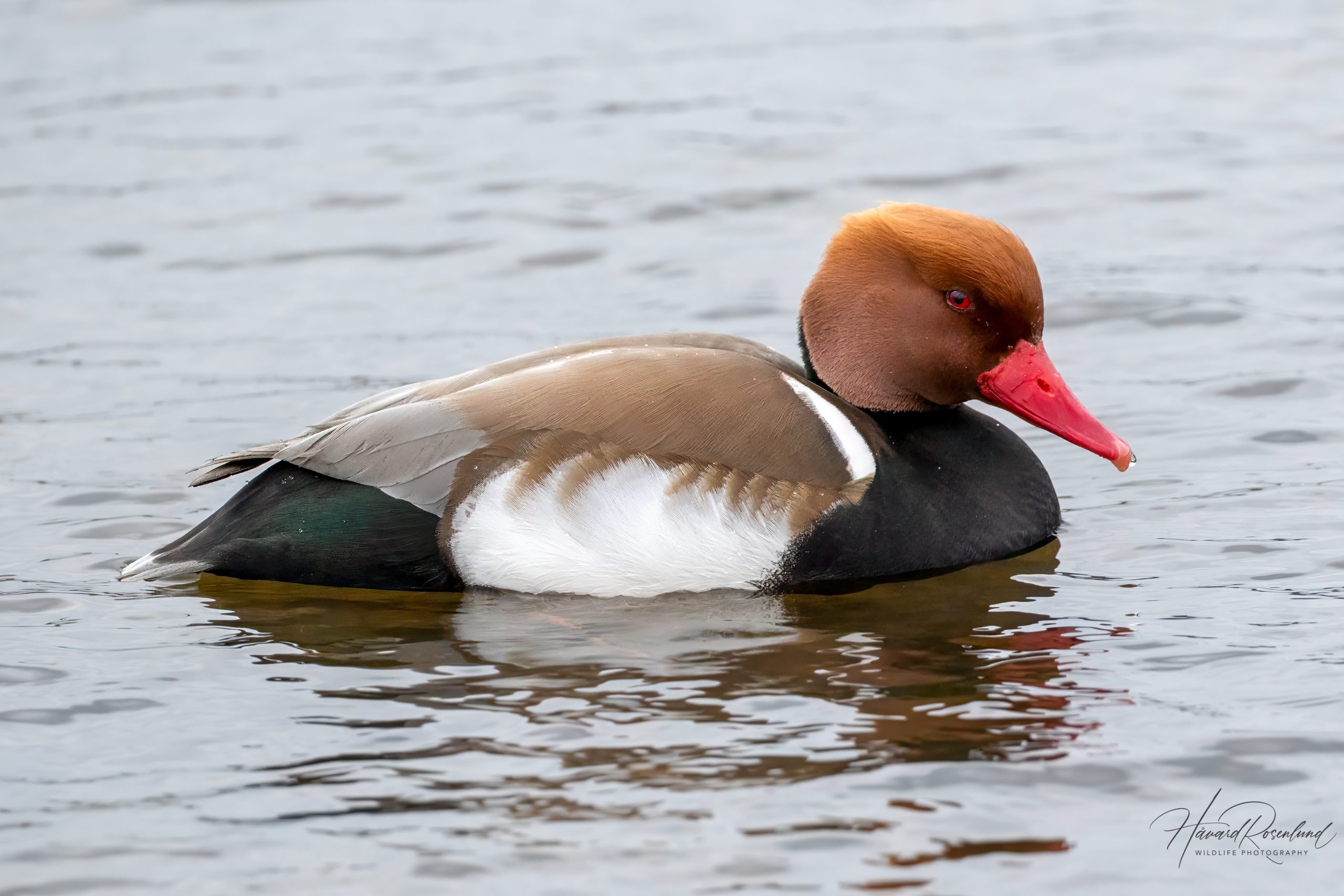
The red-crested pochard (Netta rufina) is a large, distinctive Eurasian duck. Adult males have a rounded orange-rufous head, coral-red bill, black breast, brown back and pale flanks. Females and immatures are much more subdued, with a warm brown body, darker crown and conspicuously pale cheeks. Both sexes show a broad whitish wingbar in flight.
Adults are about 53–57 cm long with a wingspan of roughly 84–88 cm and weigh around 1.1 kg. The similar common pochard (Aythya ferina) has a more angular head profile; males have a darker chestnut head, grey back and dark-tipped bill, while female common pochards lack the strongly contrasting pale cheeks of female red-crested pochards.
Habitat
Red-crested pochards favour shallow, nutrient-rich freshwater lakes, lagoons, marshes and reservoirs with extensive submerged and emergent vegetation. Breeding sites usually combine open water with reedbeds or other dense shoreline cover, while winter flocks can use larger lakes and artificial water bodies.
Diet
The diet is predominantly plant-based, including submerged leaves, stems, roots, seeds and algae, supplemented by aquatic invertebrates and other animal matter. Submerged macrophytes and charophytes can be particularly important where they form extensive underwater beds.
Foraging
Although classed among the diving ducks, red-crested pochards use a notably flexible set of feeding techniques. In shallow water they often dabble, dip the head and bill below the surface or upend with the tail raised, reaching submerged vegetation without fully diving. When food lies deeper they switch to complete dives, using the feet for propulsion and bringing plant material toward the surface.
A study published in 2020 of wintering red-crested pochards in West Bengal showed that water depth strongly affected which technique was used. Bill-dipping and upending dominated in shallow water, whereas diving became more important as depth increased. Males dived more often and stayed underwater longer than females in the study, illustrating that the species can adjust both technique and effort to local conditions rather than relying on one fixed feeding mode.
Migration
The species is partly migratory. Birds breeding in western and central Europe may move relatively short distances, while populations from colder continental and Central Asian breeding areas travel much farther to ice-free wintering sites around the Mediterranean, Black and Caspian seas, the Middle East and South Asia.
A genetic study published in 2004 showed that western European and Central Asian birds do not belong to a single freely mixing population. Females move very little between the two regions, whereas males disperse more widely. Western European birds therefore form a largely distinct population, and small western populations may receive only limited immigration from the much larger Asian populations.
Males typically leave the breeding areas earlier than females and gather at traditional moulting sites, where they become temporarily flightless while replacing the wing feathers.
Breeding
Red-crested pochards usually form pairs for the breeding season, with pair formation beginning during winter or on the spring return to breeding areas. The female chooses and builds the nest, usually concealed in dense vegetation close to water and lined with plant material and down. A clutch commonly contains around 8–12 eggs, and the female alone incubates for roughly 26–28 days.
Females may also lay eggs in the nests of other red-crested pochards. When several females use the same nest, clutches can become unusually large; nests containing up to 39 eggs laid by multiple females have been documented.
The ducklings are mobile and able to feed for themselves soon after hatching, while remaining under the female's protection. They become capable of flight after roughly seven to eight weeks.
Introduced populations
Britain holds a small naturalised breeding population, centred particularly on the Cotswold Water Park, alongside occasional birds that may arrive naturally from continental Europe. The origin of an individual seen in Britain can therefore be difficult to determine with certainty.
Status
The red-crested pochard is classified as least concern on the IUCN Red List and was also assessed as Least Concern in the European Red List of Birds 2021. The European assessment estimated about 34,600–51,600 breeding pairs and 165,000–708,000 wintering individuals, although trends differ substantially among countries.
Wetland drainage, deterioration of shallow vegetated lakes, disturbance, pollution and hunting can affect local populations. Western European breeding populations are comparatively small and genetically differentiated from Central Asian birds.
Image gallery
Loading map and observations…
Have you seen this species?
Independent species archive
Did you find this species page useful?
Wildlife Vagabond is independently built and maintained. Voluntary support helps cover hosting, maps, data storage and continued improvements to the species archive.
Support Wildlife VagabondSpecies content will remain freely available.
References
Information about the species’ global distribution and status is based primarily on global Red List data. See the references below for details.
- BirdLife International. (n.d.). European Red List of Birds 2021 – Netta rufina. https://birdlifedata.blob.core.windows.net/sub-global/469_netta_rufina.pdf
- BirdLife International. (n.d.). Red-crested Pochard. https://datazone.birdlife.org/species/factsheet/red-crested-pochard-netta-rufina
- British Trust for Ornithology. (n.d.). Red-crested Pochard. https://www.bto.org/learn/about-birds/birdfacts/red-crested-pochard
- Gay, L., Defos Du Rau, P., Mondain-Monval, J.-Y., & Crochet, P.-A. (2004). Phylogeography of a game species: the red-crested pochard (Netta rufina) and consequences for its management. Molecular ecology, 13(5), 1035-45. https://doi.org/10.1111/j.1365-294X.2004.02117.x
- International Union for Conservation of Nature. (n.d.). Red-crested Pochard. The IUCN Red List of Threatened Species. https://www.iucnredlist.org/species/22680348/86012189
- Mukherjee, A., Pal, S., & Mukhopadhyay, K. S. (2020). Diurnal time-activity budget and foraging techniques of red-crested pochards (<i>Netta rufina</i>) wintering at the wetlands of West Bengal, India. Turkish Journal of Zoology, 44(5), 424–439. https://doi.org/10.3906/zoo-2003-23